
 Kashifa Jafar
Technology Writer & Contributor
Kashifa Jafar is a technology writer and contributor at FutureTechExpert with 4+ years of experience in technology writing and content creation.
Read Full Bio of Author →
Kashifa Jafar
Technology Writer & Contributor
Kashifa Jafar is a technology writer and contributor at FutureTechExpert with 4+ years of experience in technology writing and content creation.
Read Full Bio of Author →
 Sameena Begum
Health, Technology & Digital Content Reviewer
Sameena reviews selected health, wellness, technology, and digital content for clarity, factual presentation, and reader usefulness.
Read Full Bio of Reviewer →
Sameena Begum
Health, Technology & Digital Content Reviewer
Sameena reviews selected health, wellness, technology, and digital content for clarity, factual presentation, and reader usefulness.
Read Full Bio of Reviewer →
5 G phone cameras have progressed way beyond megapixel gain. Today’s cellphone cameras use picture-perfect camera sensors with computational imaging features, artificial-intelligence processing and high-speed 5 G network to produce images and videos at very high professional standards.
The year 2026, when flagship 5G phones like Samsung Galaxy S26 Ultra, iPhone 17 Pro Max, Google Pixel 10 Pro XL, Vivo X300 Ultra, and OPPO Find X9 Ultra are bringing us even closer to DSLR/mirrorless camera quality for the main cams of a mobile photography.
 This article is part of
Mobile Technology Resources
Table of Contents
How 5G Phones Are Changing Mobile Photography
The emergence of 5G phone cameras is changing the entire landscape of mobile photography much further than just providing faster, more reliable data connections. Camera sensors, lenses and artificial intelligence processing still dominate the various factors affecting picture quality, but 5G is also enabling a more connected photography world where images can be shot, refined, stored and uploaded in record time. The smartphone has become an all-in-one camera, editing studio, file archive and publishing portal.
Benefits include:
- Faster cloud backups
- Instant photo uploads
- Real-time AI photo processing
- Faster sharing of high-resolution images
- Seamless live streaming in 4K and 8K
Photographers and creators of content now have the power to over upload huge RAW images, create and edit projects instantly in the cloud, and send and stream high quality video faster than waiting for large uploads to finish.
Modern 5G phones combine faster connectivity with improved cameras, displays, processors, and other features for everyday smartphone use.
Important 5G Phone Camera Features
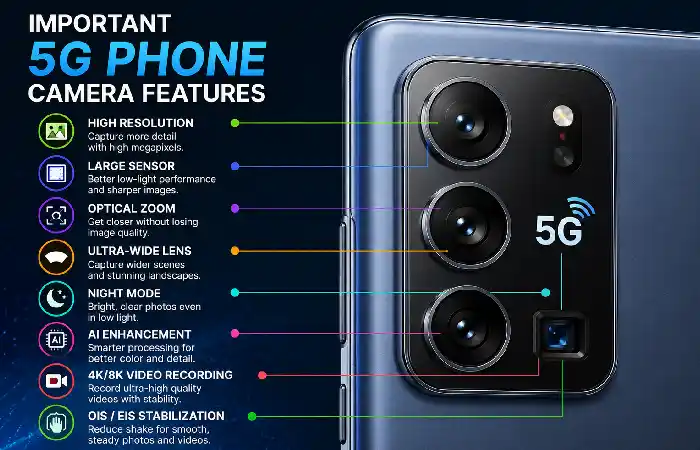
Many people still look at the megapixels if they are considering a new smartphone. But the best 5G phones cameras are based on a mixture of hardware, software and photography features to give you the best quality pictures in practice rather than on paper.
Essential Features
| Feature | Why It Matters |
| Large Sensor Size | Captures more light |
| Optical Image Stabilization (OIS) | Reduces blur |
| AI Image Processing | Improves colors and detail |
| Telephoto Lens | Better zoom quality |
| Ultra-Wide Lens | Wider landscapes |
| Night Mode | Better low-light photos |
| 4K/8K Video | Professional video recording |
| RAW Capture | Greater editing flexibility |
Even budget 5G phones now offer capable camera systems, making it possible to capture quality photos without paying flagship prices.
Main, Ultra-Wide, and Telephoto Cameras
Typical 5G phone cameras have several cameras more than the conventional one. Smartphones now combine various cameras for different conditions such as main, ultra-wide, telephoto, and so on rather than just one single camera. So knowing how the camera functions can help you select the best phones and take more professional and better pictures whatever conditions you are in.
Main Camera
The main sensor takes most of the everyday shots and is generally the better quality image.
Ultra-Wide Camera
Useful for:
- Landscapes
- Architecture
- Group photos
- Travel photography
Telephoto Camera
30 optical zoom without dropping the image quality.
Modern flagship phones offer:
- 3x optical zoom
- 5x optical zoom
- Periscope zoom systems
- AI-enhanced digital zoom
Some of the best current zoom contenders are the Samsung Galaxy S26 Ultra and the Vivo X300 Ultra.
If gaming performance is a priority, 5G phones for gaming typically pair fast connectivity with powerful processors, high-refresh-rate displays, and large batteries.
Smartphone Camera Sensors
Sensor size is a bigger issue than megapixels.
Typical Sensor Comparison
| Sensor Type | Performance |
| 1/2.76″ | Entry-level |
| 1/1.56″ | Mid-range |
| 1/1.3″ | Premium |
| 1-inch Sensor | Professional-level |
Larger sensors:
- Capture more light
- Produce cleaner images
- Improve low-light performance
- Create natural background blur
Modern flagship phones now have cameras with big sensors purely targeted at photographer.
Camera capabilities vary widely across Android 5G phones, from affordable models with multiple lenses to premium devices with advanced computational photography.
Computational Photography
Computational photography is what makes today‘s phone cameras take the incredible photos they do.
As meant that been, mobile platforms are now utilizing more than just hardware to make the photographs look better through artificial intelligence and machine learning.
Examples include:
- HDR processing
- Portrait mode
- Scene recognition
- AI object removal
- Sky enhancement
- Night photography
- Motion correction
Where Google Pixel devices get the upper hand: their computational photography is driven by AI.
Apple’s 5G iPhones combine 5G connectivity with advanced camera hardware and computational photography features.
5G Phones for Video Recording
The production of video has as become a significant purchasing decision.
Key Video Features
| Feature | Benefit |
| 4K Recording | High-quality content |
| 8K Recording | Future-ready footage |
| HDR Video | Better dynamic range |
| OIS + EIS | Smoother footage |
| LOG Recording | Professional editing |
| AI Stabilization | Better handheld video |
Among video-centric smartphones, the iPhone 17 Pro Max from Apple is among the most capable, and Samsung and Vivo are still adding better creator-oriented features.
Useful Resources
| Resource | Link |
| Android Camera Tips | Android Photography Guide |
| Apple Camera Features | Apple Camera Guide |
| Google Photos AI Tools | Google Photos |
5G and Faster Photo Sharing
The major benefit of having your phone camera apps enabled with 5G technology is how rapidly images and videos can be transferred, uploaded, stored and opened across devices. The image quality does not have any direct benefit when using 5G, but the overall process of using your camera app is more efficient, streamlined and connected.
For photographers, content creators and even regular phone users, 5G is all about less waiting and more creating.
Examples:
- Uploading RAW photos to cloud storage
- Sending large albums instantly
- Faster social media posting
- Real-time collaboration for creators
This is particularly useful for photographers who are shooting remotely or publishing very often.
Before choosing a device, use this 5G phone buying guide to compare camera specifications, performance, battery life, network compatibility, and overall value.
Camera Performance in Low Light
Low-light photography is one of the most critical criteria when judging a 5G phone camera. It is relatively easy for modern smartphones to get high-quality photos in the day, but low-light photography truly tests the ability of a camera system. With the advent of newer 5G smartphones equipped with bigger sensors, innovative image-processing techniques, AI and computational photography takes better pictures after sunset.
Having good low-light performance is useful whether you take pictures of city lights, indoors, restaurants, concerts or night Landscapes.
What Helps Low-Light Performance?
- Large sensors
- OIS stabilization
- AI Night Mode
- Multi-frame image stacking
- Wide aperture lenses
Recent comparisons among several reviewers show that the flagship models produced by Samsung, Xiaomi, Vivo and Apple provides excellent results in dark conditions.
How to Compare 5G Phone Cameras
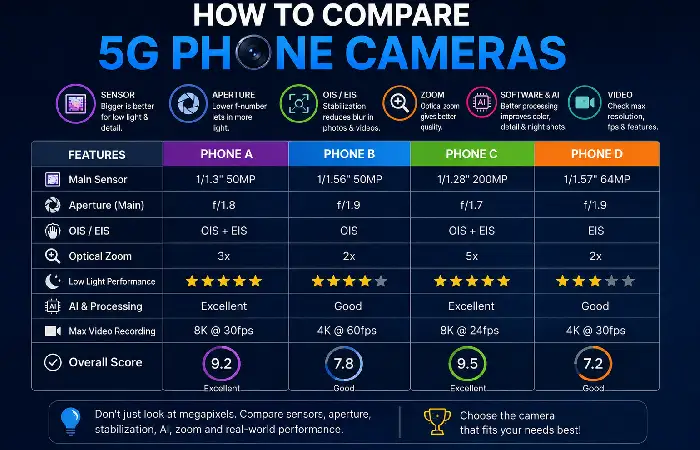
Before buying, compare these factors:
| Category | Weight |
| Main Camera Quality | 30% |
| Low-Light Photography | 20% |
| Zoom Performance | 15% |
| Video Recording | 15% |
| Selfie Camera | 10% |
| AI Features | 10% |
Make no mistake about it. Don‘t be so hasty to judge a phone‘s quality based on megapixels.
Choosing a 5G Phone for Photography
Best for Casual Users
- Google Pixel 10a
- Samsung Galaxy A-series
Best for Social Media Creators
- iPhone 17 Pro Max
- Samsung Galaxy S26 Ultra
The Best for Portrait Photography
- Vivo X300 Ultra
Best for Low-Light Photography
- Xiaomi 17 Ultra
Best Overall Camera Experience
- Samsung Galaxy S26 Ultra
- OPPO Find X9 Ultra
- iPhone 17 Pro Max
As evaluated according to expert testing and camera rankings throughout 2026.
FAQ
Are 5G phones better for photography than 4G phones?
Not because of 5G itself. Better cameras are a result of improved sensors, lenses and AI.
What megapixel camera do I need?
For most users, 50MP is more than enough. Image Sensor quality is much more important than megapixels.
Best 5G phone for photography 2026?
Which is the best for the 2nd Generation of the Galaxy S2, iPhone 17 Pro Max, Vivo X300 Ultra, OPPO Find X9 Ultra, and others.
Are 5G budget phones still worth using for photography?
Yes, many mid-range budget smart phones are coming with OIS, AI photography mode and the latest sensors as well.
Conclusion
The camera ability of 5G phone has turned into one important photography tool built-in by combining the finest hardware design, AI-enabled software, and blistering connectivity that takes story-telling capability and video processing to next level. Today, you get best-in-class camera experience on your mobile phones from a host of high-resolution main camera and multi-angle ultra-wide lenses to high-end telephoto zooms.
In addition to improved image quality, 5G substantially improves the photography process itself. Fast cloud backups, quick photo sharing, live streaming, and immediate editing and creation are all possible with the high data speeds of 5G. Features to aid users in creating high quality pictures from virtually any environment include larger camera sensors, OIS, computational photography, Night Mode, and AI-based image processing.
Kashifa Jafar is a technology writer and contributor at FutureTechExpert with 4+ years of experience in technology writing and content creation.
Read Full Bio of Author →Sameena reviews selected health, wellness, technology, and digital content for clarity, factual presentation, and reader usefulness.
Read Full Bio of Reviewer →