
 Kashifa Jafar
Technology Writer & Contributor
Kashifa Jafar is a technology writer and contributor at FutureTechExpert with 4+ years of experience in technology writing and content creation.
Read Full Bio of Author →
Kashifa Jafar
Technology Writer & Contributor
Kashifa Jafar is a technology writer and contributor at FutureTechExpert with 4+ years of experience in technology writing and content creation.
Read Full Bio of Author →
 Sameena Begum
Health, Technology & Digital Content Reviewer
Sameena reviews selected health, wellness, technology, and digital content for clarity, factual presentation, and reader usefulness.
Read Full Bio of Reviewer →
Sameena Begum
Health, Technology & Digital Content Reviewer
Sameena reviews selected health, wellness, technology, and digital content for clarity, factual presentation, and reader usefulness.
Read Full Bio of Reviewer →
Communication technology makes all this possible. Communication technology is what makes the modern world digitally connected. Cell phones, video conferencing services, fiber-optic internet, the satellite services that beam the internet into every corner of the globe it‘s all communication technology.
Communication technology is vital for everyone, be you a business owner who wants to research communications and enhance communication infrastructure, a student who wants to study or do your research on telecommunications, a connoisseur of technology who can‘t get enough of new innovations.
An all-inclusive site which covers the nuclear end of what makes up communication technology, what major forms of this, uses of communication technology in business, some security issues with communication technology, advantages of this technology, possibly some of the problems with communication technology and what to expect in the future of communication technology in 2026.
 This article is part of
Communication Technology Resources
Table of Contents
What Is Communication Technology?
Communication technology allows the conveyance of information by means of tools, systems, software, hardware, infrastructure and components which transfer between persons and organizations and even machines. It provides communication of voice, text, video, picture and information from a few meters up to a global level through cable, radio telephony and Internet.
Today‘s digital era relies on communication technology to drive the delivery of voice, email, web, video conferencing, cloud collaboration, social media and even global telecommunications. Communication technology integrates the hardware, software, network equipment and protocols that enable information to flow seamlessly, efficiently and securely.
The information being transmitted may include:
- Voice
- Text
- Images
- Video
- Data
- Multimedia content
Communication technology encompasses hardware, software, networks and protocols that provided reliable transmission of information.
Modern communication systems increasingly depend on wireless communication technologies to deliver fast, flexible, and reliable connectivity across homes, businesses, and mobile networks.
Common Examples
| Technology | Purpose |
| Smartphones | Voice and data communication |
| Digital messaging | |
| Video Conferencing | Real-time collaboration |
| Fiber Internet | High-speed data transfer |
| Satellite Networks | Long-distance communication |
| 5G Networks | Mobile connectivity |
| VoIP Systems | Internet-based calling |
How Does Communication Technology Work?
Communication technology: This process begins when we input data, which is then converted into signals, sent through a communication channel and received by the receiver. This is the same process every time such as : telephone call, video conference, e-mail or Instant messaging.
The contemporary communication systems use various combination of equipment, networks, transmitting devices and communication protocols. These systems were constructed in such a way that information is transmitted as fast, accurately and as securely as possible.
Communication technology follows a simple process:
- Information Creation
A sender generates information.
Examples:
- Voice call
- Video message
- File upload
- Signal Conversion
The information is converted into digital or analog signals.
- Transmission
Signals travel through:
- Wireless networks
- Fiber optic cables
- Copper cables
- Satellite links
- Internet infrastructure
- Reception
The receiving device captures the signal.
- Decoding
The signal is converted back into understandable information.
Communication Flow Diagram
Sender
↓
Encoding
↓
Transmission Network
↓
Receiving Device
↓
Decoding
↓
Recipient
As communication networks grow smarter and stronger by deploying AI, fiber optics, edge computing, and emerging 6G networks, communication systems are becoming faster, smarter, and more efficient to serve the growing needs of the digital society.
The widespread adoption of digital communication technology has revolutionized the transmission of voice, video, and data, making communication faster and more efficient than ever before.
Types of Communication Technology
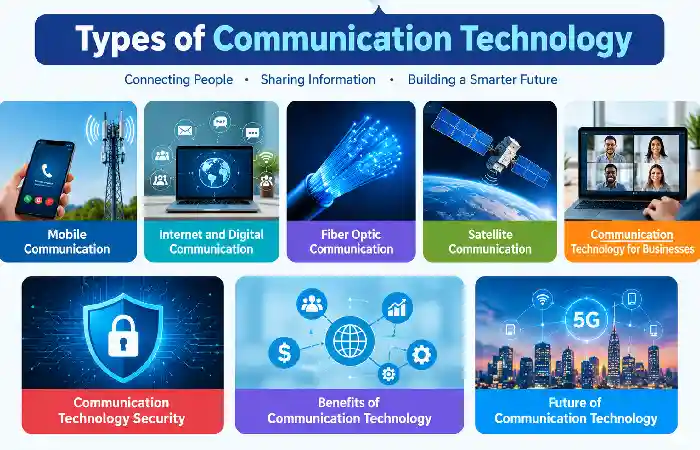
The communications systems of today can be grouped in a number of orderless categories. Communication technology refers to a range of technologies and systems that enable the transmission of information to and from different machines and across varied networks. Different types exist to satisfy different communication requirements:
By knowing the basic types of communication technology, users and businesses can select the most appropriate tools to connect with others, increase efficiency, and communicate digitally.
Wired Communication Technology
Wired communication: Physical cables are used for communication between devices and networks. It is reliable, fast and secure.
Common examples include:
- Ethernet networks
- Fiber-optic communication
- Telephone landlines
- Cable internet services
Advantages
- Stable connections
- High data transfer speeds
- Lower interference
- Enhanced security
Common Uses
- Business networks
- Data centers
- Broadband internet
- Enterprise communication systems
Wireless Communication Technology
Wireless communication- provides in terms of radio waves rather than using cables.
Popular wireless technologies include:
- Wi-Fi
- Bluetooth
- Near Field Communication (NFC)
- Zigbee
- LoRaWAN
Advantages
- Mobility
- Easy installation
- Flexible deployment
- Reduced infrastructure costs
Common Uses
- Home networks
- Smart devices
- Wireless peripherals
- Internet access
Mobile Communication Technology
This allow voice as well as data to be transmitted through celluar network.
Mobile Network Evolution
| Generation | Key Capability |
| 2G | Digital voice communication |
| 3G | Mobile internet access |
| 4G LTE | High-speed data and streaming |
| 5G | Ultra-fast connectivity and low latency |
| 6G (Future) | AI-powered communication networks |
Common Applications
- Smartphones
- Mobile broadband
- Video calling
- Mobile banking
- Location-based services
Internet Communication Technology
The Internet-based communication system- It handles file transfer, email, newsgroups, and chat. It uses IP networks to speak around the world.
Examples include:
- Instant messaging
- Video conferencing
- Voice over IP (VoIP)
- Cloud collaboration tools
Benefits
- Real-time communication
- Global accessibility
- Low communication costs
- Support for remote work
Fiber Optic Communication Technology
Fiber-optic communication sends and receives light signals over a fiber (Made of glass or plastic) using it as a medium. The data transmitted by this method is in very high speed.
Key Features
- Ultra-fast bandwidth
- Low latency
- Long-distance transmission
- High reliability
Common Applications
- Fiber broadband internet
- Telecommunications networks
- Cloud computing infrastructure
- Enterprise connectivity
Today’s high-speed networks are powered by fiber optic communication systems, which provide exceptional bandwidth, low latency, and reliable long-distance data transmission.
Wireless Communication Technology
Wireless Communication-Or provides the facility of communication of voice, data, video and other information to and from different devices without the requirement of physical connection via wires. Rather than using the wired communication systems, wireless system communicates using radio waves, microwaves, infrared signals or other types of electromagnetic radiation.
Wireless communication forms the basis of today‘s world. With that, today we‘re talking about the source of power for mobile Smartphones, WLAN, Bluetooth enabled gadgets, smart homes, IoT gadgets, and high-tech telecom networks like 4G, and 5G.
Popular Wireless Technologies
| Technology | Typical Range |
| Wi-Fi 7 | Up to 250 meters |
| Bluetooth 5.4 | Up to 240 meters |
| NFC | Less than 10 cm |
| Zigbee | 10-100 meters |
| LoRaWAN | Several kilometers |
Advantages
- Mobility
- Easy deployment
- Reduced infrastructure costs
- Scalability
Challenges
- Interference
- Security threats
- Coverage limitations
Mobile Communication Technology
Mobile communication technology is the machinery, infrastructure and equipment used to enable voice, messaging and data communication through wireless/mobile means–as people or machines are mobile and in movement. It connects users and equipment(eg. cell phones, devices, tablets, wearables) through cellular networks, with no hard-wired connection.
Mobile communication revolutionized the way people communicate, work, access information, and do business. Now, beyond a simple voice call, we use high-speed internet, streaming video during live events, and information on the go.
How Mobile Communication Technology Works
Mobile communication technology encompasses base stations, cellular towers, switching centers, and protocols that carry information from one device to another.
The process typically follows these steps:
- A mobile device sends voice or data signals.
- The nearest cellular tower receives the signals.
- The network routes the data through switching and transmission systems.
- The information travels across the mobile network or internet.
- The recipient’s device receives and decodes the data.
All these actions, takes place within milliseconds, and produces immediate transmission between local or global networks.
Evolution of Mobile Networks
| Generation | Key Features |
| 2G | Digital voice |
| 3G | Mobile internet |
| 4G LTE | HD streaming |
| 5G | Ultra-fast connectivity |
| 6G (Emerging) | AI-native networking |
2026 Mobile Network Comparison
| Feature | 4G LTE | 5G |
| Average Speed | 20–100 Mbps | 300 Mbps–10 Gbps |
| Latency | 30–80 ms | 1–10 ms |
| Device Capacity | Moderate | Massive IoT Support |
| Real-Time Applications | Limited | Excellent |
With the development of mobile network, mobile communication technology will still be the underlying pillar of world connecting from phones to future digital services, from business to life.
For regions where traditional network infrastructure is limited, satellite communication technology plays a crucial role in delivering internet access and global connectivity.
Internet and Digital Communication Technology
Internet and digital communication technology: encompasses the infrastructure, networks, software applications and rules necessary for transmitting information over the internet and digital technologies. They enable people, companies and organizations to instantly communicate via text, voice, video or data no matter where they are located.
Nowadays, internet and digital communication technologies dominate all digital services: from e-mail, instant messaging, video conferencing and social media to cloud collaboration, on-line learning, e-commerce, and many others.
Key Technologies
- Instant Messaging
- Social Platforms
- VoIP
- Video Conferencing
- Cloud Collaboration
Business Communication Platforms Comparison
| Platform Type | Use Case |
| Video Meetings | Remote collaboration |
| Team Messaging | Internal communication |
| Email Systems | Formal communication |
| Cloud Collaboration | Document sharing |
Benefits
- Global accessibility
- Remote work support
- Reduced operational costs
- Real-time communication
Despite all the skepticism, business and consumers activities will continue to adapt to the digital transformation, which will keep the internet and digital communication technologies the key enabler to global connectivity, cooperation, innovation and prosperity.
Businesses, educational institutions, and consumers rely on internet communication technologies to support cloud computing, online collaboration, streaming, and digital communication services.
Fiber Optic Communication Technology
The principle of fiber optic communication as means of high-speed communication technology, is to transmit light pulses through very narrow strands of glass or plastic fibers. By using light signals as opposed to electrical signals in traditional copper cables, fiber-optic systems are able to send information at a higher speed over greater distances.
Fiber optics are used in telecommunications, internet, cloud computing, and infrastructure. We depend on internet and fiber optics for modern communications and data transfer. As we read here fiber optics is powering communication infrastructure for 21st-century digital economy.
How Fiber Optic Communication Technology Works
Fiber-optic communication relies on light transmission to carry information.
The process typically includes:
- Data is generated by a device such as a computer or smartphone.
- The data is converted into light signals using a laser or LED transmitter.
- The light travels through fiber-optic cables.
- Optical amplifiers may boost the signal over long distances.
- The receiving device converts the light signals back into digital data.
This process enables data transmission at near-light speeds while maintaining high signal quality.
Fiber vs Copper Comparison
| Feature | Fiber Optic | Copper |
| Speed | Up to 100+ Gbps | Up to 10 Gbps |
| Distance | Long | Limited |
| Interference | Minimal | Higher |
| Reliability | Excellent | Good |
Advantages
- Ultra-fast internet
- Low latency
- Better reliability
- Future-proof infrastructure
Recommended Resources
| Resource | Purpose |
| ITU Fiber Standards | Industry standards |
| Fiber Broadband Association | Fiber deployment research |
| IEEE Communications Society | Technical resources |
Satellite Communication Technology
Satellite communication technology is a system that is designed to transmit voice, video, data and Internet data via satellite in orbit around the world. They makes it possible to communicate over long distances, over locations in the world where there is no traditional terrestrial network (like fiber optics, cellular stations).
Satellites are the backbone of modern telecommunications all over the world, enabling communication through out the internet, broadcasting, navigation, disaster recovery and aid, military and armed forces, aviation and maritime uses. With the technological development and the continuous advancement in the field, satellite communications is a vital part of the modern world.
How Satellite Communication Technology Works
Satellite Communication Satellite communications is a form of communication that uses satellites which orbit the earth receiving, amplifying and transmitting signals between two locations on the earth.
The communication process typically follows these steps:
- A ground station sends a signal to a satellite.
- The satellite receives the signal through its transponder.
- The transponder amplifies and processes the signal.
- The satellite retransmits the signal back to another ground station or user device.
- The receiving equipment decodes the information.
It’s how information is traveling across countries, oceans, and continents within few seconds.
Common Applications
- GPS Navigation
- Maritime Communications
- Aviation Connectivity
- Disaster Recovery
- Rural Broadband
Satellite Network Comparison
| Type | Orbit |
| GEO | 35,786 km |
| MEO | 2,000–35,786 km |
| LEO | 160–2,000 km |
LEO vs GEO
| Feature | LEO | GEO |
| Latency | Low | High |
| Coverage | Smaller Areas | Wider Coverage |
| Internet Performance | Better | Moderate |
Communication Technology for Businesses
Business communication technology is the equipment, networks, platforms, and information systems companies and organizations use to communicate internally and externally. Business communication technology is the foundation of virtual communication, the instant delivery of information, sharing of information, customer interaction, and efficiency. With business communication technology, organizations can communicate on both local and global levels.
Communication technology today has become a strategic business tool in the digital economy. Whether it’s a cloud-based collaboration platform, a video-conferencing facility, a mobile communication network, or a single integrated communications system, businesses rely on communication technologies today to increase productivity, facilitate remote working, and enhance the customer experience.
Every communication network depends on advanced communication devices and equipment, including routers, modems, smartphones, switches, and other essential networking hardware.
Core Business Applications
- Customer Support
- Internal Collaboration
- Video Meetings
- Cloud Communications
- Unified Communications
- Remote Workforce Management
Communication Technologies by Business Size
| Business Size | Recommended Solutions |
| Small Business | VoIP + Cloud Collaboration |
| Mid-Sized | Unified Communications |
| Enterprise | UCaaS + SD-WAN |
| Global Enterprise | Hybrid Communication Infrastructure |
Product Comparison Table
| Solution Type | Best For | Cost |
| VoIP | Small Businesses | Low |
| UCaaS | Growing Companies | Medium |
| Contact Center Platforms | Customer Service | Medium |
| Enterprise Collaboration Suites | Large Organizations | High |
Communication Technology Security
Security of communication technology encompasses the implementation of practices, policies and technologies that employ countermeasures for guarding communication systems, networks, equipment and content from unapproved access, cybercrime and information intrusions. The significance of security over communication technology has gained importance with the rise in the use of digital communication by enterprises and individuals.
In today‘s world of emails and video conferencing, not to mention networks from cell phones to all sorts of online communication, it is feared that information is being sent and received all the time and in many cases sensitive information. If not thoroughly secured, these systems would be easy targets for cyber criminals and hackers.
Major Threats
- Phishing
- Malware
- Data Breaches
- DDoS Attacks
- Social Engineering
- Account Takeovers
Security Best Practices
| Practice | Benefit |
| MFA | Prevents unauthorized access |
| Encryption | Protects data |
| VPNs | Secure remote access |
| Regular Updates | Patch vulnerabilities |
| Security Awareness Training | Reduce human error |
Communication Security Checklist
Enable MFA
Use encrypted platforms
Update software regularly
Conduct security audits
Train employees
Benefits of Communication Technology
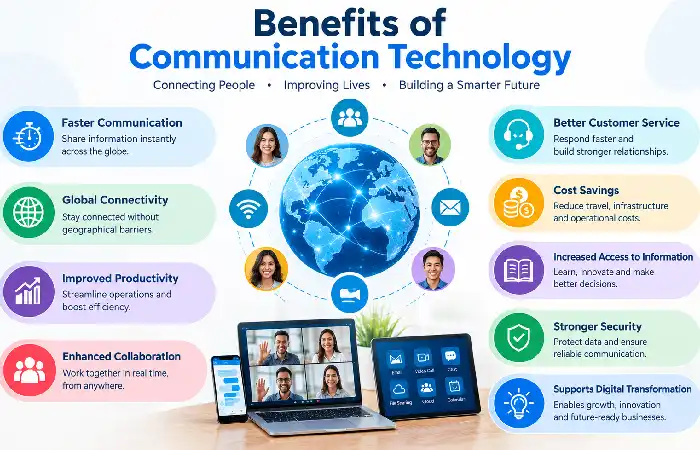
The advancement of communicatiion technology has significantly altered the way individuals, businesses and governments communicate. Today, we have a multitude of communication tools ranging from instant messaging, video conferencing, to mobile networks and cloud team working facilities which collectively facilitate instant, efficient and hassle free communication.
As digital transformation progresses across all industries, communication technology offers tremendous advantages on productivity, connectivity and quality of live, customer experience.
- Faster Communication
One of the biggest advantages of communication technology is the ability to share information instantly.
Whether sending:
- Emails
- Text messages
- Voice calls
- Video calls
- Business documents
Information can be transmitted across the world within seconds.
Benefits
- Faster decision-making
- Improved responsiveness
- Reduced communication delays
- Real-time collaboration
- Global Connectivity
Communication technology removes geographical barriers and allows people to stay connected regardless of location.
Examples include:
- International video conferences
- Global business operations
- Online education
- Remote healthcare services
This connectivity supports worldwide communication and collaboration.
- Improved Business Productivity
Modern communication tools help organizations streamline operations and improve efficiency.
Business Advantages
- Faster information sharing
- Better team collaboration
- Improved project management
- Enhanced customer support
- Reduced operational delays
Businesses can communicate effectively across departments, offices, and countries.
- Support for Remote and Hybrid Work
Communication technology enables employees to work from virtually anywhere.
Key technologies include:
- Video conferencing platforms
- Cloud collaboration tools
- Mobile communication systems
- Team messaging applications
These solutions help organizations maintain productivity while offering workplace flexibility.
- Enhanced Collaboration
Modern communication platforms allow teams to work together in real time.
Collaboration Features
- File sharing
- Screen sharing
- Virtual meetings
- Instant messaging
- Cloud document editing
Improved collaboration leads to faster project completion and better teamwork.
Future of Communication Technology
The innovations far-future communication technology is dramatically transforming because of the new breakthroughs in artificial intelligence, next-generation wireless, cloud computing, satellites, and digital immersive experiences. As the demand of business and consumers get faster, smarter, and more reliable communication devices and services, communication technologies from data and voice are now evolving to intelligent networks.
Along the coming ten years, emerging technologies will radically alter the methods which groups of people, machines and enterprises communicate, share information and work together on a global scale.
Artificial Intelligence (AI) in Communication
Artificial intelligence is becoming a major driver of communication innovation.
AI-powered communication systems can:
- Automate customer support
- Provide real-time language translation
- Generate meeting summaries
- Improve network management
- Detect cybersecurity threats
- Personalize communication experiences
Business Benefits
| AI Application | Benefit |
| AI Chatbots | 24/7 customer support |
| Virtual Assistants | Increased productivity |
| Real-Time Translation | Global communication |
| Network Optimization | Improved performance |
| Security Monitoring | Faster threat detection |
AI will continue to make communication systems smarter and more efficient.
Expansion of 5G and Future 6G Networks
While 5G deployment continues worldwide, researchers and technology companies are already developing 6G networks.
Expected 6G Capabilities
- Terabit-level data speeds
- Near-zero latency
- AI-native network management
- Holographic communication
- Enhanced augmented and virtual reality
- Massive IoT connectivity
Mobile Network Evolution
| Technology | Key Advantage |
| 4G LTE | Mobile broadband |
| 5G | Ultra-fast connectivity |
| 6G (Future) | Intelligent immersive communication |
These next-generation networks will support advanced digital experiences and smart infrastructure.
Internet of Things (IoT) Growth
The number of connected devices is expected to grow significantly over the coming years.
Examples include:
- Smart homes
- Smart cities
- Connected vehicles
- Industrial automation systems
- Healthcare monitoring devices
Communication technology will enable billions of devices to exchange data in real time, creating more efficient and automated environments.
Edge Computing and Real-Time Communication
Edge computing processes data closer to users instead of relying solely on centralized cloud servers.
Benefits
- Lower latency
- Faster response times
- Reduced network congestion
- Improved application performance
This technology will support emerging applications such as autonomous vehicles, industrial automation, and real-time analytics.
Satellite-Based Global Connectivity
Satellite communication is becoming an important component of future communication networks.
Emerging developments include:
- Low Earth Orbit (LEO) satellite constellations
- Direct-to-smartphone satellite services
- Global broadband coverage
- Improved rural connectivity
These innovations will help bridge connectivity gaps and expand internet access worldwide.
Cloud-Native Communication Platforms
Businesses are increasingly moving communication systems to cloud-based environments.
Future cloud communication solutions will offer:
- Greater scalability
- AI-driven collaboration tools
- Enhanced security
- Unified communication experiences
- Seamless global connectivity
Cloud platforms will continue to support remote work and digital transformation initiatives.
Extended Reality (XR) Communication
Extended Reality combines:
- Virtual Reality (VR)
- Augmented Reality (AR)
- Mixed Reality (MR)
Future communication platforms may include:
- Virtual workspaces
- Immersive training environments
- 3D collaboration tools
- Virtual customer experiences
These technologies will redefine how people interact in digital environments.
Quantum Communication
Quantum communication represents one of the most promising future technologies for secure communication.
Potential benefits include:
- Extremely secure data transmission
- Quantum encryption
- Enhanced cybersecurity
- Protection against advanced cyber threats
Although still developing, quantum communication could significantly improve communication security in the future.
FAQ: Communication Technology
What is the technology of communication?
Communication technology: “Systems, networks, equipment, and infrastructure involved in conveying information between people, between people and computers, and between computers”.
What forms of communication technology do we consider to be the primary types?
The main categories of communication are wired communication, wireless communication, mobile communication, internet-based communication, fiber-optic communication, satellite communication, and cloud-based communication systems.
Why communication technology considered important?
It allows us to do online shopping, accessing millions of information, online banking, 24/7 online customer support, do online conferencing, send and receive and unlike traditional conventions, online dating and jobs searching. It allows us to do IRS-related jobs over the internet; contacts in the mobile and in addition, many more.
How is a communication technology different from a telecommunications?
Communication technology, in general, refers to all systems that are used for communications. The term telecommunication is used in closer connection to send and receive information abroad electronically.
What is the future of communication technology?
Artificial intelligent (AI) enabled communications, 6G networks, quantum communications, edge computing, satellite internet expansion, and immersive digital experiences are all on the horizon.
Conclusion
Communication technology is now one of the fundamental components of our modern life, linking people, businesses, gadgets and whole industries by allowing them to share information quickly and reliably. Communication technologies of today encompass mobile communication, wireless networks, fiber-optic networks, cloud-based collaboration tools and countless of other solutions that provide communications at the push of a button.
As organizations embark on their digital transformation path, selecting the proper technology of communication solutions may boost productivity, provide better customer experiences, reinforce security, and enable long-term expansion. The new developments in artificial intelligence, edge computing, next generation fiber networks, satellite internet, and future 6G communication will bring another wave of trends to the way business information is shared and consumed.
Kashifa Jafar is a technology writer and contributor at FutureTechExpert with 4+ years of experience in technology writing and content creation.
Read Full Bio of Author →Sameena reviews selected health, wellness, technology, and digital content for clarity, factual presentation, and reader usefulness.
Read Full Bio of Reviewer →