


Last Updated: June 22, 2026
Machine Learning Engineer Jobs are set to be one of the fastest-growing tech careers in 2026. With more and more companies incorporating artificial intelligence (AI), machine learning (ML), and automation into their offerings, machine learning engineers will be heavily in demand as much in the future as they are today.
Across the board, in healthcare, in finance, in e-commerce, in security – all a business ‘s challenges are turning into opportunities for machine learning engineers to leverage the power of data towards building scalable AI-driven solutions. If a future-ready technology career is what you’re after, becoming a Machine Learning Engineer is just the right thing for you!
Why Machine Learning Engineer Jobs Are Growing in 2026
Several factors are driving hiring demand:
- Expansion of Generative AI applications
- Increased adoption of Large Language Models (LLMs)
- Growth of AI-powered automation
- Rising investment in predictive analytics
- Demand for AI infrastructure and MLOps expertise
Recent job market findings indicate that the mature AI and ML skills required by employers are overshadowing more traditional qualifications, and thus, more experienced, skilled users at any level of broader education are at an advantage. Skilled users of AI are receiving substantial salary premiums worldwide.
Table of Contents
Machine Learning Engineer Job Responsibilities
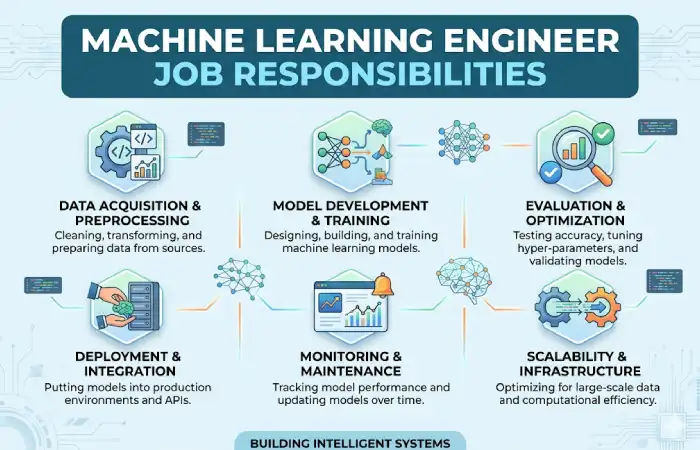
Machine Learning Engineers are the gap between data science and software engineers.
Core Responsibilities
| Responsibility | Description |
| Data Processing | Clean and prepare datasets |
| Model Development | Build machine learning algorithms |
| Training Models | Optimize model performance |
| Model Deployment | Move models into production |
| MLOps Management | Monitor and maintain ML systems |
| Performance Evaluation | Measure accuracy and efficiency |
| AI Infrastructure | Manage cloud-based ML environments |
Typical Daily Tasks
- Writing Python code
- Building predictive models
- Fine-tuning neural networks
- Deploying APIs
- Managing cloud resources
- Monitoring model drift
- Collaborating with product teams
Essential Technical Skills for ML Engineers
In order to be successful in Machine Learning Engineer Jobs, one has to be well-versed with programming skills, data science, software engineering techniques and cloud computing skills. While data scientists are mainly concerned about research and experimentation, the ML engineers have to create large scale machine learning solutions, which can operate efficiently in production.
As AI adoption continues to take off in 2026, organizations are also seeking talent that can deploy, monitor, and optimize the models in production, in addition to building them.
Most In-Demand Skills in 2026
| Skill | Demand Level | Learning Resources |
| Python | Very High | https://docs.python.org |
| Machine Learning Algorithms | Very High | https://scikit-learn.org |
| Deep Learning | Very High | https://www.tensorflow.org |
| PyTorch | High | https://pytorch.org |
| MLOps | Very High | https://ml-ops.org |
| AWS Machine Learning | High | https://aws.amazon.com/machine-learning |
| Kubernetes | High | https://kubernetes.io |
| SQL | High | https://www.postgresql.org/docs |
| Generative AI | Very High | https://platform.openai.com/docs |
| LLM Development | Very High | https://huggingface.co |
Cloud platforms like AWS are still in top 5 requested technical skills in ML job ads, and machine learning roles increasingly require MLOps, deployment and production engineering knowledge.
Soft Skills Employers Value
- Problem-solving
- Communication
- Team collaboration
- Critical thinking
- Business understanding
- Project management
Industries Hiring Machine Learning Professionals
Machine learning experts are not solely present in tech companies anymore.
Top Industries Hiring in 2026
| Industry | Common Use Cases |
| Technology | AI products, recommendation systems |
| Healthcare | Diagnostics, medical imaging |
| Finance | Fraud detection, risk analysis |
| Retail & E-Commerce | Personalization engines |
| Manufacturing | Predictive maintenance |
| Automotive | Autonomous systems |
| Cybersecurity | Threat detection |
| Telecommunications | Network optimization |
Industry Demand Comparison
| Industry | Hiring Demand | Salary Potential |
| Big Tech | Very High | Excellent |
| FinTech | Very High | Excellent |
| Healthcare AI | High | High |
| Cybersecurity | High | High |
| Manufacturing | Moderate | Good |
Machine Learning Engineer Salary Expectations
The High Earners of Technology include Machine Learning Engineers.
India Salary Comparison (2026)
| Experience Level | Average Salary |
| Entry Level (0-2 Years) | ₹8–12 LPA |
| Mid-Level (3-5 Years) | ₹15–25 LPA |
| Senior (6+ Years) | ₹30–60+ LPA |
Global Salary Comparison
| Region | Average Salary |
| United States | $160,000–$200,000 |
| United Kingdom | £55,000–£100,000 |
| Canada | CAD $100,000–$160,000 |
| Australia | AUD $110,000–$180,000 |
Salary Growth Chart
| Experience | Salary Growth |
| Fresher | Base Salary |
| 3 Years | +80% |
| 5 Years | +150% |
| 8+ Years | +300% |
This is because recruits with skills in AI and machine learning will be able to use the supply and demand balance to set salaries well above average for similar technology roles.
Career Roadmap for Aspiring ML Engineers
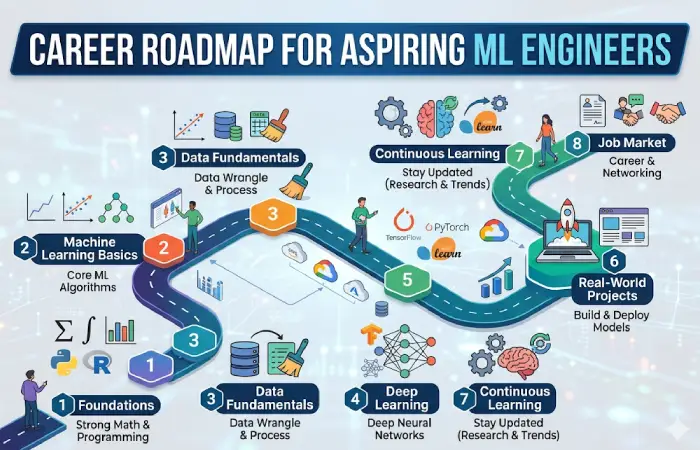
Step 1: Build Programming Foundations
Learn:
- Python
- SQL
- Git
- Linux
Step 2: Master Mathematics
Focus on:
- Statistics
- Probability
- Linear Algebra
- Calculus
Step 3: Learn Machine Learning
Study:
- Supervised Learning
- Unsupervised Learning
- Reinforcement Learning
Step 4: Learn Deep Learning
Tools:
- TensorFlow
- PyTorch
- Keras
Step 5: Learn MLOps
Major Technologies:
- Docker
- Kubernetes
- MLflow
- CI/CD route
Step 6: Build Real Projects
Examples:
- Chatbots
- Recommendation Systems
- Fraud Detection Models
- Image Identifying Applications
Step 7: Earn Certifications
Suggested Certifications:
| Certification | Provider |
| AWS Machine Learning Specialty | AWS |
| Professional ML Engineer | Google Cloud |
| Azure AI Engineer Associate | Microsoft |
| TensorFlow Developer | TensorFlow |
Machine Learning Engineer vs AI Engineer
| Feature | ML Engineer | AI Engineer |
| Focus | Model Development | AI Applications |
| Salary | Higher-Average | Slightly-Lower |
| Core Skills | ML, MLOps, & Deployment | LLMs, Prompting, & APIs |
| Demand | Very High | Very High |
Despite this, market analysis still shows a slight median salary over AI Engineers for ML Engineers and very high levels of growth across both careers.
Common Challenges and Troubleshooting
Challenge: Not Getting Interviews
Solution:
- Build GitHub projects
- Create portfolio websites
- Earn certifications
- Optimize LinkedIn profile
Challenge: Lack of Experience
Solution:
- Participate in Kaggle competitions
- Contribute to open-source projects
- Complete internships
Challenge: Model Deployment Skills Gap
Solution:
- Learn Docker and Kubernetes
- Study MLOps workflows
- Practice cloud deployment
FAQ
Are Machine Learning Engineer jobs in demand in 2026?
Yes. The demand has been holding up, due to the fast adoption of AI,growing of Cloud computingand implementation of Gen AI in many industries.
Do I need a degree to become a Machine Learning Engineer?
Not always. More and more employers are beginning to favor demonstrable skills, certification, project work etc.
Which programming language is most important?
Python remains the most common language using for work in the development and deployment of machine learning.
How long does it take to become an ML Engineer?
Most novice workers can be employed ready within 12–24 months with dedicated study, relevant projects, and certifications.
Is MLOps important for ML Engineers?
Yes, MLOps has been on of the most in demand skill set because companies require scalable production AI systems.
Conclusion
Machine Learning Engineer Jobs are perhaps one of the greatest and future-proof technology jobs going in 2026. As every business is doubling down on AI, ML, Cloud and automation, well-rounded machine learning engineers are in high demand, earning high wages, and have a wealth of career opportunities in which to progress. By developing their skills in programming, ML, MLOps and Cloud, aspiring engineers can shape a successful long-term career in the AI economy.