

Last Updated: August 5, 2026
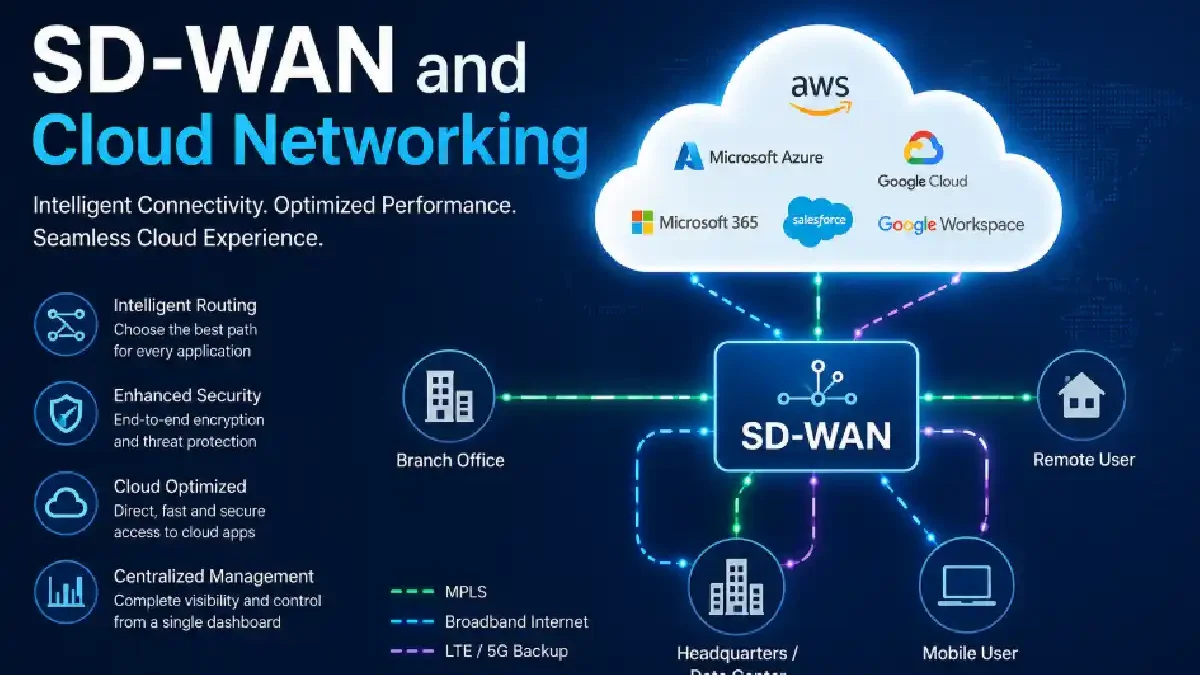
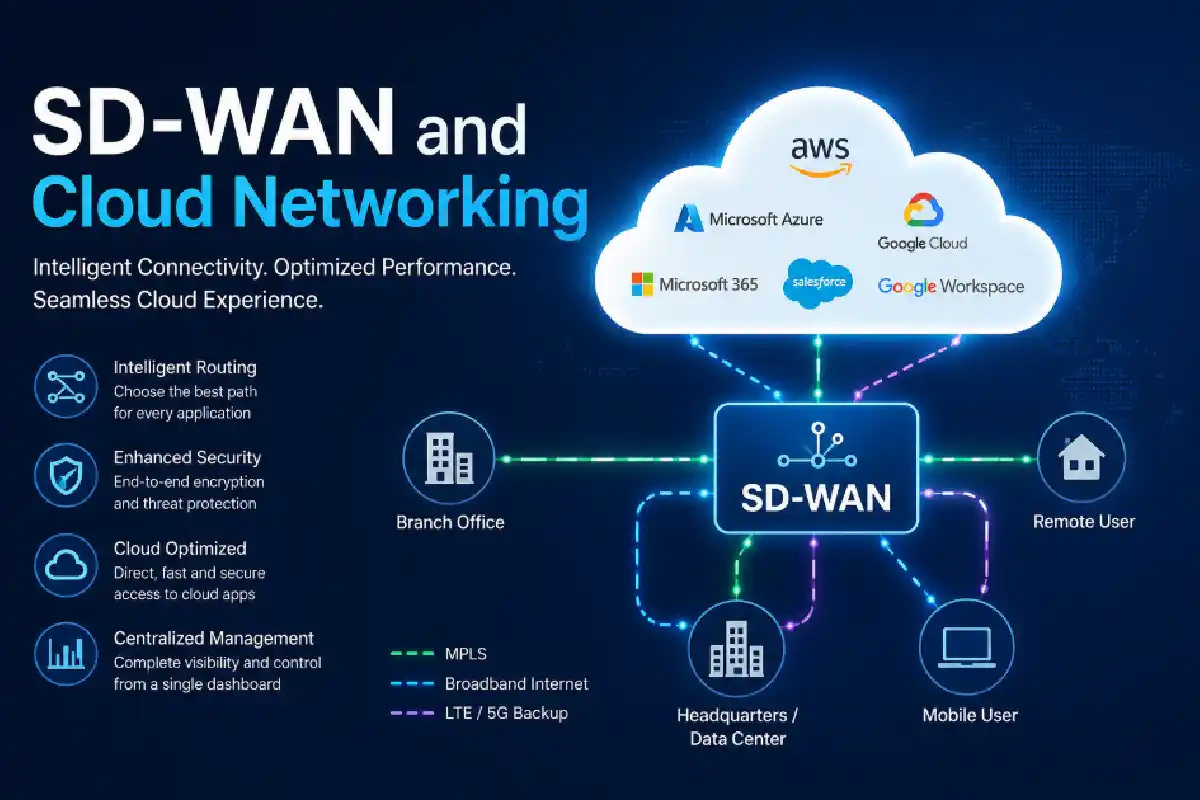
Cloud applications run almost every aspect of today‘s modern business: from Microsoft 365 and Google Workspace to AWS and Azure. Conventional WAN architectures simply can‘t cope with the every-increasing distributed workforce, hybrid cloud, and security demands. For this reason, SD-WAN and Cloud Networking are now indispensable.
SD-WAN is a critical component of modern cloud networking strategies, enabling organizations to optimize connectivity between branch offices, data centers, and cloud platforms while improving performance and reducing operational complexity.
Simple to understand, this guide makes SD-WAN easy to explain, identifies its advantages, demonstrates how it connects to cloud services, and offers hands on deploy steps from best practices to 2026.
 This article is part of
Networking Resources
Table of Contents
What Is SD-WAN?
Software-Defined Wide Area Networking (SD-WAN) is a software-based networking used to ease the management of Wide Area Network. SD-WAN provides application aware routing, intelligent path selection, centralized management to interconnect various WAN locations over the internet. Previously, Wide Area Network was built over expensive MPLS circuit between multiple sites and automated router provisioning.
Put simply, SD-WAN is like the traffic cop of your organization‘s network. It constantly tests your network for things like delay, packet loss, bandwidth utilization, and more, and then dynamically steers application traffic across the best possible path. This results in better performance for cloud apps, video calls, VoIP phone calls, and all your business-critical services.
How SD-WAN Works
SD-WAN thus incurs multiple types of network connection within one unique virtual overlay implemented from a single point of access. IT‘s operators weren‘t needed to reflect policies onto a branch office router anymore as they set up those policies onto the management console. The SD-WAN takes care of applying policies onto the rest of the links.
For example:
- A video call via Microsoft Teams automatically takes place over the internet connection with the lowest latency.
- Big updates are normally transferred over the broadband link with lowest priority.
- Any failure in one ISP would not affect users as it would route instantly to the next healthy connection.
Unlike traditional cloud networking architectures, SD-WAN uses centralized policy management and intelligent traffic routing to deliver better application performance across distributed enterprise environments.
SD-WAN Benefits
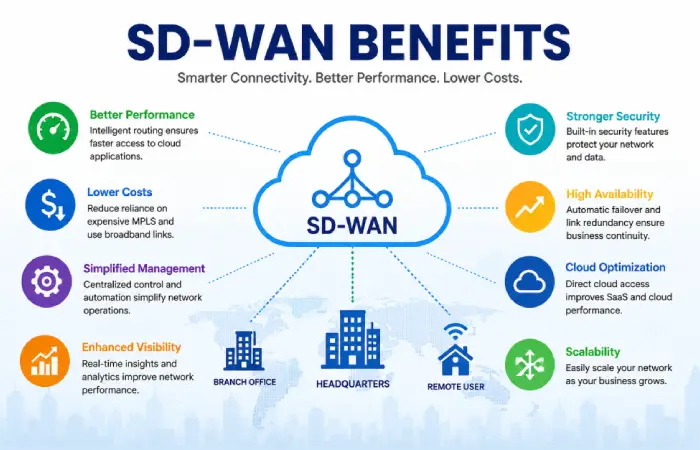
The implementation of SD-WAN provides many benefits compared to WAN architectures that have been widely used over the years such as enhanced network service quality, lowered operation costs, easy management, etc. With the proliferation of cloud application and the boom of hybrid work pattern, SD-WAN has become a widely adopted network technology to provide flexible, resilient and secure network access. The key SD-WAN benefits in 2026 include:
Improved Cloud Application Performance
Perhaps the most significant benefit of SD-WAN is the improved cloud SaaS application performance. Rather than all internet traffic being routed through a central data center, SD-WAN provides direct internet breakout by enabling users to reach SaaS applications directly (e.g. Microsoft 365, Google Workspace, Salesforce, Zoom).
Benefits include:
- Reduced latency
- Faster application response times
- Improved video conferencing quality
- Better user experience for remote employees
Lower Network Costs
Most traditional WANs hire costly MPLS circuits between branch offices. SD-WAN could use fiber, broadband, LTE/5G and MPLS connections together, so company could cut down their dependence on pricey private circuits.
| Network Type | Traditional WAN | SD-WAN |
| Primary Connectivity | MPLS | Broadband, Fiber, LTE/5G, MPLS |
| Infrastructure Cost | High | Lower |
| Scalability | Limited | Highly Flexible |
| Deployment Speed | Weeks | Days |
With less expensive Internet connections and smart traffic control, the cost of networking is minimized.
Intelligent Traffic Routing
An SD-WAN maintains a health check on network condition, such as latencies, jitters, packet bit-losses and bandwidth availability. It will choose the best path for each applications automatically.
For example:
- Voice and video traffic receive the highest priority.
- Business-critical applications are routed through the fastest connection.
- Large file downloads are assigned lower-priority links.
- Traffic automatically switches to a backup connection during an outage.
This dynamic path routing has resulted in minimizing services disruption and increasing the very high network availability.
For organizations operating across public cloud, private infrastructure, and on-premises environments, hybrid cloud networking solutions provide the flexibility needed to support secure and scalable SD-WAN deployments.
Cloud Integration
Cloud is one of the major reasons why companies adopt SD-WAN and Cloud Networking. With more and more companies moving to SaaS, IaaS and multi-cloud, SD-WAN is the secure, smart and high performance solution for connecting users, branch offices, data centers and cloud.
Unlike legacy WANs where the internet traffic is backhauled to the data center, the SD-WAN allows a direct and improved access to the cloud, leading to less latency, better application performance and superior user experience.
Why Cloud Integration Matters
Modern businesses use dozens of cloud applications every day, including:
- Microsoft 365
- Google Workspace
- Salesforce
- Zoom
- AWS
- Microsoft Azure
- Google Cloud Platform (GCP)
Without SD -WAN, traffic must traverse a longer, more convoluted path resulting in latency, increased bandwidth charges and sluggish application performance. S D -W AN addresses these issues by calculating the closest cloud gateway and directing the traffic toward that location.
How SD-WAN Integrates with Cloud Services
Deploying the SD-WAN An overlay network allowing enterprise to securely connect their branch offices, remote users and cloud providers using a centralized set of policies and intelligent path selection.
The process typically works as follows:
- A user accesses a cloud application such as Microsoft 365.
- The SD-WAN controller identifies the application’s requirements.
- It evaluates available network paths based on latency, jitter, and packet loss.
- Traffic is routed through the fastest and most reliable connection.
- If network conditions change, SD-WAN automatically switches to a better path without interrupting the user.
This auto-tuning allows the to work as a background task and migrate 2GB of data on every 15 minutes. The is automatically performing the migration, without affecting the application. Thus the also ensures that the application works as normal, even if the network is congested or the ISP‘s DNS servers are down.
Many enterprises rely on specialized cloud networking services to design, deploy, and manage SD-WAN environments that align with performance, security, and compliance requirements.
Performance Optimization
Improved Performance OptimizationSD-WAN and Cloud Networking brings huge competitive advantage through better performance optimization. An all-cloud WAN architecture is more likely to encounter poor performance issues such as high latency, packet loss and congestion, specifically when the WAN edge is in the traditional architecture. The SD-WAN architecture enables to by dynamically monitor the network and choose the most efficient path for each data type.
How SD-WAN Optimizes Network Performance
While conventional WANs rely on static routing, SD-WAN performs routing dynamically. It monitors network parameters (latency, jitter, packet-loss, throughput, etc.) and dynamically chooses the appropriate application path.
For example:
- A Microsoft Teams meeting is routed through the lowest-latency connection.
- File backups use lower-priority links to avoid impacting critical applications.
- If one ISP experiences congestion, traffic automatically switches to another connection without disrupting users.
This intelligent routing is condition for efficiently information transportation, application in the general is very rapid, at the same time, the network is in a stable state.
Key Performance Metrics
The important points monitoring the perfomance of SD-WAN included:
| Metric | What It Measures | Why It Matters |
| Latency | Time for data to travel | Lower latency improves application responsiveness |
| Jitter | Variation in packet arrival times | Low jitter ensures smooth voice and video calls |
| Packet Loss | Percentage of lost data packets | Reduces application errors and connection issues |
| Bandwidth Utilization | Available network capacity | Prevents congestion during peak usage |
| Link Health | Overall connection quality | Enables automatic failover and load balancing |
Real time monitoring can monitor application performance, security, QoE and utilization. Using all this data in real time, SD-WAN can respond immediately to evolving network parameters.
To maximize the value of SD-WAN, organizations should follow proven cloud networking best practices, including centralized monitoring, zero-trust security controls, traffic segmentation, and continuous performance optimization.
Deployment Tips
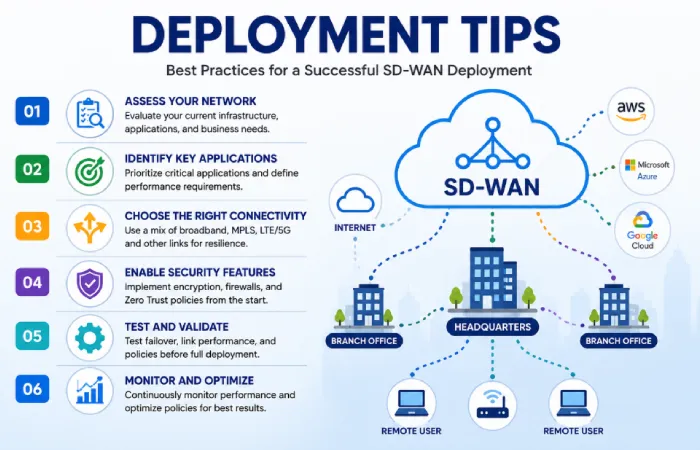
Proper planning, deployment and ongoing management of SD-WAN and Cloud Networking environments is crucial for success. This framework offers more straightforward management than traditional WANs, but following best practices around deployment, configuration and operational management will help ensure success. Use these guidelines, whether implementing SD-WAN in small business or larger enterprise environments.
Assess Your Existing Network Infrastructure
Always analyze your present network environment prior launching SD-WAN to outline the modifications and requirements needed for optimal operation.
Review the following:
- Existing WAN links (MPLS, broadband, fiber, LTE/5G)
- Branch office locations
- Current routers and firewalls
- Cloud applications in use
- Internet Service Providers (ISPs)
- Network bandwidth requirements
A comprehensive network assessment establishes a migration plan and reduces deployment risks.
Identify Critical Business Applications
The performance on the networks is not necessarily the same for all applications. Business critical applications should be prioritized through SD-WAN, so the applications should be classified from high to low importance.
| Application Type | Priority Level |
| VoIP and Video Conferencing | High |
| ERP Systems | High |
| CRM Applications | High |
| Microsoft 365 | High |
| Medium | |
| Web Browsing | Medium |
| Software Updates | Low |
Application-aware policies allocate bandwidth for mission-critical applications during peak traffic times.
Choose the Right Connectivity Options
Another strength of SD-WAN is the ability to work on multiple connections at the same time. Think about how you can combine heterogeneous connections.
Common options include:
- Fiber Internet
- Business Broadband
- MPLS
- LTE/5G Backup
- Satellite (for remote locations)
Having more ISPs on the network as a whole takes away the Single Point of Failure and allows the network to be more available.
Enable Built-In Security Features
The modern-day SD-WAN platform itself has security features built in and these should be activated at the point of deployment.
Recommended features:
- End-to-end IPsec encryption
- Next-generation firewall (NGFW)
- Intrusion Prevention System (IPS)
- Secure Web Gateway (SWG)
- DNS filtering
- Zero Trust Network Access (ZTNA)
- Multi-factor authentication (MFA)
Having these features implemented at the outset gives your organization‘s security a boost.
Configure Quality of Service (QoS)
QoS is needed to give priority for the network to give prioritization to key applications.
For example:
- Prioritize voice and video traffic.
- Allocate bandwidth for cloud-based ERP and CRM systems.
- Limit bandwidth for software downloads and non-business traffic.
Appropriate QoS configuration enhances the user experience and application latency.
While SD-WAN improves agility and bandwidth utilization, businesses must also address common cloud networking challenges such as latency management, security policy enforcement, and integration with legacy infrastructure.
FAQ
Which Wi-Fi router would you recommend for home use in the year 2026?
In most cases, the ideal solution would be a Wi-Fi 6 or 7 enabled device operating on dual/tri-band 2.4/5GHz or much broader coverage wavelengths. If the coverage area is large, a mesh Wi-Fi system should remain used.
Which is best, Wi-Fi 7 or Wi-Fi 6?
Absolutely. Such an example would be Wi-Fi 7 which provides higher rates, lower latency, MLO and more efficiencies for connecting several devices.
Should I choose between a tri-band or dual-band router?
A trio band is more appropriate for a large family, gaming requirements or a smart house with a number of appliances utilizing.
If you‘re a small business, can you utilize SD-WAN?
Yes. Managed SD-WANs via the cloud are becoming more cost-effective and could enable a business with multiple sites or high levels of SaaS traffic to significantly improve connectivity.
What industry sector loads up extra advantage to SD-WAN?
Any organization in the above mentioned industries; finance, education, healthcare, manufacturing, retail, logistics, or any organization with branch offices or hybrid cloud environments.
Conclusion
In 2026, SD-WAN and cloud networking are core enablers for today’s digital enterprises. Edge network optimization enables speed at the application layer through increased bandwidth and intelligent routing, central controls allow for fast rollout and simplified management, Integrated security protects the network and supports compliance, Cloud access allows ease of use and integrated applications, all while supporting a scalable hybrid workforce.
MVNO operators who plan their deployments effectively now and dynamically provision the right mix of applications in the future will build a flexible and resilient network to meet the demands of tomorrow.