
 Kashifa Jafar
Technology Writer & Contributor
Kashifa Jafar is a technology writer and contributor at FutureTechExpert with 4+ years of experience in technology writing and content creation.
Read Full Bio of Author →
Kashifa Jafar
Technology Writer & Contributor
Kashifa Jafar is a technology writer and contributor at FutureTechExpert with 4+ years of experience in technology writing and content creation.
Read Full Bio of Author →
 Sameena Begum
Health, Technology & Digital Content Reviewer
Sameena reviews selected health, wellness, technology, and digital content for clarity, factual presentation, and reader usefulness.
Read Full Bio of Reviewer →
Sameena Begum
Health, Technology & Digital Content Reviewer
Sameena reviews selected health, wellness, technology, and digital content for clarity, factual presentation, and reader usefulness.
Read Full Bio of Reviewer →
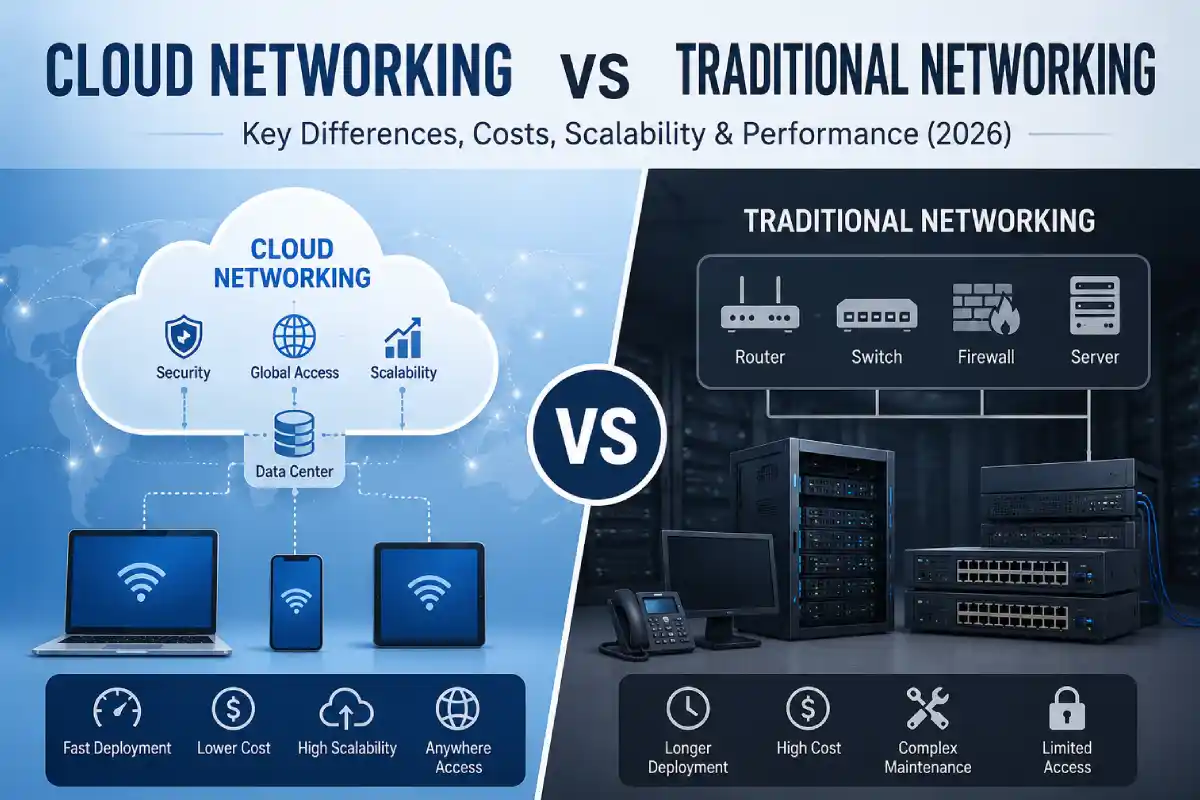
The technology infrastructure has evolved over the last decade and hence Cloud Networking Vs Traditional Networking is one of the top choices when it comes to comparing for businesses and IT community. Organizations are migrating applications, storage and networking services to cloud whereas a lot more still depend on on-premises networking for key operations.
Knowing how each method operates will allow you to lessen expenses, enhance scalability, fortify security, and ready your infrastructure for expansion.
 This article is part of
Networking Resources
What Is Cloud Networking?
Cloud networking provides the ability to run networking services on cloud environments instead of to usage of onsite physical devices in your data center or office.
What Is Traditional Networking?
Traditional networking uses physical networks of hardware on an organisation’s premises.
Typical infrastructure includes:
- Physical switches
- Routers
- Firewalls
- Ethernet cabling
- Local servers
- Network racks
Traditional networking architectures are still widely used by enterprises, but understanding how they compare with modern cloud networking strategies is essential for long-term infrastructure planning.
Table of Contents
Key Differences
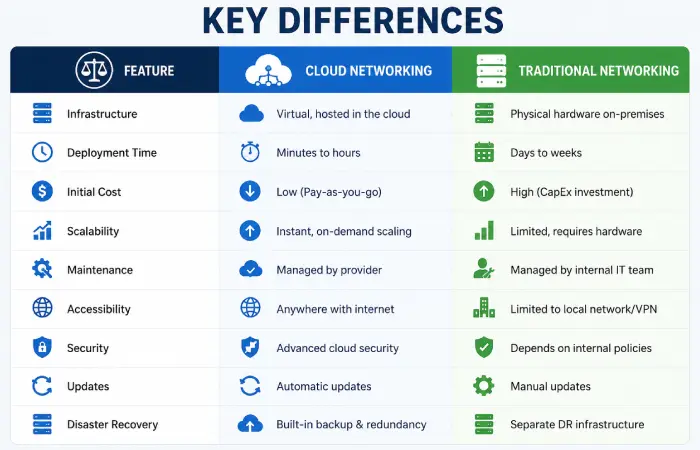
By knowing the main comparisons of cloud networking and traditional networking, companies can have the advantage to find a suitable network infrastructure for their applications. Both of them provide communication and interaction among hardware and software, but they are confused in aspects like:
| Feature | Cloud Networking | Traditional Networking |
| Infrastructure | Virtual | Physical |
| Deployment | Minutes | Days or weeks |
| Initial Cost | Low | High |
| Maintenance | Cloud provider | Internal IT team |
| Scalability | Instant | Hardware upgrades |
| Accessibility | Anywhere | Office or VPN |
| Updates | Automatic | Manual |
| Disaster Recovery | Built-in options | Requires planning |
Which Model Is Better?
No one size fits all. Cloud networking fits organizations that want easy scalability, flexibility, mobility and a lower up-front investment while traditional networking suits thosewho need full in-house control, very low latency local applications, or compliance.
As of 2026, many organizations are choosing a hybrid network, using cloud networking for the easy access and remote connectivity of public clouds, with traditional networking to meet the needs of the mission critical systems still kept local to the organization.
Cost Comparison
The Price is frequently a discriminant between Cloud Networking vs Traditional Networking. Traditional networking requires an important expense at the beginning, because of the hardware and the infrastructure. On the opposite, cloud networking is a “pay as you go” model. So the choice will depend of the business, the development and the needs at a long term.
Estimated Infrastructure Cost (2026)
| Business Size | Traditional Networking | Cloud Networking |
| Small Business | $8,000–$20,000 | $150–$600/month |
| Medium Business | $40,000–$120,000 | $1,000–$5,000/month |
| Enterprise | $500,000+ | Pay-as-you-grow |
Resource
AWS Pricing Calculator
https://calculator.aws/
Microsoft Azure Pricing
https://azure.microsoft.com/pricing/
Google Cloud Pricing
https://cloud.google.com/pricing
Many organizations are gradually extending their on-premises infrastructure through hybrid cloud networking models that combine private and public cloud resources while maintaining compatibility with traditional systems. #ahrefs
Cost Considerations
When considering the Cloud Networking over Traditional Networking, the first thing to consider is the initial cost. It affects the total cost of ownership (TCO) which is the sum of hardware, software, maintenance and support, staffing, power, cooling, and upgrades. Cloud networking usually cost less than traditional networking from the initial cost but some organisations can benefit from traditional networking to the long term stable infrastructure.
Traditional networking includes:
- Hardware purchases
- Maintenance contracts
- Cooling
- Electricity
- Equipment replacement
- IT staffing
Cloud networking typically includes:
- Subscription pricing
- Usage-based billing
- Automatic updates
- Managed infrastructure
As branch connectivity requirements increase, businesses often evaluate SD-WAN solutions for cloud networking to improve application performance and simplify network management across distributed locations.
Performance Comparison
Performance is an important criterion when discussing Cloud Networking vs Traditional Networking; however, there is no clear single winner. It all depends on your workloads, internet connectivity, application requirements and business objectives.
Traditionally, lower latency is achieved using on-premises solutions; however, cloud networking is probably the best option for distributed teams, modern applications, and global presence.
| Workload | Better Choice |
| Remote workforce | Cloud Networking |
| Branch offices | Cloud Networking |
| Internal databases | Traditional Networking |
| Manufacturing systems | Traditional Networking |
| SaaS applications | Cloud Networking |
| AI workloads | Cloud Networking |
Nowadays, cloud providers offer global low-latency networking; this makes the cloud performance becomes appropriate to most enterprise applications.
Enterprises transitioning from legacy infrastructure can benefit from managed cloud networking services that help with migration, monitoring, security, and ongoing optimization.
Scalability
Scalability is one of the most significant benefits of cloud networking as opposed to traditional networking. It is defined as the ability of a network to expand or contract according to business demand. When companies grow, introduce new applications and bring remote employees into the network, the infrastructure must be scalable.
Traditional Network
Scaling requires:
- Purchasing hardware
- Waiting for delivery
- Installation
- Configuration
- Downtime planning
Growth may take several weeks.
Cloud Networking
Scaling usually involves:
- Adjusting resources
- Adding virtual networks
- Deploying additional regions
- Auto scaling
This often takes only minutes.
Comparison
| Capability | Cloud | Traditional |
| Auto Scaling | Yes | No |
| Global Expansion | Yes | Limited |
| Remote Access | Excellent | Moderate |
| Hardware Purchase | No | Yes |
| Elastic Capacity | Yes | No |
While traditional networks offer familiarity and control, organizations must also consider the common cloud networking challenges associated with scalability, security, latency, and operational complexity.
Which One Should You Choose?
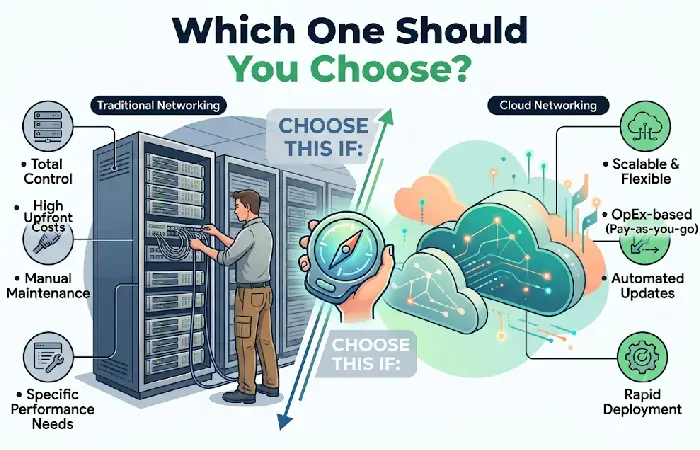
Choose Cloud Networking if you:
- Have remote employees
- Use Microsoft 365 or Google Workspace
- Need global access
- Expect business growth
- Want lower upfront costs
- Prefer managed services
Choose Traditional Networking if you:
- Require complete hardware control
- Operate offline systems
- Have strict regulatory requirements
- Need ultra-low local latency
- Already own networking infrastructure
As a result, a hybrid model of network architecture is increasingly being used today, whereby organizations utilize the cloud networking to provide more agility with the traditional network being used for the organizations most business critical workloads.
To modernize legacy environments effectively, IT teams should follow cloud networking best practices for architecture design, performance optimization, governance, and security management.
Frequently Asked Questions (FAQs)
Have you ever speculated is cloud computing replacing networking in its, basic concept?
Not really. There are many companies who are running a hybrid Cloud and traditional networking environment.
What network system is less expensive?
Cloud networking tend to have lower initial infrastructure costs, since businesses do not have to spend heavily on networking equipment. Nevertheless, (as is the case with any IT related infrastructure) the ongoing costs are dictated by usage.
Is there safety in cloud networking?
Yes. Cloud giants provide a host of security features such as encryption, identity management, network segregation, DDoS mitigation, and compliance standards and reportings. However configuration and administration are equally important.
What is best for small businesses?
Cloud computing is the more advantageous choice for small businesses because of the affordability, scalability, and less maintenance involved.
Can traditional networking make this?
Yes. Hybrid networking (hybrid cloud) enables on-premises infrastructure to securely connect to clouds over VPNs, dedicated lines or SD-WAN.
Conclusion
Ultimately, the decision of Cloud Networking vs Traditional Networking will depend on what your organization hopes to achieve, its budget, its security needs and plans for the future. Cloud Networking provides great scalability, quick implementation and financial benefits in the early stages, but traditional networking still makes sense in certain circumstances.
In 2026, most businesses will find that they get “the best of both worlds” with a hybrid solution. The benefits of cloud computing can be combined with the dependability of an on-premises network, by focusing on what each can offer your business now and in the future.
Kashifa Jafar is a technology writer and contributor at FutureTechExpert with 4+ years of experience in technology writing and content creation.
Read Full Bio of Author →Sameena reviews selected health, wellness, technology, and digital content for clarity, factual presentation, and reader usefulness.
Read Full Bio of Reviewer →