
 Kashifa Jafar
Technology Writer & Contributor
Kashifa Jafar is a technology writer and contributor at FutureTechExpert with 4+ years of experience in technology writing and content creation.
Read Full Bio of Author →
Kashifa Jafar
Technology Writer & Contributor
Kashifa Jafar is a technology writer and contributor at FutureTechExpert with 4+ years of experience in technology writing and content creation.
Read Full Bio of Author →
 Sameena Begum
Health, Technology & Digital Content Reviewer
Sameena reviews selected health, wellness, technology, and digital content for clarity, factual presentation, and reader usefulness.
Read Full Bio of Reviewer →
Sameena Begum
Health, Technology & Digital Content Reviewer
Sameena reviews selected health, wellness, technology, and digital content for clarity, factual presentation, and reader usefulness.
Read Full Bio of Reviewer →
Gadgets investing is emerging as one of the fastest growing theme playing out in the technology and financial world. Investors now look beyond stocks for their holdings to the future value of smart technology ranging from smart glasses and AI wearables to robotics and connected home products.
The worldwide market for smart devices will still grow exponentially with the introduction of AI, automation, IoT ecosystems, and the always-growing consumer demand for connected experiences. In 2026, devices are no longer just things you buy for yourself they are a reliable investment.This guide explains:
- How gadget investing works,
- which smart devices have long-term potential,
- What risks investors should understand,
- and how beginners can build exposure to the future of technology safely.
Technology evolves rapidly, making it important for investors and consumers to stay informed about the latest smart technology trends that are shaping the future of connected devices and digital innovation.
 This article is part of
Gadgets Investing
Table of Contents
What Is Gadgets Investing?
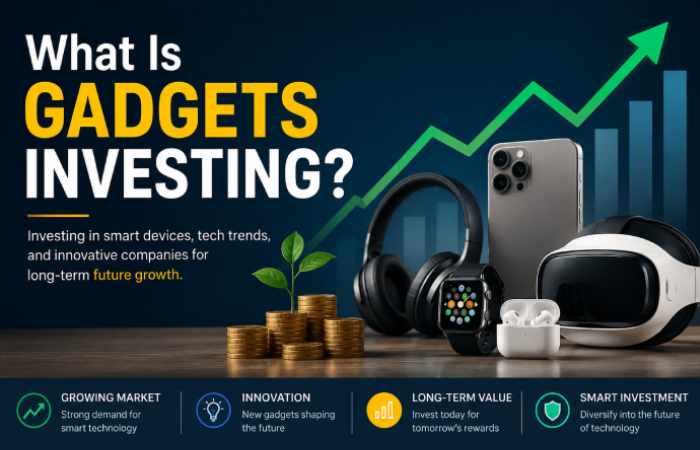
Gadgets investing, is an investment in wearable devices, consumer electronics, AI-based tools and software, gadgets or apps, and companies in the electronics or application markets that develop existing or emerging technological products with a promising place in the market. Unlike traditional investing, which primarily involves stocks, bonds, and real estate, gadgets investing crosses technology, consumer needs, and possibility of future innovations.
Gadget investing, put simply, is to identify technologies and gadgets that have the potential of becoming more valuable, more widely adopted or more profitable in the future.
Gadget investing refers to investing in:
- smart consumer electronics,
- AI-powered devices,
- wearable technology,
- smart home ecosystems,
- gadget-focused companies,
- and emerging tech hardware markets.
There are 3 ways people invest in gadgets:
| Type of Investments | Example | Level of Risk | Potential Return | |
| Physical Gadget Investing | Limited-edition gadgets | Medium | Medium-High | |
| Tech Stock Investing | Apple, NVIDIA, Sony | Medium | High | |
| Startup/Trend Investing | AI hardware startups | High | Very High |
Gadgets investing has also gained popularity partly due to the pace of technological innovation that is visible in many segments. Entire industries are being created within a few years thanks to new developments. A decade ago no one would have perceived a wearable fitness band, a voice activated home robot or an intelligent cell phone as something that would one day be in many millions of people‘s lives.
Why Tech Gadgets Are Valuable Investments
The latest innovative technology has made tech gadgets become one of the most appealing investment categories in today‘s digital economy. With the rapid advancing of technology, the cutting-edge smart devices are no longer viewed solely as luxury products but regarded as daily usage tools for communication, working, health care, enjoying entertainment, monitoring security, imparting education and automation.
From AI-enabled wearables and smart home solutions, to gaming peripherals and augmented reality devices, the asking for cool technology by consumers is on the rise, across the globe. Increasing use of smart devices opens up huge opportunities for investors, tech companies and startups alike.
The value of tech gadgets as investments comes from several important factors including:
- continuous innovation,
- rising global demand,
- recurring upgrade cycles,
- AI integration,
- expanding digital lifestyles,
- and long-term technological transformation.
As various industries continue to become more integrated due to AI and automation, many professionals see the worldwide smart gadget market becoming one of the rapidest growing industries in the next 10 years.
As technology evolves, understanding AI and the future of consumer gadgets can help investors identify emerging opportunities before they become mainstream.
Growing Global Demand for Smart Devices
A major reason the value of tech gadgets is rising is that the world has become more oriented towards the continuous usage of connected devices. Consumers today depend heavily on technology for:
- communication,
- remote work,
- fitness tracking,
- online learning,
- gaming,
- digital payments,
- and home automation.
This in turn increases demand for all markets the world over: from developed to emerging markets.
Today, along with money, they are having the pre-requisite holdings for living; be it a smartphone, or a smart watch, a wireless ear piece, an AI personal assistant, or a VR headgear and a health tracking device that should or should not be worn! With the arrival of the internet and people’s increasing digital consciousness, every year, more people are becoming part of the smart gizmos domain.
And the rising middle class in India, Brazil, Indonesia and certain other African countries is also driving demand for cheap smart electronics.
The latest innovations in gaming and entertainment technology continue to influence consumer purchasing decisions.
Artificial Intelligence Is Driving Gadget Innovation
The world of Consumer electronics is changing more rapidly than ever before. With Artifi cial Intelligence making its way into the electronics world, even the consumer electronic devices are getting smarter & faster.
AI-powered devices can now:
- understand voice commands,
- automate tasks,
- analyze user behavior,
- optimize battery usage,
- provide health insights,
- and improve user experiences in real time.
Examples of AI-driven gadgets include:
- AI smart glasses,
- AI health wearables,
- voice assistants,
- robotics devices,
- AI cameras,
- and smart home systems.
This fast-paced innovation results in attractive investments as markets for AI hardware are likely to expand considerably during the next several years. Corporations that spend 4 much money on AI enabled gadgets are normally considered by investors as good companies for long-term investment because they may getting::
- recurring customer demand,
- software ecosystems,
- subscription services,
- and future technology leadership.
One of the fastest-growing sectors in tech is smart home technology investments, driven by increasing demand for connected devices and home automation.
Consumer Upgrade Cycles Create Recurring Revenue
The consumer electronics industry is also significantly different from most other industries in that there is a predictable upgrade cycle: Most consumers replace or upgrade gadgets every few years:
- smartphones every 2–4 years,
- laptops every 3–5 years,
- gaming consoles every generation,
- and wearables as new features emerge.
This creates recurring revenue for technology companies.
Each new generation of devices typically offers:
- improved performance,
- better cameras,
- enhanced AI features,
- stronger batteries,
- and deeper ecosystem integration.
Consequently, top technology brands have long-term customer relationships and predictable sales cycles.
Furthermore, the repetition of every single request partly explains why companies such as Apple or Samsung are the bedrock of the worldwide gadget market.
From smartphones and laptops to wearable devices, exploring the latest consumer electronics products can help investors and tech enthusiasts understand current market demand.
Smart Ecosystems Increase Customer Loyalty
Contemporary technology corporations are more and more creating full-blown ecosystems rather than individual appliances. Today, devices often work together through interconnected platforms:
- smartphones connect with smartwatches,
- smart TVs sync with voice assistants,
- security cameras integrate with mobile apps,
- and home automation systems operate through centralized AI hubs.
Unlike traditional office equipment these systems build loyalty from customers as they like to buy machines which interact with each other. Once users invest in one ecosystem, they are more likely to:
- buy additional compatible products,
- subscribe to premium services,
- and remain loyal to the same brand.
This strategic foresight further increases profitability potential for technology companies in the long run and enhances investment potential of smart gadget industry.
Health Technology Is Expanding Rapidly
Trends in consumer electronics health based devices are now one of the most rapidly expanding areas. Modern wearable devices can now monitor:
- heart rate,
- sleep quality,
- blood oxygen,
- stress levels,
- physical activity,
- and overall wellness.
The combination of healthcare and AI technology is creating massive growth opportunities in:
- fitness trackers,
- smart rings,
- health wearables,
- and remote patient monitoring devices.
With the rise of digital health solutions among worldwide health systems, health-tech devices may become one of the most valuable long term technology fields. A rise in health consciousness among consumers results in greater demand for device monitoring technology and preventative healthcare.
Investors looking for long-term growth should also explore wearable technology market trends, including smartwatches, fitness trackers, and health-monitoring devices.
Smart Gadgets with Growing Demand
Best Gadget Categories for 2026
| Gadget Category | Growth Potential | Investment Score | Why It Matters |
| AI Wearables | Very High | 9.5/10 | Health + AI integration |
| Smart Glasses | Very High | 9/10 | AR ecosystem growth |
| Smart Home Devices | High | 8.5/10 | IoT adoption |
| Robotics Gadgets | High | 8/10 | Automation demand |
| Gaming Hardware | Medium to High | 7.5/10 | Strong resale ecosystem |
| Foldable Devices | Medium | 7/10 | High-end consumer demand |
AI Gadgets & Future Investment Trends
AI hardware is becoming the biggest driver of gadget investing.
Trending AI Gadgets in 2026
| AI Gadget | Market Trend | Future Potential |
| AI Smart Glasses | Rapid growth | Extremely High |
| AI Voice Assistants | Stable growth | High |
| AI Health Wearables | Explosive adoption | Very High |
| AI Security Cameras | Expanding smart homes | High |
| AI Robotics | Emerging category | Very High |
Why AI Gadgets Matter
AI-powered devices collect and process data in real time, making them more valuable than traditional electronics.
This creates:
- recurring software ecosystems,
- subscription models,
- higher consumer retention,
- and stronger company valuations.
Best Consumer Electronics Stocks
Investors who do not want to buy physical gadgets can invest through consumer electronics companies.
| Company | Sector | Why Investors Watch It |
| Apple | Smartphones & wearables | Strong ecosystem |
| NVIDIA | AI chips | AI hardware leader |
| Sony | Gaming & entertainment | Diversified revenue |
| Samsung Electronics | Smart devices | Hardware innovation |
| Xiaomi | Affordable smart gadgets | Emerging markets growth |
Gadget Investment Comparison Table
| Investment Type | Entry Cost | Risk | Time Horizon | Best For |
| Buying Gadget Stocks | Low-Medium | Medium | Long-term | Beginners |
| Collectible Gadgets | Medium | Medium-High | Long-term | Tech enthusiasts |
| Startup Gadget Investing | High | High | Long-term | Advanced investors |
| AI Hardware ETFs | Medium | Medium | Medium-Long | Diversified investors |
Many breakthrough products emerge from startup and innovation trends that reshape the tech landscape.
Risks of Investing in Tech Gadgets
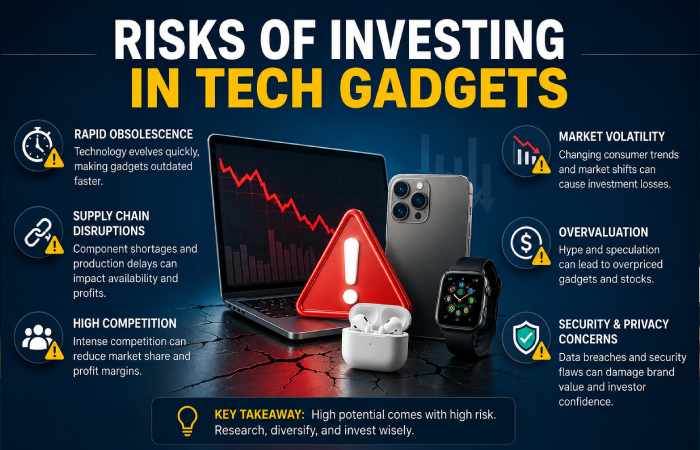
Gadgets investing offers many great opportunities in his maturing markets, however it also opens an area of high risk to the investors that are investing into smart devices, A. I. equipment or consumer electronics firms. Since the speed of technology changes is very fast, something that is extremely popular currently, will be rapidly replaced within a few years.
In contrast, the dynamics of the gadget markets are driven much more heavily by pace of innovation, consumer demand, software platforms and global macro-economic than most traditional industries. As such, investors in tech gadgets need to be mindful of risk and return trade-offs associated with these investments.
Absorbing these risks can help beginners to make wiser investment choices and avoid getting caught up in the hype while establishing a better balanced tech stock portfolio.
Readers can make better investment decisions through technology education and analysis covering industry developments.
Rapid Technology Obsolescence
One of the greatest risks lies in obsolescence. Gadgets are evolving at a lightning speed and a new gadget can take over an older one in no time.
For example:
- smartphones launch new versions almost every year,
- AI devices continuously improve,
- gaming hardware evolves quickly,
- and software requirements constantly change.
Today’s fashionable and high-tech gadget can be its past-sell date when Inext, more-hi-techgadget hits the market.
This creates challenges for:
- physical gadget collectors,
- resale investors,
- and even technology manufacturers.
Without innovating all the time, companies are going to lose their market to others that provide better hardware or AI features.
Example
Many older smart home devices lost value after newer AI-powered systems offered:
- faster automation,
- improved voice recognition,
- better security,
- and stronger ecosystem compatibility.
High Market Competition
Consumer electronics is one of the most competitive markets in the world. Consumer electronics is fought tooth and nail with large technology corporations vying for:
- smartphones,
- wearables,
- gaming,
- AI hardware,
- and smart home ecosystems.
Big companies such as Apple, Samsung, Sony or Xiaomi spend billions of dollars on R&D and marketing.
This intense competition creates several investment risks:
- smaller companies may struggle to survive,
- new gadgets may fail commercially,
- and profit margins can shrink rapidly.
Even strong products can fail because new competitors released a superior product at a lower price.
Consumer Trend Volatility
Trends in consumer technology are also unpredictable. Certain devices may suddenly boom without really being needed, only to crash when the popularity dies down.
Examples include:
- certain VR products,
- trend-based wearable gadgets,
- experimental smart devices,
- and niche gaming accessories.
As a result, guessing about the success of an application (or a hardware platform) has more variance that in other traditional sectors.
A large number of investors tend to lose money, when they rely on ‘hype products’, which are primarily fueled by buzz created on social media and lack long-term user consumer purchase.
Why This Happens
Consumer preferences often change because of:
- Changing in lifestyles,
- Economic conditions,
- Competing innovations,
- Or changing technology standards.
A type of device which at present looks the most promising can turn sales down to zero in a couple of years.
Supply Chain & Semiconductor Risks
Modern devices are at the mercy of global supply chains and microchip manufacturing. These will affect:
- The production of chips,
- Transportation,
- Availability of raw material,
- Or production capacity
Can affect the prices of a device as well as the revenues of a company. An example could be the recent years global chip shortages, which show the instability of consumer electronic business.
When semiconductor supplies become limited:
- Production gets slower,
- As device prices go up,
- Delivery times are extended,
- And company revenue might fall.
The risks these companies who own technology hardware companies face.
Cybersecurity & Privacy Concerns
And as the “Smart” Revolution gets more “connected”. Cybersecurity threat continues to grow.
Many smart devices collect user data including:
- Location information,
- Health data,
- Recordings of her voice,
- Browsing behavior,
- And biometric data.
Weak security systems can lead to:
- Hacking,
- Data leaks,
- Identity theft,
- Or privacy breaches.
People are growing more wary of corporations using users’ data on the internet. Bad press about a company‘s mishandling of personal information can push the company close to destruction, and the product loss will follow.
This is especially important for:
- To the extent of smart home devices,
- AI companions,
- Health wearables
- And linked cameras.
Not every gadget delivers the same value over time. Before making a purchase, readers should explore our gadget reviews & buying guides to compare performance, reliability, and long-term investment potential.
Emerging Gadget Markets
Gadgets are entering into an ever increasing number of devices worldwide. Worldwide gadget industry is changing everyday and many modern innovative technologies are making it easier for the people to make changes in their life style, work, travel, communication and even health care system.
Although the familiar consumer products, such as mobiles or laptops, have been the most portrayed ones in the market, more other innovations are getting some magnificent attraction from the financial investors, large producers and personal consumers.
Investors and technology enthusiasts often follow technology market trends to understand where the gadget industry is heading.
These emerging gadget markets are being driven by:
- Artifical intelligence (AI),
- Automation,
- Internet of Things (IoT),
- Digitalhealth,
- Sustainability,
- And immersive computing technologies.
The rate at which innovations will flood into these markets will propel many to trillions by 2026. Early technology investors are doubling down on “gadget groups” as the early-adoption pervasiveness advantage is going to be killer. Here is a list of the leading emergent gadget groups that will shape the future of smart tech in 2026.
Health Tech Devices
Health technology devices are among the fastest expanding categories in the global electronics industry. People are more interested in their health status and now wearable gadgets can measure much beyond simple fitness activity. (WHO Digital Health Overview)
Modern health-tech gadgets can track:
- heart rate,
- sleep quality,
- blood oxygen levels,
- stress levels,
- hydration,
- calories burned,
- and even early signs of medical conditions.
Devices such as:
- smartwatches,
- fitness bands,
- smart rings,
- AI-powered health sensors,
- and remote monitoring systems
We are transforming preventive healthcare.
Companies are increasingly integrating artificial intelligence into wearable devices to provide:
- personalized health insights,
- predictive alerts,
- and real-time wellness recommendations.
This market is expanding rapidly because:
- aging populations are increasing healthcare demand,
- consumers want preventive health monitoring,
- telemedicine adoption is rising,
- and digital healthcare systems are expanding globally.
Health-tech devices are especially attractive for long-term investment because they combine:
- AI technology,
- subscription ecosystems,
- recurring hardware upgrades,
- and healthcare innovation.
Key Growth Areas
- AI-powered health wearables
- Remote patient monitoring
- Smart rings
- Medical-grade consumer devices
- Fitness ecosystems
Industry Outlook
It is thought by many analysts that wearable healthcare devices could become as commonplace as cell phones.
Smart Mobility Devices
Smart mobility technology is revolutionizing transportation globally. Consumers are now demanding:
- eco-friendly transportation,
- AI-assisted mobility,
- connected vehicles,
- and urban transportation alternatives.
This has created growing demand for:
- electric scooters,
- smart e-bikes,
- self-balancing devices,
- AI-assisted navigation systems,
- and micro-mobility gadgets.
Urbanization and traffic are some of the driving factors behind the expansion of the smart mobility devices across the world.
Electric mobility devices are becoming popular because they offer:
- lower operating costs,
- environmental benefits,
- convenient urban travel,
- and energy efficiency.
Artificial intelligence is also improving mobility technology through:
- predictive navigation,
- smart traffic integration,
- battery optimization,
- and autonomous safety systems.
Many countries are now providing support to green transportation thus encouraging the growth of the smart mobility gadgets.
Key Growth Areas
- Electric scooters
- Smart e-bikes
- AI navigation systems
- Connected transportation devices
- Battery optimization technology
Investment Potential
The smart mobility sector is expected to benefit strongly from:
- urban smart city projects,
- sustainability regulations,
- and rising fuel costs.
AR/VR Ecosystem
Certainly, virtual reality and augmented reality is one of the most intriguing emerging sort of gadget industry. AR and VR technologies offer compelling digital experiences that integrate physical and virtual spaces. While AR/VR devices were used predominantly in the context of gaming, they are now becoming more numerous and more broadly:
- education,
- healthcare,
- remote work,
- engineering,
- retail,
- military training,
- and entertainment.
Today‘s VR head-mounted displays and smart glasses are sleeker, more powerful and more user-frendly. Technology companies are heavily investing in:
- mixed reality devices,
- AI-enhanced smart glasses,
- spatial computing,
- and immersive digital ecosystems.
Many experts also think that in the future AR glasses can even replace some features of the popular mobile phones.
Why the AR/VR Market Is Growing
Several major trends are driving this sector:
- increasing remote collaboration,
- demand for immersive entertainment,
- metaverse development,
- and advances in AI graphics processing.
Key Growth Areas
- Smart AR glasses
- VR gaming headsets
- Spatial computing
- Virtual collaboration tools
- Industrial training simulations
Long-Term Outlook
In the next ten years, AR and VR might be the compute platform as established as the cellphone.
Sustainable Gadgets
Sustainability is becoming a big focus in consumer electronics. Today‘s consumers are increasingly aware of:
- electronic waste,
- carbon emissions,
- recyclable materials,
- energy efficiency,
- and environmentally responsible manufacturing.
Therefore, the overall promise of eco-friendly gadgets is gaining much acceptance among consumers and investment companies.
Technology companies are now developing:
- recyclable electronics,
- eco-friendly packaging,
- solar-powered gadgets,
- energy-efficient smart devices,
- and repairable product designs.
Governments worldwide are also introducing stricter sustainability regulations for:
- manufacturing,
- battery disposal,
- and electronic waste management.
This is prompting companies to develop products with longer lifetime and lower environmental impact.
Why Sustainable Gadgets Matter
Sustainable technology because younger consumers are more interested in packages that are environmentally friendly. There is great optimism that sustainability-focused electronics could turn out to be one of the most robust long-term technology trends in the electronics industry. (Samsung Sustainability)
Future of Smart Technology
It is predicted that smart technology will influence nearly all aspects of future life such as business, health sectors, trade and transports. Since AI, advanced machine learning, cloud computing and IoT we will be developing, smart devices will be developing at higher speed, to be more accessible and smarter.
They will become in use by 2026 when experts believe smart devices will evolve from automated tools to proactive and adaptive preemptive behavioral systems responsive to changes in the user activity. Customized and more efficient, they will not just be automatic and predictable, but will also learn to adjust accordingly.
The future of gadget investing is closely tied to:
- Artificial intelligence.
- Automatic,
- Ambient computing,
- Andio AI,
- And connected ecosystems.
Experts predict that future devices will:
- Become more independent,
- Be dependent on AI chips,
- Integrate into the smart home,
- And create subscription-based ecosystems.
Despite ongoing issues such as monetary and security worries, issues surrounding data privacy and shorter product life spans, the smart technology outlook is, in fact, promising. The adoption rate of connected devices by businesses, investors, and consumers is shooting through the roof and, as a result, smart technology has become one of the most favorite of all global innovative practices.
FAQs
Are we wasting money on gadgets?
Yes, you can make money from investing in gadgets – just wait until you are riding the trend of multi-year tech movements such as AI wearables, smart homes, robotics etc.
Are smart devices worth purchasing in 2026?
AI embedded devices and wearable AI devices will have the most room to expand in 2026.
A secure way of investing in such equipment is:
Rather investing in well ever consumer electonics companies, or even a multinational ETF is less risky.
26-Which of these four types really have most future potential?
One of the few fastest growing areas in the AI wearable, smartglasses and health-tech field.
Mind the Equipment Is there a way we could factor them into the price?
Certainly. Some obscure gaming console or a rare electronics or collectible item can turn out to be very valuable.
Conclusion
Gadgets investing is so much more than just purchasing that new iPhone or PS4 anymore its really become more of a larger opportunity taking in many angles of Artificial Intelligence, Smart Ecosystems and Wearable Technology, Robotics, and future generation‘s consumer electronics as the move to a more embedded society continues to grow in 2026.
Kashifa Jafar is a technology writer and contributor at FutureTechExpert with 4+ years of experience in technology writing and content creation.
Read Full Bio of Author →Sameena reviews selected health, wellness, technology, and digital content for clarity, factual presentation, and reader usefulness.
Read Full Bio of Reviewer →