
Social Media Apps: Complete Guide to Popular Platforms, Features, Benefits, and Future Trends (2026)

Last Updated: September 17, 2026
The social media applications are revolutionary to how media is exchanged and consumed, how communities are created and maintained, and how entertainment is produced. Through them, we are allowed to: chat with friends, upload videos, network professionally and create hit content.
2026 billions of users are using social media apps in many ways such as computer work, sharingfun, entertainment, education, business and marketing. So, if you are looking best social networking app, safe and secured message platform, professional networking platform, then understanding behavior and functionality of social media apps is helpful.
An all-you-need-to-know guide to social media app is here! Covering from what social media apps are, the different types, the key features, the incentives, the security and the future, to!
Table of Contents
What Are Social Media Apps?
Social media apps are computer programs on the internet that give consumers the ability to create user profiles, connect and share content with others, interact in real time, and participate in community forums. In essence, social media apps give users the ability to communicate with ‘anyone, friend, family, brand, creator or network’ from ‘anywhere’.
While a website is a source of information, apps such as social media are all about interaction and content-sharing. News can be broadcast in the form of a status through, photos, video uploads, direct messaging, group joining, commenting, liking or other emojis, and even live streaming. These all help to create communities of people with similar interests, hobbies, careers and brands.
There are many other reasons to use a social media app in 2026. Social media apps are used for marketing purposes to target customers from a business, using it for customer support, making connections with professional contacts, visiting for education, or simply for entertainment purposes. They are used for shopping on-line, or creating content and sharing with other users.
These applications enable interactions through:
- Text posts
- Photos
- Videos
- Stories
- Live streams
- Messages
- Comments
- Reactions
- Community discussions
The apps are different from traditional websites since the content is co-authored by users and they are more used for sharing.
Key Characteristics
| Feature | Description |
| User Profiles | Personal accounts and identities |
| Content Sharing | Photos, videos, posts, and stories |
| Communication | Messaging and comments |
| Networking | Connecting with friends or professionals |
| Communities | Groups and discussion forums |
| Notifications | Real-time activity updates |
How Do Social Media Apps Work?
A social media applications uses internet network, cloud computing, database, algorithm and artificial intelligence (AI) to allow user to generate, share, search and interacting with content. When users open the social media application, the social media will load a sponsored content from the social media application server based on the user’s interest list, activity, activity of someone the user connected and the user activity.
A huge number of interactions happen at the back end of social media apps every second. Anything from a like, comment, share, follow or message all creates data which inform the platform how to better its recommendations and hence make the experience more personal.
Basic Workflow
- User creates an account.
- User builds a profile.
- Content is uploaded.
- Platform stores data on servers.
- Algorithms distribute content.
- Other users engage through likes, comments, and shares.
- AI recommends similar content.
Core Technologies
| Technology | Purpose |
| Cloud Computing | Data storage and scalability |
| Artificial Intelligence | Content recommendations |
| APIs | App integrations |
| Databases | User data management |
| Content Delivery Networks | Faster media delivery |
| Machine Learning | Personalized feeds |
Social Media Architecture
User Device
↓
Mobile App
↓
Application Server
↓
Database
↓
Recommendation Engine
↓
Personalized Content Feed
Why Understanding How Social Media Apps Work Matters
By providing the user with an explanation of the ways in which social media functions, she is able to have more say in what she would like to see or do. Those who know about the functions of algorithms, recommendation engines based on AI, messaging services and advertising networks can make the most of the web for communication, entertainment, education or development.
However, as social media technology advances, AI-enabled personalized experiences, immersive interaction, social commerce, and enhanced privacy controls will drive consumer usage behavior.
Types of Social Media Apps
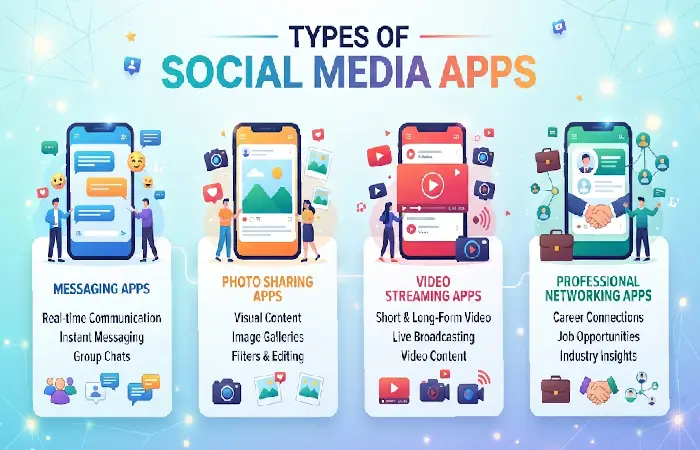
There are countless applications of social media; every app or service caters to at least one function that social media offers. There is a wide range of targeted group of people that the application is created for. Not every social media apps have all the same features.
Learning about the various social media applications is beneficial for users as well as those who wish to share, market, or promote their pages. It can be advantageous for content creators and marketers to determine which social media type will best meet their needs before creating their own page.
Major Types of Social Media Apps
| Social Media App Type | Primary Purpose | Popular Examples |
| Social Networking Apps | Connect with friends and family | Facebook, Threads |
| Photo and Video Sharing Apps | Share visual content | Instagram, Snapchat |
| Messaging Apps | Private communication | WhatsApp, Telegram |
| Community-Based Apps | Discussions and groups | Reddit, Discord |
| Short-Form Video Apps | Quick entertainment and discovery | TikTok, YouTube Shorts |
| Professional Networking Apps | Career and business networking | |
| Live Streaming Apps | Real-time broadcasting | Twitch, YouTube Live |
| Social Commerce Apps | Shopping and product discovery | Instagram Shopping, Pinterest |
| Content Publishing Platforms | Long-form content sharing | Medium, Substack |
| Interest-Based Networks | Niche communities and hobbies | Goodreads, Strava |
Social Networking Apps
Social networking apps are used by individuals to communicate, connect and maintain relationships on the Internet. They involve participants by establishing profiles, affiliates or fans, join interest groups, post information about themselves or subjects they care about and distribute information and stories about subjects that appeal to them.
Social networking applications are among the first and most common forms of social media. In addition to facilitating messaging and video, they now enable promotion of business, creation of online communities, event planning and transactions.
Social networking application are presently used by billions of people worldwide to stay in touch with relatives and friends, to catch up on news and trends, to join communities or to communicate with brands or famous people.
Features
- Friend requests
- News feeds
- Groups
- Events
- Marketplace integrations
- Community interactions
Examples
| Platform | Main Purpose |
| Social networking | |
| Threads | Public conversations |
| X | Real-time discussions |
| Topic-based communities |
Best For
- Staying connected
- Community engagement
- Local groups
- Event participation
Why Social Networking Apps Matter
Social networking applications have greatly transformed the way individuals interact, exchange and communicate information and establish online relationships. Whatever social sites are utilized for personal, community, career or company marketing purpose, it is clear that they will remain a crucial part of online interaction.
With constantly improving technology social networking apps are becoming increasingly tailored towards the user, more engaging and woven into people‘s lives, making them one of the most dominant groups in social media.
Photo and Video Sharing Apps
Photography and video sharing applications is the social media platform where the users are meant for uploading, editing, creating, and sharing images, short flicks, live broadcasts, stories and rich media.
Now that images have become one of the most popular ways of sharing content, photo/video sharing applications are generally the most active and widely used features found in social media. They tend to have an appeal for individuals, influencers, creators, companies, teachers and marketers who are more eager to reach audiences with meaningful visuals than via text.
Photo and video sharing applications are becoming some of the most popular forms of social media as visual content continues to improve. These apps are used by individuals, influences, creators, companies, educators and marketers who wish to reach audiences via visually engaging displays unlike conventional text based interaction.
The dominance of images as the strongest content for social media interaction continues in 2026. Photo and video sharing applications are pointin at the must-have tools of communication, entertainment, branding and marketing.
How Photo and Video Sharing Apps Work
They enable users to take or upload videos, photos or other media and sharing with followers, friends or the public. Sophisticated algorithms recommend content to users based on their preferences, actions and taste.
A typical process includes:
- Creating an account and profile.
- Capturing or uploading photos and videos.
- Editing content using built-in tools and filters.
- Publishing content to a feed, story, or reel section.
- Receiving likes, comments, shares, and saves.
- Expanding reach through recommendations and hashtags.
Popular Features
- Image uploads
- Video publishing
- Stories
- Filters
- Editing tools
- Reels and Shorts
Examples
| App | Best For |
| Photos and Reels | |
| Visual discovery | |
| Snapchat | Temporary content |
| YouTube | Long-form video |
Advantages
- High engagement
- Creative expression
- Brand marketing
- Influencer opportunities
Messaging and Community Apps
Messaging and community apps are a type of social media platform concentrated on real-time communication, private messaging, group conversations and community management. They are preoccupied with one-to-one communication, private and controlled community interaction, rather than using scrolling news feeds and public posting behavior typical of most social networking apps.
By 2026, messaging and community applications have become two of the most important tools in our daily life. They are used for small-scale and one-to-one communication, business collaboration, customer support, online education, online gaming business, community of interest, and even millions-strong online communities.
Core Features
- One-to-one messaging
- Group chats
- Voice calls
- Video calls
- File sharing
- End-to-end encryption
Popular Apps
| Platform | Specialty |
| Personal communication | |
| Telegram | Large communities |
| Discord | Gaming and communities |
| Messenger | Facebook integration |
Business Applications
- Customer support
- Team collaboration
- Marketing communication
- Community management
Why Messaging and Community Apps Matter
Messaging and community applications have become an integral part of today‘s digital landscape. They facilitate real-time communication, build relationships, enhance business activities, and nurture online communities.
From reaching out to family members or keeping in touch with friends and coworkers to coexisting with customers and collaborating on large-scale communities around the world, these entertainment apps offer the tools that make communication simple in today’s increasingly connected world. With technological develop, messaging and entertainment communities App will become smarter, safer and closer integrated with our daily digital life.
Short-Form Video Apps
A short-form video app is a social media where content is generated by users as well as viewed, with what the format focuses on is short videos (from seconds to minutes). Building on this speed of sharing, short-form apps are among the fastest-growing type of social media as they make highly engaging yet infinitely repeatable content fit for mobile consumption.
By 2026, short-form video platforms are the leading source of user engagement on all social media, drawing billions of views per day. Thanks to sophisticated algorithmic recommendations, editing capabilities, and trend homes, shortform’s effect on entertainment consumption, skill building, trend tracking, and brand engagement is revolutionary.
No matter what kind of content users are passionate about, those short-form videos apps deliver the long hours of videos. Comedy, education, review, travel, lifestyle all are offered on demand.
Key Characteristics
- Videos under a few minutes
- AI-driven recommendations
- Viral discovery
- Creator monetization
Examples
| Platform | Focus |
| TikTok | Viral short videos |
| Instagram Reels | Social entertainment |
| YouTube Shorts | Video discovery |
| Moj | Regional content |
Why They’re Popular
- Quick entertainment
- Personalized content
- High engagement rates
- Strong creator economy
Professional Networking Apps
Professional networking applications offer social platforms to assist consumers and firms during online networking, establishing business relationships, finding potential customers and business opportunities, sharing industry information and maintain contact with colleagues.
This are distinguished from applications targeted at personal communication and entertainment. Professional networking sites generally focus on careers, professional growth, employment/recruitment, and industry involvement.
In 2026, the professional networking application is another indispensable tool in the worlds of career development. Job seekers seek employment through the platform, professional connect with colleagues from their successful careers, and organizations share content and build communities to gained thought leadership.
From a student searching for his first job to a freelancer trying to find clients and a company trying to find the right people to grow its business, professional networking applications are great tools to improve one‘s career prospects and company‘s future.
Features
- Career profiles
- Job listings
- Professional communities
- Business networking
- Skill endorsements
Leading Platforms
| Platform | Purpose |
| Professional networking | |
| Business networking | |
| Meetup | Professional communities |
Benefits
- Career growth
- Recruitment
- Industry knowledge
- Lead generation
Common Features of Social Media Apps
A list of common features of social media applications were identified. These features are present across applications in all five social media categories and although the applications may differ in other features and characteristics, they all possess the following features which facilitate online interaction.
Contemporary social media applications are continually adding new features driven by new technology, such as AI (artificial intelligence), Cloud computing, AR (augmented reality) and analytics. Despite this, the main function of everyday social media apps is they all rely on sharing content, communicating and interacting.
Knowing what these common elements are can enable users to select the platform they want to use and can help businesses to plan a more effective social media marketing strategies.
| Feature | Purpose |
| User Profiles | Identity management |
| News Feed | Content discovery |
| Stories | Temporary content |
| Live Streaming | Real-time interaction |
| Messaging | Communication |
| Groups | Community engagement |
| Notifications | Activity alerts |
| Search | Content discovery |
| AI Recommendations | Personalized experiences |
Advanced Features
- AI content creation
- Augmented Reality filters
- Social commerce
- Live shopping
- Creator monetization
Popular Social Media Apps
Social media applications still lead various digital activities, such as communication, fandom, and creating both contents and business promotional activities. There is still a huge volume of users all over the world with different purposes. Facebook, Instagram, WhatsApp, YouTube, TikTok still have a place in the world top social applications with the largest active users.
Top Social Media Apps Comparison
| App | Primary Purpose | Best For | Official Resource |
| Social networking and communities | Friends, groups, businesses | ||
| Photo and video sharing | Creators, influencers, brands | ||
| Messaging and communication | Personal and business messaging | ||
| YouTube | Video sharing and streaming | Education, entertainment, marketing | YouTube |
| TikTok | Short-form video content | Viral content and creators | TikTok |
| Professional networking | Careers and business networking | ||
| Telegram | Messaging and communities | Large groups and channels | Telegram |
| Community discussions | Forums and niche topics | ||
| Snapchat | Visual messaging | Temporary content sharing | Snapchat |
| Visual discovery | Inspiration and shopping ideas |
Social Media App Comparison Table
| App | Best For | Content Type | Messaging | Business Use |
| Networking | Mixed | Yes | Excellent | |
| Visual Content | Photos/Videos | Yes | Excellent | |
| TikTok | Entertainment | Short Videos | Limited | Good |
| Professionals | Business Content | Yes | Excellent | |
| Communication | Messaging | Yes | Good | |
| Telegram | Communities | Messaging | Yes | Good |
| Discussions | Text & Media | Limited | Moderate |
Benefits and Limitations of Social Media Apps
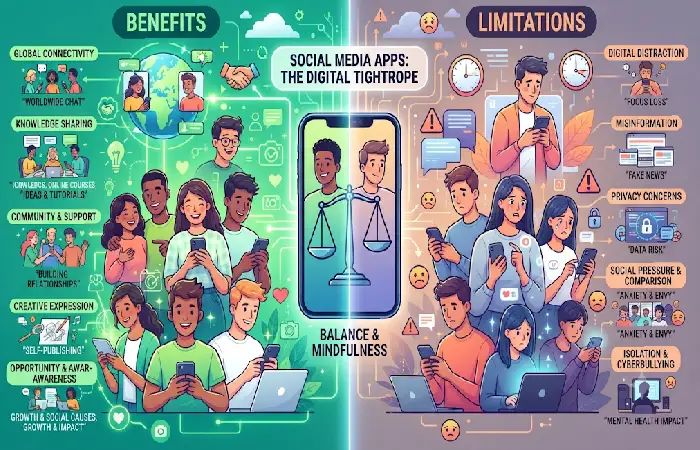
Social Media applications have revolutionized the way in which individuals interact, learn, work and do their business. Facebook, Instagram, What’s App, TikTok, LinkedIn, YouTube, Telegram, etc. have their billions of users across the globe and make it possible to communicate and share content and information instantly.
These applications provide huge benefits for individuals and organizations; however, they may also cause significant problems and concerns in relation to privacy and security, misinformation and digital health.
By recognizing the pros and cons of social media, it will allow the user to access the application and decide how they want to use it and also deal with their online identity.
Benefits
- Global Connectivity
Connect to people around the world anytime.
- Information Sharing
Current news and updates.
- Business Marketing
Low cost customer acquisition.
- Learning Opportunities
School communities and resources.
- Personal Branding
Establish a solid online profile and credibility.
Limitations
- Privacy Concerns
Collection of user data.
- Misinformation
There is also the risk of falsehood traveling quickly.
- Screen Addiction
Can be too time consuming.
- Cyberbullying
Even today, there are problems of online abuse.
- Algorithm Dependence
Visibility is often determined by what the platform algorithms favor.
Social Media Privacy and Security
With social media apps embedded in our daily lives, privacy and security issues have accelerated as a serious concern to users, business and platform enablers/hosts alike. Every day billions of individuals worldwide post personal details and electronic content (e.g. pictures, videos etc.) and all details of their communication, locations, interactions on social media sites. But the functional, inter-personal benefits of social media also imply the possibility of data privacy, security, online fraud and theft.
Understanding the privacy and security risks related to social media is important for users in order to enhance the protection of sensitive personal information, preserving their online identity, and avoiding cyber attack.
Common Risks
| Risk | Description |
| Data Breaches | Unauthorized data access |
| Identity Theft | Stolen account information |
| Phishing | Fake login attempts |
| Malware Links | Harmful downloads |
| Social Engineering | Manipulative attacks |
Security Best Practices
Enable Two-Factor Authentication
Adds an extra layer of account protection.
Use Strong Passwords
Avoid password reuse across platforms.
Review Privacy Settings
Control who can see your content.
Avoid Suspicious Links
Verify before clicking.
Update Apps Regularly
Security patches reduce vulnerabilities.
How to Choose a Social Media App
Weighing up the means in which you intend to use that particular social media app is vital in choosing the right one; knowing your goals and interests for using the application can mean an easier route to finding the right application for you.
Define Your Purpose
Begin by asking yourself why you want to use a social media application. For staying in touch with friends and relatives sites such as Facebook or WhatsApp might be appropriate. For networking and finding work LinkedIn could be more appropriate.
Consider Content Preferences
All four app has some type of content. Instagram and Pinterest are mainly for pictures, Youtube for long form videos and TikTok for short form videos. Select the one where your nostalgic/aesthetic content is there.
Evaluate Privacy and Security
Examine the privacy options, security measures and policies of the application. Privacy settings, account controls, and secure privacy options help ensure data security.
Check Audience and Community
Consider where those in your target market (friends, colleagues, clients, prospects) congregate. Visit a site that provides vibrant targeted communities for a more fulfilling experience.
Look at Features and Usability
Compare other features like messaging, live streaming, groups, content creation and business features. Pick an app that is user friendly and has the features that you need.
The Future of Social Media Apps
Social media continues evolving rapidly.
Major Trends for 2026 and Beyond
Artificial Intelligence
AI-generated content and smarter recommendations.
Augmented Reality
Immersive social experiences.
Social Commerce
Direct shopping within apps.
Creator Economy Expansion
More monetization opportunities.
Decentralized Social Networks
Greater user control and data ownership.
Enhanced Privacy Controls
Stronger regulations and transparency.
Future Technology Comparison
| Technology | Impact |
| AI Assistants | Content creation |
| AR Filters | Immersive engagement |
| VR Social Spaces | Virtual interaction |
| Blockchain Identity | Data ownership |
| Social Commerce | Integrated shopping |
Frequently Asked Questions About Social Media Apps
What do we mean by social media applications?
Social media apps are an online service that enables users to interact with each other and share info, images and video.
What is the most used social media app?
Facebook, Instagram, WhatsApp, You Tube and TikTok are still the most used social medias globally.
Are You Using Social Media Apps?
The majority of social media apps are free, although many have premium capabilities and subscriptions.
What social media application is suitable for commercial use?
How many of these do you use for business marketing/professional contacts approximately? LinkedIn, Facebook, Instagram, YouTube.
Are social media application safe?
Can be secure if users enable the security features, select strong passwords and adopt privacy best practices.
What is the revenue model of most social media apps?
The majority of them earn money with advertising, subscription, social commerce, cross selling, etc.
Conclusion
Social media apps are now vital channels for everything from connecting and sharing to earning business opportunities. Whether it’s Facebook, Instagram, LinkedIn, TikTok or Telegram you‘ll find a platform built for a specific community, use case and interaction type.
Knowing how these apps function and their potential and shortcomings enables both users and organizations to exploit their benefits and avoid pitfalls. As AI, augmented reality, social commerce and creator tools develop, it’s evident that social media apps will be the focus of the online world for many years to come.