
 Kashifa Jafar
Technology Writer & Contributor
Kashifa Jafar is a technology writer and contributor at FutureTechExpert with 4+ years of experience in technology writing and content creation.
Read Full Bio of Author →
Kashifa Jafar
Technology Writer & Contributor
Kashifa Jafar is a technology writer and contributor at FutureTechExpert with 4+ years of experience in technology writing and content creation.
Read Full Bio of Author →
 Sameena Begum
Health, Technology & Digital Content Reviewer
Sameena reviews selected health, wellness, technology, and digital content for clarity, factual presentation, and reader usefulness.
Read Full Bio of Reviewer →
Sameena Begum
Health, Technology & Digital Content Reviewer
Sameena reviews selected health, wellness, technology, and digital content for clarity, factual presentation, and reader usefulness.
Read Full Bio of Reviewer →
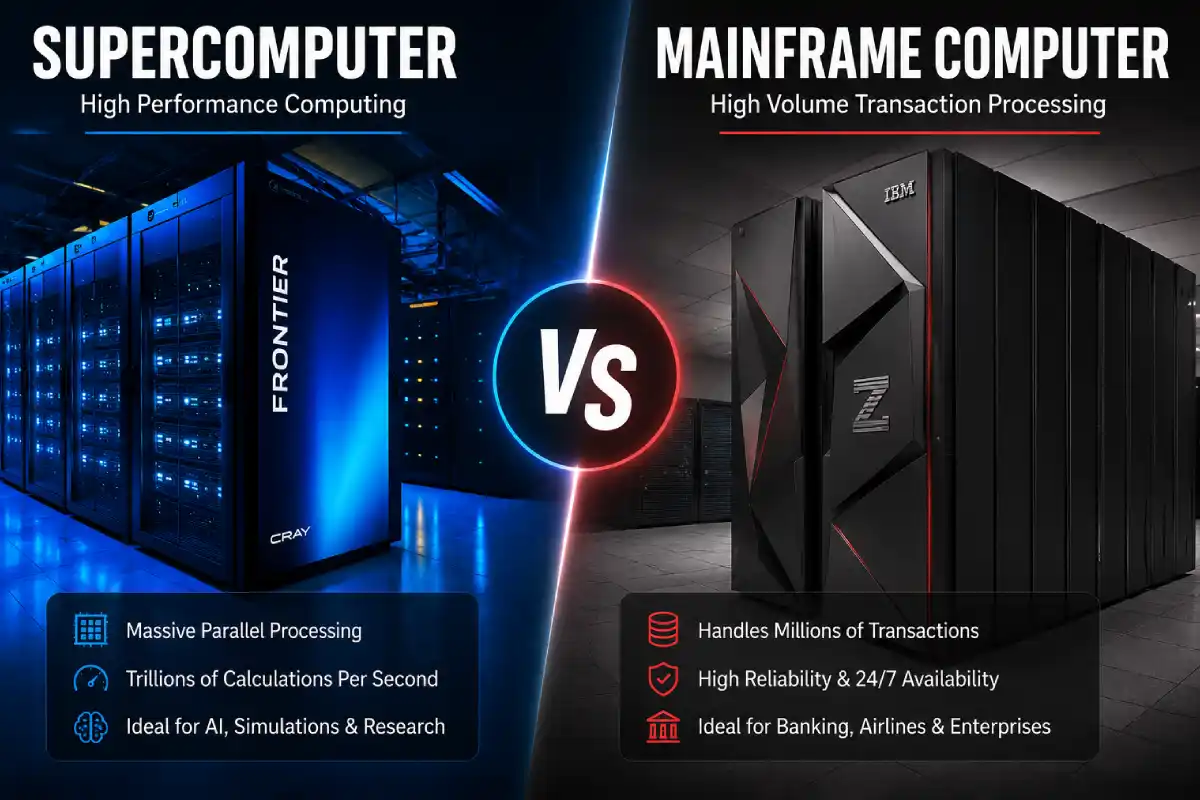
Today’s organisations generate huge data flows by the second, although not all the high-speed computers are destined to work for the same tasks. The knowledge of the Supercomputer vs Mainframe Computer comparison benefits businesses, researches or IT technicians selecting the appropriate technology.
Despite the fact that both pieces of equipment are immensely powerful, they bring to the table very different issues: mainly they deal with enormous mathematical calculations and huge number of business operations.
Supercomputers and mainframes are only two categories in the broader world of types of computers, each designed for different workloads and industries.
In this guide, you‘re going to learn about how these systems are different, where they are used and which one is stronger according to your workload.
 This article is part of
Computers Resources
Supercomputer vs Mainframe Comparison (2026)
| Feature | Supercomputer | Mainframe Computer |
| Primary Purpose | Scientific calculations | Business transaction processing |
| Processing Style | Parallel computing | High-volume concurrent processing |
| Speed | Measured in FLOPS | Measured in TPS (Transactions Per Second) |
| Best For | Simulations, AI, Weather | Banking, Airlines, Healthcare |
| Reliability | High | Extremely High (99.999% uptime) |
| Number of Users | Few specialized users | Millions simultaneously |
| Cost | Millions to hundreds of millions USD | Millions of USD |
| Resource | IBM, TOP500 | IBM Z Systems |
Table of Contents
What Is a Supercomputer?
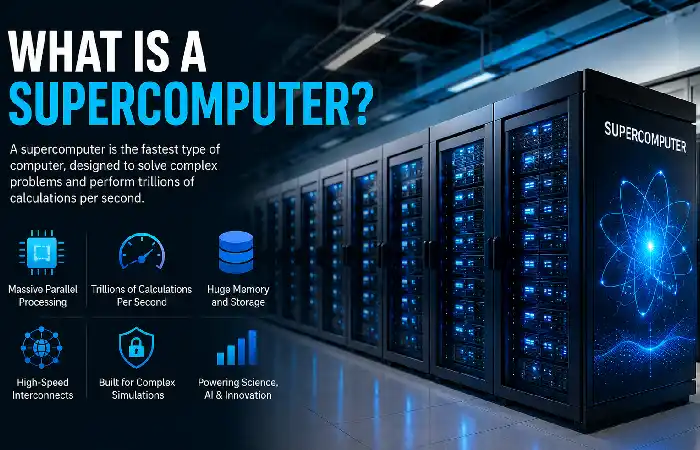
It has been determined that a supercomputer is the fastest of all the computers. It is precisely designed such that it can execute the most intensive calculations at very high speeds. As opposed to a media centre or a personal computer that executes mostly general, day-to-day application, supercomputers execute a problem at the speed that thousands to millions of processing cores working in parallel can solve in a matter of day.
The highest-powered supercomputers are measured in FLOPS (FLoating Point Operations Per Second). This is a measurement of how many calculations (mathematical functions) they can execute in one second. In 2026 supercomputers hit exascale computing. This is equal to more than 101 calculations per second.
Key Features of a Supercomputer
- Massive parallel processing using thousands of CPUs and GPUs
- Extremely high computational speed measured in FLOPS
- Large memory and storage capacity for handling huge datasets
- Advanced cooling systems to manage heat generated by intensive workloads
- High-speed networking for fast communication between processing nodes
- Designed for continuous, high-performance operation
Common Applications of Supercomputers
Supercomputers are used in industries where massive computational power is required, including:
- Artificial Intelligence and machine learning model training
- Weather forecasting and climate change simulations
- Drug discovery and medical research
- Space exploration and astrophysics
- Nuclear and defense simulations
- Genomics and DNA sequencing
- Engineering and aerospace design
- Financial risk modeling and large-scale data analysis
Unlike personal computers (PCs) that are built for individual users, supercomputers and mainframes are engineered to support enterprise-scale computing.
What Is a Mainframe?
Mainframe is a large capacity, high-end processing system which can process millions of transactions reliably, efficiently and securely for companies that run mission critical applications. Unlike supercomputers which are used to perform complex mathematical calculations at the fastest possible rate, mainframes are built to provide very large data sets, support thousands of concurrent users and offer virtually 100% up time.
Mainframes power banking, airline, insurance, government (local and national), hospitals, and big retail networks; because they can process enormous volumes of data, reliably. Built for availability, growth, security, integrity of data, they are the backbone of many a business’ IT system.
Key Features of a Mainframe
- Processes millions of transactions per day with exceptional reliability
- Supports thousands of simultaneous users and applications
- Delivers near 99.999% uptime for mission-critical operations
- Advanced security features for protecting sensitive business data
- Large memory and storage capacity for enterprise databases
- Highly scalable to meet growing business demands
- Supports virtualization, cloud integration, and AI-powered workloads
Common Applications of Mainframes
Mainframes are essential for organizations that require continuous processing of large-scale business operations, including:
- Banking and financial transaction processing
- Airline reservation and ticketing systems
- Government tax and public service databases
- Healthcare patient record management
- Insurance claims processing
- Retail inventory and payment systems
- Enterprise Resource Planning (ERP) applications
- Large-scale payroll and accounting systems
If you’re deciding between everyday computing devices, our desktop vs laptop comparison explains which option best suits home, office, and professional use.
Key Differences
Even though both these types of computers can be classified among the most powerful computing systems, there are whole range of differences between the supercomputer and the mainframe computer. The supercomputer is used for high speed scientific and engineering calculations. The mainframe handles huge number of business transactions at great levels of security and dependability.
| Feature | Supercomputer | Mainframe Computer |
| Primary Purpose | Performs complex scientific calculations and simulations | Processes high-volume business transactions and enterprise workloads |
| Performance Metric | Measured in FLOPS (Floating Point Operations Per Second) | Measured in Transactions Per Second (TPS) and I/O throughput |
| Processing Method | Massive parallel processing using thousands of CPUs and GPUs | Concurrent processing for thousands of users and applications |
| Main Focus | Maximum computational speed | Maximum reliability, availability, and scalability |
| Typical Users | Scientists, researchers, engineers, AI developers | Banks, airlines, governments, healthcare providers, retailers |
| Concurrent Users | Limited number of specialized users | Thousands to millions of users simultaneously |
| Workloads | AI training, climate modeling, simulations, scientific research | Banking, payroll, ERP, airline reservations, financial transactions |
| Reliability | High, but occasional maintenance is acceptable | Extremely high with up to 99.999% uptime |
| Security | Strong security for research environments | Enterprise-grade security for sensitive financial and customer data |
| Examples | Frontier, Aurora, El Capitan, Fugaku | IBM z17, IBM LinuxONE 5, Unisys ClearPath Forward |
Unlike embedded computers, which are designed for dedicated tasks inside devices, supercomputers and mainframes handle massive computational and business workloads.
Performance Comparison
When comparing a supercomputer and mainframe, the ranges of tasks they are capable of are very far apart. A supercomputer is designed to handle scientific and AI computation at an unprecedented rate while a mainframe computer can handle billions of transactions at a time, at an exceptional level of reliability. The “best” performer is dependent on the task at hand.
Supercomputer Performance
Supercomputers are optimized for high-performance computing (HPC) and consist of many thousands or millions of CPU and GPU cores communicating in parallel. Their processing power is measured in FLOPS (Floating Point Operations Per Second), the most recently developed exascale (1018) system capable of a billion billion of calculations per second.
These systems are ideal for:
- Artificial intelligence and machine learning model training
- Climate and weather forecasting
- Space exploration and astrophysics
- Drug discovery and genomic research
- Engineering simulations and computational physics
Mainframe Performance
Mainframes remain optimized for handling enterprise activities and not for exploiting the full potential of raw speed. They do not particularly excel at number crunching but are extremely good at designing a computer system that can handle a huge load of business data whilst supporting several thousands of users. They are normally measured in Transactions Per Second (TPS), input/output (I/O) throughput, availability and response time.
Mainframes remain commonly used for:
- Banking and financial transactions
- Airline reservation systems
- Healthcare records management
- Government databases
- Retail payment processing
- Enterprise Resource Planning (ERP)
Real-World Applications
Supercomputer Industries
- Space agencies
- Universities
- National laboratories
- Artificial Intelligence companies
- Pharmaceutical research
- Climate science
Example Workloads
- Predicting hurricanes
- Genome sequencing
- Large Language Model training
- Earthquake simulation
Mainframe Industries
- Banking
- Stock exchanges
- Airlines
- Insurance
- Government agencies
- Healthcare
Example Workloads
- ATM transactions
- Airline ticket booking
- Tax processing
- Medical record systems
- Credit card payments
Understanding the applications of different types of computers helps explain why organizations choose supercomputers for simulations and mainframes for transaction processing.
Which Is More Powerful?
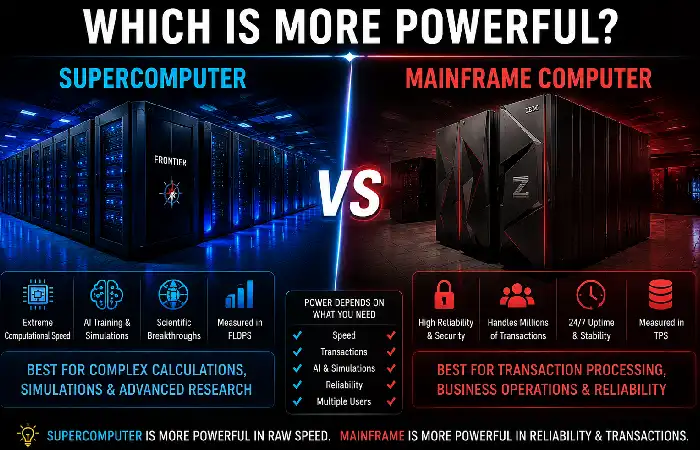
This question can have many answers as “power” will be task dependant.
| If You Need… | Choose |
| Scientific simulations | Supercomputer |
| AI model training | Supercomputer |
| Weather prediction | Supercomputer |
| Banking software | Mainframe |
| Airline reservations | Mainframe |
| Enterprise databases | Mainframe |
| Millions of secure users | Mainframe |
If were purely into number crunching, supercomputers are a clear choice. However, when its transactions processing, uptime, security and business focus, nothing beats a mainframe.
Advances in AI, quantum computing, and high-performance systems are shaping the future of computers, including next-generation supercomputers.
Frequently Asked Questions
Is the super-fast enough than a mainframe?
Yes, mainframes remain more suited for high-volume transaction processing than supercomputers, which remain best suited for scientific calculations.
Reasons for using mainframes in banks?
Mainframes remain used by several banks because of their stability, security and ability to manage millions of financial transactions with very little time offline.
Is a supercomputer the replacement for mainframes?
No. While a supercomputer may be faster for such computation, it is not as well-suited for enterprise transaction processing or ongoing business activities.
Are mainframes in use in 2026?
Yes. Large scale computers continue to vital in banks, healthcare, insurance, Govt and aeronautics. They have a synergy with cloud and AI.
Which one is more costly?
Both are expensive systems. Pricing is highly variable depending on configuration, but high-end supercomputers tend to cost more to maintain in terms of hardware, power and cooling requirements.
Conclusion
In reality, the Supercomputer versus Mainframe issue is one of selecting the right machine for the job at hand. Supercomputers are valuable for production and research in scientific, computational, and artificial intelligence applications, bringing states of the art parallel processing power. Mainframes remain best suited for heavy client-side application processing, transaction processing, and large enterprise computing. Having a deep understanding of what each is capable of means that organizations can strive toward purchasing the most significant IT Hardware for their infrastructure and a future-oriented design.
Kashifa Jafar is a technology writer and contributor at FutureTechExpert with 4+ years of experience in technology writing and content creation.
Read Full Bio of Author →Sameena reviews selected health, wellness, technology, and digital content for clarity, factual presentation, and reader usefulness.
Read Full Bio of Reviewer →