

Last Updated: June 22, 2026
The speed of consumer technology development is moving faster than ever before and the Emerging Gadgets Trends are re-defining the way we do our jobs, communicate, keep healthy, and entertain ourselves. By 2026 gadgets will no longer be standalone. They will be intelligent ecosystems powered by AI, edge computing, wearable sensors and distributed connectivity.
According to industry predictions, AI-powered devices, intelligent wearables, connected homes and intelligent personal assistance are the leads of growth for consumer electronics around the globe. Consumer electronic industry is becoming more and more personalised and autonomous, and consumers are interested in time saving, health enhancement, and automation devices.
Whether you are a tech fiend, investor or consumer, these trends can be your ticket to staying ahead of the game.
Table of Contents
What Are the Biggest Gadget Trends This Year?
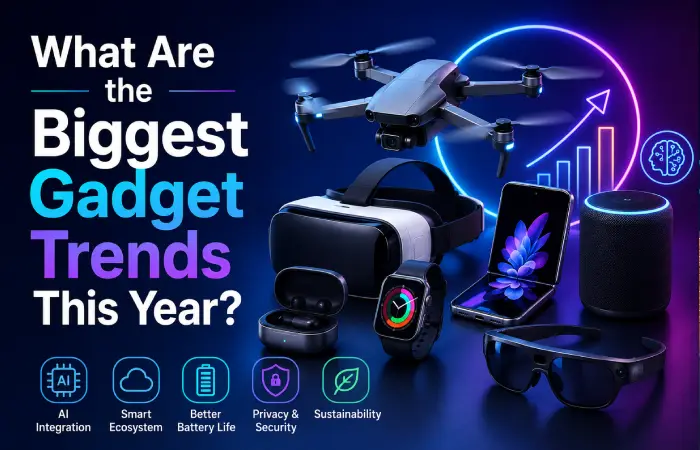
One of the fastest periods of innovation has been seen in consumer technology, and manufacturers are concentrating on more intelligent, more networked and extremely customised products.
In 2026, consumer products are evolving from having the sole purpose of communication and entertainment to become intelligent helpers of the user. They range from productivity, health, home security and everyday convenience enhancement. Trends such as artifical intelligence, smarter sensors, faster network connections and green computing is steering the new age of consumer electronics.
Top Emerging Gadget Categories
| Trend | Description | Growth Potential | Resource |
| AI-Powered Devices | Smartphones, laptops, and accessories with on-device AI | Very High | https://www.apple.com/apple-intelligence/ |
| Smart Wearables | Smartwatches, smart rings, health trackers, smart glasses | Very High | https://ouraring.com/ |
| Smart Home Ecosystems | Connected security, lighting, and automation devices | High | https://csa-iot.org/all-solutions/matter/ |
| AI Smart Glasses | Hands-free computing and real-time assistance | High | https://blog.google/products/android/android-xr/ |
| Personal Health Technology | Continuous biometric monitoring and wellness tracking | High | https://www.whoop.com/ |
| Home Robotics | Cleaning, security, and mobility-assistance robots | Medium-High | https://www.irobot.com/ |
Based on consumer-electronics projections, smart-wearable, AI-enabled, and smart-home gadgets will continue to be some of the fastest-growing sectors in 2026.
Key Takeaway
The greatest is simply this: gadgets are changing, becoming more clever, self-sufficient and able to think for themselves.
Technologies Driving Innovation in Consumer Devices
A number of underlying technologies are rapidly driving gadget innovation.
- On-Device Artificial Intelligence
Nowaday devices locally process, not send data to cloud.
Benefits include:
- Faster performance
- Improved privacy
- Reduced latency
- Better battery efficiency
Examples include:
- AI-powered smartphone photography
- Voice assistants
- Real-time translation
- Intelligent productivity tools
- Edge Computing
Edge computing enables separation of merely huge powers from local processing.
This enables:
- Faster responses
- Lower bandwidth usage
- Better security
- Advanced Sensors
New biometric sensors are enabling:
- Sleep analysis
- Heart health monitoring
- Stress detection
- Cognitive performance tracking
- Matter Smart Home Standard
The Matter standard is making advances towards greater interoperability between smart home devices. This means less Ecosystem fragmentation and easier installation for consumers.
How Smart Gadgets Are Changing Daily Life
Every average day the consumer will reach out and interact with dozens of connected devices.
Daily Impact of Smart Gadgets
| Activity | Traditional Method | Smart Gadget Enhancement |
| Fitness Tracking | Manual logging | Automatic health monitoring |
| Home Security | Basic alarms | AI-powered threat detection |
| Work Productivity | Multiple apps | Context-aware AI assistants |
| Communication | Typing messages | Voice and AI-generated responses |
| Entertainment | Manual content search | Personalized recommendations |
Real-World Examples
Smart Rings
Modern smart rings track:
- Sleep quality
- Heart rate variability
- Recovery metrics
- Activity levels
Smart Glasses
AI-powered smart glasses offer:
- Navigation assistance
- Language translation
- Hands-free information access
- Voice-controlled productivity
Connected Homes
Smart homes can now automatically:
- Adjust lighting
- Control temperature
- Manage energy consumption
- Enhance security
The result is a more efficient and personalized daily experience.
Investment Opportunities in Emerging Gadget Markets
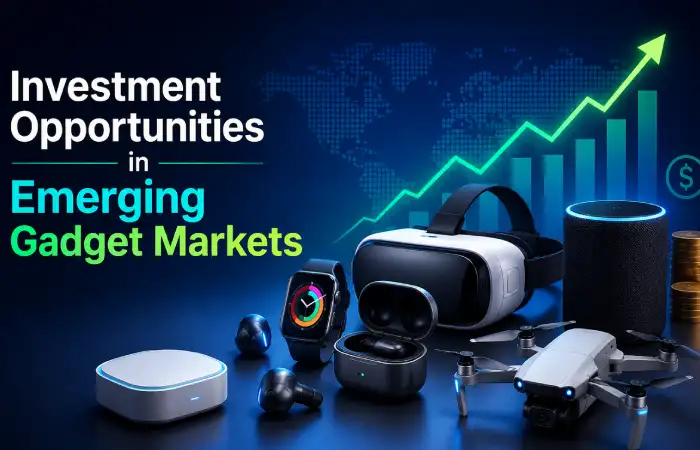
Investors are now starting to focus on hardware companies that offer AI alongside software subscriptions within networked ecosystems.
High-Growth Gadget Markets
| Market Segment | Opportunity Level | Growth Drivers |
| AI Wearables | Very High | Health monitoring and AI coaching |
| Smart Home Devices | High | Connected living adoption |
| Smart Glasses | High | Augmented reality and AI integration |
| Consumer Robotics | Medium-High | Automation and aging populations |
| Health Technology | High | Preventive healthcare demand |
What Investors Should Watch
Recurring Revenue Models
Companies increasingly generate revenue through:
- Subscriptions
- Premium services
- AI features
- Cloud integrations
Ecosystem Strength
A common feature of companies with integrated ecospheres is increased customer loyalty.
Examples include:
- Smartphones
- Wearables
- Smart home products
- AI assistants
Risk Factors
Investors should also consider:
- Regulatory changes
- Hardware margins
- Market saturation
- Competitive pressure
Diversification is just as important when investing into emerging technologies.
Future Predictions for Smart Technology
The next five years will see even greater upheavals.
Expected Developments by 2030
| Technology | Current Status | Future Outlook |
| AI Assistants | Reactive | Proactive digital companions |
| Smart Glasses | Early adoption | Mainstream computing platform |
| Health Wearables | Fitness-focused | Medical-grade monitoring |
| Home Automation | Rule-based | Fully autonomous systems |
| Robotics | Limited adoption | Household assistants |
Key Predictions
Ambient AI Everywhere
AI will become invisible yet constantly available through:
- Earbuds
- Glasses
- Watches
- Home devices
Screenless Computing
Many interactions may occur through:
- Voice commands
- Augmented reality
- Gesture controls
Personalized Health Technology
Devices in the future may be able to track health conditions on an ongoing basis, giving early warnings when anomalies occur before symptoms.
Gadget Trend Comparison: 2026 Market Leaders
| Category | Primary Benefit | Adoption Rate | Long-Term Potential |
| Smart Watches | Health tracking | High | High |
| Smart Rings | Recovery insights | Growing Fast | High |
| Smart Glasses | Hands-free AI | Emerging | Very High |
| Smart Home Devices | Automation | High | High |
| Home Robotics | Convenience | Moderate | High |
FAQ
What are the biggest emerging gadget trends in 2026?
Some of the major trends are the following: Devices, smart wearables, connected homes, health technology, smart glasses, and so on that are also powered by AI.
Are smart glasses the future of consumer technology?
According to many experts smart glasses may turn into a mainstream computing platform as machine learning advances to become state-of-the-art.
Which gadget sector has the strongest investment potential?
Today, the highest growth opportunities currently lie in the fields of AI wearables, health technology and smart home ecosystems.
How is AI changing consumer gadgets?
Helping devices to understand context, automate tasks, enhance personalization, and provide more proactive help.
Are smart homes worth investing in?
Existingand future homes alike can benefit from smarter homes that offer increasing levels of convenience, security, energy efficiency in turn, offering justifications for adoption by consumers and investment by firm.
Conclusion
The hot new device trends for 2026, however, are all about intelligence, connectivity, and personalization. AI-enabled hardware, body-borne wearables, intelligent homes, and advanced computing platforms will revolutionise our relationship with devices. As the gap between capabilities and consumer experience narrows and continues to evolve, those who get it now will be best poised to capitalize on the evolution in the next decade.
Kee p on top of developments in AI, wearables, robotics and connected ecosystems and you can stay ahead of one of the fastest developing industries in the world.