

Last Updated: June 22, 2026
The consumer electronics industry is witnessing a new phenomenon as artificial intelligence is also catching up with technology. AI-Powered Gadgets are at the forefront and are entirely changing the way modern day machines are experienced. Devices such as smart glasses & AI assistants, wearables and home automation applications are making gadgets more customized, smarter and practical than before.
By 2026, consumers will not be purchasing devices based on specs but based on automation, intelligent technology and enhanced productivity. A recent report and a major showcase of current technology have revealed that AI has emerged as one of the biggest trends in consumer electronics.
This guide examines the newest AI-enabled products, the advantages and disadvantages, what the future of AI holds and what to look for when considering purchasing an AI-enabled product.
Table of Contents
How AI Is Revolutionizing Gadgets
Artificial intelligence has moved on from simple voice computing now a days applications can contextualize the situation, learn about you, recognize visual information and suggest accordingly.
Some major AI capabilities now found in consumer devices include:
- Real-time language translation
- Predictive health monitoring
- Context-aware voice assistants
- Personalized recommendations
- Intelligent automation
- Computer vision and object recognition
- On-device AI processing for improved privacy
One of the most significant trends for 2016 is the adoption of on-device AI, enabling devices to process information locally rather than having to send data to a third-party cloud architecture. This improves latency and is overall more secure.
AI Gadget Evolution Timeline
| Generation | Primary Function | AI Capability |
| Smart Devices 1.0 | Basic Automation | Rule-Based Actions |
| Smart Devices 2.0 | Voice Control | NLP Assistants |
| AI Gadgets 3.0 | Personalized Assistance | Machine Learning |
| AI Gadgets 4.0 (2026) | Context Awareness | Multimodal AI |
| Future Devices | Autonomous Agents | Predictive Intelligence |
Best AI-Powered Devices Available Today
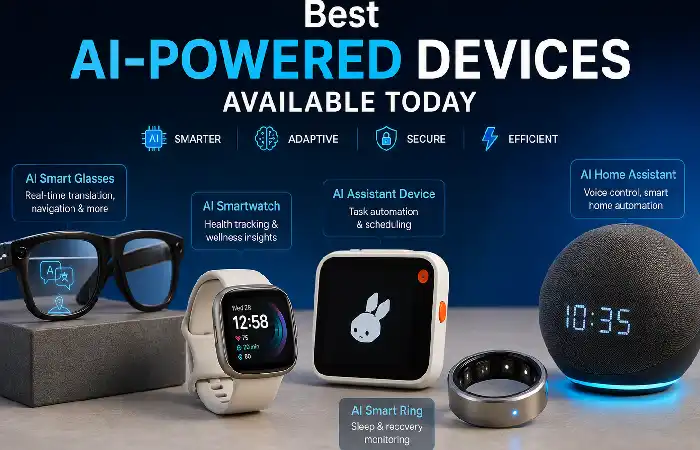
A selection of AI gadgets has become usable consumer product.
AI-Powered Gadget Comparison Table (2026)
| Device Category | Example Product | AI Features | Best For | Official Resource |
| Smart Glasses | Ray-Ban Meta Smart Glasses | Translation, navigation, object recognition | Everyday productivity | https://www.meta.com |
| Smart Ring | Samsung Galaxy Ring | Sleep analysis, health insights | Health tracking | https://www.samsung.com |
| Smartwatch | Fitbit Sense 3 | AI wellness recommendations | Fitness monitoring | https://www.fitbit.com |
| AI Assistant Device | Rabbit R2 | Task automation, scheduling | Productivity | https://www.rabbit.tech |
| AI Pin | Humane AI Pin 2 | Voice-first interaction | Hands-free computing | https://www.humane.com |
| AI Home Robot | Home Assistant Robots | Elderly care, reminders | Smart homes | Manufacturer-specific |
Numerous devices integrate speech and vision, as well as context awareness, to make their use more natural. Unsurprisingly, the number of smart glasses is growing rapidly, and is expected to be one of the fastest expanding AI hardware categories in 2026.
Benefits of Artificial Intelligence in Consumer Tech
Products based on AI technology provide many benefits compared to conventional electronic devices.
- Personalized User Experiences
The artificial intelligence is able to learn from its user and adjust its features according to the habits of the person. The smartwatches are able to suggest a training, while the assistant will be able to set reminders to the user in advance.
- Improved Productivity
AI-powered devices automate repetitive tasks such as:
- Meeting summaries
- Email organization
- Appointment scheduling
- Smart notifications
Products such as Rabbit R2 and AI note-taking devices are targeted to help lessen digital workload.
- Better Health Monitoring
Modern wearables continuously track:
- Heart rate
- Sleep quality
- Recovery metrics
- Stress levels
- Activity patterns
AI does not do just display numbers, there is more to it than that, what AI does is transform the data into actionable suggestions.
- Enhanced Accessibility
AI enables:
- Real-time captioning
- Speech-to-text conversion
- Object recognition
- Language translation
This makes technology more accessible to a larger audience.
- Smarter Home Automation
AI-powered smart homes can:
- Predict energy usage
- Optimize lighting
- Improve security monitoring
- Automate household routines
Ongoing industry and government initiatives across the globe are enhancing AI infusion into consumer appliance vehicles.
Challenges and Risks of AI Gadgets
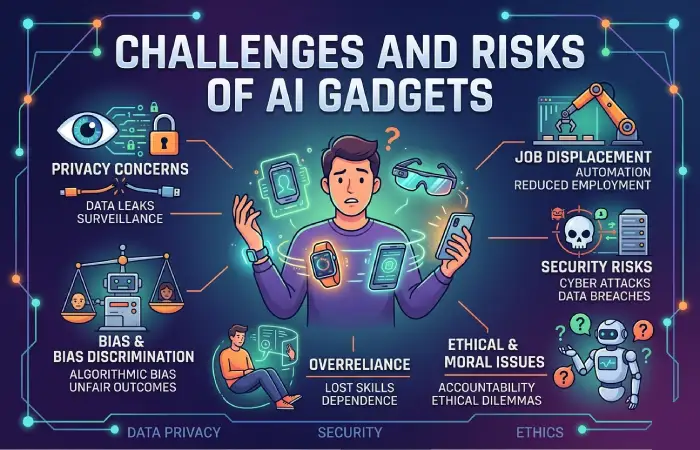
In addition to the impressive benefits of the AI gadgets, customers should be cautious about the weaknesses.
Privacy Concerns
Many AI devices continuously collect data through:
- Cameras
- Microphones
- Sensors
- Usage patterns
They should understand privacy policies fully before using AI-based products.
Data Security
Connected devices may still be at risk to cyber-attacks if a manufacturer does not apply adequate security measures.
Battery Consumption
Much more advanced processing of AI could potentially take a huge toll on the battery life, particularly to wearable devices.
Overdependence on Automation
Overdependence on AI suggestions can diminish in some contexts the ability to think and make decisions critically.
Cost Barriers
Cost of a High-end machine due to AI-enabled machine is higher, because they contain high-end processor.
AI-Powered Gadgets Market Growth (2025–2026)
| Segment | 2025 Market Size | 2026 Market Size |
| Smartphones & Wearables | $86.21 Billion | $113.19 Billion |
| Growth Rate | – | 31.3% |
Source: Industry market research referenced in 2026 technology reports.
Future Innovations in AI Technology
The soon-to-be-released next generation of digital gadgets, which will be powered by the innovative AI technology, is likely to be far more sophisticated.
AI Smart Glasses
Researchers and manufacturers are developing glasses capable of:
- Continuous contextual awareness
- Live web search assistance
- Real-world object interaction
- Hands-free task completion
Research papers from 2026 indicated that AI glasses could emerge as next platform to run computing.
AI Home Robots
Future robots may provide:
- Elderly care support
- Household management
- Security monitoring
- Conversational companionship
Autonomous AI Agents
Any new AI devices will more and more be left to accomplish tasks for themselves rather than just taking orders.
AI-Powered XR and AR Devices
New AI chips designed specifically for smart glasses and XR headsets are enabling:
- Faster processing
- Better battery life
- Local AI execution
These developments are likely to encourage wider uptake of wearable artificial intelligence.
Frequently Asked Questions
What are AI-powered gadgets?
AI machine gadgets are machines that use artificial intelligence to learn user behavior, control automaton and help them intelligent.
Are AI gadgets worth buying in 2026?
Where benefits or improved productivity, health monitoring, and convenience are attractive features for users, most AI gadgets offer utilitarian value rather than just novelty.
Which AI gadget category is growing fastest?
Just blink, a on smart glasses, AI wearables, and intelligent health devices have been identified as some of the fastest growing categories within consumer technology market.
Are AI gadgets safe?
Most mainstream equipment is generally safe if used correctly. However it is recommended that the user check privacy settings, security updates for this equipment.
Will AI gadgets replace smartphones?
According to industry insiders, AI wearables and smart glasses are “becoming” the companions and, perhaps, the replacements for the smartphone.
Conclusion
The age of AI-Powered Devices is truly here. From smart wearables and AI helpers to smart spectacles and autonomous home appliances, artificial intelligence is reinventing consumer devices in ways that would have been absurd even just a couple of years ago.
With AI becoming more personalized, more private, and more capable of running on-device, consumers can expect smarter, faster and more useful devices throughout 2026 and beyond. The earlier you know about these trends, the more you will be able to benefit from the next wave of AI adoption.