
 Kashifa Jafar
Technology Writer & Contributor
Kashifa Jafar is a technology writer and contributor at FutureTechExpert with 4+ years of experience in technology writing and content creation.
Read Full Bio of Author →
Kashifa Jafar
Technology Writer & Contributor
Kashifa Jafar is a technology writer and contributor at FutureTechExpert with 4+ years of experience in technology writing and content creation.
Read Full Bio of Author →
 Sameena Begum
Health, Technology & Digital Content Reviewer
Sameena reviews selected health, wellness, technology, and digital content for clarity, factual presentation, and reader usefulness.
Read Full Bio of Reviewer →
Sameena Begum
Health, Technology & Digital Content Reviewer
Sameena reviews selected health, wellness, technology, and digital content for clarity, factual presentation, and reader usefulness.
Read Full Bio of Reviewer →
Smart lighting installation will be one of the simplest and most efficient ways to improve a modern home. It is an effective improvement whether you are investing in a smart home or a retrofit.
Modern smart lighting systems are available with smartphone apps, voice controls, scheduling, occupancy detection and via any other of the available home automation controls. And with properly implemented Matter enabled devices hitting the market in 2026, installation and integration is straightforward.
 This article is part of
Smart Home Gadgets Resources
Table of Contents
What Is Smart Lighting Installation?
Smart lighting installation comprises the installation and configuration of connected lighting fixtures and light bulbs, which will then be remotely controllable and can be automated or integrated into a smart home system.
Different from a ordinary light system, where switch lighting is used and handled manually by the switch, smart lighting also can be controlled through switch by the app, voice, scheduled timer, sensor or some kind of automation system.
Smart lighting can be achieved using the following components smart bulb, smart switch/dimmer, motion/occupancy sensor, and smart hub. These components usually communicate over Wi-Fi, Zigbee, Z-Wave, Bluetooth or Matter allowing you remote access from virtually anywhere.
A typical smart lighting system includes:
- Smart bulbs
- Smart light switches
- Smart dimmers
- Motion sensors
- Occupancy sensors
- Mobile apps
- Voice assistants
- Smart home hubs (optional)
The personalized brightness, schedules, scenes and automation are more easily realized through intelligent systems than conventional lighting system without the need to operate any wall switches.
Before installing smart lights, review our complete smart home installation guide to understand how connected devices work together.
Benefits of Smart Lighting
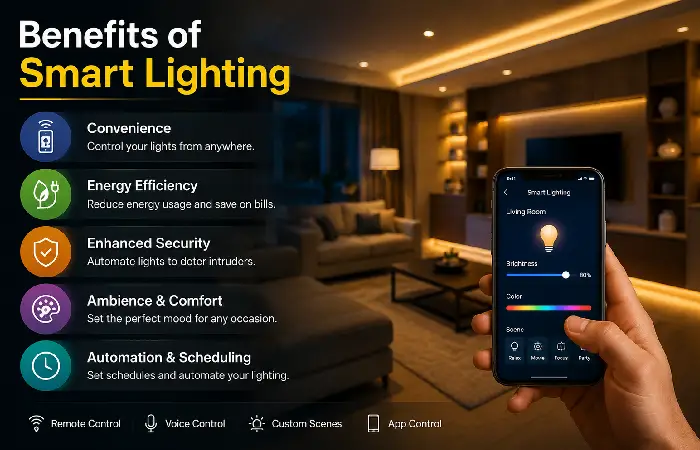
| Benefit | Impact |
| Remote Control | Manage lights from anywhere |
| Energy Savings | Reduce electricity consumption |
| Enhanced Security | Simulate occupancy when away |
| Convenience | Voice and app control |
| Customization | Personalized lighting scenes |
| Improved Comfort | Automated brightness adjustment |
Research and industry sponsored research reveal that advanced lighting controls and smart scheduling can cut wasteful energy down to 10% of use in larger homes.
Smart lighting becomes more powerful when paired with smart home automation systems that can automate schedules and routines.
Smart Bulbs vs. Smart Light Switches
Simply speaking, both smart light bulbs and remote light switches can make your home lighting automated and controllable remotely. The choice of them is based on their functions and your house environment. As their main purpose is different, you may need to know more details to decide what you want to buy according to your house design and your budget.
| Feature | Smart Bulbs | Smart Switches |
| Installation Difficulty | Easy | Moderate |
| Wiring Required | No | Yes |
| Color Control | Excellent | Depends on bulb |
| Works with Existing Fixtures | Yes | Yes |
| Cost for Entire Home | Higher | More economical |
| Best For | Individual rooms | Whole-home automation |
Best Choice
- Use smart bulbs for bedrooms, lamps, and mood lighting.
- Use smart switches for whole-house lighting control.
Many homeowners use a Hybrid of both ways in order to have the most maximum flexibility.
Smart Lighting Controls
Today, we have various control options in new systems.
Smartphone Apps
Apps allow:
- On/off control
- Dimming
- Scheduling
- Energy monitoring
- Scene creation
Smart Home Platforms
Popular platforms include:
- Amazon Alexa
- Google Home
- Apple Home
- Samsung SmartThings
Support of their matter made it adapts more easily to different ecosystems.
Voice-Controlled Smart Lighting
Smart voice controlled lighting: voice activated virtual assistants such as Apple Siri, Amazon Alexa and Google Assistant can also be used to control your lighting. Meaning that instead of having to find a light switch or find and open an app on your phone, you can just speak to control your lighting. For example you could say ‘turn on/off the lights,’ ‘set brightness to’ ‘change lighting to’ ‘set scene’, etc.
Common commands include:
- “Turn off kitchen lights.”
- “Set living room lights to 50%.”
- “Activate movie mode.”
Voice control is particularly useful for:
- Elderly users
- Accessibility improvements
- Hands-free operation
Motion and Occupancy Sensors
Motion sensors Automate the lights in a room with a motion sensor.
Common Locations
- Hallways
- Staircases
- Bathrooms
- Garages
- Closets
Occupancy Sensor Benefits
| Sensor Type | Best Use |
| Motion Sensor | Quick movement detection |
| Occupancy Sensor | Longer room presence monitoring |
The sensors themselves not only minimize the amount of energy wasted but they also make things more convenient.
Smart Lighting Automation
Automation turns lights into proactive responses to every situation.
Popular automations include:
Morning Routine
- Lights gradually brighten at sunrise.
Evening Routine
- Warm lighting activates after sunset.
Vacation Mode
- Lights turn on and off automatically to simulate occupancy.
Entertainment Mode
- Lighting syncs with movies or music.
More sophisticated systems have the capability to learn the user‘s habits and automatically fine-tune the schedule.
A strong network is essential for reliable performance, so follow this smart home Wi‑Fi setup guide before adding multiple smart lighting devices.
Energy Efficiency and Smart Lighting
The technological solution to saving money on electricity. Smart lighting is not only convenient but cuts down electricity bill as well.
Energy Comparison
| Lighting Type | Average Energy Use |
| Incandescent | High |
| CFL | Medium |
| LED | Low |
| Smart LED with Automation | Lowest |
Estimated Savings
| Household Size | Potential Lighting Savings |
| Apartment | 10–20% |
| Small Home | 15–25% |
| Large Home | 20–35% |
Savings come from:
- Scheduling
- Motion activation
- Automatic shutoff
- Dimming controls
For enhanced protection, combine automated lighting with smart camera installation for home monitoring to deter intruders.
How to Plan Smart Lighting for Your Home
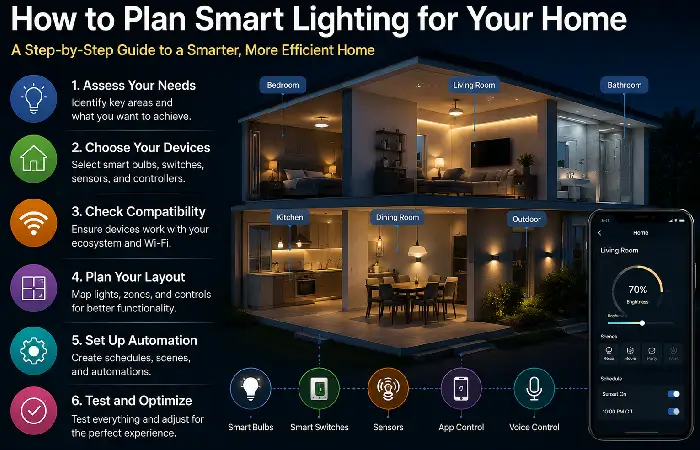
Planning is key once you have decided to go ahead with the installation: it will be a success.
Step 1: Identify Priority Areas
Start with:
- Living room
- Bedrooms
- Entryways
- Kitchen
Step 2: Choose Control Method
Decide whether you’ll use:
- Voice control
- Mobile app
- Smart switches
- Automation routines
Step 3: Check Wi-Fi Coverage
Stable WIFI is essential for Device communication.
Step 4: Select Compatible Products
Look for:
- Matter compatibility
- Alexa support
- Google Home support
- Apple Home support
Step 5: Create Lighting Zones
Examples:
- Upstairs
- Downstairs
- Outdoor lighting
- Entertainment spaces
Energy-efficient homes often integrate lighting controls with smart thermostat installation benefits to optimize comfort and reduce utility costs.
Smart Lighting Installation Tips
Before Installation
Verify electrical compatibility
Check bulb base types
Confirm dimmer support
Update router firmware
During Installation
Label rooms clearly in apps
Test automation rules immediately
Group devices logically
After Installation
Create backup schedules
Enable firmware updates
Review energy reports monthly
Motion-activated lights work especially well alongside smart home security installation solutions for comprehensive home protection.
FAQ
Is it worth having smart lighting?
Yes. Smart lighting provides comfort, remodeling, money saving, as well as living home security.
Do smart lights need a hub?
Not necessarily. There are many current products which connect directly through Wi-Fi or Matter enabled networks.
Can I fit smart lighting or home automation?
Smart bulbs can be more or less DIY, but are usually pretty DIY. Smart switches may require knowledgeable assistance to install.
Have you wondered if smart lighting really saves on electricity bills?
Yes. Automation, dimming, and occupancy sensing that is enabled all cut down on excess energy use.
What is the top smart lighting system available in the year 2026?
Philips Hue is still regarded as the premium alternatives, whereas WiZ and Govee are the value alternatives which is much more affordable.
Conclusion
Lighting is perhaps the easiest upgrade to make for a connected, energy-efficient, user-friendly home. Modern smart lighting includes smart bulbs and switches, motion detectors, and even voice-activated controls to do everything from adjusting the glow of a cozy reading nook to setting the porch lighting to brightening automatically when the dog needs to go outside.
Whether you have a single room or an entire home to automate, correctly building the foundation for your smart lighting by selecting the right devices and a robust Wi-Fi network, as well as creating automations that work with your life is the key to achieving a successful smart lighting automation. With Matter-compatible products and smart home systems improving throughout 2026, setting up your smart lighting system is now more simple, dependable and easier than ever before.
Kashifa Jafar is a technology writer and contributor at FutureTechExpert with 4+ years of experience in technology writing and content creation.
Read Full Bio of Author →Sameena reviews selected health, wellness, technology, and digital content for clarity, factual presentation, and reader usefulness.
Read Full Bio of Reviewer →