

Last Updated: July 28, 2026
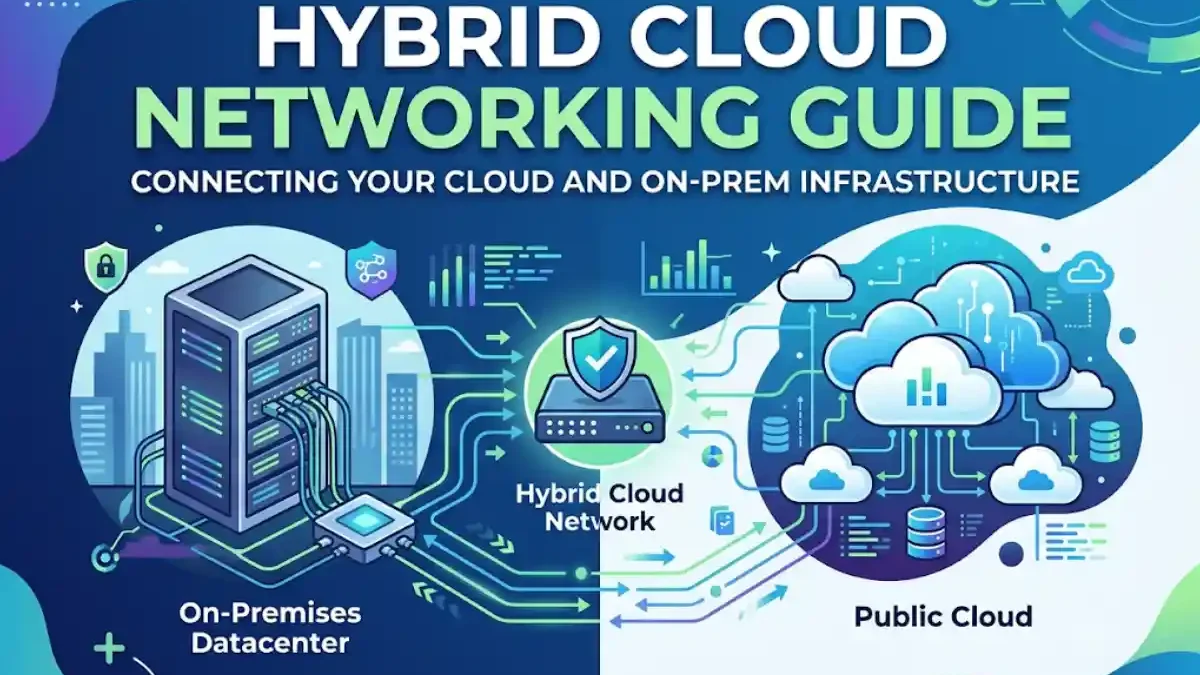
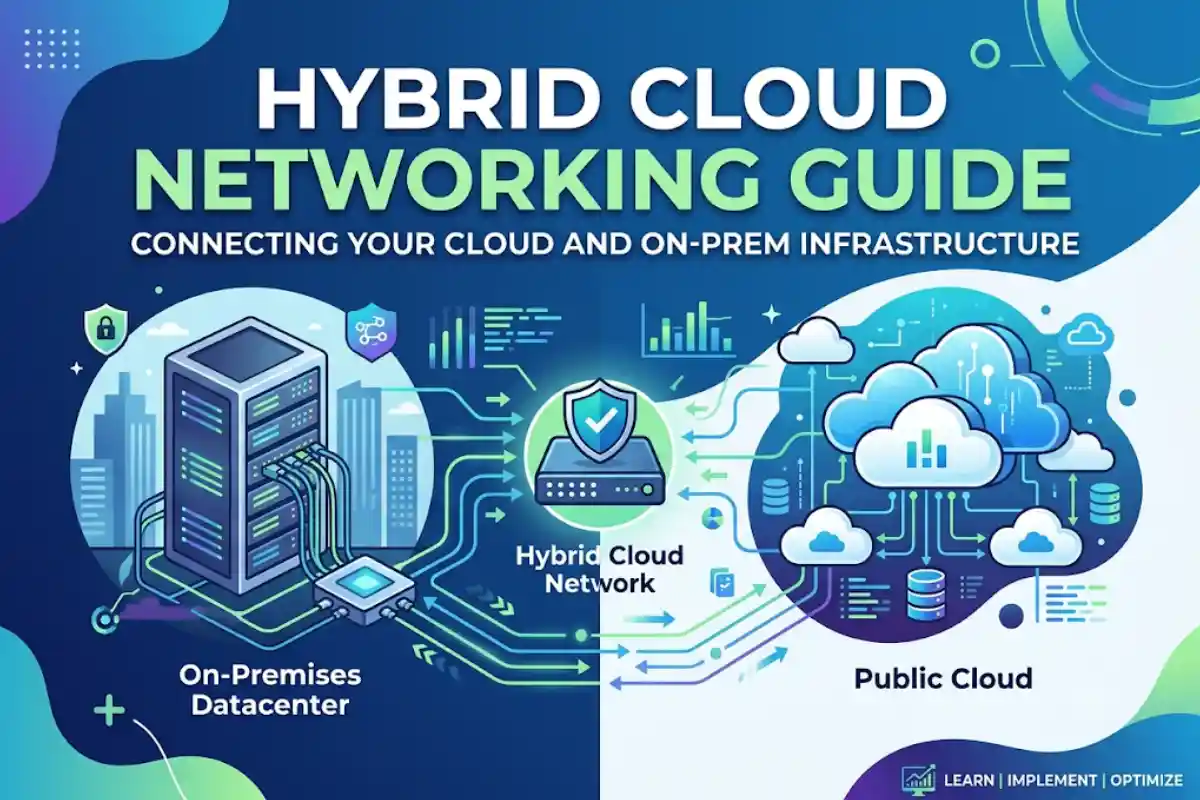
No business uses a single IT environment in 2026. This Hybrid Cloud Networking Guide details how companies bridge on-premises environments to the public cloud and private cloud to build secure, scalable, and economical hybrid networks. This is the business case for starting your first hybrid cloud network or optimizing a current environment.
Several cloud industry reports show that more than 80% of enterprises today run in a hybrid or multi-cloud environment, and that hybrid networking is one of the most critical IT strategies to date.
Table of Contents
What Is Hybrid Cloud?
A hybrid cloud may be defined as ‘comprising two or more different types of cloud infrastructure (private, community or public) that are unique entities but are bound together by standardized or proprietary technology that enables data and application portability’.
A hybrid cloud allows work loads to be spread out over various different platforms, in contrast to the traditional IT model, having all work loads in the same location. Sensitive data and sometimes mission critical applications may stay in a private cloud or data center, whereas web applications, backups or development environments may benefit from the freedom and lower cost of public cloud providers.
How a Hybrid Cloud Works
A hybrid cloud connects different environments using secure networking technologies, such as:
- Virtual Private Networks (VPNs)
- Dedicated cloud connections (e.g., AWS Direct Connect, Azure ExpressRoute)
- Software-Defined Wide Area Networking (SD-WAN)
- APIs and cloud integration services
- Identity and Access Management (IAM)
Allow programs and users to securely access resources no matter where they happen to be located.
Benefits of Hybrid Networking
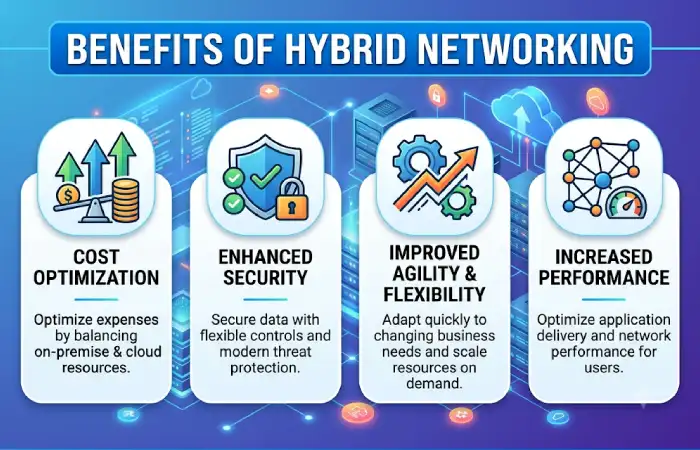
Hybrid networks combine the dependability of an on-premises framework with the agelessness of private and public cloud administration, enabling firms to boost their performance, improve security and cut costs for their newest business requirements.
As the number of businesses deploying the technology continues to grow in 2026, hybrid networking is the preferred choice for creating scalable and resilient IT infrastructures.
Major Benefits
| Benefit | Business Impact |
| Scalability | Expand resources instantly |
| Cost Savings | Reduce hardware investments |
| Better Performance | Place workloads closer to users |
| Disaster Recovery | Improved business continuity |
| Security | Keep sensitive data on private infrastructure |
| Compliance | Easier regulatory management |
| Flexibility | Deploy applications anywhere |
| Business Continuity | Reduced downtime |
Common Use Cases
Hybrid cloud networking is everywhere, as it allows many organizations to leverage the best of both worlds. Private sites can be used to secure critical workloads, while the cloud provides scalability, performance and reduced costs. We list some of the most popular use cases in 2026.
Healthcare
- Electronic health records remain private.
- Patient portals run in the public cloud.
Financial Services
- Secure transaction processing
- Regulatory compliance
- Fraud detection analytics
Manufacturing
- Factory systems stay on-premises.
- Cloud-based AI analyzes production data.
Retail
- Inventory databases
- E-commerce websites
- Customer analytics
- Seasonal scaling
Education
- Learning Management Systems
- Student databases
- Remote learning
Government
- Sensitive citizen records
- Public-facing portals
Integration Challenges
While hybrid cloud networking can deliver what it was set out to achieve in terms of flexibility, extra scalability and better business continuity, connecting on-premise with pubic and private cloud can greatly result in more technical and operational complexity. These are some common challenges that can be encountered in hybrid cloud.
Network Complexity
Managing a couple of environments increases operational complexity.
Solution
Use centralized management platforms and automation.
Security Risks
A number of environments appear to have larger attack surfaces.
Solution
Implement:
- Zero Trust
- MFA
- Encryption
- Identity management
Data Synchronization
Getting applications to keep in sync across clouds is a challenge.
Solution
Implement automated replication and synchronize software.
Latency Issues
Application performance suffers as a result of poor network routing.
Solution
Implement the use of SD-WAN and edge computing.
Compliance
The data regulations vary from country to country.
Solution
Select your cloud regions wisely and monitor once again all the compliance.
Best Practices for Hybrid Cloud Networking
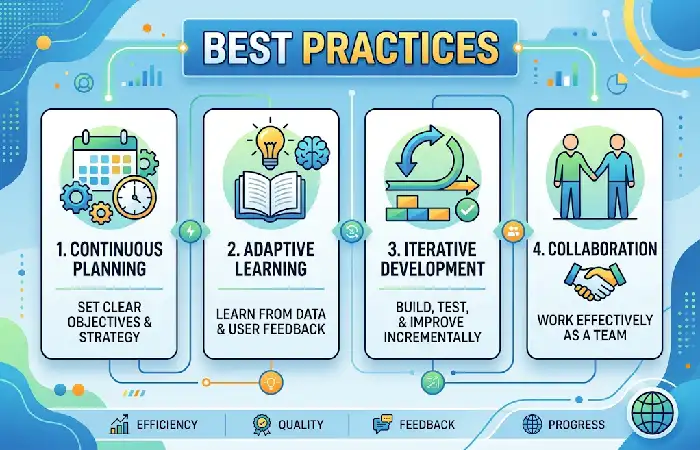
A hybrid cloud network, if properly designed can offer the on-demand elasticity and flexibility of the public cloud, with the security, control and compliance of a private network. With good best practice architecture and design to guide the way.
By following these recommendation, new hybrid cloudarchitecture can be implemented or the existing architecture can be fine-tuned.
- Design Before Deployment
Map:
- Applications
- Data flows
- User locations
- Security requirements
- Automate Everything
Use Infrastructure as Code (IaC).
Automation reduces errors and deployment times.
- Implement Zero Trust Security
Never trust users automatically.
Always verify:
- Identity
- Device
- Network
- Location
- Monitor Performance Continuously
Track:
- Latency
- Packet loss
- Bandwidth
- Cloud costs
- Application health
- Optimize Network Traffic
Use:
- SD-WAN
- Load balancing
- Intelligent routing
- Encrypt Data Everywhere
Encrypt:
- Data at rest
- Data in transit
- Backup storage
- Build Disaster Recovery Plans
Prepare for:
- Hardware failures
- Cyberattacks
- Natural disasters
- Cloud outages
Frequently Asked Questions
How does hybrid cloud networking work?
Hybrid cloud networking enables the on-premise environment to connect securely with public cloud and private cloud environments for applications and data to travel between each environment.
Is hybrid cloud better compared to public cloud?
It really depends upon what your business needs are. Hybrid is more flexible with more robust compliance options and increased control of sensitive workload, whereas the public cloud is easier to manage and scale quickly.
What technologies are used to form hybrid networks?
Popular technologies are VPNs, SD-WAN, software defined networking (SDN), dedicated cloud interconnects, network virtualization and identity based access control.
Do we expect hybrid cloud to be secure?
Yes. A well-implemented Zero Trust environment can keep even hybrid cloud environment secure by implementing encryption, multi-factor authentication, continuous monitoring, and strong identity management.
What are the most beneficial sectors?
Healthcare, financial services, retail, manufacturing, education, government or any organization confronted by regulation and the need to provide scale cloud services.
Conclusion
Hybrid cloud networking is the dominant architecture for businesses wanting to combine the flexibility and simplicity of the public cloud with the control and security of a private cloud infrastructure. Such a solution should be flexible, scalable and capable of supporting the organization into the future.
In addition to keeping the pages secure, ongoing scans for malicious code, and linking internally to related cloud networking topics, this is a definitive resource that will hopefully rank for lots of variants of the search term and as a support for the AI Overviews that Google plans for 2026.