

Last Updated: August 5, 2026
Cloud networking has revolutionised how enterprises are deploying applications, connecting end-users and scaling their infrastructure, but the hybrid and multi-cloud world is only increasing the challenge of managing them.
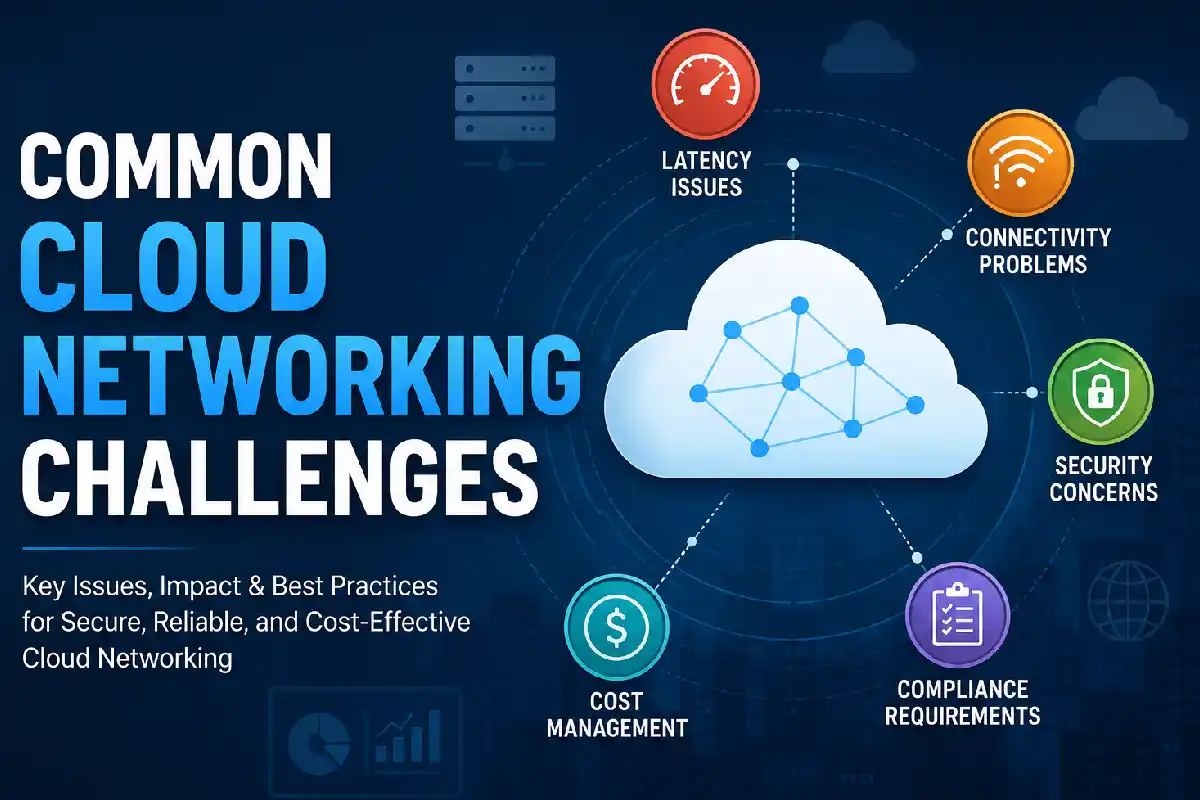
The more you understand about Common Cloud Networking Challenges, the better you will be at keeping your performance high, security tight, costs down, and meeting those regulations. No matter which cloud platform you are running your workloads on be it Amazon, Azure, Google Cloud, or Multi-Cloud, you‘ll find that knowledge useful.
Many organizations encounter scalability, visibility, and security concerns when adopting cloud infrastructure. Understanding the fundamentals of cloud networking architectures helps businesses identify the root causes of these operational challenges.
This document describes the most common cloud networking problems, recommended solutions, troubleshooting procedures and best practices for 2026.
 This article is part of
Networking Resources
Why Cloud Networking Is Challenging
Cloud networks are not static. Instead they are distributed and dynamic in nature. As opposed to conventional on-premises network that are Static in nature.
Modern organizations often manage:
- Multiple cloud providers
- Remote employees
- Hybrid infrastructure
- SaaS applications
- Edge computing
- Global users
Each adds yet another layer of complication.
To minimize long-term operational risks, organizations should follow proven cloud networking best practices, including network segmentation, automated policy management, continuous monitoring, and performance optimization.
Table of Contents
Latency Issues
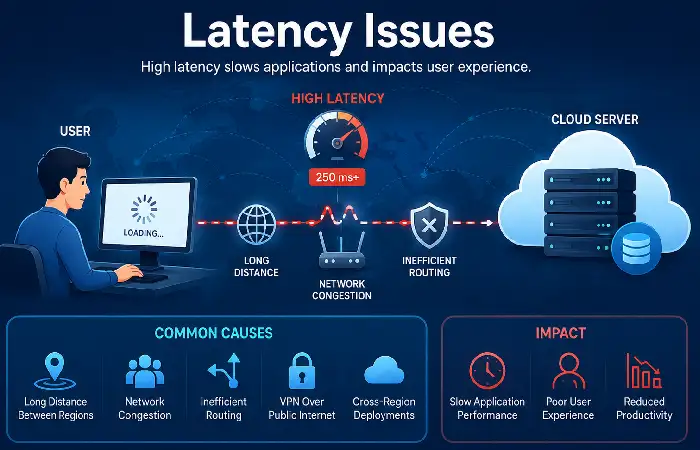
Latency is the time taken for data to.
Speed is no longer the only concern for networks, as increasingly distributed workloads are raising latency issues.
Common Causes
- Long-distance data transmission
- Poor routing
- Network congestion
- Underpowered VPN gateways
- Cross-region deployments
- Internet bottlenecks
Performance Comparison
| Network Architecture | Average Latency (2026) | Best Use Case |
| Single Region | 5–20 ms | Internal applications |
| Multi-Region | 20–80 ms | Disaster recovery |
| Hybrid Cloud | 40–120 ms | Enterprise workloads |
| Public Internet VPN | 60–200 ms | Remote users |
| Dedicated Cloud Connection | 5–25 ms | Mission-critical workloads |
How to Reduce Latency
- Deploy workloads closer to users.
- Use Content Delivery Networks (CDNs).
- Enable load balancing.
- Optimize routing paths.
- Use dedicated cloud connections instead of public internet VPNs.
- Implement edge computing where appropriate.
One of the most common cloud networking challenges is integrating legacy systems with modern cloud platforms. Organizations that still rely on traditional cloud networking models often face higher latency, manual configuration overhead, and limited scalability.
Connectivity Problems
Connectivity that you can count on is the foundation of each cloud deployment.
Regrettably, connectivity problems continue to rank within the most prevalent operational difficulties.
Common Problems
- VPN failures
- DNS misconfiguration
- Firewall rules blocking traffic
- Routing conflicts
- Incorrect subnet design
- BGP synchronization issues
Connectivity Comparison
| Issue | Symptoms | Recommended Solution |
| VPN failure | Users disconnected | Configure redundant VPN tunnels |
| DNS errors | Applications unavailable | Use managed DNS with health checks |
| Firewall conflicts | Blocked traffic | Review security rules regularly |
| Routing loops | Slow connectivity | Optimize routing tables |
| IP conflicts | Network instability | Proper IP planning |
Security Concerns in Cloud Networking
Cloud networking offer agility and scalability, but they also pose new security challenges. Because cloud services are connected worldwide over open networks and may involve various countries and providers, the security of network traffic and sensitive data is harder to guarantee than on the traditional on-premises network. A single weak access policy or misconfiguration can endanger valuable business assets.
Adopting a proactive security posture, for example through implement strong identity management solutions, encryption, close monitoring of network and systems, and dividing the network into isolate segments all together will help to minimize the risk.
Businesses operating across on-premises and cloud environments frequently struggle with workload mobility and consistent security policies. Adopting hybrid cloud networking strategies can help reduce these integration and management complexities.
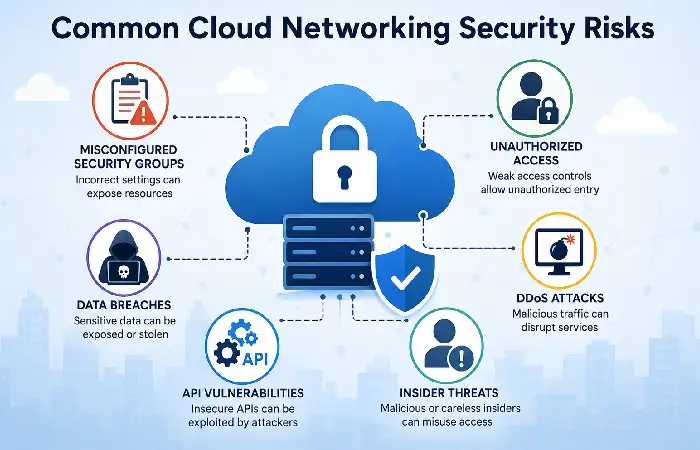
Common Cloud Networking Security Risks
Compliance Requirements
One of the considerations for cloud networking is when moving the workloads over to the cloud to adhere with the regulatory and industry compliances. Compliance controls are in place to make sure that the sensitive data is protected in the storage, transmission and processing stages according to the legal and industry authority requirements. There are consequences for non-compliance such as financial penalties, legal action and damage to company réputation, customer confidence or brand image.
Cloud providers offer integrated compliance processes and certifications, however the client is still responsible for deploying the cloud environment appropriately under the shared responsibility model.
Common Compliance Standards for Cloud Networking
| Compliance Standard | Industry | Purpose | Key Networking Requirements |
| GDPR | Organizations handling EU citizen data | Protect personal data and privacy | Data encryption, access controls, audit logging, data residency |
| HIPAA | Healthcare | Safeguard protected health information (PHI) | Secure data transmission, encryption, network access controls |
| PCI DSS | Payment and eCommerce | Protect cardholder data | Network segmentation, firewalls, encryption, continuous monitoring |
| ISO/IEC 27001 | All industries | Information Security Management System (ISMS) | Risk management, security policies, incident response |
| SOC 2 | SaaS and cloud service providers | Ensure security, availability, and confidentiality | Continuous monitoring, identity management, audit trails |
Network performance degradation across distributed offices is another major concern for cloud-first organizations. Implementing SD-WAN solutions for cloud networking can improve traffic routing, application performance, and centralized network control.
Cost Management
On the other hand, cloud network offers flexible and scalable. However, this can come with high networking cost if you don‘t plan for this accordingly. Cost of data transfer, load balancer, VPN Gateway, NAT Gateway, and cross-region traffic may not be obvious until a large percentage of a organization‘s cloud bill.
The key to wise investment in the cloud is to closely watch network loading, cut down on redundant resources and use cost-efficient ways that can help your business derive the most out of cloud investments.
Common Cloud Networking Cost Challenges
| Cost Challenge | Description | Business Impact | Recommended Solution |
| Data Transfer (Egress) Charges | Cloud providers charge for data leaving their network or moving between regions. | Higher monthly cloud bills | Minimize cross-region traffic and use Content Delivery Networks (CDNs). |
| Cross-Region Traffic | Applications deployed across multiple regions increase bandwidth costs and latency. | Increased operational costs | Keep workloads and databases in the same region whenever possible. |
| NAT Gateway Costs | High outbound internet traffic through NAT gateways can become expensive. | Rising networking expenses | Consolidate traffic and monitor NAT gateway usage regularly. |
Many organizations lack the in-house expertise required to manage complex cloud environments effectively. Partnering with specialized cloud networking services providers can help address monitoring, security, automation, and compliance challenges.
Frequently Asked Questions
What are the top cloud networking issues?
Typical obstacles are latencies, connectivity issues, security concerns, compliance obligations, multi-cloud complications and increasing networking charges.
Why does latency matter in cloud networking?
High latency translates to slower application performance, increased response times and would impact user experience adversely. Cutting down the latency would mean better productivity and customer satisfaction.
What can companies do to improve security on cloud networks?
Organizations should implement Zero Trust security. This can include encryptions, MFA, network segmentation, continuous monitoring, and frequent security evaluations.
What is leading to an increase in cloud networking costs?
Cost drivers that are frequently encountered are internet egresscosts, traffic between regions, NAT gateways, load balancers or any unused network resources.
What do companies do to be in conformity in a cloud?
They use centralized log collection, identity and access management, encrypt data, automatic compliance check and audit frequently to ensure the standards keeping toes such as: GDPR, HIPAA, PCI DSS, ISO 27001, SOC 2.
Conclusion
Take business to the cloud and look past the globe enables organizations to proliferate applications, are worldwide users, and innovates in their misconfigurations. But to make this successful various issues such as Latency, Connectivity, and security threats, compliances and increasing costs need constant effort and planning.
Modern networks architectures, operational automation, performance management and security best practices provide the foundation to a scalable cloud.