

Last Updated: August 5, 2026
Cloud networking is the foundation of today‘s IT infrastructure. Moving applications to the cloud or operating in a multi-cloud environment, implementing the optimal Cloud Networking Best Practices will lead to improved security, less latency, cost saving and high availability.
Based on information from major cloud partners, organizations are beginning to leverage automation, Zero Trust security, AI-driven monitoring, and multi-cloud networking for increased reliability and business continuity. The following are the fundamental best practices all beginner and it know by 2026.
Modern businesses are adopting cloud networking practices to improve connectivity, scalability, and operational efficiency across distributed environments.
 This article is part of
Networking Resources
Cloud Networking Best Practices at a Glance (2026)
| Best Practice | Primary Benefit | Recommended For | Resource |
| Network Segmentation | Improved security | All organizations | https://aws.amazon.com/vpc/ |
| Infrastructure as Code | Faster deployment | DevOps teams | https://developer.hashicorp.com/terraform |
| Zero Trust Networking | Better access control | Enterprises | https://cloud.google.com/beyondcorp |
| Continuous Monitoring | Early issue detection | All cloud users | https://azure.microsoft.com/services/monitor/ |
| Disaster Recovery | Business continuity | Critical workloads | https://learn.microsoft.com/azure/site-recovery/ |
Table of Contents
Network Planning
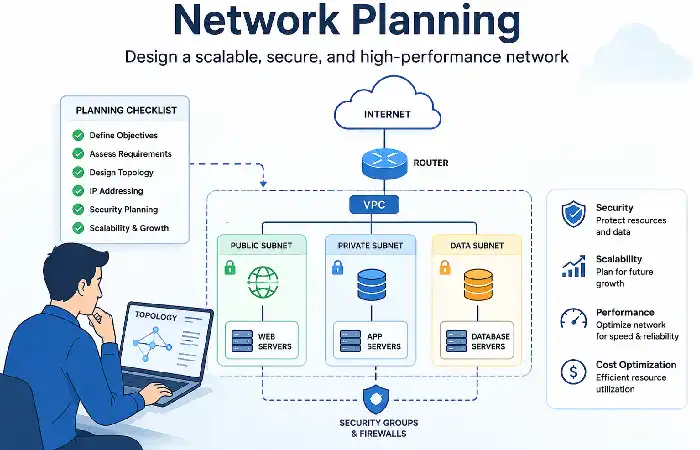
Planning is the key to good cloud networking. Having a sound network design not only boost efficiency and security but also makes scaling and expansion much easier: Plan the structure of your cloud platform before launching your workloads, and plan the planning.
Best Practices for Network Planning
Mi. Select the appropriate cloud deployment model: Determine which is the right is the most suitable for your business needs Public, Private, hybrid or multi-cloud.
Design a logical IP addressing scheme: you should not be sharing the same IP ranges between your different Cloud environments and on-premise networks.
Make your network more secure: Segment your network by employing Virtual Private Clouds (VPCs), subnets, and security groups, to segregate applications from each other and to protect data.
Device availability and numbers plan ahead for scalability: plan to have a limited, yet scalable, number of IP addresses and design networks that do not need rebuilt if more devices are added.
Minimize latency: Run the workloads close to the users and distribute among many availability zones for high availability.
Implement the Zero Trust model: scrutinize each connection to validate its legitimacy and grant users and services a limited amount of access.
While moving away from legacy infrastructure, organizations should understand the limitations of traditional cloud networking approaches and evaluate modern solutions that align with their business goals.
Performance Monitoring
A cloud network even if it is well architecture would need to be monitored constantly. Our network‘s performance can change because of traffic surge, configuration errors, network hardware failures or sheer growth of your application.
Key Metrics to Monitor
- Network latency
- Bandwidth utilization
- Packet loss
- Throughput
- CPU and memory usage of network appliances
- Application response time
- Network error rates
- Availability and uptime
Many enterprises are now combining public and private cloud environments through hybrid cloud networking strategie to achieve greater flexibility, security, and performance.
Automation
Automation is one of the most valuable Cloud Networking Best Practices. It allows to decrease human error and the time it takes to deploy infrastructures. Today in 2026, the use of IaC and AI-based automation is now a common practice in Cloud.
Benefits of Network Automation
- Deploy cloud infrastructure consistently
- Reduce human errors and downtime
- Scale resources automatically
- Improve security compliance
- Accelerate disaster recovery
- Lower operational costs
Popular Automation Tools
| Tool | Best Use Case | Key Features | Resource |
| Terraform | Multi-cloud Infrastructure as Code | Declarative infrastructure management | https://developer.hashicorp.com/terraform |
| AWS CloudFormation | AWS automation | Native infrastructure templates | https://aws.amazon.com/cloudformation/ |
For organizations managing multiple locations, implementing SD-WAN cloud networking solutionscan simplify network management and enhance connectivity across branches.
Disaster Recovery
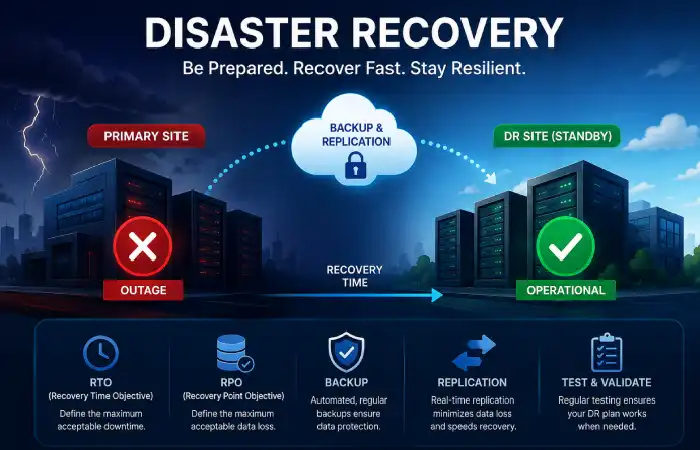
Disaster recovery (DR)assures that access to business vital cloud-based apps and information will be maintained in a case of failure/disaster/malfunction. Proper DR planning reduces uptime and allows organizations to meet their business continuity requirements.
Essential Disaster Recovery Best Practices
- Replicate critical data across multiple regions.
- Use automated backup and testthem frequently.
- Clarify the RTO and RPO.
- Spread workloads across multiple AZs.
- Ongoing testing of disaster recovery plans via tabletop and simulation exercises.
- Encrypt both network and stored backup data.
Disaster Recovery Strategy Comparison
| Strategy | Recovery Speed | Cost | Best For | Resource |
| Backup & Restore | Slow | Low | Small businesses | https://learn.microsoft.com/azure/backup/ |
| Pilot Light | Medium | Medium | Medium-sized applications | https://aws.amazon.com/disaster-recovery/ |
| Warm Standby | Fast | High | Business-critical workloads | https://cloud.google.com/architecture/dr-scenarios-planning-guide |
| Multi-Site Active/Active | Near Instant | Highest | Enterprise applications | https://aws.amazon.com/architecture/disaster-recovery/ |
Common Disaster Recovery Mistakes
- Not testing backup restoration procedures.
- Keeping backups in the same cloud region.
- Ignoring application dependencies.
- Failing to document recovery processes.
- Using outdated recovery plans.
A robust disaster recovery plan will not only ensure that your data is protected, you build customer confidence knowing that services and resources will always be available.
Choosing the right partner for implementation is essential, and professional cloud networking services can help businesses design, deploy, and optimize their network infrastructure.
Future Trends
Cloud networking remains in a state of flux as more organizations embrace Artificial Intelligence (AI) edge computing and multiple cloud solutions. Keeping pace with this evolution enables organizations to develop networks that are resilient scalable and prepared for future data workloads.
Top Cloud Networking Trends for 2026
| Trend | Impact | Business Benefit | Resource |
| AI-Powered Network Operations (AIOps) | Uses AI to detect and resolve issues automatically | Faster troubleshooting and reduced downtime | https://cloud.google.com/blog/products/networking |
| Multi-Cloud Networking | Connects workloads across multiple cloud providers | Greater flexibility and reduced vendor lock-in | https://aws.amazon.com/hybrid/ |
| Intent-Based Networking | Automates network configuration based on business policies | Simplified management and fewer configuration errors | https://blogs.cisco.com/networking |
Emerging Technologies to Watch
- AI-driven traffic optimization
- Software-Defined Wide Area Networking (SD-WAN)
- Secure Access Service Edge (SASE)
- Network Digital Twins for testing changes
- IPv6 adoption across cloud environments
- Serverless networking advancements
- Quantum-resistant encryption for cloud communications
Before implementing a cloud networking strategy, companies should evaluate common cloud networking challenges such as security risks, performance issues, and integration complexities.
Frequently Asked Questions (FAQs)
What are cloud networking best practices?
Best practices for cloud networking involve the correct planning of networks, segmentation, automation of configurations and provisioning, constant monitoring, Zero Trust security principles, and disaster recovery, to enhance performance, scalability and security.
Why is network automation important?
Automations minimizes human errors, rapid deployments, repeatable configurations and improves the efficiency of the operation through Infrastructure as Code(IaC).
How can I improve cloud network security?
Implement Zero Trust, encrypt all data, implement firewall, security groups, enable multi-factor authentication (MFA) and perform a network configuration audit on regular basis.
What is the role of performance monitoring?
Performance monitoring monitoring measures the latency, bandwidth, packetsloss, and availability which help team members to identify the problems in the early stage and optimize network.
Which cloud providers offer the best networking services?
AWS, Microsoft Azure and Google Cloud who top playersoffer other networking services like virtual networks, load balancing, monitoring, hybrid cloud connectivity.
Conclusion
Following these Cloud Networking Best Practices will help enterprise organizations to design very flexible, scalable and secure cloud architectures. Organizations can minimize downtime, reduce costs and keep customers happy if they establish effective network planning, focus on network monitoring, automate network operations and have an effective disaster recovery plan.