
 Kashifa Jafar
Technology Writer & Contributor
Kashifa Jafar is a technology writer and contributor at FutureTechExpert with 4+ years of experience in technology writing and content creation.
Read Full Bio of Author →
Kashifa Jafar
Technology Writer & Contributor
Kashifa Jafar is a technology writer and contributor at FutureTechExpert with 4+ years of experience in technology writing and content creation.
Read Full Bio of Author →
 Sameena Begum
Health, Technology & Digital Content Reviewer
Sameena reviews selected health, wellness, technology, and digital content for clarity, factual presentation, and reader usefulness.
Read Full Bio of Reviewer →
Sameena Begum
Health, Technology & Digital Content Reviewer
Sameena reviews selected health, wellness, technology, and digital content for clarity, factual presentation, and reader usefulness.
Read Full Bio of Reviewer →
Cloud Data Encryption is now one of the most critical security mechanisms for securing information within cloud. With more and more enterprise and consumers storing data, such as documents, databases, backups, applications and customer data on the cloud, the need to secure this data from sabotage has become a priority.
Cyberattacks are becoming more sophisticated and numerous. Small and large organizations are facing increased occurrences of ransomware, phishing, insider threats and data breach activity. Encryption helps to safeguard those organizations as it keeps data unreadable to would-be thieves without a key.
Encryption is only one component of a comprehensive cloud data security strategy that protects sensitive information across cloud environments.
 This article is part of
Security Resources
Table of Contents
What Is Cloud Data Encryption?
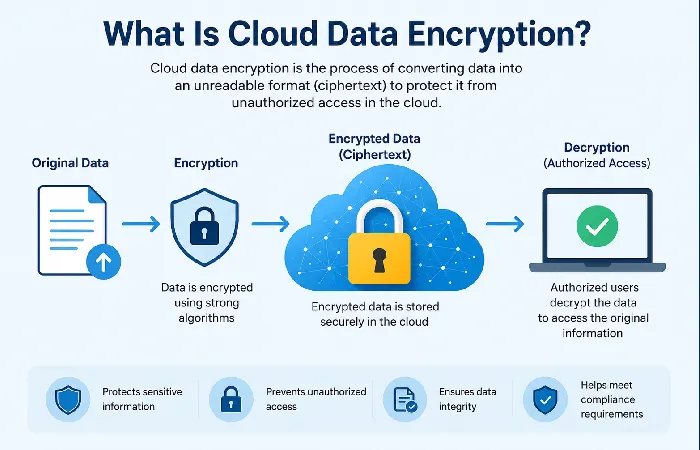
Cloud data encryption is a method of cybersecurity that is applied to convert clear data into an unclear form. This method is simply converting user readable content into a non-readable content this is done with mathematical equations with the server encryption key.
Suppose you wish to transmit a sensitive business report via the Internet. If you don‘t encrypt, anyone who picks up the data can probably read it. If you encrypt, the gobbledygook data that is captured by an intruder is unreadable. What if an intruder steals the encrypted data file, he will not know what it says.
Encryption is effective at all stages of the life cycle of a piece of cloud data. It can be encrypted on your own machine before it‘s sent to the cloud, it can be encrypted over the web while being sent to the cloud, and while it‘s stored in the cloud.
Encryption helps secure information, while cloud data loss prevention solutions prevent unauthorized sharing and exposure of sensitive data.
Encryption at Rest vs Encryption in Transit
Data in the cloud is in a continuous flux from users to applications, databases and storage. Organisations need to protect this information during its complete life cycle. For such a purpose data encryption in two variations – at rest and in transit, is employed. While both variations of encryption safeguard private information, they address different realms of security.
Key Differences
| Aspect | Encryption at Rest | Encryption in Transit |
| Data State | Stored | Moving |
| Threat Addressed | Unauthorized access to storage | Data interception during transmission |
| Storage Location | Cloud disks, databases, backups | Internet, VPNs, APIs, networks |
| Encryption Timing | Before data is stored | Before data is transmitted |
| Example | Encrypted cloud database | HTTPS website connection |
By deploying both techniques, this provides comprehensive coverage, regulatory compliance, and greatly reduces the risk of a breach. Many organizations will want to deploy a hardy cloud security model and should consider enabling both forms of encryption as a best practice.
Even encrypted data can be lost, making a strong cloud backup and disaster recovery plan essential for business continuity.
Symmetric vs Asymmetric Encryption
Encryption algorithms are the essential element of cloud data security. They remain used to transforming human-readable information into unreadable data which only permitted users can read. Up to date, there are many encryption algorithms. Symmetric encryption algorithms and asymmetric encryption algorithms are the popular two algorithms.
Comparison Table
| Feature | Symmetric Encryption | Asymmetric Encryption |
| Number of Keys | One secret key | Public key + Private key |
| Encryption Speed | Very fast | Slower |
| Performance | High | Moderate |
| CPU Usage | Low | Higher |
| Best For | Large datasets | Secure communication |
| Key Sharing | Required | Not required |
| Cloud Storage | Excellent | Limited |
| Email Encryption | Rare | Common |
| Digital Signatures | No | Yes |
| Authentication | Limited | Strong |
| Scalability | Moderate | High for communication |
| Security | Excellent when keys are protected | Excellent for key exchange and identity verification |
Symmetric and asymmetric encryption work together to deliver the benefits of cloud security. Data that requires quick, efficient protection such as data stored in a database is best secured using symmetric encryption. Asymmetric encryption, on the other hand, is suitable for public key encryption, data integrity, authentication, and secure data exchange.
When both hybrid encryption techniques remain combined as a hybrid encryption model, it provides strong protection along with good performance, scalability and application/data security to cloud applications and data.
Encryption becomes more effective when implemented alongside a Zero Trust cloud security model that continuously verifies users and devices.
Key Management Best Practices
Equally, the encryption keys must remain taken into account. Regardless of the type of encryption algorithm used (for example, AES-256 or RSA-4096), if the key used to encrypt the data itself is not well-managed, then the data cannot remain regarded as secure. This is why key management is so paramount.
In cloud environments enterprise could be generating thousands, possibly even millions, of encryption keys for securing databases, virtual machines, applications, backups, APIs and storage services. Lack of centralised key management strategy opens organisations to risk of data breach, compliance-related fines and data loss.
A secure key management system. Keys remain generated securely, stored securely, rotated frequently, monitored continuously and destroyed when they remain no longer needed.
Key Management Checklist
Use this checklist to strengthen your key management strategy:
- Use a dedicated Key Management Service (KMS).
- Store keys separately from encrypted data.
- Rotate encryption keys regularly.
- Enable Multi-Factor Authentication (MFA).
- Apply Role-Based Access Control (RBAC).
- Use Hardware Security Modules (HSMs) for sensitive workloads.
- Monitor and audit key usage continuously.
- Maintain secure backups of encryption keys.
- Revoke compromised keys immediately.
- Automate key lifecycle management wherever possible.
Encryption is only as good as the protection of the keys. An enterprise key management strategy establishes controls for the secure generation, storage, distribution, rotation, monitoring, and deactivation of keys throughout their lifecycle.
Applying best practices like employing a dedicated Key Management Service, keeping keys apart from encrypted data, providing customer control over keys, enforcing rigorous access controls and taking advantage of Hardware Security Modules can lead to improved cloud security, improved compliance and decrease the chances of data breaches.
Organizations should combine encryption with proven cloud security best practices such as access controls, monitoring, and regular audits.
Benefits of Encryption
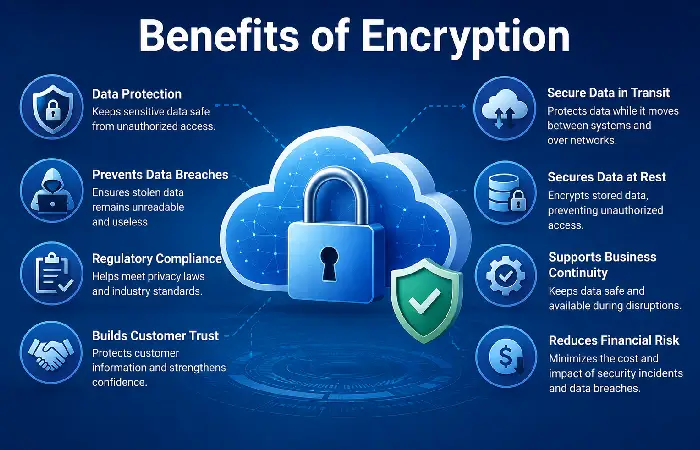
Cloud encryption presents several security benefits.
Protects Sensitive Information
Even if the storage remain lost, the encrypted files cannot remain read.
Regulatory Compliance
Encryption helps organizations comply with:
- GDPR
- HIPAA
- PCI DSS
- ISO 27001
- SOC 2
Prevents Data Breaches
Attackers cannot decrypt the encrypted data without the keys.
Builds Customer Trust
Customers want companies to use only high encryption levels when storing personal information.
Supports Zero Trust Security
Encryption supports the identity verification and continuous authentication.
Common Encryption Challenges
Encryption of data stored in cloud is one of the best security measures, although it is hard to set up and maintain encryption in a current cloud environment. Several issues may occur when deploying and maintaining encryption, for example, the need to ensure a compromise between security and performance, compliance, usability and operational efficiency.
Most Common Encryption Challenges
In addition to the benefits, there are also operational issues with encryption.
Key Loss
Lost encryption keys could lead to the permanent loss of all data.
Performance Overhead
Encrypting large amounts of data takes extra CPU power.
Complex Key Rotation
Handling thousands of encryption keys is a big problem at enterprise level.
Compatibility Issues
Some legacy applications can not use strong encryption.
Cost
Higher costs of operating in the cloud: heavy duty encryption and HSM services.
Many modern cloud security tools include encryption management, key rotation, and compliance monitoring features.
Frequently Asked Questions
What is cloud data encryption?
Data remain encrypted into a unreadable form which can only be unencrypted using correct encryption Key.
Which cryptograhpy is the most popular using in Cloud Storage?
AES-256 is the most common encrypting standard used for providing cloud at rest data security.
Is encrypting the data alone enough?
No. It needs to remain put together with identity management, access controls, monitoring, backups and mass authentication.
How is encryption at rest different from encryption in transit?
Encryption at rest refers to the encryption of stored information; encryption in transit refers to the encryption of data in motion.
Are cloud providers allowed to see what data is encrypted?
In the case of provider-managed keys the provider may have had access, whereas customer-managed keys offer more control.
Conclusion
Cloud data encryption is an integral part of contemporary data security solutions and ensuring encryption of private data when it is in storage or transmission through cloud systems. To enhance the security level, it is essential to implement secure data encryption algorithms (AES-256, RSA-2048, etc.), proper key management systems, security measures including multi-factor authentication and secure updates and periodic key upgrades.
Kashifa Jafar is a technology writer and contributor at FutureTechExpert with 4+ years of experience in technology writing and content creation.
Read Full Bio of Author →Sameena reviews selected health, wellness, technology, and digital content for clarity, factual presentation, and reader usefulness.
Read Full Bio of Reviewer →