

Last Updated: June 22, 2026
Cloud computing has emerged as one of the most cost-effective approaches for organizations to realize the dual benefits of reducing IT costs and enhancing scalability and operational efficiency.
Cost Savings Through Cloud Computing is no longer a buzz word or even a technology trend it is a tested business strategy that allows enterprises to slash infrastructure costs, do away with hardware investments and pay merely for the resources they require.
Based on the latest cloud industry statistics, companies are still emphasizing cost optimization, as almost all recent measurement report for the industry shows that organizations are driven by substantial savings they make by adopting cloud appropriately and conducting FinOps. And reaching 29-32% reduction in cloud consumption.
Discover what cloud computing cost saving advantages you need to know about in this guide, including how pay-as-you-go pricing works and ways to measure cloud ROI in 2026.
Table of Contents
How Cloud Computing Reduces IT Costs
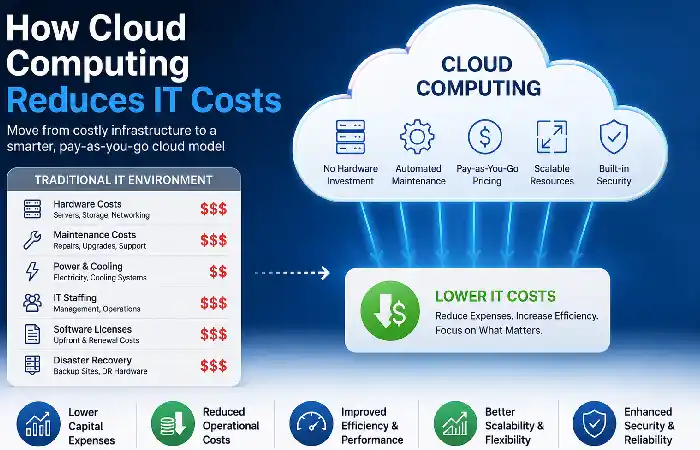
The cost for a traditional IT environment is high. An organization has to buy and implement AS WELL AS implement the architecture for servers, networking equipment, storage, software licensing, security foundation, etc. It is large CapEx budget.
Here the costs are turned into an operational Expenditure (OpEx) since the businesses have to only pay for the resources they use.
Key Cost Reduction Benefits
| Cost Area | Traditional IT | Cloud Computing |
| Hardware Purchase | High upfront investment | No upfront hardware cost |
| Infrastructure Scaling | Requires new equipment | Instant scalability |
| Maintenance | Dedicated IT staff needed | Managed by provider |
| Software Updates | Manual and costly | Included in service |
| Disaster Recovery | Expensive secondary sites | Built-in options |
Businesses can also avoid costs associated with:
- Data center operations
- Electricity consumption
- Cooling systems
- Physical security
- Hardware replacement cycles
The total cost of owning infrastructure for many organizations drops after moving supported workloads to the cloud.
Eliminating Hardware and Maintenance Expenses
One of the biggest financial savings of cloud computing is eliminating the purchase of expensive hardware.
Traditional Infrastructure Costs
A typical on-premises setup often requires:
- Servers
- Storage arrays
- Networking hardware
- Backup systems
- UPS systems
- Cooling equipment
Beyond purchasing hardware, companies must also budget for:
- Maintenance contracts
- Hardware upgrades
- Equipment replacement
- IT support personnel
Cloud-Based Alternative
Cloud providers handle:
- Hardware management
- Security patching
- Capacity planning
- Infrastructure monitoring
- Data center maintenance
This limits operational overhead substantially while utilizing the internal IT teams to concentrate on strategic projects instead of infrastructure management.
Example Comparison
| Expense Category | On-Premises | Cloud-Based |
| Initial Setup | Very High | Low |
| Annual Maintenance | High | Included |
| Hardware Refresh | Every 3–5 Years | Provider Managed |
| Scalability Costs | Significant | Usage-Based |
Pay-As-You-Go Pricing Models Explained
Another major reason that organizations are able to save money in the cloud is due to the cloud being a pay as you go model.
Rather than an organization purchasing resources that may not be fully used, it only pays for what is used.
Common Cloud Pricing Models
| Pricing Model | Best For | Cost Benefit |
| Pay-As-You-Go | Variable workloads | No upfront commitment |
| Reserved Instances | Predictable workloads | Lower long-term pricing |
| Spot Instances | Non-critical tasks | Deep discounts |
| Serverless Computing | Event-driven applications | Pay only when code runs |
Cost Savings Potential
Recent cloud optimization research highlights:
| Optimization Method | Potential Savings |
| Rightsizing Resources | 20–35% |
| Reserved Capacity | 30–72% |
| Spot Instances | 60–90% |
| Storage Tier Optimization | 40–70% |
Source Resources:
- Flexera State of Cloud Report 2026
- CloudZero Cost Optimization Research
- Gartner Cloud Spending Forecasts
Reference Links:
| Resource | URL |
| Flexera State of Cloud Report | https://www.flexera.com |
| Gartner Cloud Forecast | https://www.gartner.com |
| CloudZero Research | https://www.cloudzero.com |
Cost Optimization Strategies for Businesses
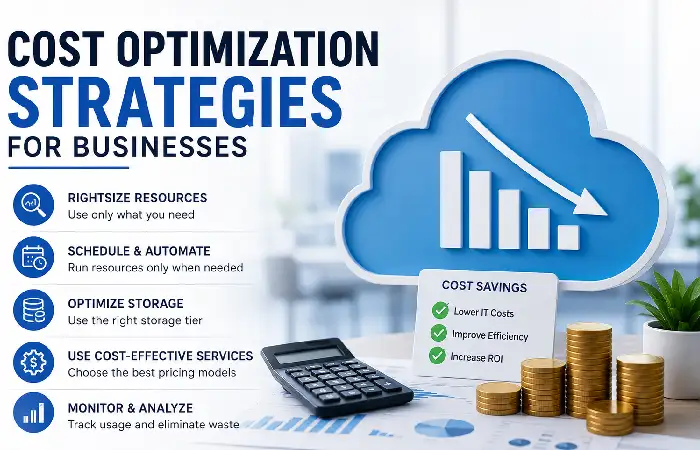
Just shifting workloads to the cloud doesn‘t necessarily mean you‘ll save. You have to look for efficiencies.
- Rightsize Resources
Many companies over provision to much larger virtual machines.
Regular performance monitoring helps identify:
- Underutilized servers
- Oversized databases
- Excess storage allocations
Rightsizing have potential to put as much as 70% savings on cloud.
- Implement FinOps Practices
FinOps is a collaboration between finance, engineering and ops teams to improve visibility of the cost of the cloud.
Benefits include:
- Better forecasting
- Cost accountability
- Waste reduction
- Improved ROI tracking
Organizations that have dedicated FinOps teams working on their cloud typically see much better cloud ROI results.
- Automate Resource Scheduling
Non-production environments are on a 24/7 schedule often, regardless of its necessity.
Automating shutdown schedules for:
- Development environments
- Testing environments
- Training systems
can generate substantial savings.
- Optimize Storage
Leverage lifecycle policies to archive less-accessed data into cheaper storage.
Benefits include:
- Lower storage costs
- Improved data management
- Better resource utilization
- Monitor Cloud Spending
Continuous monitoring helps identify:
- Idle resources
- Unexpected usage spikes
- Cost anomalies
Measuring Cloud ROI Effectively
The ROI of cloud should not only focus on the infrastructure savings.
Cloud ROI Formula
Cloud ROI (%) =
[(Total Benefits – Cloud Costs) ÷ Cloud Costs] × 100
Key Metrics to Track
| Metric | Why It Matters |
| Infrastructure Savings | Direct cost reduction |
| Resource Utilization | Efficiency measurement |
| Downtime Reduction | Productivity gains |
| Deployment Speed | Faster innovation |
| Operational Efficiency | Staff productivity |
Sample ROI Calculation
| Item | Annual Value |
| Hardware Savings | $50,000 |
| Maintenance Savings | $20,000 |
| Productivity Gains | $30,000 |
| Total Benefits | $100,000 |
| Cloud Costs | $60,000 |
| ROI | 66.7% |
A FinOps framework is an easily implemented methodology that, when applied consistently, enables an organization to achieve its cloud ROI goals more efficiently and with less waste.
Frequently Asked Questions
Is cloud computing always cheaper than on-premises infrastructure?
Not necessarily. Achieved savings are highly reliant on workload architecture, usage behavior, and optimization practices. A poorly managed cloud environment might be very expensive.
How much can businesses save with cloud computing?
Many organizations report 20 40% reduction in IT costs from moving to the cloud and optimizing.
What is FinOps?
FinOps is a cloud financial management discipline that enables organizations to derive maximum value from the cloud while managing costs.
What causes cloud overspending?
Regular reasons are under-utilised infrastructure, oversized job, lack of monitoring and weak governance.
Conclusion
Cost savings continue to be one of the most compelling business value estimates for cloud computing. In addition to the further hardware investments and decreasing maintenance costs, the capex/OPEX split, pay-to-use approach and the latest FinOps practices need to be exploited to bring further decrease in IT costs and increase of flexibility and scalability.
By 2026, the most successful organizations will not just have completed a migration to the cloud. Instead, cloud cost optimization will be a continuous process. Continual monitoring, governance and resource management means cloud computing can provide a tangible ROI and sustainable competitive advantages.