
 Kashifa Jafar
Technology Writer & Contributor
Kashifa Jafar is a technology writer and contributor at FutureTechExpert with 4+ years of experience in technology writing and content creation.
Read Full Bio of Author →
Kashifa Jafar
Technology Writer & Contributor
Kashifa Jafar is a technology writer and contributor at FutureTechExpert with 4+ years of experience in technology writing and content creation.
Read Full Bio of Author →
 Sameena Begum
Health, Technology & Digital Content Reviewer
Sameena reviews selected health, wellness, technology, and digital content for clarity, factual presentation, and reader usefulness.
Read Full Bio of Reviewer →
Sameena Begum
Health, Technology & Digital Content Reviewer
Sameena reviews selected health, wellness, technology, and digital content for clarity, factual presentation, and reader usefulness.
Read Full Bio of Reviewer →
Cloud computing & AI is also a strong combination in 2026. Cloud computing & AI were used to offer intelligent chat bots and recommender systems, autonomous business processes and insightful analysis. Millions of organizations are using AI-enabled cloud computing infrastructure for its capacity to provide computational, scalable and flexible resources.
If you are a business, an IT professional, a student or even just a technology lover, it is important you know how cloud computing and AI are interconnected in order to a future-proof career.
Businesses adopting intelligent infrastructure often explore the broader benefits of cloud computing to improve automation, scalability, and digital innovation.
 This article is part of
Benefits of Cloud Computing
Table of Contents
How Cloud Computing Powers AI
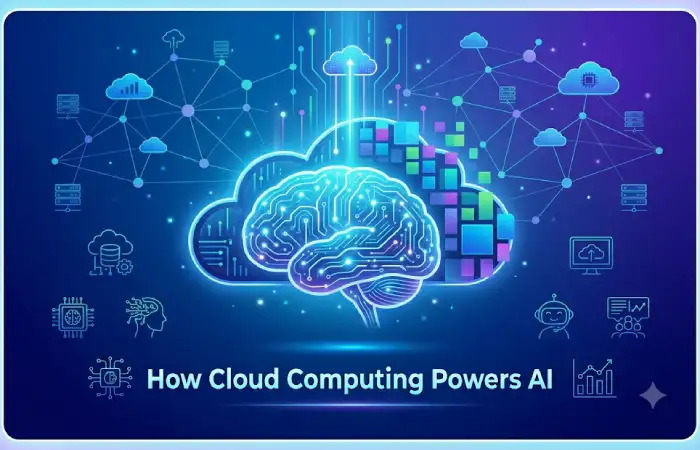
Artificial intelligence demands large scale amounts of computing power. For example, the training of machine learning algorithms can require the processing of millions or billions of examples. Such infrastructure is costly and resource intensive to buy and maintain.
Cloud computing solves this challenge by providing:
- Computing power available as needed
- Available resources are independent from the provider.
- Priorities can be guaranteed for a number of or unlimited parallel jobs
Flexible computation resources:
- scalable GPU and TPU, and large RAM storage
- Extremely large storage capacity
- Distributed data processing
- Managed AI development environments
Leading cloud service providers like Amazon Web Services (AWS), Microsoft Azure and Google Cloud provide AI focused services for making, training and running machine learning models without any hardware interactions.
By 2026, AI workloads will be the dominant driver of cloud consumption, as enterprise increasingly run Generative AI and Large Language Models in production. It has made clouds the ‘AI-first’ landscape.
Understanding cloud computing basics is essential for implementing artificial intelligence tools in modern cloud environments.
Cloud Infrastructure for Machine Learning
The infrastructure to support machine learning work needs specialized components which servers are not capable of providing efficiently.
Artificial intelligence applications increasingly rely on specialized cloud industry solutions for processing and deployment.
Key Components of AI Cloud Infrastructure
| Component | Purpose | Benefits |
| GPUs & TPUs | Model training | Faster processing |
| Data Lakes | Data storage | Centralized datasets |
| MLOps Tools | Model management | Automation |
| Kubernetes | Container orchestration | Scalability |
| Serverless AI | Event-driven AI execution | Cost efficiency |
Popular Cloud Platforms for AI in 2026
The AI cloud market in 2026 is led by hyperscalers and enterprise AI platforms offering GPU-centric cloud infrastructure, foundation models, MLOps toolkits, and generative AI services. The most popular platforms are AWS, Microsoft Azure, Google Cloud, IBM watsonx, and Oracle Cloud Infrastructure (OCI).
| Cloud Platform | Key AI Services | Best For | Resource Link |
| Amazon Web Services (AWS) | SageMaker, Bedrock, Trainium, & Inferentia | Enterprise AI, Generative AI, & Large-scale ML | AWS AI Services |
| Microsoft Azure AI | Azure AI Foundry, Azure OpenAI, & Copilot Services | Enterprise AI, & Microsoft Ecosystem | Azure AI Platform |
| Google Cloud AI | Vertex AI, Gemini, & TPU Infrastructure | Data Science, ML Research, & GenAI | Vertex AI Documentation |
| IBM watsonx | watsonx.ai, watsonx.data, & Governance Tools | Regulated Industries, & Hybrid AI | IBM watsonx Resources |
| Oracle Cloud Infrastructure (OCI) | OCI AI Services, & OCI Supercluster | Large AI Training Clusters | OCI AI Services |
| NVIDIA DGX Cloud | DGX SuperPOD, & AI Foundation Models | GPU-intensive AI Workloads | DGX Cloud Platform |
| Databricks AI Platform | Mosaic AI, & Lakehouse AI | Data Engineering + AI | Databricks AI Resources |
| Snowflake Cortex AI | Cortex AI, & ML Functions | AI-Powered Analytics | Snowflake Cortex Docs |
Most enterprises use multi-clouds, as they favour some service from a provider, for example, compute for one, analytics for the next and AI development in a third. As evidence, industry estimates show that it‘s over 85% of enterprises are multi-cloud.
AI workloads require scalable cloud storage solutions to manage large datasets efficiently.
Benefits of AI Cloud Services
Using AI cloud services offers many benefits for more conventional infrastructure.
- Lower Infrastructure Costs
Organisations only pay for the resources that they use and do not have to make large investments in hardware.
- Faster AI Development
Pre-built frameworks, APIs and AI tools, built for machine learning projects speed up deployment.
- Scalability
AI services are scalable on cloud platforms. The cloud platforms automatically scales-up its resources according to the increased AI workloads.
- Improved Accessibility
AI environments are accessible from anywhere there is an internet connection.
- Enhanced Security
The cloud providers has a lot of investment on security, compliance and governance controls.
Advanced automation systems rely heavily on cloud security and data protection to safeguard sensitive information and AI-driven operations.
AI Cloud Service Benefits Comparison
| Feature | Traditional Infrastructure | AI Cloud Services |
| Initial Cost | High | Low |
| Scalability | Limited | Unlimited |
| Maintenance | Internal Team | Provider Managed |
| Deployment Speed | Slow | Fast |
| AI Tools | Manual Setup | Built-In |
Edge Computing vs Cloud Computing
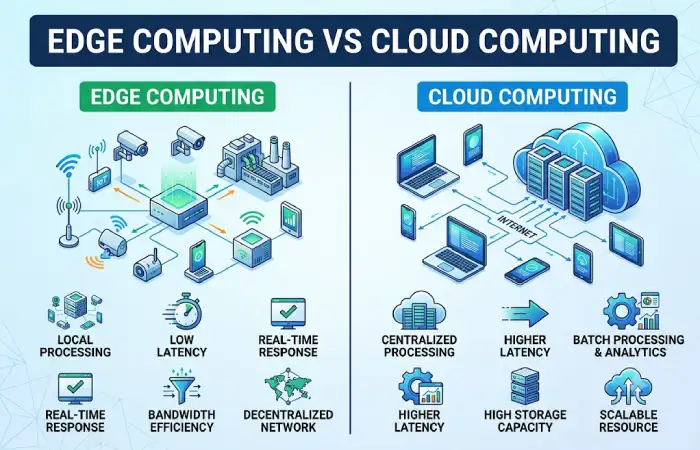
With AI applications demanding real-time responses, edge computing is increasingly seen as an adjunct.
What is Edge Computing?
Edge computing handles data closer to the originating devices, be they IoT, sensors, cellphones.
Many enterprises use leading cloud computing platforms to deploy scalable artificial intelligence applications and services.
Cloud vs Edge Comparison
| Factor | Cloud Computing | Edge Computing |
| Processing Location | Centralized Data Centers | Near Devices |
| Latency | Moderate | Very Low |
| Scalability | Excellent | Moderate |
| Cost | Pay-As-You-Go | Hardware Dependent |
| AI Training | Excellent | Limited |
| AI Inference | Good | Excellent |
When to Use Each
Choose Cloud Computing for:
- AI model training
- Big data analytics
- Enterprise applications
- Long-term storage
Choose Edge Computing for:
- Autonomous vehicles
- Smart factories
- IoT systems
- Real-time monitoring
Available frameworks will probably run on more computing layers (device, edge, cloud) at same time, in order to optimize performance, cost, and latency.
Organizations are combining AI solutions with the business benefits of cloud computing to enhance productivity and operational efficiency.
Future of AI & Cloud Technology
The prospects of cloud computing and AI appear very bright.
Key Trends Shaping 2026 and Beyond
AI-Native Cloud Platforms
Not just adding AI as an edge service, cloud providers are building their platform around an AI-first architecture.
Agentic AI
The innovation that is being driven by cloud is largely being led by AI agents that can operate independently.
Multi-Cloud Expansion
Workloads are moving more and more across multiple cloud providers, to make the business more flexible and resilient.
Sovereign Cloud Adoption
Data country of residence and compliance is being an increasing concern for governments and regulated industries.
Custom AI Hardware
Cloud providers are designing their own AI chips to lower cost and enhance performance.
According to industry analysts, the growth of the cloud in 2026 will be led more by AI consumption than migration to cloud projects. AI-native cloud environments are increasingly becoming the norm an architecture adopted by modern enterprises.
The future of AI is closely connected to future cloud computing trends that enhance performance and automation.
Real-World AI Cloud Use Cases
Healthcare
- Medical imaging analysis
- Disease prediction
- Personalized treatment recommendations
Finance
- Fraud detection
- Risk assessment
- Algorithmic trading
Retail
- Personalized recommendations
- Demand forecasting
- Customer service automation
Manufacturing
- Predictive maintenance
- Quality control
- Smart automation
Developers often learn through cloud comparisons and tutorials when building AI-powered solutions.
FAQ
Is cloud computing necessary for AI?
Sometimes, but most of the time it can provide the processing power and scalability needed to support most of the current AI applications.
Which cloud platform is best for AI?
AWS, Azure and Google Cloud are the top three options with all three providing up- and coming AI and machine learning capabilities.
What is AI-native cloud?
An AI-native cloud is a cloud that is instantiated to be optimized to facilitate AI workloads, machine learning models, and intelligent automation.
Can small businesses use AI cloud services?
Yes. Cloud AI services enable smaller companies to afford this kind of cutting edge infrastructure.
Will AI replace cloud computing?
No. AI and cloud computing are complementary. Then, cloud computing is the backbone of AI. Cloud infrastructures and data centres provide all the necessities for high computing power and data storage.
Conclusion
Gartner shows how a new era of Cloud & AI will revolutionise how organizations design, implement and extend technology solutions. Growing demands on AI use cases are being met by cloud‘s elasticity, advance infrastructure, and in capitalising on next-generation intelligent applications.
Kashifa Jafar is a technology writer and contributor at FutureTechExpert with 4+ years of experience in technology writing and content creation.
Read Full Bio of Author →Sameena reviews selected health, wellness, technology, and digital content for clarity, factual presentation, and reader usefulness.
Read Full Bio of Reviewer →