
 Kashifa Jafar
Technology Writer & Contributor
Kashifa Jafar is a technology writer and contributor at FutureTechExpert with 4+ years of experience in technology writing and content creation.
Read Full Bio of Author →
Kashifa Jafar
Technology Writer & Contributor
Kashifa Jafar is a technology writer and contributor at FutureTechExpert with 4+ years of experience in technology writing and content creation.
Read Full Bio of Author →
 Sameena Begum
Health, Technology & Digital Content Reviewer
Sameena reviews selected health, wellness, technology, and digital content for clarity, factual presentation, and reader usefulness.
Read Full Bio of Reviewer →
Sameena Begum
Health, Technology & Digital Content Reviewer
Sameena reviews selected health, wellness, technology, and digital content for clarity, factual presentation, and reader usefulness.
Read Full Bio of Reviewer →
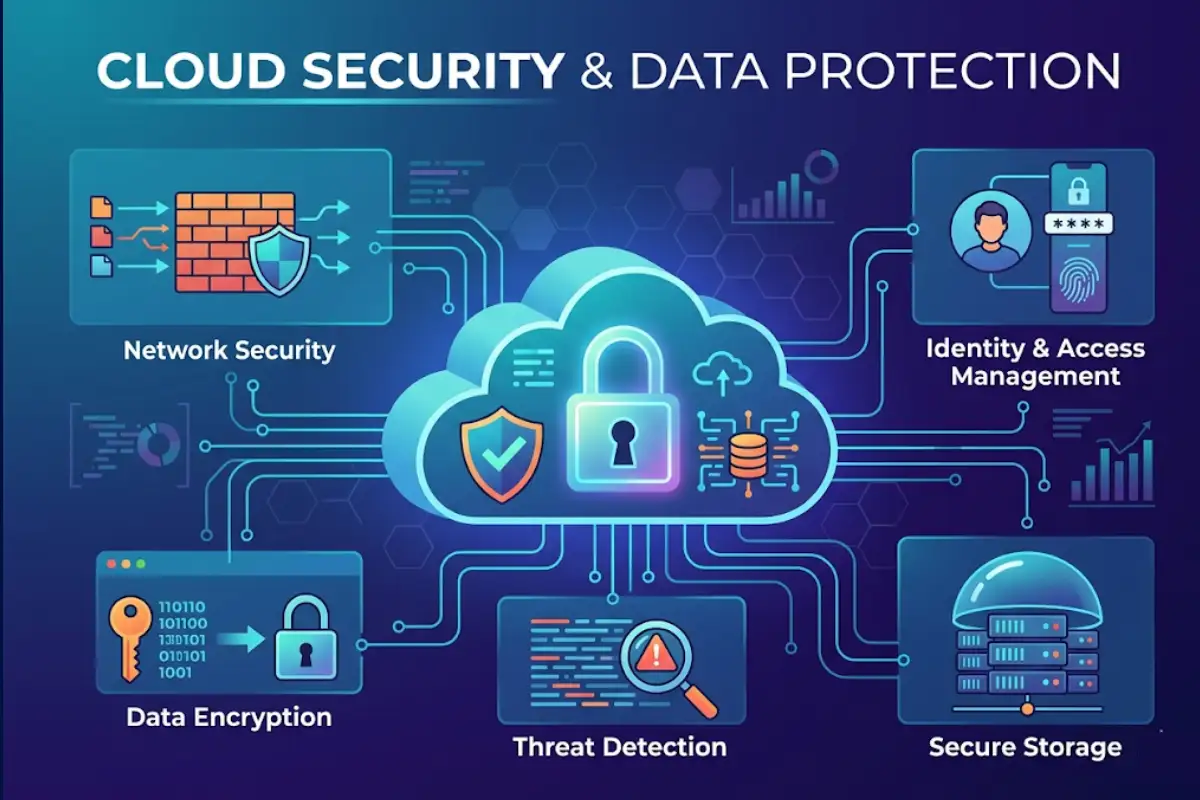
Cloud Security & Data Protection has emerged as a new must-have requirement for businesses of any size. With more and more of enterprise data, applications and workloads migrating to the cloud, safeguarding digital assets from cyber-attacks and unauthorized accesses has become a mandatory business process. Industry analysts and publications cite that the cloud-based infrastructure now runs 80-90% of modern business, creating a need for Security and Data Protection everywhere.
By reading through this guide, you will discover how cloud security works, what positive aspects it has, the best roadmaps for implementation and, finally, how firms may safely secure their data without overloading you or putting the company at risk of going against regulations.
Organizations investing in digital infrastructure often explore the broader benefits of cloud computing to improve scalability, flexibility, and operational efficiency.
 This article is part of
Benefits of Cloud Computing
Table of Contents
What Is Cloud Security & Data Protection?
This objective covers the operation of cloud security and what benefits it can bring, how it can be best implemented, and how an organisation can protect their data without sacrificing either efficiency or compliancy.
Cloud security encompasses:
- Identity and access management (IAM)
- Data encryption
- Network security controls
- Compliance monitoring
- Threat detection and response
- Backup and disaster recovery solutions
Data protection is an area that deals with confidentiality, availability and integrity of business information stored in the cloud.
Many cloud industry solutions include advanced security features tailored to specific sectors.
Cloud Security vs Traditional Security
| Feature | Traditional On-Premise Security | Cloud Security |
| Infrastructure Control | Fully managed internally | Shared responsibility model |
| Scalability | Limited | Highly scalable |
| Maintenance | Internal IT teams | Provider-assisted |
| Backup Capabilities | Manual or local | Automated and distributed |
| Disaster Recovery | Expensive | Built-in options available |
| Security Updates | Manual deployment | Continuous updates |
Unlock Enterprise-Strength Security now available to all organizations when they deploy to the cloud.
Understanding cloud computing basics is essential for implementing secure systems and protecting sensitive business data.
Security Benefits of Cloud Computing
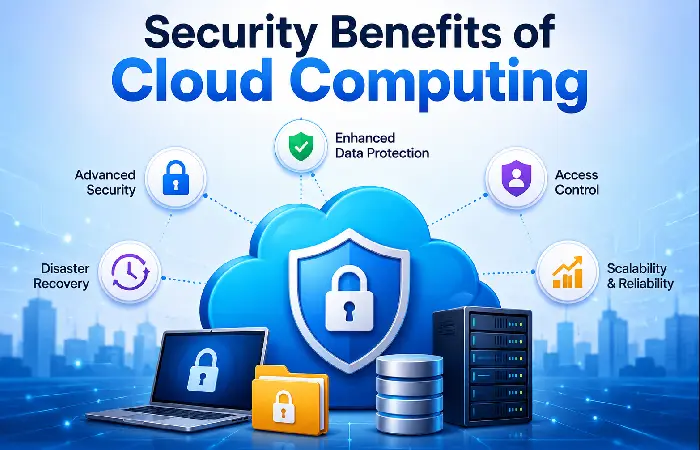
Using the cloud brings numerous security advantages.
- Advanced Encryption
Today, cloud providers encrypt data in motion and at rest securely using available industry encryption protocols.
- Continuous Security Monitoring
The cloud environment provides a monitoring facility that can be used for continuous monitoring of the system in order to detect unusual activities and security challenges.
- Automatic Security Updates
Vulnerabilities are patched and infrastructure is upgraded to make the public attack surface as small as possible.
- Identity and Access Controls
Businesses can implement:
- Multi-factor authentication (MFA)
- Role-based access control (RBAC)
- Single sign-on (SSO)
- Zero Trust security frameworks
- Regulatory Compliance Support
Major cloud providers support compliance standards including:
- GDPR
- ISO 27001
- SOC 2
- PCI DSS
- HIPAA
The growing focus on online protection has increased demand for professionals pursuing cloud computing careers with expertise in cybersecurity and compliance.
Cloud Data Backup & Disaster Recovery
Data loss continues to be one of the most serious problems for organizations migrating to the cloud.
Cloud Backup and disaster Recovery solutions provide a assurance for business continuity by always making duplicate copies of the essential data to more than one location.
Protecting information requires reliable cloud storage solutions with strong backup capabilities.
Key Components
| Component | Purpose |
| Automated Backups | Scheduled data protection |
| Geo-Redundancy | Data stored in multiple regions |
| Version Control | Recovery from accidental changes |
| Disaster Recovery Plans | Rapid restoration after outages |
| Continuous Replication | Near real-time data protection |
Recovery Objectives
| Metric | Description |
| RPO (Recovery Point Objective) | Maximum acceptable data loss |
| RTO (Recovery Time Objective) | Maximum downtime allowed |
The organizations with a solid backup framework will be restored rapidly from ransomware, hardware crashing, as well as the accidental deletion.
Modern businesses are integrating artificial intelligence in cloud computing to improve threat detection, monitoring, and automated security responses.
Is Cloud Computing Safe for Businesses?
One question which business executives are constantly asking is ‘are the clouds secure?’.
The answer is Yes if organizations follow security best practices and are aware of the shared responsibility model.
Shared Responsibility Model
| Cloud Provider Responsibilities | Customer Responsibilities |
| Physical security | User access management |
| Infrastructure maintenance | Data classification |
| Hardware protection | Security policies |
| Network infrastructure | Endpoint security |
| Core platform security | Application security |
The majority of the breaches to the cloud will not happen because the technology is not secure but misappropriated configurations, poor password selection, or lack of strong access control.
Strong cybersecurity strategies play a major role in maximizing the business benefits of cloud computing while reducing operational risks.
Common Cloud Security Risks
- Misconfigured storage buckets
- Insider threats
- Weak authentication
- Phishing attacks
- Unsecured APIs
- Malware and ransomware
The pro-active measures taken by all organizations to avoid such risks further enhances security.
Cloud Security Best Practices
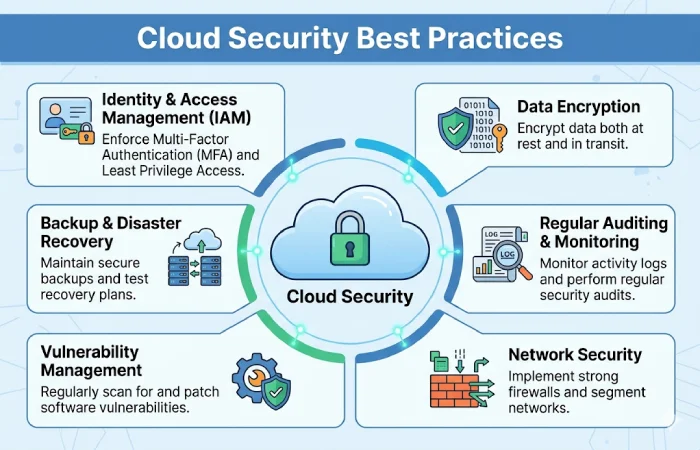
If an organisation has layered protection, it is best to make the most from this. Security professionals closely follow future cloud computing trends that impact data protection.
Implement Multi-Factor Authentication
Another form of authentication used by MFA is the additional level of verification, which further decreases available options of unsanctioned access.
Enforce Least Privilege Access
Access to resources must be limited to only what‘s required by staff.
Encrypt Sensitive Data
Data should be encrypted:
- At rest
- In transit
- During backups
Monitor and Audit Regularly
Conduct:
- Security assessments
- Vulnerability scans
- Compliance audits
- Access reviews
Develop Incident Response Plans
Prepare procedures for:
- Data breaches
- Ransomware incidents
- Service outages
- Insider threats
Employee Security Training
Despite the continuous training in awareness reduced the chances of getting a business email or social engineering attack.
Many enterprises rely on advanced cloud computing platforms that offer built-in security tools and encrypted data management features.
Cybersecurity in Cloud Computing
Cybersecurity is a key pillar for securing cloud environments against future activities.
Modern cloud cybersecurity includes:
Threat Detection
AI and machine learning are used to assist monitors in viewing anomalies as they occur in real time.
Security Information and Event Management (SIEM)
SIEM platforms: combining various log data sources into a single platform through automation of threat detection processes.
Extended Detection and Response (XDR)
XDR in its sytem combines endpoint, network, email and cloud monitoring into a single platform providing best-in class visibility.
Zero Trust Architecture
Zero Trust assumes no user or device should be trusted a priori. Core principles include:
- Verify every request
- Minimize privileges
- Continuously monitor activity
Top Cloud Security Solutions Comparison (2026)
| Cloud Security Solution | Best For | Key Features | Official Resource |
| Wiz | Multi-cloud visibility & risk prioritization. | Agentless CNAPP, CSPM, DSPM, attack path analysis, Security Graph | Wiz Cloud Security Academy |
| Palo Alto Networks Prisma Cloud | Enterprise cloud security and complianc | Code-to-cloud security, CSPM, CWPP, CIEM, compliance automation | Prisma Cloud Documentation |
| Microsoft Defender for Cloud | Azure and hybrid clouds | Native Azure security, threat protection, posture management, DevSecOps | Microsoft Defender for Cloud Docs |
| CrowdStrike Falcon Cloud Security | Mode of operation: protection while in progress and detection of threats. | CNAPP, CSPM, workload protection, threat intelligence, XDR integration | CrowdStrike Falcon Cloud Security |
| Orca Security | Commands within agentless cloud security actions and operations: | Attack path analysis, vulnerability management, compliance monitoring | Orca Security Learning Center |
| Check Point CloudGuard | Cloud network and workload security | Threat prevention, posture management, cloud firewall security | CloudGuard Documentation |
| Trend Micro Cloud One | Multi-clod workload protection | Container security, file storage protection, workload security | Trend Micro Cloud One Resources |
| Aqua Security | Security of security: Security of container: Kuber. | Container runtime protection, supply chain security, Kubernetes security | Aqua Security Learning Center |
Businesses should select tools based on regulatory requirements, budget, and security maturity. Understanding best practices is easier with detailed cloud comparisons and tutorials.
Frequently Asked Questions
What is cloud security?
Cloud security encompasses the technologies, policies and it resources that are used for protecting cloud computing resources (such as data, applications and infrastructure).
Why is cloud data protection important?
It assists in avoiding data breach and assists business continuity in the event of an incident and compliance.
Is cloud storage safer than local storage?
Most of the time, yes. Major cloud providers have superior security, redundancy and disaster recoverability than traditional local storage.
What is the biggest cloud security risk?
Mis-configured cloud resources are still the number one reason for data exfiltration from the cloud.
How often should cloud backups be performed?
Business critical systems should be backed up on a continuous/daily basis, as decided by the recovery requirements.
Conclusion
Cloud Security & Data Protection will always remain a fundamental aspect of operating a successful 21st century business. Any company implementing secure access control, encryption and backup frameworks and practices along with the tools to implement the latest cyber security essentials will take that journey peacefully with the cloud developments in 2026.
Kashifa Jafar is a technology writer and contributor at FutureTechExpert with 4+ years of experience in technology writing and content creation.
Read Full Bio of Author →Sameena reviews selected health, wellness, technology, and digital content for clarity, factual presentation, and reader usefulness.
Read Full Bio of Reviewer →