

 Kashifa Jafar
Technology Writer & Contributor
Kashifa Jafar is a technology writer and contributor at FutureTechExpert with 4+ years of experience in technology writing and content creation.
Read Full Bio of Author →
Kashifa Jafar
Technology Writer & Contributor
Kashifa Jafar is a technology writer and contributor at FutureTechExpert with 4+ years of experience in technology writing and content creation.
Read Full Bio of Author →
 Sameena Begum
Health, Technology & Digital Content Reviewer
Sameena reviews selected health, wellness, technology, and digital content for clarity, factual presentation, and reader usefulness.
Read Full Bio of Reviewer →
Sameena Begum
Health, Technology & Digital Content Reviewer
Sameena reviews selected health, wellness, technology, and digital content for clarity, factual presentation, and reader usefulness.
Read Full Bio of Reviewer →
Cloud Computing Basics is among the top technology concepts learners, businesses, students, and it professionals need to grasp by 2026. Almost all applications today, such as email apps, online videos, artificial intelligence, online banking, and more, run using cloud computing technology.
Instead of software and data existing on your PC, they become stored on the cloud. Reports of the industry show that cloud spending is on the rise all over the world as companies shift work from on premises to flexible cloud domains.
Learning the fundamentals of cloud computing is just a first step in understanding the digital skills needed, and the possibilities for working with cloud.
Modern cloud environments increasingly rely on artificial intelligence in cloud computing to automate processes and improve system performance.
 This article is part of
Benefits of Cloud Computing
Table of Contents
What Is Cloud Computing Explained Simply
Cloud computing is the provision of various services over the Web. that is everything could be provided via the internet.
These services include:
- Data storage
- Servers
- Databases
- Networking
- Software applications
- Artificial Intelligence tools
- Security services
Instead of buying and maintaining costly hardware, cloud computing users rent computing resources from the cloud provider and pay only for the resources that they actually use.
Learning about cloud industry solutions helps beginners understand real-world cloud applications.
Simple Example
Whereas your personal device would store everything for you, instead it is housed remotely in data centres run by cloud providers.
No matter you‘are storing pictures in Google Drive, accessing Netflix, or signing into Microsoft 365, you are using cloud computing.
Key Benefits
| Benefit | Description |
| Cost Savings | Eliminates expensive hardware purchases |
| Scalability | Resources increase or decrease instantly |
| Accessibility | Access from anywhere with internet |
| Security | Enterprise-grade protection available |
| Reliability | High uptime and disaster recovery |
| Speed | Rapid deployment of applications |
Once you understand the fundamentals, you can explore the broader benefits of cloud computing, including scalability, flexibility, and cost efficiency for organizations of all sizes.
Types of Cloud Computing Models
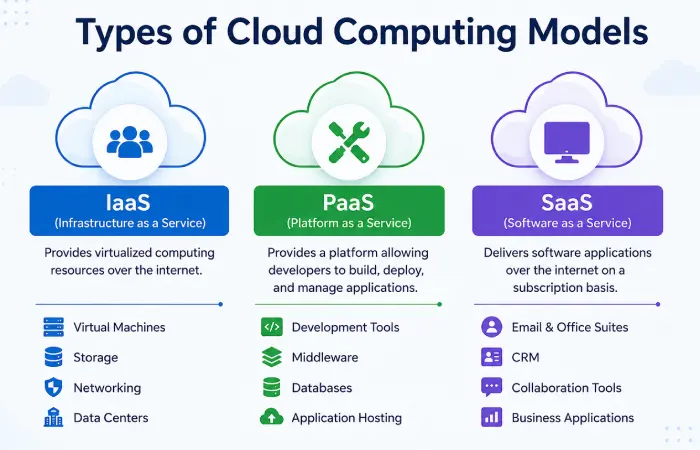
The characteristics of cloud computing can be classified under three service models. There are:
- Public Cloud
The infrastructure is provided by third parties.
Examples:
- Amazon Web Services (AWS)
- Microsoft Azure
- Google Cloud Platform
Best for:
- Startups
- Small businesses
- Web applications
- Software development
- Private Cloud
Dedicated infrastructure; Infrastructure is dedicated to an organization.
Benefits:
- Greater control
- Enhanced security
- Regulatory compliance
Best for:
- Healthcare organizations
- Government agencies
- Financial institutions
- Hybrid Cloud
Merge public and private clouds.
Benefits:
- Flexibility
- Cost optimization
- Improved workload management
Best for:
- Large enterprises
- Organizations with sensitive data
Beginners exploring online infrastructure often start by comparing leading cloud computing platforms used by businesses worldwide.
Public vs Private vs Hybrid Cloud
Choosing the most appropriate cloud deployment model appears to be the most important choices that a organization can make, as all models have a very profound impact on cost, security, agility and control.
By understanding the existing distinctions between the models, organizations can choose the best infrastructure to address their operational needs, compliance standards and growth strategies.
| Feature | Public Cloud | Private Cloud | Hybrid Cloud |
| Ownership | Third-party provider | Single organization | Combination of both |
| Initial Cost | Low | High | Medium |
| Operating Cost | Pay-as-you-go | Higher ongoing costs | Balanced |
| Security | High | Very High | Very High |
| Scalability | Excellent | Moderate | Excellent |
| Customization | Limited | Extensive | Extensive |
| Compliance Support | Moderate | Excellent | Excellent |
| Deployment Speed | Fastest | Slower | Moderate |
| Maintenance | Provider-managed | Organization-managed | Shared responsibility |
| Best Use Case | Startups & SMBs | Regulated industries | Large enterprises |
New users can build knowledge through cloud comparisons and tutorials that explain key concepts.
Leading Cloud Solutions by Deployment Model
| Cloud Model | Popular Solution | Ideal For | Official Resource |
| Public Cloud | AWS | Scalable applications and startups | AWS Cloud Services |
| Public Cloud | Microsoft Azure | Enterprise workloads | Microsoft Azure Cloud Concepts |
| Public Cloud | Google Cloud | AI and analytics workloads | Google Cloud Overview |
| Private Cloud | VMware Private Cloud | Enterprise infrastructure | VMware Private Cloud Solutions |
| Private Cloud | Red Hat OpenShift | Hybrid and private cloud deployments | Red Hat OpenShift Platform |
| Hybrid Cloud | IBM Hybrid Cloud | Enterprise hybrid environments | IBM Hybrid Cloud Solutions |
| Hybrid Cloud | Oracle Cloud Infrastructure | Enterprise databases and applications | Oracle Hybrid Cloud |
By 2026, most organizations will have adopted hybrid cloud as the long-term IT strategy of choice because it offers both the unlimited scale of pubic clouds to the everything-as-a-service world and, equally, the controls, resilience, cost-savings and security advantages of private infrastructure. However:
- A Public Cloud is still the cheapest solution for startups and developing businesses.
- Privates Cloud continues to be a ideal solution for highly regulated industries.
- Hybrid Cloud is the most well-balanced solution in terms of flexibility, security and performance for large enterprise.
As organizations continue adopting digital technologies, demand for professionals in cloud computing careers continues to grow rapidly.
Cloud Computing for Beginners

If you are new to cloud technology, focus on understanding these core concepts:
Cloud Service Models
SaaS (Software as a Service)
Software is accessed through internet by the users.
Examples:
- Gmail
- Dropbox
- Zoom
PaaS (Platform as a Service)
Developers create apps without managing servers.
Examples:
- Google App Engine
- Azure App Service
IaaS (Infrastructure as a Service)
Offers virtual servers, networking, and storage.
Examples:
- AWS EC2
- Azure Virtual Machines
Service Model Comparison
| Feature | SaaS | PaaS | IaaS |
| User Management | Minimal | Moderate | Extensive |
| Infrastructure Control | Low | Medium | High |
| Technical Skills Needed | Low | Medium | High |
| Deployment Speed | Fastest | Fast | Moderate |
Companies increasingly rely on cloud solutions because of the significant business benefits of cloud computing, from reduced IT costs to improved operational efficiency.
History & Evolution of Cloud Computing
Cloud computing is nothing new. It has been known for many years. Most cloud environments depend on efficient cloud storage solutions for data management and accessibility.
Cloud Computing Timeline
| Year | Milestone |
| 1960s | The development of time-sharing computer systems leads. |
| 1999 | Salesforce releases cloud CRM |
| 2002 | AWS web services are here! |
| 2006 | AWS EC2 launches |
| 2008 | Google App Engine released |
| 2010 | Microsoft Azure has been commercially launched. |
| 2020 | Adaptation of multi-cloud speeds up |
| 2026 | Enterprise growth is driven by AI-enabled cloud services. |
Evolution Trends in 2026
- AI-integrated cloud platforms
- Edge computing expansion
- Serverless computing growth
- Multi-cloud strategies
- Green cloud infrastructure
- Enhanced cybersecurity automation
Cloud Platform Comparison (2026)
| Provider | Strengths | Best For |
| AWS | Largest service ecosystem | Enterprises |
| Microsoft Azure | Strong Microsoft integration | Corporate IT |
| Google Cloud | AI and analytics leadership | Data-driven businesses |
| IBM Cloud | Hybrid cloud expertise | Regulated industries |
| Oracle Cloud | Database performance | Enterprise applications |
Cloud Adoption Statistics (2026)
Global Enterprise Cloud Usage
| Technology Area | Adoption Rate |
| Cloud Storage | 94% |
| SaaS Applications | 92% |
| Hybrid Cloud | 76% |
| AI Cloud Services | 71% |
| Multi-Cloud Strategy | 68% |
Understanding cloud fundamentals also involves learning about cloud security and data protection to ensure safe and reliable digital operations.
Frequently Asked Questions
What is cloud computing in simple words?
Cloud Computing It is distribution of computing resources (like servers, storage, applications and services) over the web.
What are the three types of cloud computing?
The deployment models include: Public Cloud, Private Cloud, and Hybrid Cloud.
Is cloud computing difficult to learn?
No. All beginners are able to learn supply of cloud computing service model and key fundamentals in several days.
Which cloud platform is best for beginners?
Each free tier for each of AWS, Microsoft Azure and Google Cloud is quite simple.
Why is cloud computing important?
Cloud computing benefits include: cost reduction, flexibility, elasticity, increase of accessibility and supporting several modern technologies like AI and machine learning.
Final Thoughts
The Basics of Cloud Computing have become a fundamentally important aspect of business and technology in today‘s digital economy. If you are a student choosing a path of technology careers, a business owner looking for a scalable infrastructure, or an IT professional broadening your skill set, utilizing cloud computing will be the foundation for your success.
Learning deployment models and service levels and gaining an understanding of the major cloud computing providers will allow you to establish a comprehensive knowledge for one of the largest impact technologies of 2026.
Exploring future cloud computing trends provides insight into the evolution of cloud technologies.
Kashifa Jafar is a technology writer and contributor at FutureTechExpert with 4+ years of experience in technology writing and content creation.
Read Full Bio of Author →Sameena reviews selected health, wellness, technology, and digital content for clarity, factual presentation, and reader usefulness.
Read Full Bio of Reviewer →