
 Kashifa Jafar
Technology Writer & Contributor
Kashifa Jafar is a technology writer and contributor at FutureTechExpert with 4+ years of experience in technology writing and content creation.
Read Full Bio of Author →
Kashifa Jafar
Technology Writer & Contributor
Kashifa Jafar is a technology writer and contributor at FutureTechExpert with 4+ years of experience in technology writing and content creation.
Read Full Bio of Author →
 Sameena Begum
Health, Technology & Digital Content Reviewer
Sameena reviews selected health, wellness, technology, and digital content for clarity, factual presentation, and reader usefulness.
Read Full Bio of Reviewer →
Sameena Begum
Health, Technology & Digital Content Reviewer
Sameena reviews selected health, wellness, technology, and digital content for clarity, factual presentation, and reader usefulness.
Read Full Bio of Reviewer →
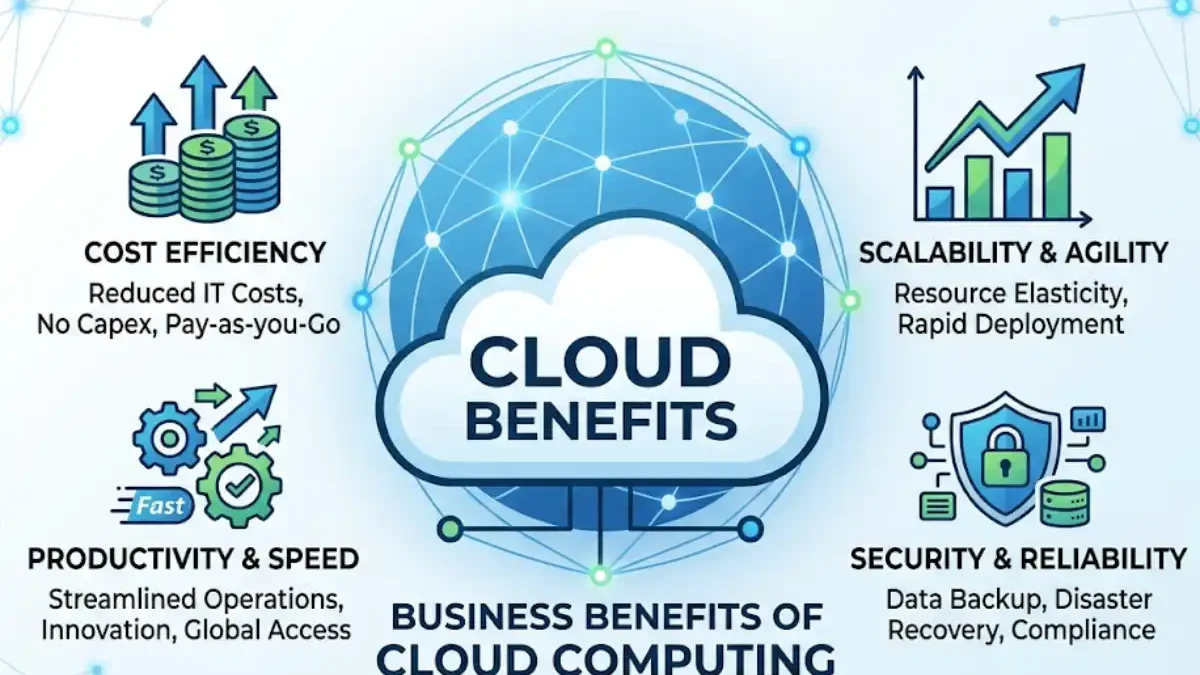
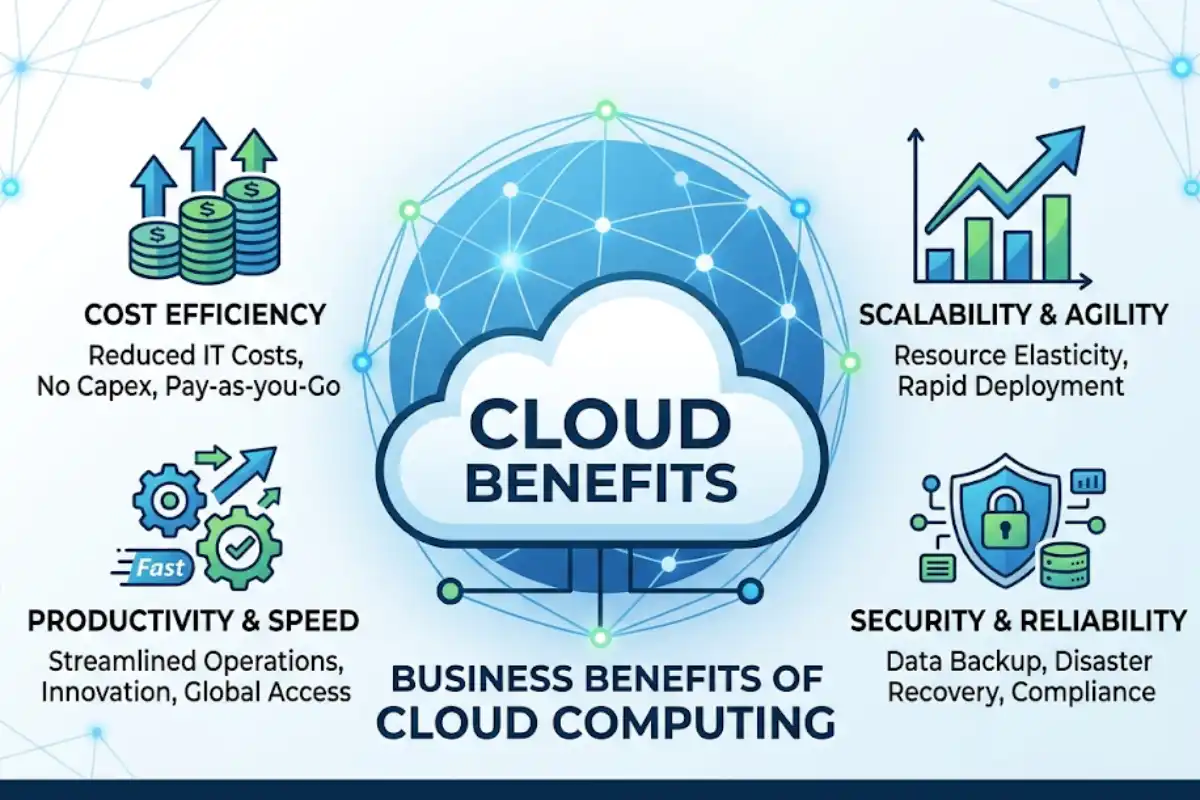
One of the most significant technology developers impacting business growth in 2018 is cloud computing. The Business Benefits of Cloud Computing implications extend well beyond mass storage.
Organizations of all types and sizes startups to global companies are employing cloud technology for cost savings and greater innovation, secure data sharing and more effective collaboration.
Industry research shows that now over 90% of companies utilize at least one cloud service and cloud spending is still on the rise while firms are still transitioning into new operation models.
Regardless if you own a small firm, a virtual team or a startup, cloud computing has the ability to give you a competitive edge. In this white paper, you will find out how cloud computing can help companies, why they are moving to the cloud and how to find the right cloud solution.
Businesses often implement cloud industry solutions to streamline operations and reduce costs.
Table of Contents
What Is Cloud Computing?
Cloud Computing is a style of computing in which IT resources applications and infrastructure are supplied as a service over the internet (“the cloud”). With a cloud you can work-on-demand, only pay for the usage rather than investing in costly hardware and supporting it. This makes cloud computing more flexible, scalable and cheaper than traditional hardware.
While businesses focus on operational advantages, it’s also important to understand the broader benefits of cloud computing, including flexibility, scalability, and enhanced accessibility.
 This article is part of
Benefits of Cloud Computing
Benefits of Cloud Computing for Small Businesses

A small business is also vulnerable to all those conditions of disadvantages such as budget constrain, lack of dedicated IT personnel, and growing operation demands and so on. They can get rid of these disadvantages by using cloud computing.
Decision-makers often use cloud comparisons and tutorials when selecting service providers.
Key Benefits
Lower Upfront Costs
With this cloud computing service, companies have the convenience of paying for what they are actually consuming rather than to pay large sums of money on servers and networking equipment.
Better Flexibility
The Cloud allows teams to work from anywhere at any time and on any device while sharing common data and services.
Faster Deployment
Companies are able to deploy websites, applications and internal systems in hours rather than weeks.
Improved Security
Billions are poured into state-of-the-art security technologies by top-tier cloud providers that most SMBs could not possibly afford to deploy on their own.
Automatic Updates
Providers undertake upgrades and maintenance taken care of by the IT Lightening the load.
Small Business Cloud Comparison
| Feature | Traditional IT | Cloud Computing |
| Initial Cost | High | Low |
| Maintenance | Business Managed | Provider Managed |
| Scalability | Limited | On-Demand |
| Remote Access | Difficult | Easy |
| Deployment Speed | Weeks | Hours |
Companies adopting digital transformation strategies often prioritize cloud security and data protection to safeguard business operations and sensitive information.
How Cloud Computing Reduces Business Costs
Cost savings are by far the biggest reason why organizations adopt the cloud.
- Elimination of Hardware Expenses
All companies no longer are required to buy and maintain servers, cooling equipment, networks, etc is too expensive.
- Reduced IT Staffing Costs
‘Cloud providers are able to address infrastructure management costs and free up resources of much smaller IT teams.’
- Pay-As-You-Go Pricing
The charge is based solely on the systems resources actually consumed.
- Lower Downtime Costs
Cloud provider infrastructures are highly available and redundant thus reducing the productivity losses suffered in outages.
Scalable cloud storage solutions support growing business data requirements.
Why Enterprises Are Moving to the Cloud
Many large organizations are now adopting a cloud-first strategy.
Enterprise Benefits
Scalability
Resources can be scaled instantly for moments of high peak demand.
Global Reach
Cloud providers also location data centers around the world to optimize application performance.
Business Continuity
On-line disaster recovery services and backups safeguard vital business information.
AI and Analytics
Modern cloud platforms are integrated with machine learning and business intelligence.
Faster Innovation
Ease of development Development teams are able to develop and launch new applications much more quickly.
The growing demand for digital infrastructure has created strong opportunities in cloud computing careers across technology-driven industries.
Enterprise Cloud Adoption Drivers
| Driver | Impact |
| Digital Transformation | High |
| Security Improvements | High |
| Cost Optimization | High |
| Remote Workforce Support | Medium |
| AI Adoption | Growing |
Cloud Computing for Remote Work
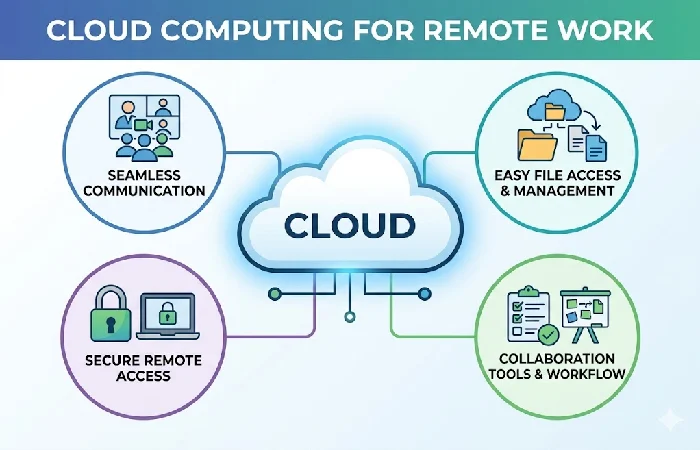
The era of remote and hybrid working has propelled access to cloud computing services to become the lifeline of many business operations.
Major Advantages
Anywhere Access
It (can be accessed) from any location.
Real-Time Collaboration
TEAM members can collaborate on documents, programs and communication tools.
Improved Productivity
Cloud workflows replace the old and clunky file sharing system.
Better Communication
Unified communications ease meetings, messaging, project management.
Many organizations improve scalability and efficiency by investing in advanced cloud computing platforms tailored for modern enterprise needs.
Recommended Cloud Tools
| Tool Category | Tool Name | Best For | Key Features | Resource Link |
| Productivity Suite | Microsoft 365 | Businesses of all sizes | Word, Excel, Teams, OneDrive, AI-powered productivity | Microsoft Official |
| Productivity Suite | Google Workspace | Remote teams & collaboration | Gmail, Docs, Drive, Meet, Gemini AI integration | Google Official |
| Video Conferencing | Zoom Workplace | Hybrid and remote work | Meetings, Team Chat, AI Companion, Webinars | Zoom Official |
| Team Collaboration | Microsoft Teams | Enterprise communication | Chat, meetings, file sharing, collaboration | Microsoft Official |
| Cloud Storage | Google Drive | Document storage & sharing | Real-time collaboration, cloud backups | Google Official |
| Cloud Storage | Dropbox Business | File management | Secure sharing, backup, collaboration | Dropbox Official |
| Infrastructure Cloud | Amazon Web Services (AWS) | Enterprise cloud infrastructure | Compute, storage, AI, analytics | AWS Official |
| Infrastructure Cloud | Microsoft Azure | Hybrid cloud environments | Virtual machines, databases, AI services | Azure Official |
| Infrastructure Cloud | Google Cloud Platform (GCP) | AI and data analytics | BigQuery, Vertex AI, cloud storage | Google Cloud Official |
| CRM Platform | Salesforce Cloud | Customer relationship management | Sales, marketing, automation | Salesforce Official |
| Project Management | Asana | Task and workflow management | Project tracking, automation | Asana Official |
| Project Management | Monday.com | Team productivity | Dashboards, workflow automation | Monday Official |
| Cloud Security | Cloudflare Zero Trust | Secure remote access | Network security, access control | Cloudflare Official |
| Backup & Recovery | Veeam Backup & Replication | Business continuity | Backup, disaster recovery | Veeam Official |
Cloud Technology for Startups
What do startups require to effectively operate? Startups require flexibility, rapidity and low costs. Everything is provided by the latest cloud technology.
Startup Advantages
Rapid Scaling
Infrastructure can expand simultaneously with the needs of the customers.
Lower Risk
Require no costly large initial investments of servers.
Faster Product Launches
Instantaneously class can be created.
Access to Advanced Technology
Startups have opportunity to utilize AI, machine learning, analytics and automation tools which would not have previously been available to a small enterprise.
Companies that monitor future cloud computing trends can gain a competitive advantage.
Startup Growth Comparison
| Factor | Traditional Setup | Cloud-Based Startup |
| Launch Speed | Months | Days |
| Infrastructure Cost | High | Low |
| Scalability | Limited | Instant |
| Global Expansion | Difficult | Easier |
Cloud Provider Comparison (2026)
Choosing the right provider is critical.
| Provider | Best For | Strength |
| AWS | Enterprises | Largest ecosystem |
| Microsoft Azure | Microsoft environments | Hybrid cloud |
| Google Cloud | AI & Analytics | Machine learning |
| IBM Cloud | Regulated industries | Enterprise solutions |
| Oracle Cloud | Databases | High-performance workloads |
If you’re new to cloud technology, reviewing the basics of cloud computing can help you better understand how cloud services support modern business operations.
Frequently Asked Questions
What is the biggest benefit of cloud computing for businesses?
One of the major benefits of this concept is cost savings. It scalable, flexible, as well as increases operational efficiency.
Is cloud computing secure for businesses?
Yes. The large cloud providers spend large sums on encryptions, regulation, threat detection, safety monitoring.
How much can businesses save with cloud computing?
Many organizations have experienced close to 50% infrastructure savings, variable based on workload and implementation approach.
Which cloud provider is best?
AWS, Microsoft Azure and Google Cloud are still dominant but its best-take plan is demanding business needs.
Is cloud computing suitable for startups?
Definitely. With the cloud services, startups can get to launch fast and scale easily with very low infrastructure costs.
Final Thoughts
Business Benefits of Cloud Computing: it is also getting more and more popular with the business entering another period of digitization of world. The cloud solutions help businesses cut costs of operation, operate across borders, utilize new AI technology, support work no matter where people are.
For a startup expecting to grow, a small business wishing to become more efficient or a large enterprise trying to migrate and to optimize your infrastructure, cloud computing gives you the agility and advantage to win the digital economy.
The right cloud strategy and provider will help the company do two things increase productivity and strengthen security leading to a sustainable future. Picking the right strategy and provider will help a company‘s increase productivity, increase security, and have a sustainable future.
Businesses are increasingly integrating artificial intelligence in cloud computing to automate workflows and improve operational productivity.
Kashifa Jafar is a technology writer and contributor at FutureTechExpert with 4+ years of experience in technology writing and content creation.
Read Full Bio of Author →Sameena reviews selected health, wellness, technology, and digital content for clarity, factual presentation, and reader usefulness.
Read Full Bio of Reviewer →