

Last Updated: August 12, 2026
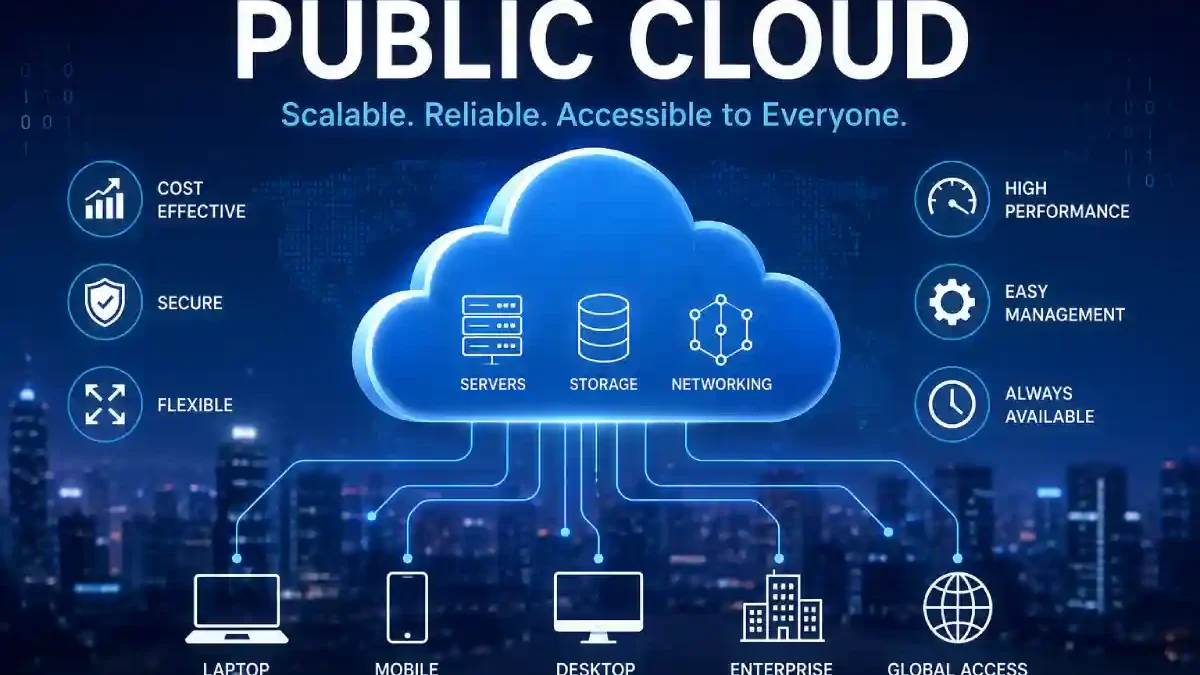
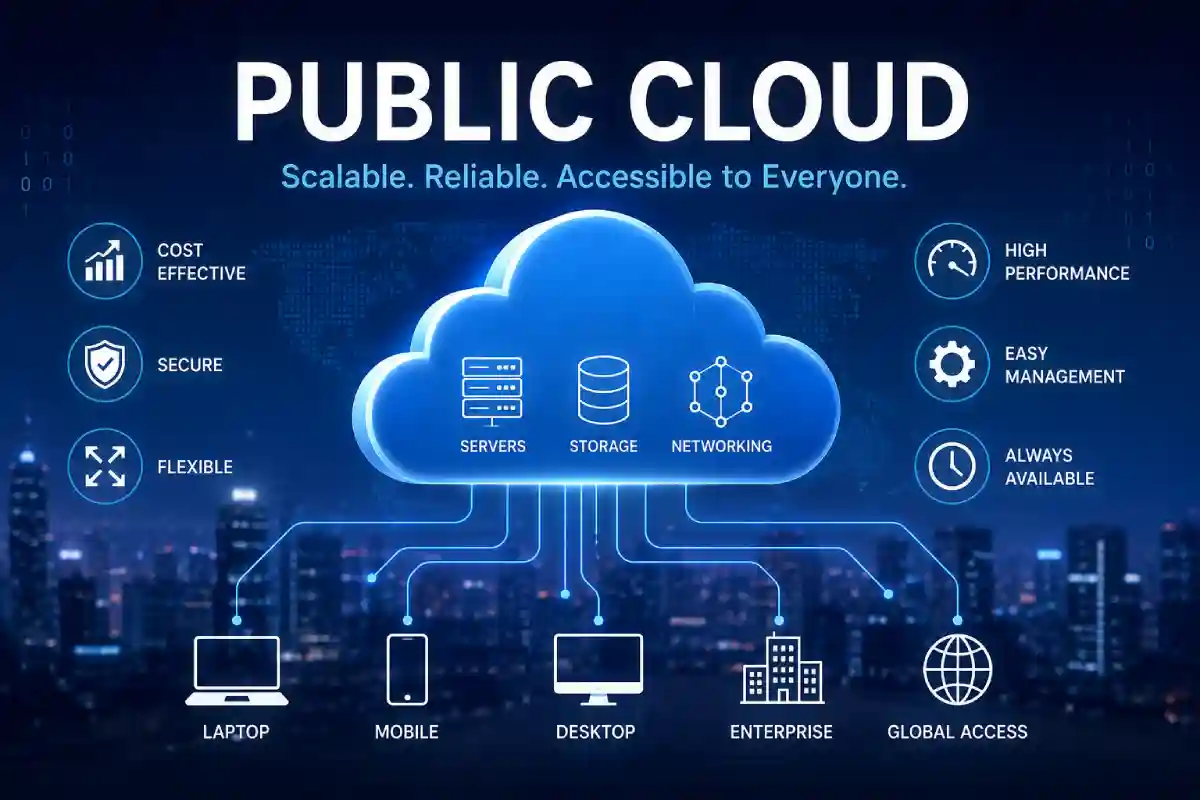
Public cloud is a cloud computing model provided by third-party organizations that use the internet to supply a range of service including servers, storage, databases, networking, applications, and development platforms. Instead of purchasing and managing both hardware and software, organizations can take use of on demand service with pay as you go pricing.
Public cloud environments and services enable startups, enterprises, developers, governments and individual users to get up and running quickly with innovative technologies, scalable capacity, and managed services without the need to establish their own data centres.
In 2026, AI infrastructure, application modernization, scalable data platforms and consumption-oriented IT will be even more influential catalysts for public cloud adoption. According toGartner, Indian public cloud market will grow to US$17.5 billion, a 28.1% increase over the FY25 figure of US$13.7 billion. IaaSis expected to report the fastest growth rate in 2026 at 40%.
Table of Contents
What Is Public Cloud?
Public cloud an IT environment in which the infrastructure is owned and operated by a cloud provider and its computing resources are offered to numerous customers over the Internet.
Providers are managing extensive data centers housing servers, storage devices, network technologies and virtualization. Virtual enterprises are providing access to resources via web UI, command line interface, APIs, auto-provisioning.
The major public cloud providers include:
- Amazon Web Services (AWS)
- Microsoft Azure
- Google Cloud
- IBM Cloud
- Oracle Cloud Infrastructure (OCI)
The National Institute of Standards and Technology (NIST) refers to public cloud infrastructure as infrastructure that is made available for use by the general public.
However, in the cloud approach, users may not need to buy a server beforehand to run their apps, like a traditional data center.
How Public Cloud Works
Public Cloud providers–these organizations bring together the physical infrastructure, virtualization, software defined network, and the automation and management platforms to provide a service.A simplified process looks like this:
User → Internet/API → Cloud Platform → Virtual Resources → Application/Data
E.g. purchasing a cloud services such as managed databases, virtual machines, object storage, networking service for the company to host an ecommerce site rather than establish a data center.
Resource management by virtualization of the underlying physical infrastructure into logical entities which then can be allocated among customers. In the public cloud, these environments are typically multi-tenant; several customers share a common pool of underlying infrastructure while logically isolating their workloads and data.
Common Public Cloud Service Models
| Model | What You Get | Typical Uses | Resource |
| IaaS | Virtual servers, storage and networking | Hosting applications, databases and workloads | AWS IaaS |
| PaaS | Managed application-development environment | App development and deployment | Microsoft Azure PaaS |
| SaaS | Ready-to-use software | Email, collaboration and business applications | Google Cloud SaaS overview |
Key Features of Public Cloud
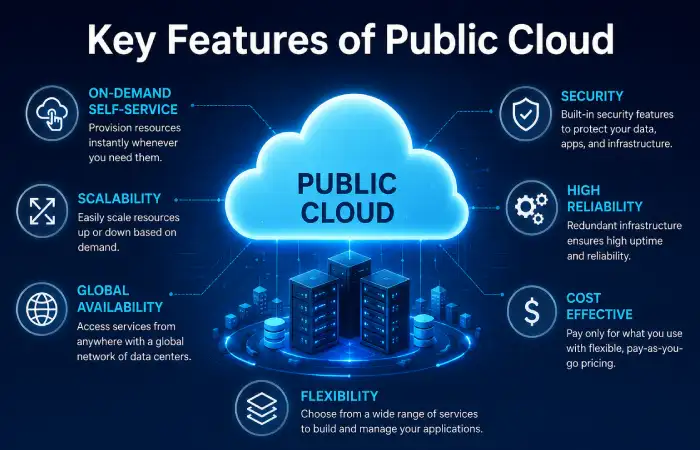
Public cloud platforms commonly provide:
- On-demand provisioning: Resources can be created when needed.
- Multi-tenancy: Infrastructure is shared while customer workloads remain logically isolated.
- Self-service management: Users can provision and manage resources through dashboards or APIs.
- Elastic scalability: Capacity can increase or decrease according to workload requirements.
- Global infrastructure: Providers operate regions and data centers across multiple geographic locations.
- Managed services: Customers can use databases, analytics, AI, security and other services without managing every underlying component.
- Usage-based billing: Many services use pay-as-you-go pricing.
These features are advantageous for businesses seeking to obtain infrastructure flexibility in the absence of owning any physical hardware.
Benefits of Public Cloud
- Lower Upfront Infrastructure Costs
A company is able to hold off on the purchase of a great quantity of physical infrastructure until the exact amount that is needed becomes apparent.2. Fast Deployment
Cloud resources can generally be provisioned in minutes rather than having to wait for servers to be bought, shipped and installed.
- Scalability
They can also add resources during high loads and cut back during lower loads.
- Access to Advanced Technology
Public cloud platforms make available AI, machine learning, analytics, databases, high performance infrastructure and serverless operating environment which might be costly otherwise.
- Reduced Infrastructure Management
The provider is responsible for the up-keep of the infrastructure data centers, physical servers and many other components of the infrastructure.
- Global Availability
Organizations can also host applications and services nearer to end users with the use of distributed cloud regions around the globe.
AWS, Google Cloud and Microsoft Azure all highlight auto-scaling, managed services and ga globally distributed architecture as critical public-cloud features.
Challenges of Public Cloud
It does not mean that a public cloud is always cheaper, easier or safer for any types of workloads.
Common challenges include:
- Unexpected cloud bills
- Vendor lock-in
- Configuration errors
- Data privacy and compliance requirements
- Internet dependency
- Migration complexity
- Skills shortages
- Performance variability
- Managing multiple cloud services
- Data transfer and egress costs
One of the biggest problems is how to manage costs of running in the cloud. An application that costs very little to run in development can turn into costly project when then the amount of storage, compute, database requests, network and data transfer increase.
Therefore, organizations should track usage rather than assume that pay as you go means just in time to justify the costs.
Public Cloud Security
Security for the public cloud is based on a shared responsibility model for cloud security.
The cloud provider, in most cases, has the responsibility of how to secure the underlying cloud infrastructure, whereas the customer is responsible for how to secure the workloads, identities, configurations and data as appropriate to the services used.
Important controls include:
- Multi-factor authentication
- Identity and access management
- Encryption at rest and in transit
- Network segmentation
- Security monitoring
- Vulnerability management
- Logging and auditing
- Backup and disaster recovery
- Least-privilege access
- Secure configuration policies
Public cloud, does not imply that customer data is exposed to the world. The physical infrastructure serving workloads of multiple customers is shared, but the workloads don‘t have to be shared.
Public Cloud Scalability and Flexibility
Scalability is one of the reasons, one of the main reasons that organizations turn to public cloud.
For instance, an online retailer might need more compute capacity on the day of a big sale but a far lesser amount during the rest of the year.
Public cloud supports several scaling approaches:
- Vertical scaling: Increase the resources assigned to an existing instance.
- Horizontal scaling: Add additional instances.
- Auto-scaling: Automatically adjust resources according to predefined conditions.
- Serverless scaling: Let the provider dynamically allocate execution resources.
This lack of flexibility is undesirable for applications like ML and AI workloads.
Public Cloud Pricing and Resource Management
Public cloud pricing varies by provider and service. Common billing models include:
| Pricing Model | How It Works | Best For |
| Pay-as-you-go | Pay for actual consumption | Variable workloads |
| Reserved/committed pricing | Commit to usage for discounts | Predictable workloads |
| Spot/preemptible | Discounted spare capacity | Flexible batch workloads |
| Subscription | Fixed recurring charge | Certain SaaS services |
Resource Management
| Provider | Major Cloud Services | Pricing Resource |
| AWS | Compute, storage, databases, AI/ML | AWS Pricing |
| Microsoft Azure | Compute, databases, AI, networking | Azure Pricing |
| Google Cloud | Compute, storage, data, AI | Google Cloud Pricing |
In 2026, Cost optimization is gaining more importance due to the significant volume of computing, storage and networking resources utilized by AI workloads. FinOps maturity growth and disciplined cloud use have been singled out as particular priorities by Gartner.
Common Public Cloud Use Cases
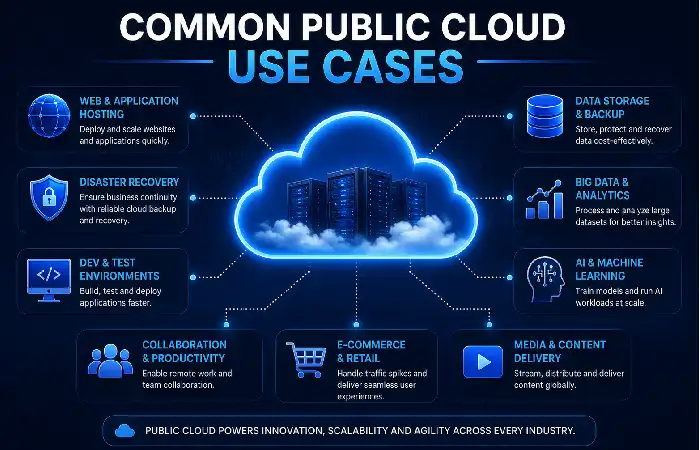
Public cloud is used across many industries for:
- Website and application hosting
- Data backup and disaster recovery
- Software development and testing
- AI and machine learning
- Big-data analytics
- Content delivery
- Database hosting
- Ecommerce platforms
- Remote work applications
- Digital transformation projects
The growing importance of AI. Gartner notes that the need for AI-ready infrastructure such as GPU, high performance computing, networking and scalable storage are helping to boost adoption of IaaS in India.
How to Choose a Public Cloud Environment
The workload should determine the choice of a public cloud provider, and not the brand.
Evaluate:
- Required compute capacity
- Storage requirements
- Database compatibility
- AI/ML requirements
- Geographic availability
- Security controls
- Compliance requirements
- Pricing structure
- Existing technology stack
- Technical expertise
- Support options
- Migration complexity
- Vendor lock-in risk
FAQs About Public Cloud
Is the public cloud safe?
Yes, public cloud can be extremely secure but with the right configuration. It is important to note that from a security perspective the cloud provider and the customer are sharing responsibility, so poor identity controls, vulnerable resources or mis configuration could leave you at risk.
Public Cloud Is AWS a Public Cloud?
Yes, Amazon Web Services (AWS) is a public cloud provider that offers the infrastructure and managed services to all customers over the internet.
What are some public clouds?
They include a few prominent public cloud platforms such as AWS, Microsoft Azure and Google Cloud.
Public cloud or private cloud?
It all comes down to the workload. For certain scenarios, a public cloud can help minimize initial infrastructure expenditure and offer scalable consumption; for others, if not carefully monitored, it can have a significant impact on the total operating spend.
How do public and private Clouds differs?
Public cloud utilizes shared infrastructure, managed by the provider, that can be shared by multiple customers. Private cloud is provisioned for exclusive use by a single organization. Choice of model will depend on requirements for control, cost, scalability, security and compliance.
Final Takeaway
Public cloud has grown from being just a cheap alternative to in-house physical servers into an underlying platform for today‘s applications, data analysis and AI and digital services. The most significant benefits are the on-demand access, elastic scalability, managed services and variable consumption of resources.
However, moving workloads to the public cloud isn‘t enough for successful public cloud adoption. Strong security controls, cost oversight, governance, workload planning, and provider selection will be needed.