

 Kashifa Jafar
Technology Writer & Contributor
Kashifa Jafar is a technology writer and contributor at FutureTechExpert with 4+ years of experience in technology writing and content creation.
Read Full Bio of Author →
Kashifa Jafar
Technology Writer & Contributor
Kashifa Jafar is a technology writer and contributor at FutureTechExpert with 4+ years of experience in technology writing and content creation.
Read Full Bio of Author →
 Sameena Begum
Health, Technology & Digital Content Reviewer
Sameena reviews selected health, wellness, technology, and digital content for clarity, factual presentation, and reader usefulness.
Read Full Bio of Reviewer →
Sameena Begum
Health, Technology & Digital Content Reviewer
Sameena reviews selected health, wellness, technology, and digital content for clarity, factual presentation, and reader usefulness.
Read Full Bio of Reviewer →
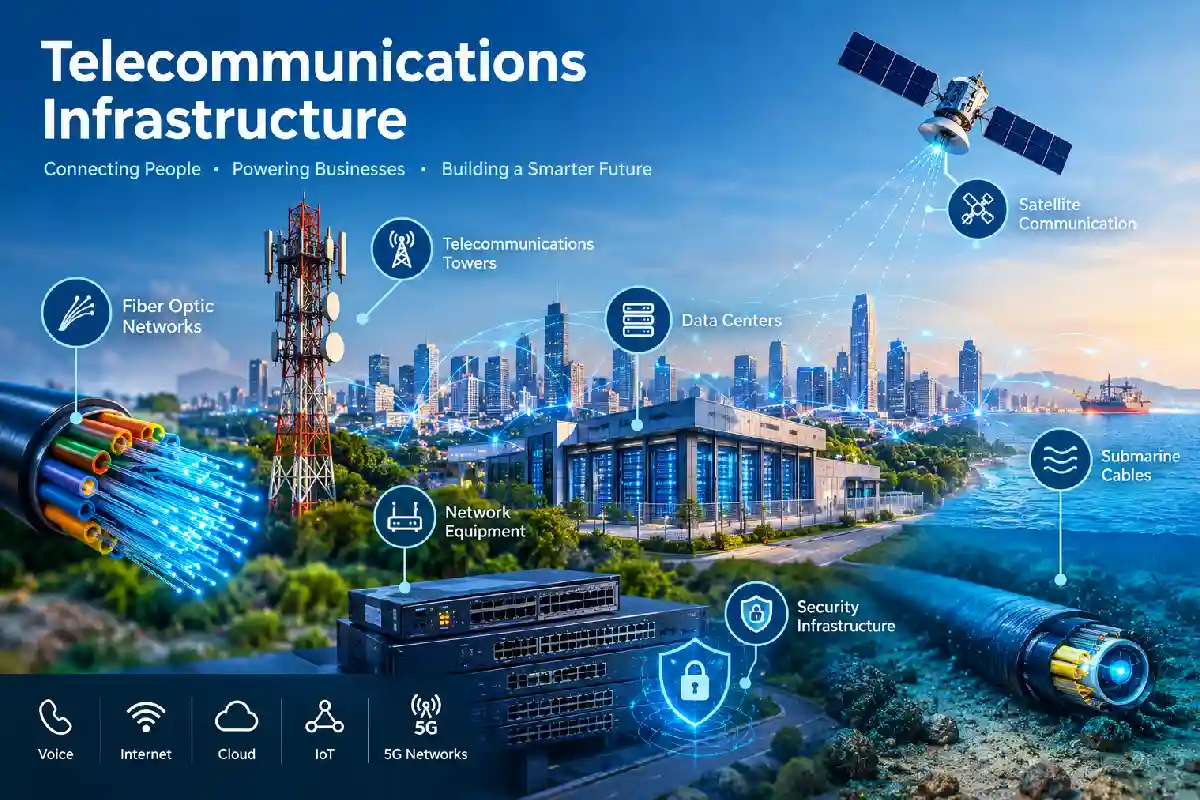
Telecommunications infrastructure is the backbone of the digital economy by providing voice communication, internet, video, cloud computing, and digital communication facilities around the world. It includes fiber optics, base stations, data centers, submarine cable systems.
With an ever-increasing share of global internet traffic being generated by AI, Cloud Computing, IoT devices, and 5G rollout, enterprises and governments are racing to upgrade telecom networks. Learning about the present telecommunications infrastructure gives enterprises a benchmark to compare their innovations against, and offers a glimpse into the world‘s other telecom systems.
 This article is part of
Telecommunications Services Resources
Table of Contents
What Is Telecommunications Infrastructure?
Telecommunications infrastructure is the underlying physical and electronic systems that carry data, voice, video, and internet traffic between customers and the network. These are the networks, cablees, towers, switching systems, routers, data centers, satellites and network management platforms that enable the provision of new services.
Without telecommunications infrastructure, services such as:
- Mobile communications
- Broadband internet
- Cloud computing
- Video conferencing
- Streaming services
- IoT connectivity
The telecommunications infrastructure, consisting of a mixture of wired and wireless infrastructure, is designed to provide a robust link from one city to the next, country to the next, and even continent to the next.
Components of Telecommunications Infrastructure
The telecommunications infrastructure is made up of several interlinked systems that work collaboratively to facilitate voice, data, video and internet communications. These systems represent the essential infrastructure upon which all digital communication is based, from mobile phone calls and internet access, to cloud computing and the Internet of Things (IoT).
This knowledge furthers the understanding on how these telecommunications networks operate efficiently and reliably.
| Component | Purpose |
| Fiber Optic Networks | High-speed data transmission |
| Mobile Towers | Wireless communication |
| Data Centers | Store and process network data |
| Routers & Switches | Direct network traffic |
| Submarine Cables | International connectivity |
| Satellite Systems | Remote-area communication |
| Security Systems | Network protection |
This forms all the infrastructure needed for a telecommunications network, providing services to millions of individual users.
Telecommunications infrastructure forms the backbone of global communication by supporting voice, data, and internet transmission across various platforms. To gain a broader understanding of the industry, read our complete guide on telecommunications.
Fiber Optic Infrastructure
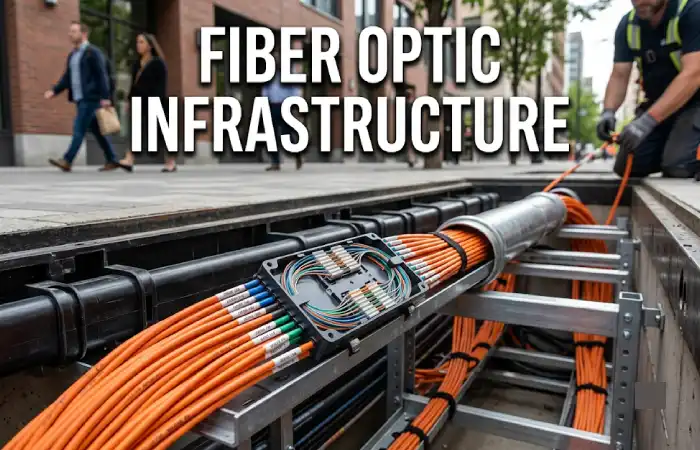
Fiber optic infrastructure is the backbone of the telecommunications network.
Has a fiber-optic cable as oppose to a copper cable which transmits data by your computer to the other at high speeds over long distances with very little deterioration of the signal.
Benefits of Fiber Optics
| Feature | Fiber Optic | Traditional Copper |
| Speed | Up to 800 Gbps+ | Limited |
| Distance | Very Long | Moderate |
| Reliability | High | Medium |
| Interference | Low | Higher |
| Maintenance | Lower | Higher |
Key Applications
- Broadband internet services
- Enterprise networking
- Cloud connectivity
- 5G backhaul
- Data center interconnection
A robust infrastructure includes switches, routers, transmission equipment, and data centers that work together as integrated telecommunications systems to ensure seamless communication services.
Mobile Network Infrastructure
Mobile network infrastructure provides the means for wireless transmission by the means of cell and base stations.
Major Components
- Cell towers
- Antennas
- Radio equipment
- Baseband units
- Backhaul networks
- Core network systems
Evolution of Mobile Infrastructure
| Generation | Speed | Main Use |
| 3G | Mbps | Mobile internet |
| 4G LTE | 100+ Mbps | Streaming |
| 5G | Multi-Gbps | AI, IoT, Automation |
| 6G (Future) | Expected Tbps | Advanced immersive services |
Modern telecom infrastructure depends on advanced hardware, software, and transmission methods to deliver reliable connectivity. Staying updated with the latest communication technologies can help organizations improve network performance and efficiency.
Data Centers and Telecommunications
A data center is the nerve center where digital information is stored, processed and routed.
Telecommunications providers rely on data centers to support:
- Cloud services
- Network management
- Content delivery
- AI workloads
- Customer applications
Telecom Data Center Comparison
| Type | Best For |
| Enterprise Data Center | Internal operations |
| Colocation Facility | Shared infrastructure |
| Edge Data Center | Low-latency applications |
| Hyperscale Data Center | Massive cloud services |
Telecommunications Towers
It would be more economically and technically feasible to put up telecommunications towers structures that hold up antennas and wireless gear.
Common Tower Types
| Tower Type | Characteristics |
| Monopole | Space-efficient |
| Lattice | High-capacity |
| Guyed Tower | Cost-effective |
| Rooftop Tower | Urban deployment |
Why Towers Matter
- Expand network coverage
- Improve signal quality
- Support growing mobile traffic
- Enable 5G deployment
With the proliferation of mobile usage across the world, telecom operators will continue to invest in tower infrastructure.
As networks become more connected, protecting infrastructure from cyber threats is critical. Implementing strong telecommunications security measures helps safeguard sensitive information and maintain network reliability.
Submarine Cable Infrastructure
More than 95% of all international internet traffics are transmitted via submarine cable systems, as oppose to satellites.
There are also huge undersea fibre optic cables connecting the continents.
Advantages
- Massive bandwidth capacity
- Low latency
- High reliability
- Cost-effective international connectivity
Major Infrastructure Elements
- Landing stations
- Optical repeaters
- Cable protection systems
- Monitoring platforms
Resource: TeleGeography Submarine Cable Map
Network Equipment
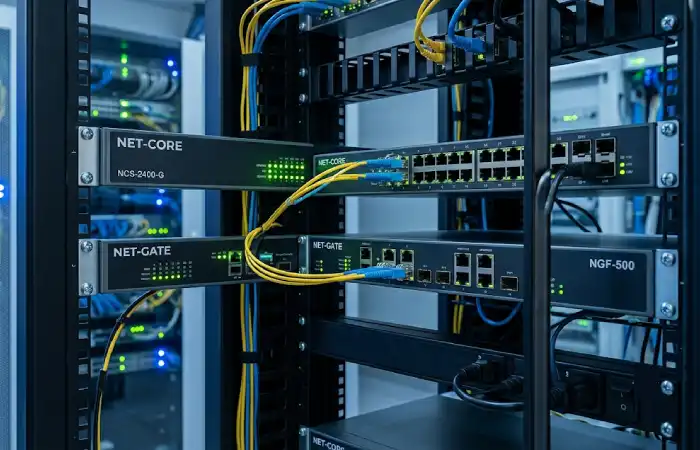
Network equipment manages, directs and protects the flow of telecommunications traffic.
Essential Equipment
| Equipment | Function |
| Routers | Traffic routing |
| Switches | Local connectivity |
| Firewalls | Security protection |
| Optical Transport Systems | Fiber communications |
| Core Network Platforms | Telecom management |
Leading Technology Vendors (2026)
| Vendor | Specialty |
| Cisco | Enterprise networking |
| Nokia | Telecom infrastructure |
| Ericsson | Mobile networks |
| Juniper Networks | High-performance routing |
| Ciena | Optical networking |
Infrastructure Security
The telecommunications infrastructure is on rise of cyber security threats.
Common Risks
- DDoS attacks
- Ransomware
- Network intrusion
- Supply chain attacks
- Insider threats
Security Best Practices
| Practice | Benefit |
| Network Segmentation | Limits attack spread |
| Encryption | Protects data |
| Multi-Factor Authentication | Reduces unauthorized access |
| Continuous Monitoring | Faster threat detection |
| Zero Trust Architecture | Enhanced security |
For more information, internally link to:
- Telecommunications Security
- Telecommunications Services
Future of Telecommunications Infrastructure
The future of telecommunications infrastructure will be driven by:
- 5G Expansion
Increased small cell deployments and edge computing infrastructure.
- 6G Research
Premium performance to provide ultra-low latency and advanced AI integration.
- Edge Computing
On the other hand, data could be processed nearer to the end users, thus providing a faster service.
- AI-Powered Networks
Automatic network optimization, and predictive maintenance.
- Sustainable Infrastructure
Energy-efficient network infrastructures and green data centers.
2026 Infrastructure Trends Comparison
| Trend | Impact Level |
| AI Network Automation | Very High |
| Edge Computing | High |
| Private 5G Networks | High |
| Green Data Centers | High |
| 6G Research | Emerging |
Telecom infrastructure enables a variety of solutions, including broadband internet, voice communication, cloud connectivity, and enterprise networking. Learn more about modern telecommunications services and their role in supporting businesses and consumers.
FAQ
What do we mean by telecommunications infrastructure?
Telecommunications infrastructure comprising the physical and digital means of providing all forms of communication (internet, telephone, mobile, cloud connectivity) is included within telecommunications.
What is the significance of fiber optics infrastructure?
Fiber optics allow for fast, cost-effective, and reliable high-bandwidth data transmission capable of scaling to the dimensions of today‘s Internet and telecommunications services.
How do the telecommunications towers work?
Towers hold antennas and radio gear transmitting and receiving wireless signals between mobiles and telecom networks.
In what way do telecommunications depend upon data centers?
Data centers alone are responsible for the processing, storing and distribution of data while also facilitating the use of cloud applications, overseeing network operations and providing digital services.
What is the importance of submarine cables?
Essentially underground, under the ocean (or having massive multi-attenuated coaxial cables running within a network of undersea fiber rings), these global super highways transmit the lion’s share of internet traffic.
What is being done to keep the telecommunication infrastructure secure?
Security practices are encryption, firewalls, monitoring network traffic, Zero Trust, multi-factor authentication.
Conclusion
The telecommunications infrastructure is the unseen backbone of the modern interconnected environment. It includes the pipes of fiber optic cable, as well as the towers and the data centers of cell networks and satellite or submarine connections.
With the rollout of 5G, the development of edge computing solutions, and ongoing research into 6G, communications infrastructure will continue to advance to meet the demands of future digital services. Companies that leverage modern telecom infrastructure will be at a competitive advantage for service reliability, scalability, security, and sustainable expansion.
Kashifa Jafar is a technology writer and contributor at FutureTechExpert with 4+ years of experience in technology writing and content creation.
Read Full Bio of Author →Sameena reviews selected health, wellness, technology, and digital content for clarity, factual presentation, and reader usefulness.
Read Full Bio of Reviewer →