
 Kashifa Jafar
Technology Writer & Contributor
Kashifa Jafar is a technology writer and contributor at FutureTechExpert with 4+ years of experience in technology writing and content creation.
Read Full Bio of Author →
Kashifa Jafar
Technology Writer & Contributor
Kashifa Jafar is a technology writer and contributor at FutureTechExpert with 4+ years of experience in technology writing and content creation.
Read Full Bio of Author →
 Sameena Begum
Health, Technology & Digital Content Reviewer
Sameena reviews selected health, wellness, technology, and digital content for clarity, factual presentation, and reader usefulness.
Read Full Bio of Reviewer →
Sameena Begum
Health, Technology & Digital Content Reviewer
Sameena reviews selected health, wellness, technology, and digital content for clarity, factual presentation, and reader usefulness.
Read Full Bio of Reviewer →
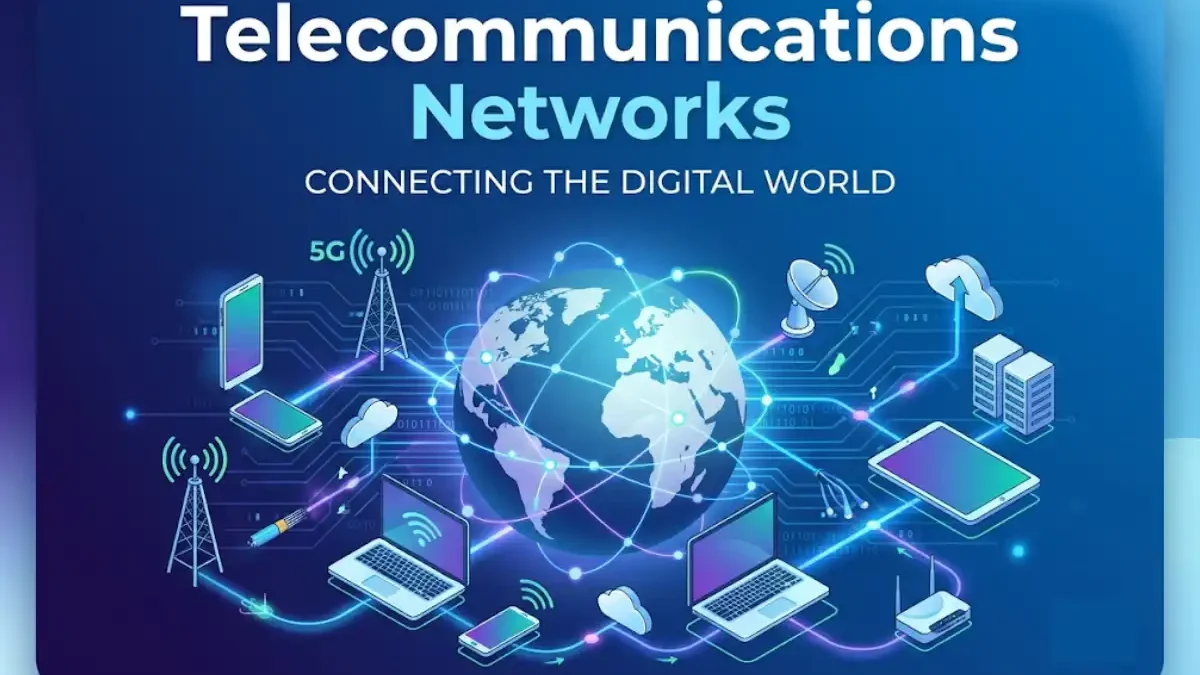
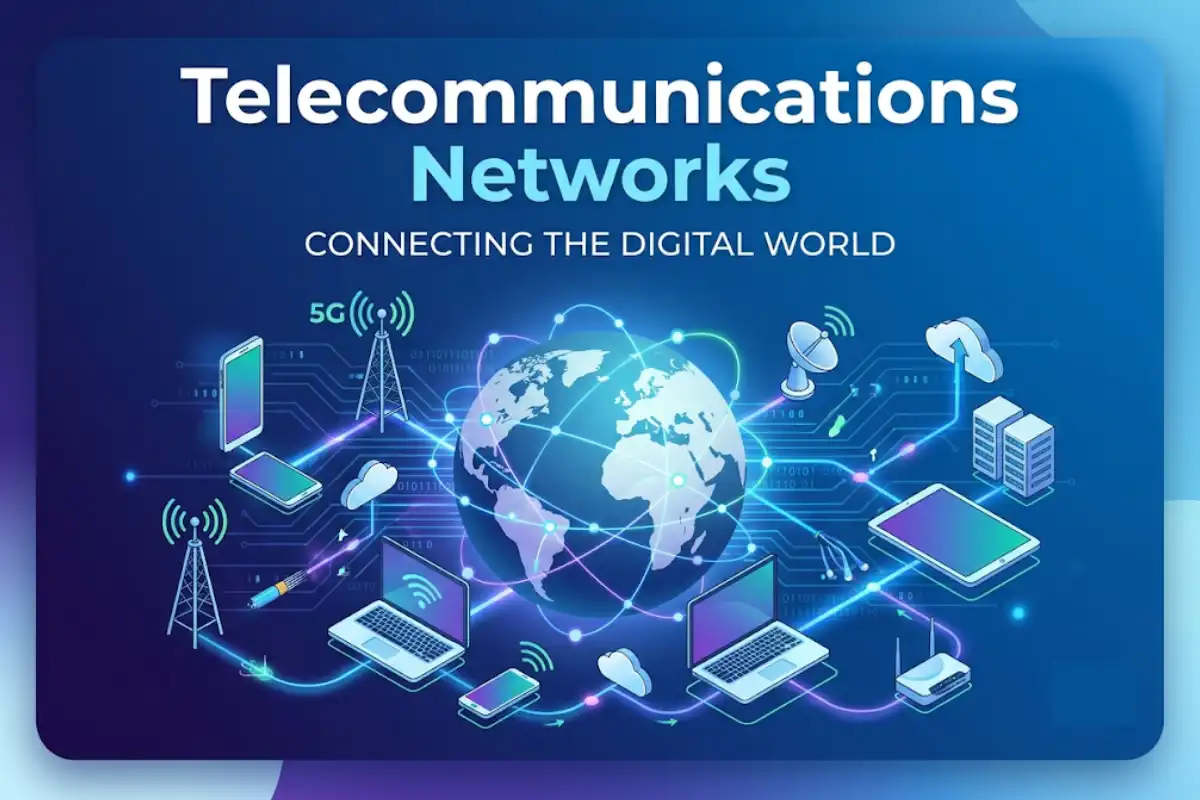
Telecommunications networks are the medium for digital communications today. They connect billions of devices across the world by offering services like voice, data, video and internet. You are part of a network each time you dial.
In 2026, as the pace of the digital transformation reaches a dizzying speed, the telecommunications network is also evolving fast. We have 5G take off, and a fiber-optic infrastructure expanding. The cloud play an increasing role, and the network itself becomes smarter. Artificial intelligence becomes the maestro of our digital systems.
 This article is part of
Telecommunications Services Resources
Table of Contents
What Is a Telecommunications Network?
A telecommunications network is a collection of interconnected networks of devices, transmission media and communications equipment that carries voice, data, video and internet traffic between users and devices across local, national and international distances.
Put frankly, telecommunications networks are the systems of developing communications for a person or an organization. All communication, whether a phone call, a text message, a web cast, a visit to a web site, or a cloud based application, passes through a telecommunications network.
Core Components
| Component | Function |
| Transmitters | Send data signals |
| Receivers | Receive transmitted signals |
| Communication Channels | Carry signals between devices |
| Switching Systems | Route data efficiently |
| Network Management Systems | Monitor and optimize performance |
Modern telecommunications networks support:
- Voice communication
- Internet access
- Video conferencing
- Cloud applications
- IoT devices
- Mobile communications
To gain a broader understanding of communication technologies and industry trends, explore our comprehensive guide to telecommunications, covering networks, infrastructure, services, and emerging innovations.
How Telecommunications Networks Work
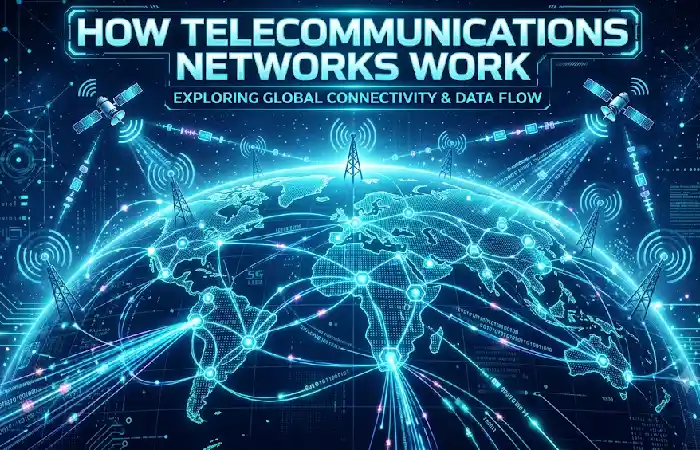
From the source to the destination, a telecommunications network must follow a certain process to move information from one end to the other.
Basic Communication Flow
Sender Device
↓
Signal Encoding
↓
Transmission Medium
↓
Network Routing
↓
Receiving Device
↓
Signal Decoding
Network Communication Steps
- Data is generated by a device.
- Information is converted into digital signals.
- Signals travel through wired or wireless infrastructure.
- Routers and switches determine the best path.
- The destination device receives and decodes the information.
This is done in a matter of milliseconds between international networks.
Every telecommunications network depends on reliable telecommunications infrastructure, including fiber-optic cables, transmission towers, switches, and data centers that enable seamless connectivity.
Types of Telecommunications Networks
Various telecommunication networks exist to meet various communication requirements.
Comparison of Network Types
| Network Type | Coverage | Speed | Primary Use |
| Mobile Networks | Wide Area | High | Smartphones |
| Fixed-Line Networks | Local/National | Very High | Business Communications |
| Broadband Networks | Regional | Ultra-High | Internet Access |
| Wireless Networks | Flexible | Moderate-High | Mobility |
| Satellite Networks | Global | Moderate | Remote Locations |
Mobile Networks
when you can be reached wirelessly via mobile cellular towers and radio frequencies.
Mobile Network Generations
| Generation | Maximum Speed | Main Benefits |
| 3G | Up to 2 Mbps | Basic Internet |
| 4G LTE | Up to 1 Gbps | HD Streaming |
| 5G | Up to 20 Gbps | Ultra-Low Latency |
| 6G (Emerging) | Projected 100+ Gbps | AI-Native Connectivity |
Advantages of Mobile Networks
- Mobility and flexibility
- Broad geographic coverage
- Rapid deployment
- Support for IoT ecosystems
Best Use Cases
- Remote work
- Mobile applications
- Smart cities
- Connected vehicles
Modern communication systems are powered by advanced telecommunications technology such as 5G, cloud networking, software-defined networks, and artificial intelligence.
Fixed-Line Networks
Telecommunications: The fixed-line telecommunications networks, which pass information using hard wire cables.
Common Fixed-Line Technologies
| Technology | Medium | Typical Speed |
| Copper DSL | Copper Wire | Up to 100 Mbps |
| Fiber Optic | Glass Fiber | Up to 10+ Gbps |
| Ethernet | Twisted Pair | Up to 100 Gbps |
Benefits
- High reliability
- Low latency
- Strong security
- Consistent performance
Natural for critical business applications is to use fixed-line networks.
Understanding how telecommunications systems operate helps explain how voice, video, and data are transmitted efficiently across local and global networks.
Broadband Networks
It provide high-capacity data transmission to residential and business customers.
Broadband Technology Comparison
| Technology | Speed Range | Reliability |
| Fiber Broadband | 300 Mbps–10 Gbps | Excellent |
| Cable Broadband | 100 Mbps–2 Gbps | Very Good |
| Fixed Wireless | 50 Mbps–1 Gbps | Good |
| Satellite Broadband | 25 Mbps–500 Mbps | Moderate |
Resource Links
| Provider | Official Resource |
| Cisco Networking | https://www.cisco.com |
| Ericsson Networks | https://www.ericsson.com |
| Nokia Networks | https://www.nokia.com |
| GSMA Intelligence | https://www.gsma.com |
| ITU Telecom Standards | https://www.itu.int |
Wireless Networks
A wireless network is one that runs without the use of cables and instead uses radio waves.
Wireless Technologies
- Wi-Fi 6E
- Wi-Fi 7
- Bluetooth
- Zigbee
- Cellular Networks
- Satellite Wireless
Wireless vs Wired Comparison
| Feature | Wireless | Wired |
| Mobility | Excellent | Limited |
| Installation | Easy | Complex |
| Speed | High | Very High |
| Reliability | Good | Excellent |
| Security | Moderate | High |
It still become more and more popular due to the appearance of more flexible services and less expensive implementation.
As cyber threats continue to evolve, organizations must implement strong telecommunications security practices to protect sensitive data and critical network infrastructure.
Network Infrastructure
Network infrastructure The physical and virtual structures that form the foundation to the provision of telecommunications services.
Infrastructure Components
Physical Infrastructure
- Cell towers
- Fiber-optic cables
- Data centers
- Satellite stations
- Network switches
Virtual Infrastructure
- Software-defined networking (SDN)
- Network function virtualization (NFV)
- Cloud networking platforms
- AI monitoring systems
Modern Infrastructure Trends (2026)
| Trend | Impact |
| Edge Computing | Reduced latency |
| AI Operations (AIOps) | Automated management |
| Network Automation | Lower operational costs |
| Open RAN | Vendor flexibility |
| Cloud-Native Networks | Greater scalability |
Network Performance
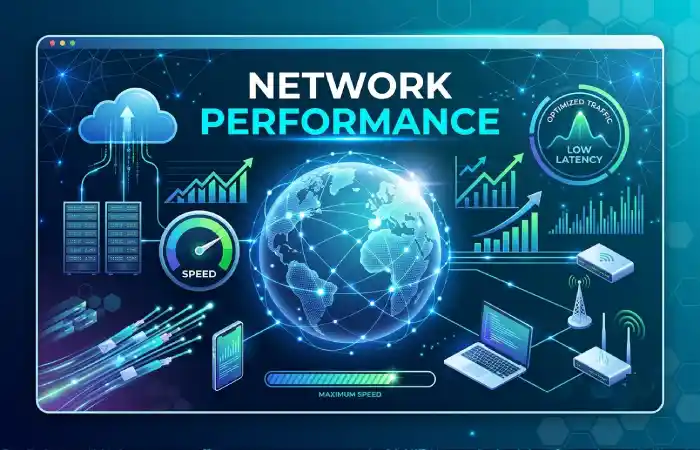
Performance of a network has a direct impact on the efficiency of the business and the overall usability.
Key Performance Metrics
| Metric | Description |
| Latency | Response delay |
| Throughput | Data transfer volume |
| Packet Loss | Lost data percentage |
| Jitter | Delay variation |
| Availability | Uptime percentage |
Network Performance Benchmarks (2026)
| Metric | Excellent | Good | Needs Improvement |
| Latency | <20ms | 20–50ms | >50ms |
| Packet Loss | <1% | 1–2% | >2% |
| Availability | 99.99% | 99.9% | <99.5% |
Future of Telecommunications Networks
The VoIP industry is on the dawn of the most exciting change era yet due to advancements in AI, cloud computing and next generation connectivity.
Emerging Trends
AI-Powered Networks
Manufacturing execution systems (MES) and broad channel alone have committed the network monitoring, predictive maintenance, and traffic optimization of automated AI.
6G Development
Researchers expect 6G networks to deliver:
- 100 Gbps+ speeds
- Near-zero latency
- AI-native architecture
- Advanced digital twins
Quantum-Secure Communications
Quantum-resistant encryption will be integrated into future networks.
Satellite Mega-Constellations
There are thousands of Low Earth Orbit (LEO) satellites up there that provide internet access to the world. They are especially helping underserved populations access the internet.
Telecommunications networks serve as the foundation for numerous telecommunications services, including broadband internet, mobile communication, VoIP, cloud connectivity, and enterprise networking solutions.
Frequently Asked Questions
What is the main purpose of a network?
The telecommunication network (hierarchical network) allows voice, video and data transmission of users and devices in different locations.
What distinguishes mobile networks from fixed networks?
Wireless cellular network (mobile) are used. Fixed line network (internet etc.) are run over physical network Infrastructure (e.g. Cables “fibre optics”)
What is the importance of fiber optics?
The fibre provides a communication link with much higher bandwidth, much lower delay, and a far more reliable channel than a copper link.
What are the advantages of 5g?
Provides higher velocity, reduced delay, more capacity, and better services for IoT.
What network technologies will be employed on future network infrastructures?
AI, 6 G, edge computing, cloud native infrastructure, Open RAN, and quantum secure networking will be the future driving force of the innovations.
Conclusion
Telecommunications networks are the backbone of today‘s digital society, enabling connectivity for mobile phones, internet, cloud computing, and emerging smart cities. With the rapid deployment of 5G, expanding fiber networks, and increasing automation powered by artificial intelligence, telecommunications networks will provide ever more rapid, dependable, and intelligent communication solutions.
Businesses that have insight into the network infrastructure, business performance, and new and innovative technologies will be better prepared to harness the new digital communication era.
Kashifa Jafar is a technology writer and contributor at FutureTechExpert with 4+ years of experience in technology writing and content creation.
Read Full Bio of Author →Sameena reviews selected health, wellness, technology, and digital content for clarity, factual presentation, and reader usefulness.
Read Full Bio of Reviewer →