
 Kashifa Jafar
Technology Writer & Contributor
Kashifa Jafar is a technology writer and contributor at FutureTechExpert with 4+ years of experience in technology writing and content creation.
Read Full Bio of Author →
Kashifa Jafar
Technology Writer & Contributor
Kashifa Jafar is a technology writer and contributor at FutureTechExpert with 4+ years of experience in technology writing and content creation.
Read Full Bio of Author →
 Sameena Begum
Health, Technology & Digital Content Reviewer
Sameena reviews selected health, wellness, technology, and digital content for clarity, factual presentation, and reader usefulness.
Read Full Bio of Reviewer →
Sameena Begum
Health, Technology & Digital Content Reviewer
Sameena reviews selected health, wellness, technology, and digital content for clarity, factual presentation, and reader usefulness.
Read Full Bio of Reviewer →
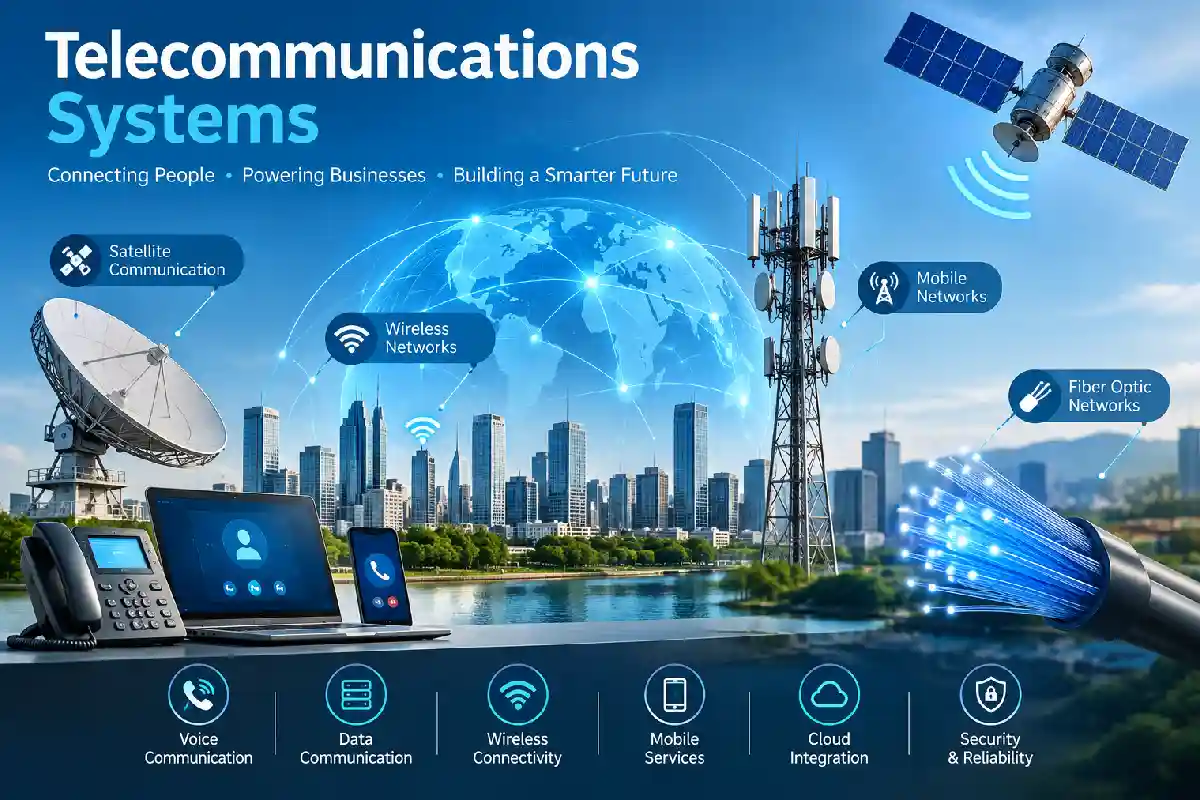
Telecommunication Systems. Telecom systems, or telecommunication systems, allow us to communicate with other people or access information all over the world. It is the infrastructure that allows cell phones and computers to send and receive data, that is then used to make phone calls or send emails or even sit in front of a computer at work. It helps us conduct business over the internet and share information across the world with real-time efficiency.
With the way organizations are moving towards utilizing cloud technologies, 5G networks, IoT devices, and AI guided conversations by 2026, having knowledge of Telecommunications systems is critical for companies and tech people.
 This article is part of
Telecommunications Services Resources
Table of Contents
What Are Telecommunications Systems?
The equipment, software, transmission media, and networking technology that makes up a telecommunications system transmit information from one location to another
These systems allow communication through:
- Voice calls
- Video conferencing
- Text messaging
- Internet access
- Cloud applications
- Data transfer
- IoT communications
New telecommunications systems connect billions of devices around the world by means of hundreds of wired and wireless communication networks.
Core Functions
| Function | Purpose |
| Transmission | Sends data between locations |
| Switching | Routes communication traffic |
| Signal Processing | Converts signals into usable formats |
| Network Management | Monitors performance and reliability |
| Security | Protects communications from threats |
Components of Telecommunications Systems
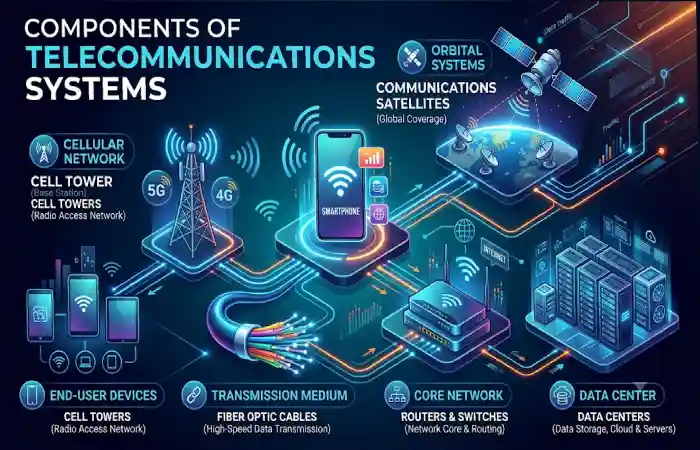
All telecommunication systems consist of a group of interacting elements.
| Component | Role |
| Transmitters | Generate communication signals |
| Receivers | Interpret incoming signals |
| Communication Channels | Carry data across networks |
| Switching Equipment | Direct traffic efficiently |
| Routers & Gateways | Connect networks |
| Network Management Platforms | Monitor performance |
| Security Systems | Protect data transmission |
Telecommunications Infrastructure Comparison
| Infrastructure Type | Speed | Coverage | Best Use Case |
| Copper Networks | Medium | Local | Legacy systems |
| Fiber Optic Networks | Very High | Regional/Global | High-speed internet |
| Cellular Networks | High | Wide | Mobile communication |
| Satellite Networks | Moderate | Global | Remote areas |
| Fixed Wireless | High | Regional | Rural broadband |
Resources
- ITU: https://www.itu.int
- GSMA: https://www.gsma.com
- IEEE Communications Society: https://www.comsoc.org
Telecommunications systems are the backbone of modern digital communication, enabling the transmission of voice, data, and video across various networks. To understand the broader industry, its evolution, and key communication technologies, read our guide on telecommunications.
Voice Communication Systems
Voice is still by far one of the most basic applications of telecommunications systems.
Most conventional landline networks are now converted into IP world.
Common Voice Technologies
- VoIP (Voice over Internet Protocol)
- SIP Trunking
- PBX Systems
- Unified Communications Platforms
- Cloud Calling Solutions
Voice System Comparison
| Technology | Cost | Scalability | Quality |
| Traditional PSTN | High | Low | Good |
| VoIP | Low | High | Excellent |
| Cloud PBX | Medium | Very High | Excellent |
| Unified Communications | Medium | High | Excellent |
Data Communication Systems
Information and data communication systems are responsible for digitally communicating data between all computers, servers, cloud servers and other connected devices.
Common applications include:
- Email systems
- Cloud computing
- Enterprise networking
- Data centers
- IoT ecosystems
- AI applications
Data Transmission Technologies
| Technology | Typical Speed |
| Ethernet | 1–400 Gbps |
| Fiber Networks | Up to 800 Gbps |
| Wi-Fi 7 | Up to 46 Gbps |
| 5G Networks | Up to 20 Gbps |
| Satellite Broadband | 100 Mbps–2 Gbps |
Modern businesses increasingly rely on high-capacity telecommunications systems to support digital transformation initiatives.
Every telecommunications system relies on robust telecommunications infrastructure, including fiber-optic cables, cell towers, switches, satellite systems, and data centers that support reliable connectivity.
Wireless Communication Systems
Wireless telecommunications systems transmit without physical cabling via radio frequencies.
Key Wireless Technologies
- Wi-Fi
- Bluetooth
- Zigbee
- Cellular Networks
- Microwave Links
- Fixed Wireless Access
Benefits
Mobility
Lower deployment costs
Rapid scalability
Remote connectivity
IoT support
Wireless communication systems are still growing due to the increasing number of smart cities and connected devices.
Mobile Telecommunications Systems
The systems of mobile telecommunications provide the framework on which communication of smart phones and mobile internet services are built.
Evolution of Mobile Networks
| Generation | Key Features |
| 2G | Digital voice |
| 3G | Mobile internet |
| 4G LTE | HD streaming |
| 5G | Ultra-low latency |
| 6G (Research Stage) | AI-native networking |
5G Impact on Telecommunications
According to industry forecasts, 5G adoption continues accelerating worldwide due to:
- Faster download speeds
- Improved reliability
- Massive IoT support
- Smart manufacturing
- Autonomous systems
- Real-time AI applications
Fiber Optic Systems
Information is tranmitted via light signals through glass fibers in an optical fiber systems.
These systems offer the greatest bandwidth of any telecommunications system today.
Advantages of Fiber Optics
| Benefit | Description |
| Speed | Extremely fast transmission |
| Reliability | Low signal degradation |
| Security | Difficult to intercept |
| Capacity | Supports massive bandwidth |
| Future-Proofing | Ready for next-generation services |
Satellite Communication Systems
The fiber network continues to be the backbone solution choice for both enterprise telecom systems and broadband providers.
Common Applications
- Maritime communications
- Aviation connectivity
- Rural broadband
- Emergency response
- Defense communications
- Global broadcasting
Satellite Types
| Type | Orbit Height | Latency |
| GEO | 35,786 km | High |
| MEO | 2,000–35,786 km | Medium |
| LEO | Below 2,000 km | Low |
Satellite tele-communication systems facilitate communication in areas devoid of ground installations.
Businesses and consumers depend on a wide range of telecommunications services, including voice calling, broadband internet, video conferencing, cloud communications, and managed network solutions.
Telecommunications System Security
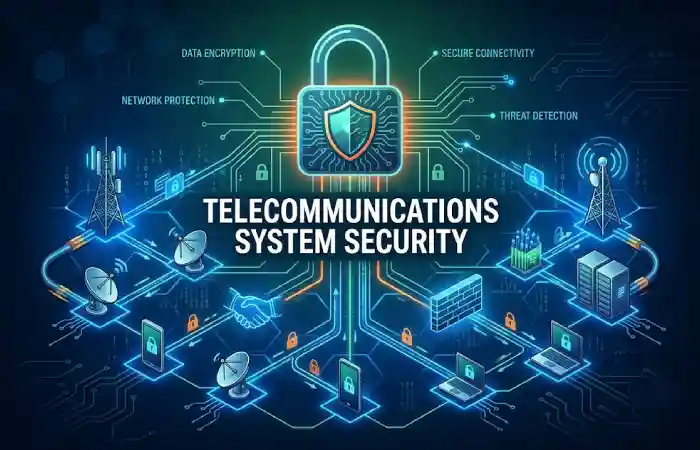
With cybercrime on the rise, security in the telecommunications industry is becoming even more important.
Common Threats
- DDoS attacks
- Data interception
- Network intrusion
- Malware
- Ransomware
- Identity theft
Security Best Practices
| Security Measure | Importance |
| Encryption | High |
| Multi-Factor Authentication | High |
| Zero Trust Architecture | High |
| Network Segmentation | Medium |
| Continuous Monitoring | High |
| AI Threat Detection | High |
As cyber threats continue to evolve, implementing strong telecommunications security measures is essential for protecting networks, sensitive data, and critical communication services from unauthorized access.
Future of Telecommunications Systems
The telecommunications market is still going full speed by emerging technologies.
Key Trends for 2026 and Beyond
| Trend | Expected Impact |
| AI-Powered Networks | Automated optimization |
| 5G Advanced | Improved performance |
| 6G Research | Next-generation connectivity |
| Edge Computing | Lower latency |
| Private Networks | Enterprise control |
| Quantum Security | Enhanced protection |
| Satellite Broadband Expansion | Global coverage |
Telecommunications Technology Roadmap
| Technology | Adoption Stage |
| Fiber Expansion | Mature |
| 5G Standalone | Growing |
| AI Networking | Growing |
| Private 5G | Emerging |
| Open RAN | Emerging |
| 6G Research | Early Development |
Telecommunications systems operate through interconnected telecommunications networks that route signals between devices, applications, servers, and communication endpoints worldwide.
FAQ
What are the telecommunications systems?
Telecommunications systems, such as networks and technologies, are the systems for transmitting voice, video and data between locations
What are the important parts of a telecommunications system?
Elements of the infrastructure include, receivers, transmitters, lines for transmitting, communication, switches, routers and protection systems.
What is their relevance?
Fiber optics is the last which provide high speed, reliable, and scalable communication infrastructure for today‘s networks.
What are the advantages of 5G?
Enhanced performance provided by 5G include higher speed, lower latency, increased capacity, andmore support for emerging technologies like Internet of Things (IoT) and Artificial Intelligence (AI).
Are telecom systems protected?
Contemporary telecommunications systems can be effectively protected if implemented by organizations using encryption, use of monitoring, authentication and Zero Trust security models.
Conclusion
Telecommunications Systems are integral to our interconnected societies, enabling voice services, broadband, cloud computing solutions, Internet of Things (IoT) technologies, and Artificial Intelligence applications. With the ongoing development of fiber optics, 5G technology, satellite systems, and network automation well into 2026, those that deploy up-to-date telecommunication systems will be poised to benefit from greater functionality, growth potential, dependability, and secure transmission of data. It is vital to comprehend these emerging telecommunications systems to utilize this knowledge in making strategic business choices and furthering digital evolution.
Kashifa Jafar is a technology writer and contributor at FutureTechExpert with 4+ years of experience in technology writing and content creation.
Read Full Bio of Author →Sameena reviews selected health, wellness, technology, and digital content for clarity, factual presentation, and reader usefulness.
Read Full Bio of Reviewer →