

Last Updated: September 19, 2026
Web application architecture is the underlying concept of a website. It can have a direct impact on a website‘s performance, its scalability, and how information is transferred between users, servers, databases and APIs. No matter whether you want to build a business website, or a giant SaaS platform, knowing web application architecture can help you build safe, scalable and easy to maintain application.
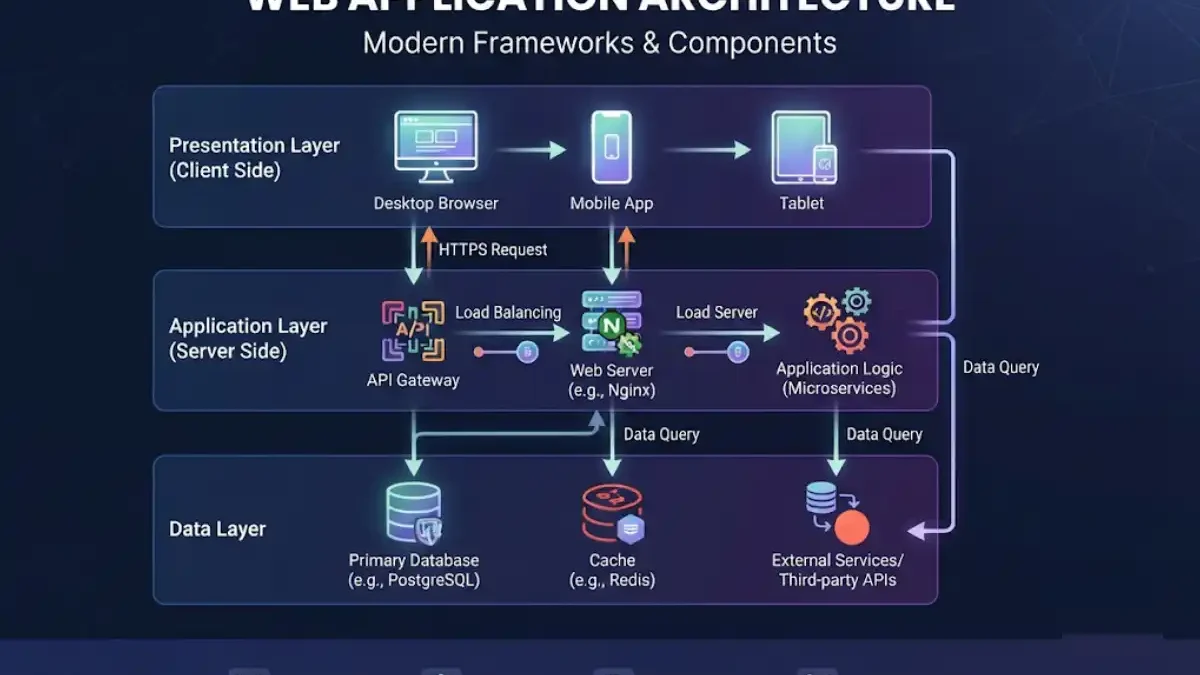
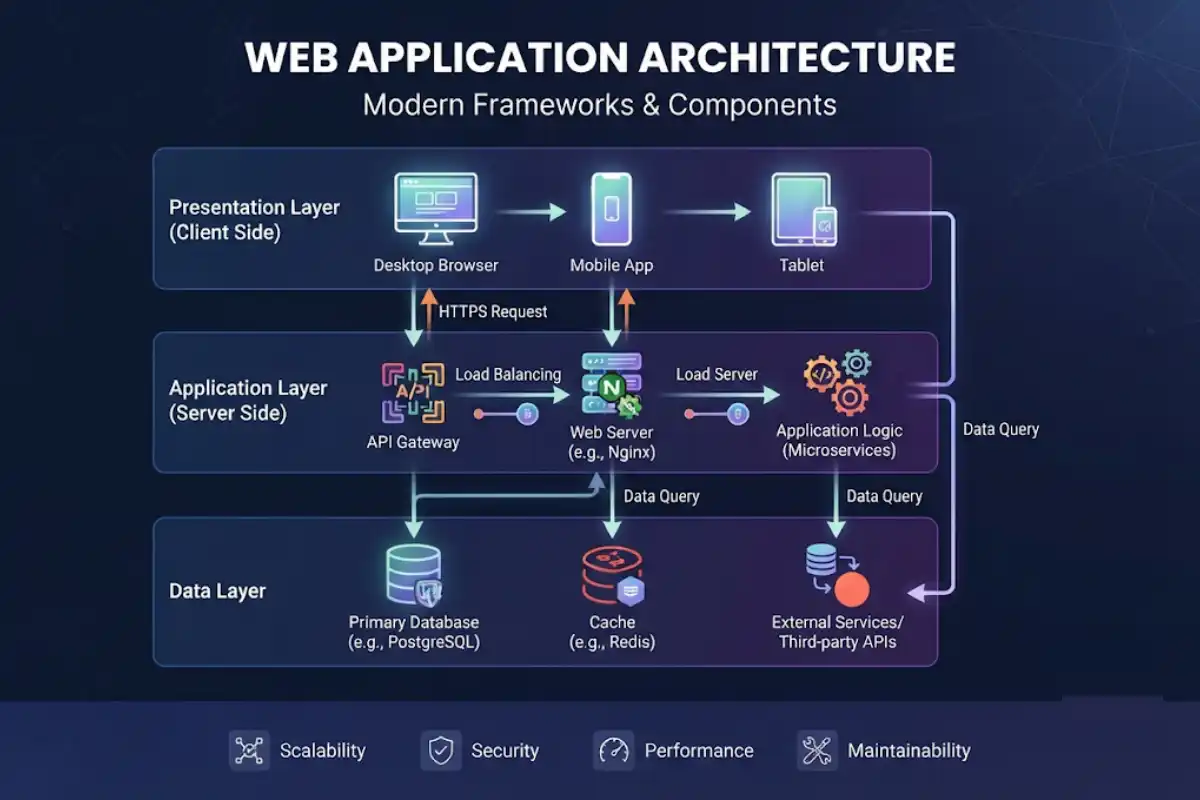
Today, a web application consists of several architectural layer interacting to achieve rapid and reliable user interactions. In 2026, businesses keep on transforming digitally. Choosing architecture is now essential to a successful application.
Table of Contents
What Is Web Application Architecture?
Web Application Architecture is the conceptual structure and logical order of a web application. It explains how each component of the application operates and cooperates and how the entire application supplies the final service to the user.
In an easily understandable term, web application architecture is simply the plan of a web application. Like a building architect who plans out building structures, most software architects also do the planning of a web application before implementation. Strong architecture would also enable the application to perform better, to scale along with growing user numbers and to maintain easily.
A well-designed architecture helps:
- Improve scalability
- Enhance performance
- Increase security
- Simplify maintenance
- Support future growth
How Web Application Architecture Works
A typical request follows this process:
- User interacts with the browser.
- Browser sends a request to the web server.
- Server processes business logic.
- Database retrieves or stores data.
- Response returns to the browser.
- User sees updated content.
This formal method of communication guarantees uninterrupted operation on every application level.
Key Components of a Web Application
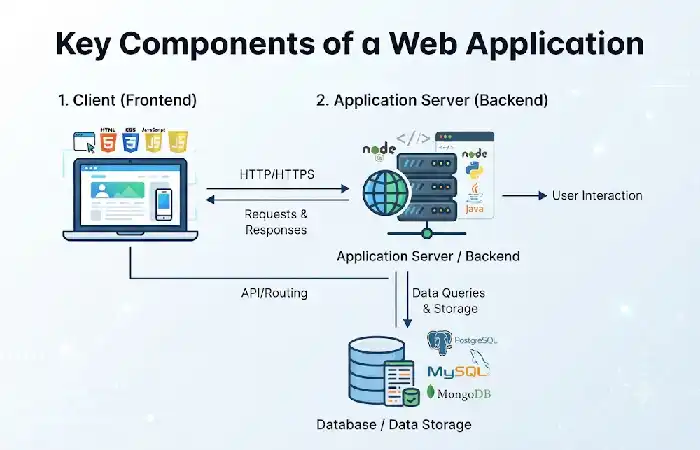
The core components of any web application Content is the king in the digital realm. In any web application, there is a set of interconnected core components working in sync to serve the end users.
Each component has a certain function in content presentation, business logic and the data store. We combine all these elements to make a scalable and robust, web app that is able to support thousands – or even millions – of users.
| Component | Purpose |
| Client (Browser) | Displays the user interface |
| Front-End | Handles user interactions |
| Back-End | Processes business logic |
| Database | Stores application data |
| APIs | Connects services and applications |
| Web Server | Handles incoming requests |
| CDN | Delivers static content faster |
| Load Balancer | Distributes traffic across servers |
Resource Links
| Resource | URL |
| React | https://react.dev |
| Angular | https://angular.dev |
| Vue.js | https://vuejs.org |
| Node.js | https://nodejs.org |
| PostgreSQL | https://www.postgresql.org |
Client-Side Architecture
Client-side architecture deals mainly with the bits and pieces we see and experience through our browser.
Common technologies include:
- HTML5
- CSS3
- JavaScript
- React
- Angular
- Vue.js
Advantages
- Faster user experience
- Reduced server load
- Dynamic page updates
- Improved responsiveness
Popular Client-Side Models
| Model | Description |
| SPA (Single Page Application) | Loads one page and updates dynamically |
| MPA (Multi-Page Application) | Loads a new page for each request |
| PWA (Progressive Web App) | Provides app-like experiences |
SPAs are mainly used for dashboards and SaaS applications, while MPAs are still the norm for information intensive websites.
Server-Side Architecture
Server-side architecture consists of the business logic, authentication, data, and integrations.
Popular backend technologies include:
- Node.js
- Python Django
- Laravel
- Spring Boot
- ASP.NET
Core Responsibilities
- User authentication
- Data validation
- Request processing
- API management
- Security enforcement
The server topology is designed for high traffic systems.
Front-End and Back-End Architecture
The front-end and back-end systems are designed to work together in order to develop a complete web application.
| Front-End | Back-End |
| User Interface | Business Logic |
| Browser-Based | Server-Based |
| React, Angular, Vue | Node.js, Django, Laravel |
| Visual Experience | Data Processing |
Architecture Flow
User
↓
Front-End
↓
API
↓
Back-End
↓
Database
And this separation leads to easier and scalable maintainability.
Database Architecture
The architecture of application data All the frameworks of database architecture concerning the storage, accessing, and organizing of data are made.
Common Database Types
| Database Type | Examples |
| Relational | PostgreSQL, MySQL |
| NoSQL | MongoDB, Cassandra |
| In-Memory | Redis |
| Cloud Database | Amazon RDS, Azure SQL |
Best Practices
- Normalize data structures
- Implement indexing
- Use database caching
- Enable backups
- Monitor performance
Contemporary use of both: Higher flexibility can be achieved by using either of the solutions in unison; SQL and NoSQL.
APIs and Web Application Architecture
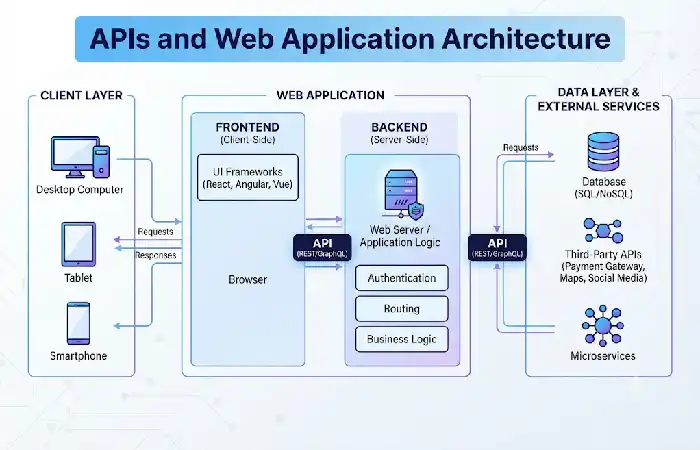
APIs serve as connectors among application components.
Types of APIs
| API Type | Use Case |
| REST API | Standard web communication |
| GraphQL | Flexible data querying |
| SOAP | Enterprise systems |
| WebSocket | Real-time applications |
API Benefits
- Supports integrations
- Enables microservices
- Simplifies development
- Improves scalability
Currently, most modern architectures use REST API extensively or have GraphQL service(s).
Common Web Application Architecture Patterns
It needs to be clear that the best architecture pattern will entirely depend on the business requirements of the application.
Architecture Comparison Table (2026)
| Architecture Pattern | Best For | Scalability | Complexity |
| Monolithic | Startups, MVPs | Medium | Low |
| Layered (N-Tier) | Business Applications | High | Medium |
| Microservices | Enterprise Platforms | Very High | High |
| Serverless | Event-Based Apps | High | Medium |
| Event-Driven | Real-Time Systems | Very High | High |
Monolithic Architecture
- Single codebase
- Easy deployment
- Lower initial costs
Microservices Architecture
- Independent services
- Better scalability
- Faster development cycles
Serverless Architecture
- Pay-per-use model
- Automatic scaling
- Reduced infrastructure management
In view of this, new enterprises now use micro services and cloud native architectures to operate at very large scale.
How to Choose an Architecture
The suitable web application architecture will only be apparent after consideration of various and complex factors.
Decision Matrix
| Requirement | Recommended Architecture |
| Startup MVP | Monolithic |
| Medium SaaS Platform | Layered Architecture |
| Enterprise Software | Microservices |
| High-Traffic Web App | Cloud-Native |
| Real-Time Application | Event-Driven |
Consider These Factors
- Expected user traffic
- Budget
- Team expertise
- Security requirements
- Future scalability
- Maintenance costs
Most new application launches in 2026 by businesses can start from a modular monolith or layered architecture first and proceed to microservices when necessary.
Frequently Asked Questions
What is web application architecture?
Web application architecture is the sets of structures and systems that bridge together various web interfaces such as front-end, back-end, databases, API.
Why is web application architecture important?
It enhances scalability, performance, security, maintainability and user experience.
What are the main layers of web application architecture?
The three horizontal layers are the presentation layer (front-end), application layer (back-end) and data layer (database).
What is the difference between monolithic and microservices architecture?
The application to be built can be one monolithic application that encompasses all features, or separated into a number of microservices.
Which architecture is best for modern web applications?
Every architecture has its own advantages and disadvantages. There is not a single architecture that is suitable for all situations. The best architecture will depend on the business requirements, the scalability needs, the project budget and the available development team.
Conclusion
Web Application Architecture gives us a structure for designing scalable, resilient and fast web applications. By gaining a good understanding in client side architecture, server-side architecture, databases, APIs, and other modern architecture patterns, companies can make business-critical decisions for the long term. Whether you are designing a startup MVP or an enterprise platform, a decision about architecture today, can save your company ten times the development costs in a few years.