
 Kashifa Jafar
Technology Writer & Contributor
Kashifa Jafar is a technology writer and contributor at FutureTechExpert with 4+ years of experience in technology writing and content creation.
Read Full Bio of Author →
Kashifa Jafar
Technology Writer & Contributor
Kashifa Jafar is a technology writer and contributor at FutureTechExpert with 4+ years of experience in technology writing and content creation.
Read Full Bio of Author →
 Sameena Begum
Health, Technology & Digital Content Reviewer
Sameena reviews selected health, wellness, technology, and digital content for clarity, factual presentation, and reader usefulness.
Read Full Bio of Reviewer →
Sameena Begum
Health, Technology & Digital Content Reviewer
Sameena reviews selected health, wellness, technology, and digital content for clarity, factual presentation, and reader usefulness.
Read Full Bio of Reviewer →
Without a doubt one of the most crucial investing skill in 2026 would be Investment Education & Analysis. With artificial intelligence, cloud computing, semiconductors, robots, and 3D printing revolutionizing the world markets, knowing how to analyze investment opportunities is no longer optional.
Whether you are an experienced investor looking to portfolio diversification into the technology sector, or you are a new investor building your first portfolio by the end you will learn how to evaluate investments, measure risks and plan long term strategies based on real market behavior.
According to the estimation of Gartner, the big demand in global IT consumption in 2026 will involve a total expenditure of $6.31 trillion predicted, mostly driven by AI infrastructure, cloud services and software expansion, which indicates there will be potentially profitable high-tech investment prospects.
Readers interested in industry insights often explore the broader gadgets investing landscape to better understand emerging technology opportunities.
 This article is part of
Gadgets Investing
Table of Contents
Why Investment Education Matters in 2026
Many investors simply invest in stocks because of hype they hear on social media or because they think there is a short-term wind in the market. Wise investors use:
- Fundamental analysis
- Industry research
- Market trends
- Risk management
- Long-term planning
Investment education helps investors:
| Benefit | Why It Matters |
| Better Decision Making | Reduces emotional investing |
| Risk Management | Protects capital during downturns |
| Portfolio Diversification | Balances growth and stability |
| Long-Term Wealth Creation | Compounds returns over time |
| Market Understanding | Identifies future opportunities |
Learning about smart technology trends can help professionals stay ahead of future innovations and market shifts.
How to Invest in Gadget Companies
The gadget industry includes companies involved in:
- Smartphones
- Wearables
- Smart home devices
- Gaming hardware
- Consumer electronics
- AI-powered gadgets
Many breakthrough technologies originate from startup and innovation trends that shape the future of the industry.
Popular Technology Investment Categories
| Technology Category | Why Investors Like It | Growth Outlook (2026) | Risk Level | Resource |
| Artificial Intelligence (AI) | AI infrastructure, enterprise AI software, automation, and AI agents Is attracting the most capital. | Very High | High | Gartner AI Research |
| Cloud Computing | Companies are more and more migrating workloads to the cloud and AI-based cloud services. | High | Medium | Google Cloud Resources |
| Semiconductors & Chips | AI chips, graphics processors, advanced memory | Very High | Medium-High | Deloitte Semiconductor Outlook |
| Cybersecurity | Growing cyber threats | High | Medium | Cybersecurity Ventures |
| Software-as-a-Service (SaaS) | Software that is ‘pay once, pay forever’ produces recurring revenue and attractive margins. | High | Medium | Bessemer Cloud Index |
| Robotics & Automation | Automation is continuously being implemented in the fields of manufacturing, logistics, healthcare and warehouses. | High | High | International Federation of Robotics |
| Data Centers & AI Infrastructure | Massive artificial intelligence expenditures are fuelling the need for servers, networking equipment, and electrical power infrastructure. | Very High | Medium-High | Uptime Institute Research |
| Quantum Computing | Emerging technology with the potential to evolve over the next two or more decades and disrupt entire industries. | Speculative | Very High | IBM Quantum Learning |
| Internet of Things (IoT) | The use of smart devices, industry sensors or connected ecosystems keeps growing. | Medium-High | Medium | IoT Analytics |
| Green Technology & Clean Energy Tech | Sustainable initiatives continue to receive billions of dollars from business and government. | High | Medium | International Energy Agency (IEA) |
What to Analyze Before Investing
- Revenue growth
- Profit margins
- Product innovation
- Market share
- Competitive advantages
- Research & Development spending
Understanding the evolution of consumer electronics products provides valuable context for technology analysis.
Beginner’s Guide to Tech Investing
Even though investing in technology can be intimidating for relative beginners, it need not be and can be made very simple.
The evolution of gaming and entertainment technology provides valuable insights into consumer behavior and innovation cycles.
Step 1: Understand Technology Sectors
Technology investments generally fall into:
| Sector | Risk Level | Growth Potential |
| Cloud Computing | Medium | High |
| Artificial Intelligence | High | Very High |
| Cybersecurity | Medium | High |
| Semiconductors | Medium-High | High |
| Robotics | High | High |
| Software-as-a-Service (SaaS) | Medium | High |
Step 2: Start With Diversification
Instead of investing in a single company:
- Use technology ETFs
- Invest across multiple sectors
- Balance growth and value stocks
Step 3: Learn Key Metrics
Important metrics include:
- Price-to-Earnings Ratio (P/E)
- Earnings Growth
- Free Cash Flow
- Revenue Growth
- Return on Equity (ROE)
Many analysts focus on AI and future technologies when evaluating long-term industry developments.
Risks of Investing in Emerging Technology
Technology can deliver large payoffs but it also entails distinct risks.
Major Technology Investment Risks
| Risk | Impact |
| Regulatory Changes | Can affect profitability |
| Market Volatility | Large price swings |
| Competition | New entrants may disrupt leaders |
| Technology Obsolescence | Products become outdated |
| Economic Slowdowns | Reduced consumer spending |
AI Investment Risks in 2026
While many investor sentiment remains bullish on AI, rising infrastructure spending and backlit fund-raising may pose surprises for a stock group. Investors should focus on fundamentals, not a hype cycle.
The rapid growth of the smart home technology sector offers important lessons about consumer adoption and innovation.
How to Reduce Risk
- Diversify investments
- Invest gradually
- Avoid emotional trading
- Focus on fundamentals
- Review portfolios regularly
Gadget Industry Market Analysis (2026)
Technology market is still growing fast.
2026 Technology Market Snapshot
| Market Segment | 2026 Outlook |
| Global IT Spending | $6.31 Trillion |
| Data Center Growth | +55.8% |
| Software Spending Growth | +15.1% |
| Semiconductor Industry Revenue | $975 Billion |
| AI Infrastructure | Strong Expansion |
Sources reveal that AI infrastructure, cloud computing, high-end memory, and advanced semiconductor technologies still remain as the largest growth engines.
Research into wearable technology devices helps identify trends influencing healthcare, fitness, and productivity.
Technology Investment Trend Comparison
| Trend | Investment Potential |
| Artificial Intelligence | Very High |
| Cloud Computing | High |
| Cybersecurity | High |
| Robotics | Medium-High |
| Smart Devices | Medium |
| Quantum Computing | Speculative |
Long-Term Technology Investment Strategies
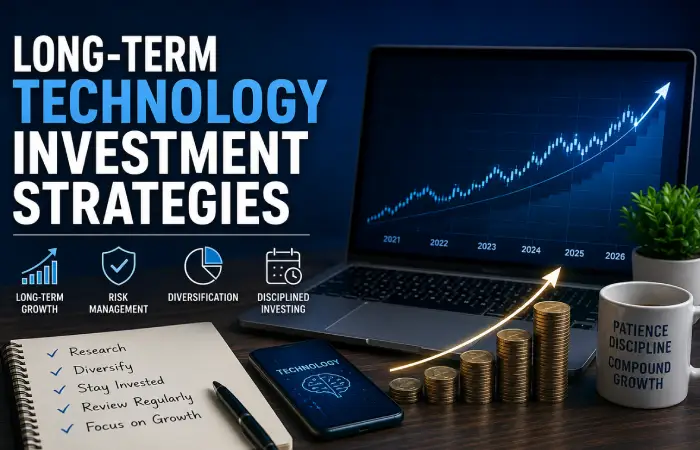
Knowing what to buy, not when is the key to successful investing.
Strategy 1: Buy and Hold
Invest in quality technology companies and tend to hold for many years.
Benefits:
- Lower trading costs
- Reduced emotional decisions
- Potential compound growth
Strategy 2: Dollar-Cost Averaging
Invest a fixed amount regularly no matter what the market conditions.
Benefits:
- Reduces timing risk
- Builds investing discipline
- Suitable for beginners
Strategy 3: Technology Theme Investing
Focus on long-term innovations:
- Artificial Intelligence
- Cloud Infrastructure
- Semiconductors
- Robotics
- Digital Transformation
Strategy 4: Portfolio Diversification
Example allocation:
| Asset Type | Allocation |
| Technology Stocks | 50% |
| Technology ETFs | 20% |
| Broad Market ETFs | 20% |
| Cash | 10% |
Consumers often improve purchasing decisions through trusted technology reviews and buying guides that evaluate product performance.
2026 Technology Investment Opportunity Matrix
| Sector | Growth Outlook | Risk Level | Investor Type |
| AI Infrastructure | Very High | High | Aggressive |
| Semiconductors | High | Medium | Growth |
| Cloud Computing | High | Medium | Long-Term |
| Cybersecurity | High | Medium | Balanced |
| Consumer Gadgets | Moderate | Low-Medium | Conservative |
| Robotics | High | High | Aggressive |
Understanding technology market trends is essential for making informed investment and business decisions.
Frequently Asked Questions
Is technology investing suitable for beginners?
Yes. For beginners, starting with a tech ETF, then moving on to learn individual stocks, is a way to go.
What is the safest way to invest in technology?
Diversified ETFs, and large longstanding technology firms tend to be less risky than speculative startups.
Are AI stocks still worth buying in 2026?
AII still one of the strongest growth themes. however, investors should take note of valuations and fundamentals before jumping in.
How much of my portfolio should be in technology stocks?
Allocation is really up to your risk tolerance, but most growth investors tend to allocate 20%–50% of their shares to technology.
What technology sectors have the best long-term potential?
In the current environment, artificial intelligence, cloud computing, semiconductors, security and robotics areas have promising long term fundamentals.
Conclusion
Investor Education & Analysis having a firm grasp of market analysis, risk management and long-term investing outlook will be the key to companies and investors building wealth during the ongoing disruption in 2026, driven by AI, cloud computing, semiconductors and digital transformation.
In this technological world, the best strategy is to pursue education, diversification and discipline, rather than chasing the trends. “With some research, patience and sound judgment, investors will be able to take advantage of some of this age ‘s biggest technology opportunities.
Kashifa Jafar is a technology writer and contributor at FutureTechExpert with 4+ years of experience in technology writing and content creation.
Read Full Bio of Author →Sameena reviews selected health, wellness, technology, and digital content for clarity, factual presentation, and reader usefulness.
Read Full Bio of Reviewer →