

Last Updated: June 22, 2026
AI is impacting every industry and job in the world today making the AI Engineer Career Path one of the best technology career options in 2026. The AI Engineer Career Path is being pursued by companies ranging from healthcare, banking, and e-commerce to cybersecurity and much more as they hire experts who will be able to create, engineer, and run AI-enabled solutions.
In India, AI engineering hiring grew by almost 60% YoY, making it one of the fastest-growing Tech jobs in the world, according to recent industry reports. Organisations are pouring investments into Generative AI, Large Language Models (LLMs), and automation systems, which drives the need of talented AI engineers upward.
This guidebook can help students, software developers or “career switchers” understand what it takes to become an AI Engineer.
Table of Contents
What Does an AI Engineer Do?
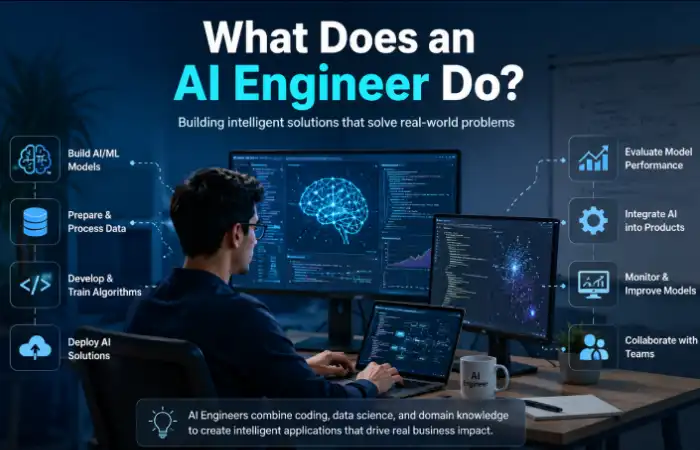
AI Engineer builds intelligent application with the technologies of machine learning, deep learning, natural language processing (NLP), computer vision and generative AI.
Typical responsibilities include:
- Building machine learning models
- Training and fine-tuning AI systems
- Deploying AI applications to production
- Integrating Large Language Models (LLMs)
- Creating Retrieval-Augmented Generation (RAG) systems
- Managing AI infrastructure and MLOps pipelines
- Monitoring model performance and accuracy
While AI researchers will try to develop new algorithms, AI Engineers will build real AI products that solve actual business issues.
AI Engineer vs Related Roles
| Role | Primary Focus | Coding Level |
| AI Engineer | Build AI-powered applications | High |
| Data Scientist | Analyze data and insights | Medium |
| Machine Learning Engineer | Train and optimize ML models | High |
| AI Researcher | Develop new AI algorithms | Very High |
| MLOps Engineer | Deploy and maintain AI systems | High |
Skills Required to Become an AI Engineer
To become an AI Engineer, we need a blend of programming skills, strong foundations in machine learning, numerical skills and deployment skills. By 2026, job providers will seek those who will be able to build and deploy business-ready AI models.
The top AI Engineers are those who maintain a good mix of technical, analytical and problem-solving skills that help develop scalable AI Applications.
Technical Skills
| Skill | Importance |
| Python | Essential |
| SQL | Essential |
| Machine Learning | Essential |
| Deep Learning | Essential |
| TensorFlow/PyTorch | Essential |
| LLM Development | High |
| RAG Systems | High |
| Cloud Computing (AWS/Azure/GCP) | High |
| APIs & FastAPI | High |
| Docker & Kubernetes | Medium |
| MLOps | High |
Soft Skills
- Problem-solving
- Communication
- Critical thinking
- Business understanding
- Team collaboration
Organizations are also looking for AI Engineers who can, along with themselves, fill the gap of business applications as well.
Education and Certifications for AI Engineers
A solid educational background and certified credentials can go a long way toward enabling you to craft a successful career path as an AI engineer.
In 2026, practical skills and experience matter more to employers but studying and acquiring certification is still needed to show credibility, technical competence and learning potential.
Recommended Degree Paths
- Computer Science
- Artificial Intelligence
- Data Science
- Software Engineering
- Mathematics
- Statistics
Top AI Certifications in 2026
| Certification | Provider | Resource |
| Machine Learning Specialization | Coursera | https://www.coursera.org/specializations/machine-learning-introduction |
| AI Engineer Professional Certificate | IBM | https://www.coursera.org/professional-certificates/ai-engineer |
| Azure AI Engineer Associate | Microsoft | https://learn.microsoft.com/certifications |
| AWS Certified Machine Learning Engineer | AWS | https://aws.amazon.com/certification |
| TensorFlow Developer Certificate | TensorFlow | https://www.tensorflow.org/certificate |
Best Learning Platforms
| Platform | Best For |
| Coursera | University-backed programs |
| edX | Academic AI education |
| Udemy | Affordable skill learning |
| DataCamp | Data Science and AI |
| DeepLearning.AI | Generative AI and LLMs |
AI Engineer Salary and Career Growth
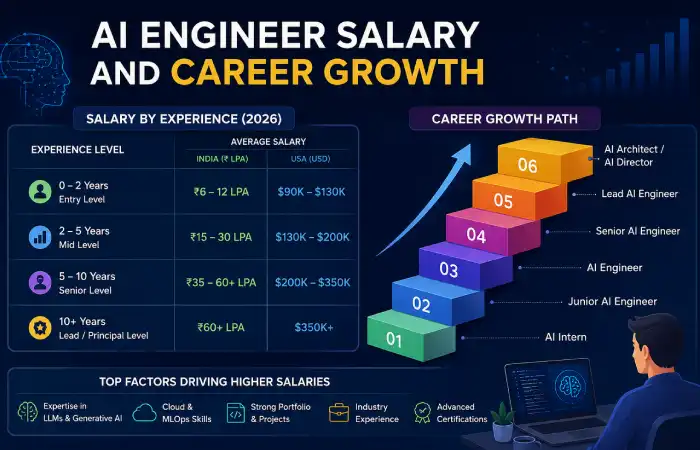
AI Engineering continues to be one of the top earning technology careers in 2026.
Average Salary Comparison (2026)
| Experience Level | India Salary | US Salary |
| Entry Level (0-2 Years) | ₹6–12 LPA | $90k–130k |
| Mid-Level (3-5 Years) | ₹15–30 LPA | $130k–200k |
| Senior Level (5-10 Years) | ₹35–60+ LPA | $200k–350k+ |
| Lead/Principal AI Engineer | ₹60+ LPA | $350k+ |
Actual pay ranges by company, location and specialization. The highest salaries within the latest published figures are paid to AI Engineers specializing in LLMs, cloud deployments and MLOps.
Career Progression Roadmap
| Stage | Timeline |
| AI Intern | 0-1 Year |
| Junior AI Engineer | 1-2 Years |
| AI Engineer | 2-4 Years |
| Senior AI Engineer | 4-7 Years |
| Lead AI Engineer | 7-10 Years |
| AI Architect / AI Director | 10+ Years |
How to Start a Career in Artificial Intelligence
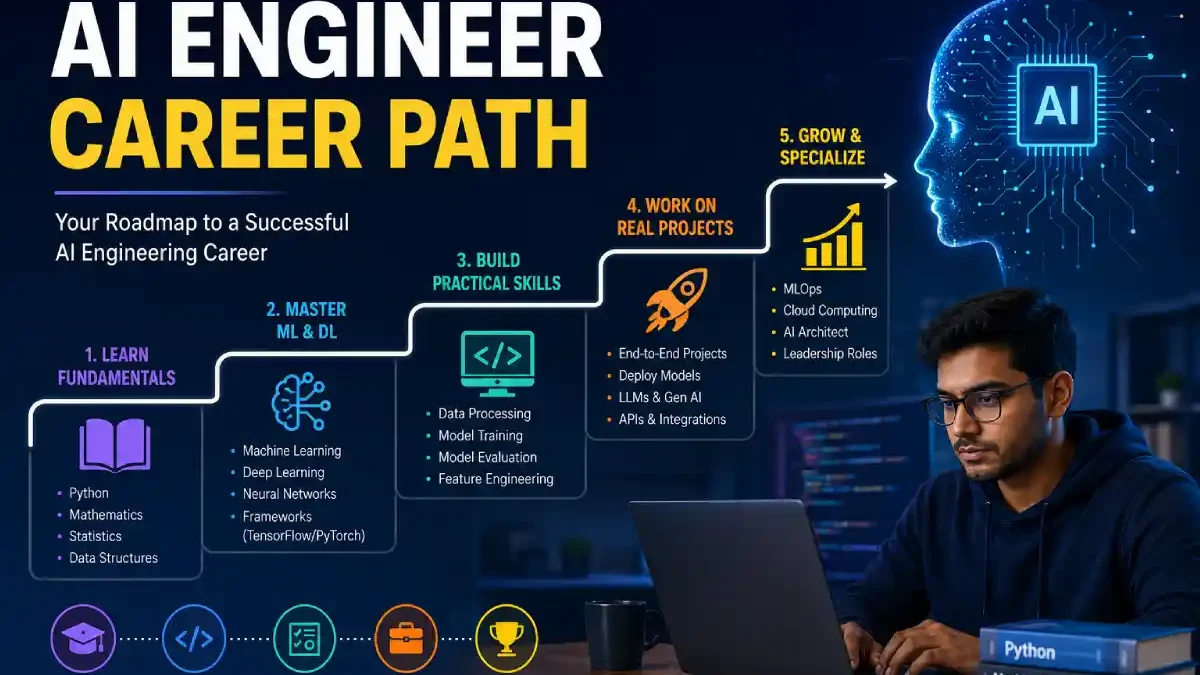
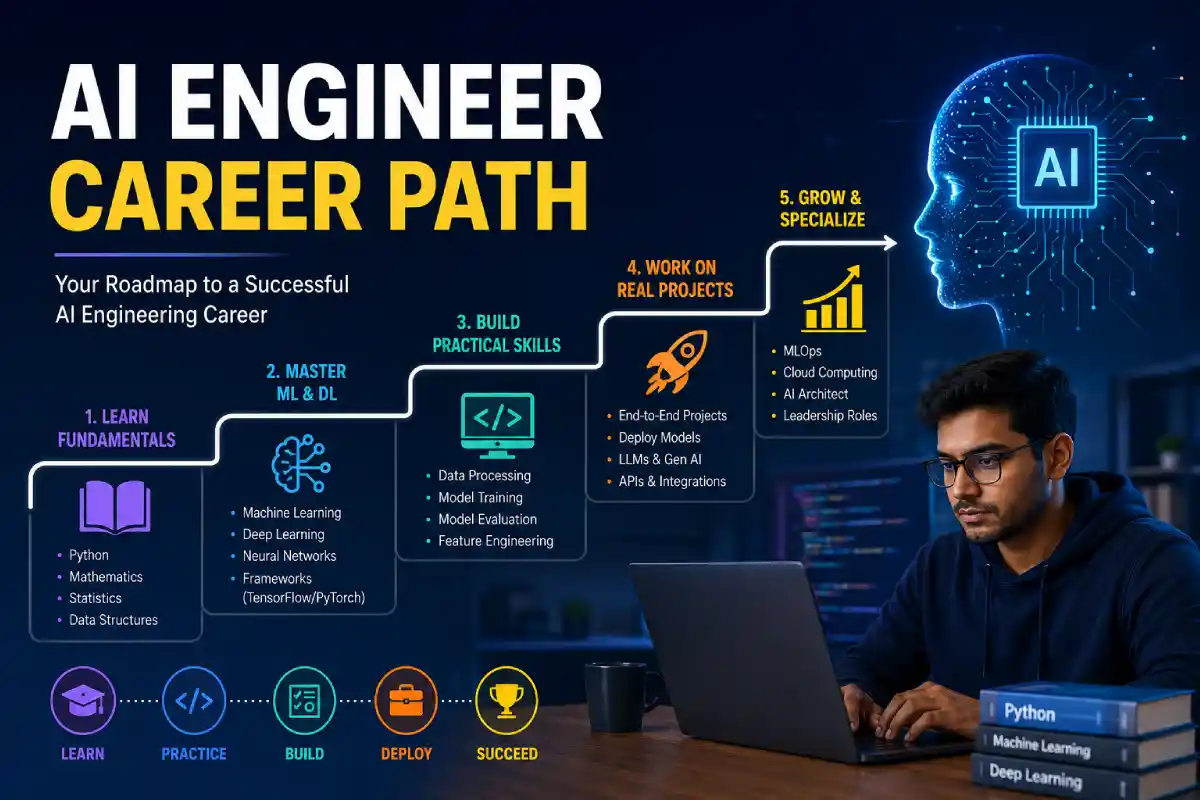
If you start from 0, just follow this road map and you are basically guaranteed to make it.
Step 1: Learn Python
Focus on:
- Variables
- Functions
- OOP
- Data structures
- APIs
Step 2: Learn Mathematics
Understand:
- Linear Algebra
- Probability
- Statistics
- Calculus basics
Step 3: Master Machine Learning
Learn:
- Regression
- Classification
- Clustering
- Model evaluation
Step 4: Study Deep Learning
Explore:
- Neural Networks
- CNNs
- RNNs
- Transformers
Step 5: Learn Generative AI
Key topics include:
- LLMs
- Prompt Engineering
- LangChain
- Vector Databases
- RAG Systems
- AI Agents
Step 6: Build Projects
Examples:
- AI Chatbot
- Resume Analyzer
- Recommendation Engine
- Document Search Assistant
- AI Coding Assistant
Step 7: Deploy Applications
Learn:
- FastAPI
- Docker
- AWS
- Azure
- Kubernetes
Step 8: Build a Portfolio
Publish your projects on Github. Have a professional LinkedIn profile.
AI Engineer Skills Most In Demand in 2026
From the analysis of the recent job market, the most frequent occurrences of the following skills are detected in job descriptions for AI Engineers:
| Skill | Demand Level |
| Python | Very High |
| Generative AI | Very High |
| LLM Integration | Very High |
| RAG Architecture | Very High |
| Cloud Computing | High |
| MLOps | High |
| LangChain | High |
| Vector Databases | High |
Such tools are replacing more and more AI-only workflows as companies move to production-ready AI solutions.
Frequently Asked Questions
Is AI Engineering a good career in 2026?
Yes. AI Engineering is still one of the fastest-growing and best paid tech careers around the world, with high demands from all sorts of industries.
Do I need a degree to become an AI Engineer?
Not necessarily. Degrees are still useful, but employers look more at practical skills, certificates, portfolios of past projects.
How long does it take to become an AI Engineer?
For most learners, 6–12 months of regular study and practical projects can prepare them for employment.
Which programming language is best for AI?
The strength of python is that it has the vastest AI environment.
Is AI Engineering harder than Software Engineering?
AI Engineering demands greater expertise on machine learning, data science, deployment of models, etc. though more focused, it is more exciting and rewarding.
Conclusion
The AI Engineer Career Path will prove to be a rewarding endeavour r for those willing to commit to acquiring technical expertise and practical experience. Because companies are expected to continually deploy generative AI, AI Agents and machine learning into daily processes, jobs for AI Engineers are likely to be plentiful for the next ten years.
The top AI Engineers of 2026 are not just model builders, they are problem solvers who can architect, implement, and scale practical AI systems that generate business impact. Begin with Python, craft projects, dive into state-of-the-art AI tools, and keep enhancing your portfolio for long-term success in one of the world‘s most thrilling tech careers.