
 Kashifa Jafar
Technology Writer & Contributor
Kashifa Jafar is a technology writer and contributor at FutureTechExpert with 4+ years of experience in technology writing and content creation.
Read Full Bio of Author →
Kashifa Jafar
Technology Writer & Contributor
Kashifa Jafar is a technology writer and contributor at FutureTechExpert with 4+ years of experience in technology writing and content creation.
Read Full Bio of Author →
 Sameena Begum
Health, Technology & Digital Content Reviewer
Sameena reviews selected health, wellness, technology, and digital content for clarity, factual presentation, and reader usefulness.
Read Full Bio of Reviewer →
Sameena Begum
Health, Technology & Digital Content Reviewer
Sameena reviews selected health, wellness, technology, and digital content for clarity, factual presentation, and reader usefulness.
Read Full Bio of Reviewer →
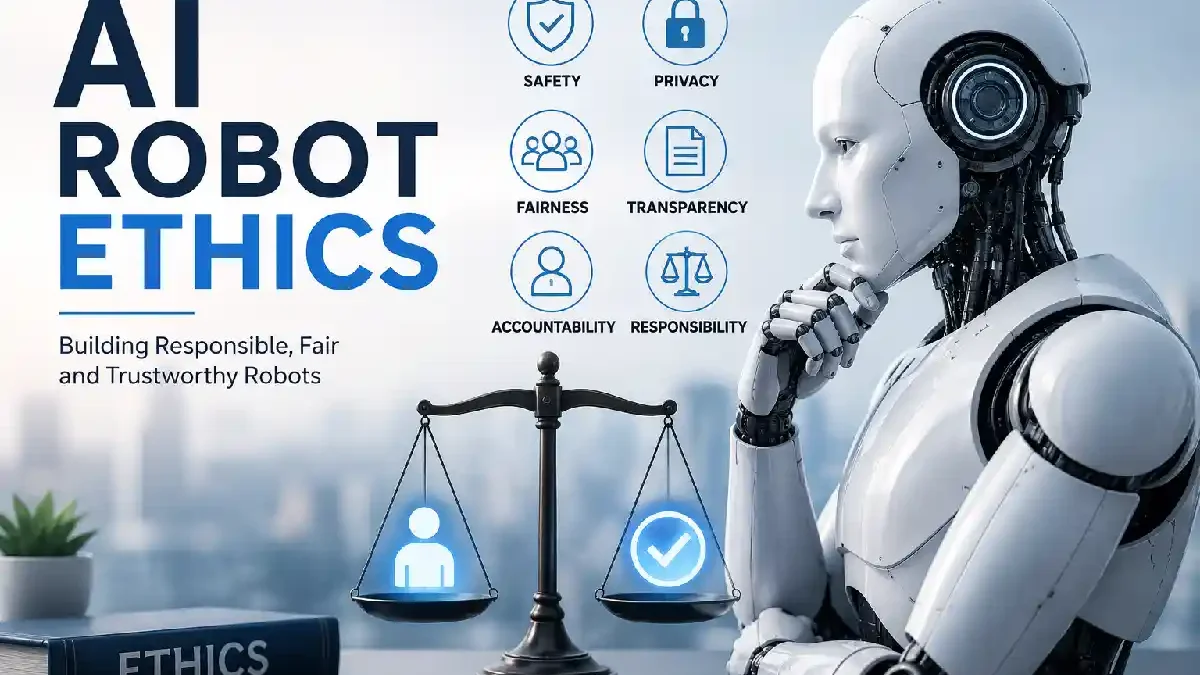
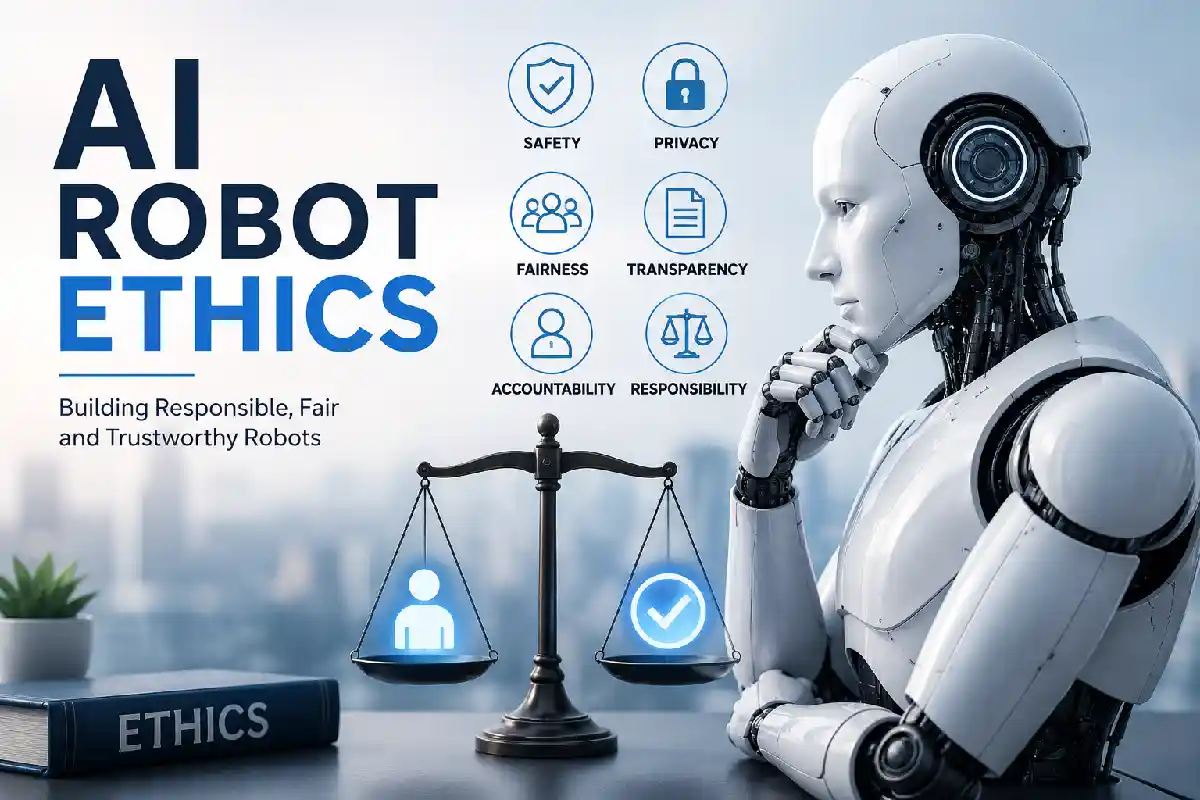
All aspects of the healthcare, manufacturing, logistics, agriculture, educational and even household robotics are being revolutionized by artificial intelligence. While robots grow increasingly autonomous, AI Robot Ethics become one of the most discussed topic among technology debates. This makes ethical robotics that enables AI systems to operate justly, transparently and securely remaining benign and respecting individuals’ privacy.
Ethical concerns become more important as AI robot continue expanding into industries, healthcare, education, and everyday life.
The ethical dilemmas of AI Robots are outlined in this guide along with a comparison of the leading three ethical models and an overview of recommendations for developers and organizations that will be deploying robotics in 2026.
 This article is part of
Artificial Intelligence Resources
Table of Contents
Why AI Ethics Matters in Robotics
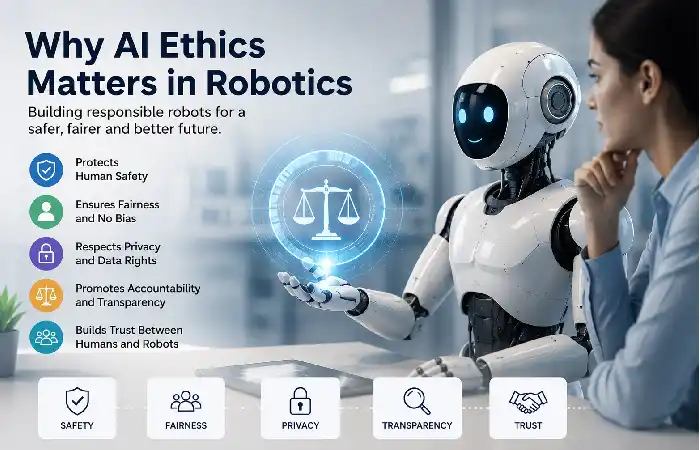
AI ethics is important in robotics because gradually robots that has a certain degree of intelligence make decision that may influence the privacy and safety of the population. For example, many robots like delivery robots that can drop system, automation warehouse, robot in health care or robots in customer service are used directly to people with little supervision. Ethical code ensures that robot behave in a responsible way.
Their decisions can affect:
- Human safety
- Privacy
- Employment
- Legal responsibility
- Public trust
They could potentially discriminate, offend or make unsafe decisions without the support of an ethical framework.
Ethical AI Goals
| Principle | Purpose | Real-world Example |
| Fairness | Avoid discrimination | Equal hiring recommendations |
| Transparency | Explain AI decisions | Medical diagnosis robots |
| Safety | Prevent harm | Industrial robots stopping near workers |
| Privacy | Protect user information | Home assistant robots |
| Accountability | Define responsibility | Autonomous delivery robots |
The ethical debate becomes even more complex with humanoid AI robots, which are designed to closely mimic human appearance and behavior.
Privacy and Surveillance Concerns
Robots that utilize AI require a large array of technologies to function including, camera and microphone systems, GPS systems, and facial recognition. Many of these already present privacy issues and additional concerns may arise from extending this kind of surveillance to robots. Security and storage of personal data is also a concern for AI systems, that requires a proper amount of care and resources.
Modern AI robots rely on:
- Cameras
- Microphones
- GPS
- Facial recognition
- Environmental sensors
These technologies would be gathering large amounts of personal data.
Privacy Risks
| Risk | Potential Impact | Mitigation |
| Facial recognition misuse | Identity tracking | Consent-based recognition |
| Continuous video recording | Privacy invasion | Local data processing |
| Voice recording | Personal information leakage | Encryption |
| Cloud storage | Data breaches | Secure storage policies |
| Location tracking | Behavioral profiling | Anonymous data collection |
Ensure proper using privacy-by-design on the organization surface. In conjunction with local regulations for privacy protection.
Understanding the real-world applications of AI robots helps explain why responsible development and ethical guidelines are increasingly necessary.
Bias in AI Decision-Making
They reported that the Issue of bias within the conclusions of machine intelligence represents one of the more ethically complex issues for the robotics community. For AI robot there is machine learning from the training data, the hard-driving of the artificial intelligence, programs itself by analyzing vast database of information which may carry the bias.
Common Bias Sources
| Bias Type | Example |
| Dataset Bias | Underrepresenting certain populations |
| Algorithm Bias | Favoring one group |
| Human Bias | Developer assumptions |
| Selection Bias | Limited training environments |
| Feedback Bias | Reinforcing previous errors |
Example
A recruitment robot readig the candidate CVs it has access to my have a bias towards candidates similar to other candidates a company already has hired.
Continually audit AI systems and use various data sets to prevent bias
Learning how AI robots work provides valuable context for understanding issues such as transparency, decision-making, and accountability.
Accountability and Responsibility
As the use of AI-enabled robots increases in autonomy, identification of the accountability and responsibility becomes one of the most significant ethical issues. When robot makes an erroneous decision, causes damage to property or injures someone, Accountability helps to identify who is responsible.
Who is responsible when an AI robot makes a harmful decision?
Possible responsible parties include:
- Software developers
- Robot manufacturers
- Business owners
- AI model providers
- Operators
Responsibility Comparison
| Scenario | Responsible Party |
| Programming error | Software developer |
| Hardware malfunction | Manufacturer |
| Incorrect configuration | Business operator |
| Poor maintenance | Organization |
| Unauthorized modifications | User |
Clear governance policies help reduce legal uncertainty.
While discussing ethical concerns, it’s equally important to recognize the many benefits of AI robots across healthcare, manufacturing, and public services.
Workforce Impact
Increasing use of AI-enabled robots is impacting an increasing number of industries and workplaces every day from manufacturing, to healthcare, to logistics, agriculture, retail, and customer service. Though many may be concerned that automation takes jobs away, it also increases efficiency and reduces those monotonous jobs:
To be able to implement the use of AI robotics responsibly and help staff manage and adapt to up-coming changes, businesses need a good understanding of the effects on the workforce.
Jobs Most Affected
| Industry | Automation Risk |
| Manufacturing | High |
| Warehousing | High |
| Retail | Medium |
| Agriculture | Medium |
| Healthcare | Low-Medium (robots assist rather than replace) |
Positive Effects
- Improved workplace safety
- Higher productivity
- New AI engineering jobs
- Better precision
- Reduced repetitive work
Challenges
- Job displacement
- Reskilling costs
- Economic inequality
- Workforce transition
Companies that are implementing robotics will need to carry out training and re-skilling.
Ethical Guidelines for Developers
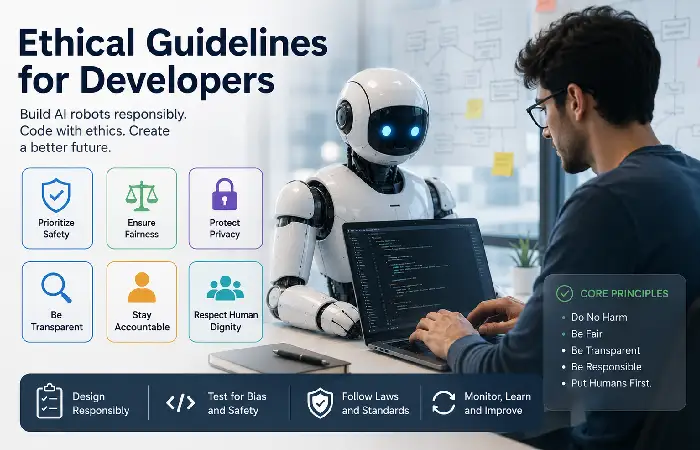
The greatest responsibility in advancing the deployment of AI responsibly falls to the developers.
Many ethical issues overlap with the broader challenges facing AI robots, including privacy, security, bias, and regulatory compliance.
Best Practices
- Design for human safety
- Minimize bias in datasets
- Explain AI decisions
- Protect user privacy
- Continuously monitor AI performance
- Test edge cases
- Enable human oversight
- Maintain audit logs
- Perform regular security testing
- Follow international AI standards
Ethical Development Lifecycle
| Stage | Ethical Consideration |
| Planning | Risk assessment |
| Data Collection | Fair datasets |
| Model Training | Bias testing |
| Validation | Safety evaluation |
| Deployment | Human supervision |
| Monitoring | Continuous auditing |
Comparison of Major AI Ethics Frameworks (2026)
| Framework | Focus | Best For | Resource |
| OECD AI Principles | Human-centered AI | Governments & businesses | https://oecd.ai |
| UNESCO Recommendation on AI Ethics | Human rights | Global organizations | https://unesco.org |
| NIST AI Risk Management Framework | Risk management | Enterprises | https://nist.gov |
| ISO/IEC 42001 | AI management systems | Compliance | https://iso.org |
| IEEE Ethically Aligned Design | Engineering ethics | Robotics developers | https://standards.ieee.org |
Frequently Asked Questions
What are the ethics of AI robot?
The ethical principles governing AI robot centers will be those which govern the safe, fair, open and accountable operation of the AI robot centers.
What is the significance of ethics in robotics?
Ethics are important to prevent the discrimination, privacy breaches, dangerous actions, and inappropriate use of autonomous systems, and foster public confidence.
Are AI robots capable of bias?
Yes. Bias can stem from any of the above due to the training data, the algorithm, or the assumptions made by humans while designing it.
Who is to blame when AI robots go wrong?
Responsibility will depend on the context and can be the developers, manufacturers, operators or organizations that implement the robot.
What sorts of robot can developers design in ways that they are, besides being safe, ethically dependable?
To overcome these challenges, the authors employed various approaches such as diverse datasets, perform fairness testing, protecting privacy, deploying explainable AI as well as constant monitoring of the systems once they are in production.
Conclusion
AI robot ethics is no longer an option. It is a requirement for building intelligent robot systems that consumer trust in. With intelligent robots being built to serve in diverse industries including healthcare, manufacturing, logistics, education et al, manufacturers and users are required to weave fairness, transparency, privacy, safety and accountability into every phase of the AI life.
Satisfying accepted ethical principles such as eliminating bias in models, protecting user data and having human intervention renders user confident in the responsible use of AI-equipped robots, compliance with new regulations, while offering adaptable consumer driven experiences. Their use guarantees security of customers, and makes them more flexible.
Kashifa Jafar is a technology writer and contributor at FutureTechExpert with 4+ years of experience in technology writing and content creation.
Read Full Bio of Author →Sameena reviews selected health, wellness, technology, and digital content for clarity, factual presentation, and reader usefulness.
Read Full Bio of Reviewer →