
 Kashifa Jafar
Technology Writer & Contributor
Kashifa Jafar is a technology writer and contributor at FutureTechExpert with 4+ years of experience in technology writing and content creation.
Read Full Bio of Author →
Kashifa Jafar
Technology Writer & Contributor
Kashifa Jafar is a technology writer and contributor at FutureTechExpert with 4+ years of experience in technology writing and content creation.
Read Full Bio of Author →
 Sameena Begum
Health, Technology & Digital Content Reviewer
Sameena reviews selected health, wellness, technology, and digital content for clarity, factual presentation, and reader usefulness.
Read Full Bio of Reviewer →
Sameena Begum
Health, Technology & Digital Content Reviewer
Sameena reviews selected health, wellness, technology, and digital content for clarity, factual presentation, and reader usefulness.
Read Full Bio of Reviewer →
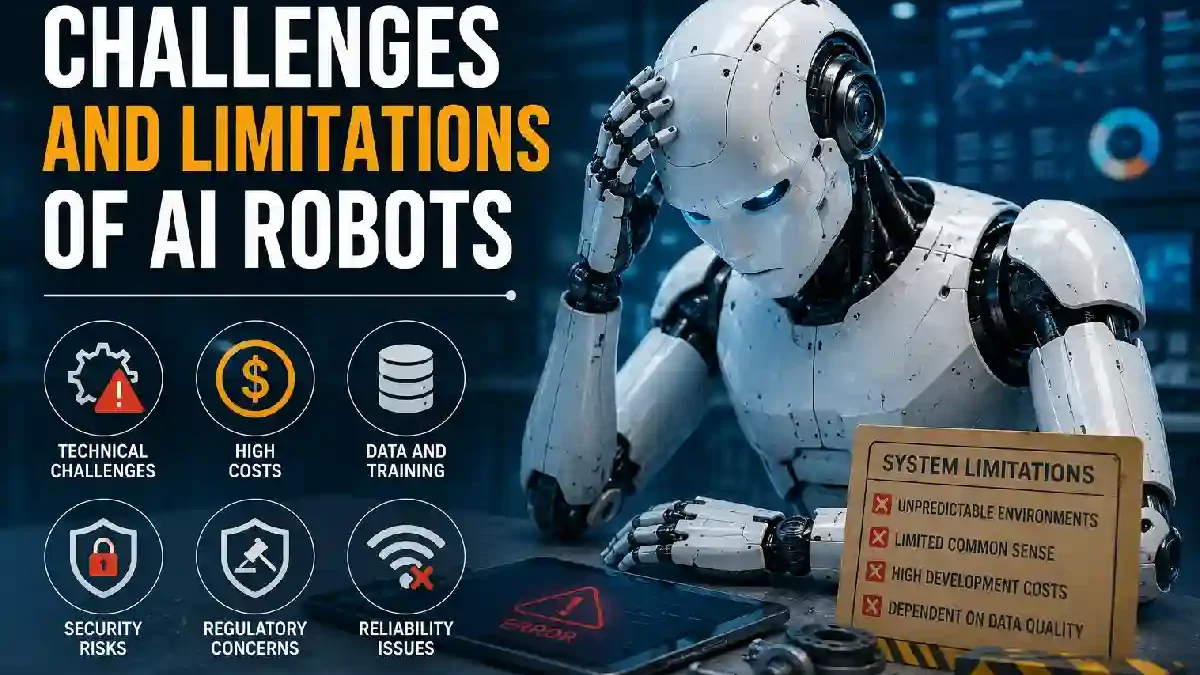
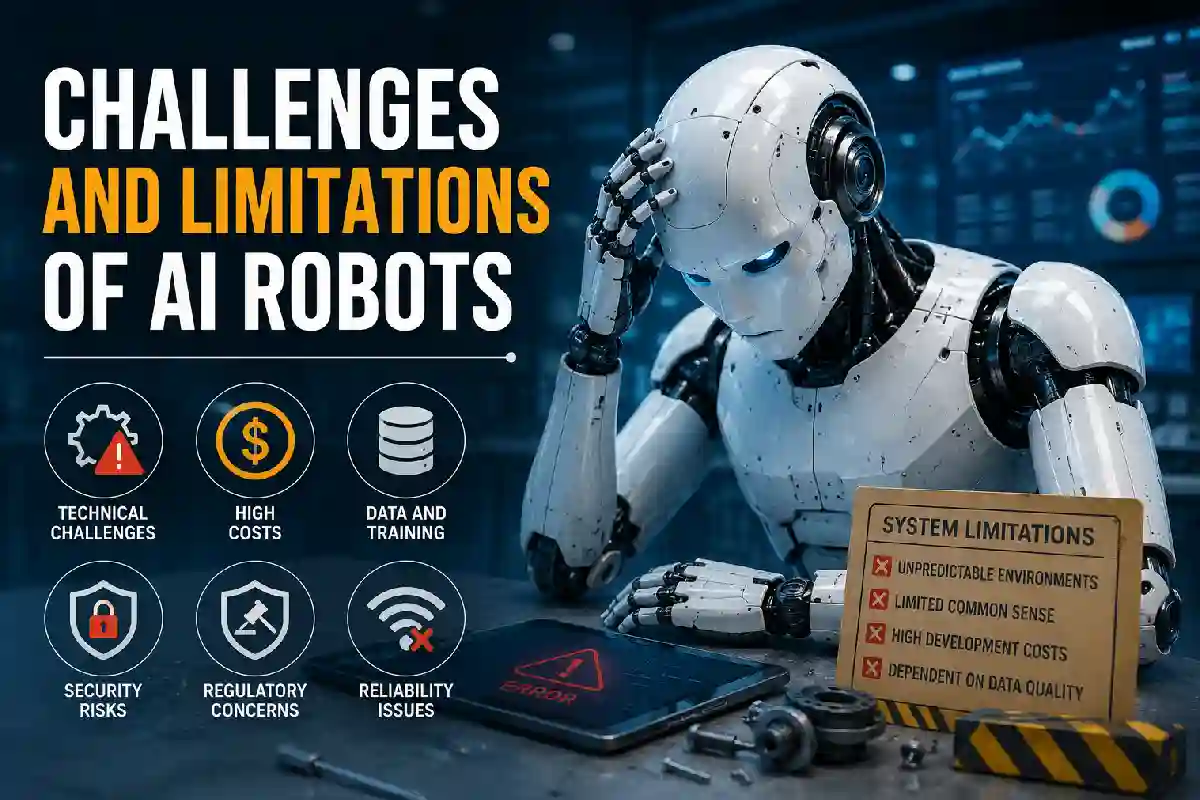
The Impact of Robots in Various Industries and Fields? AI Robots have been considered as a valuable tool to various industries and fields such as healthcare, manufacturing, retail or logistics. And as it advances, Challenges and Limitations of AI Robots also become obstacles of large-scale implementation. An organization planning to automate should be aware of their technical limitations, costs, security, regulations and maintenance.
Before exploring these obstacles, it’s helpful to understand AI robot explained, including how they combine artificial intelligence with robotics to perform complex tasks.
Here we describe the main challenges using easy terminology and compare the most recent robotic technologies using current 2026 industry information.
 This article is part of
Artificial Intelligence Resources
AI Robot Challenges at a Glance (2026)
| Challenge | Impact | Difficulty | Business Risk | Resource |
| Technical complexity | High | High | High | IBM AI Research |
| Development costs | High | Medium | High | NVIDIA Robotics |
| Data requirements | High | High | Medium | Google AI |
| Reliability | Medium | Medium | High | IEEE Robotics |
| Cybersecurity | Very High | High | Critical | NIST AI Framework |
| Regulations | Medium | Medium | High | EU AI Act |
Table of Contents
Technical Challenges
AI robots integrate computer vision, machine learning, sensors, processors and mechanical systems. Any form of failure even the smallest disrupts the system.
Major technical challenges include:
- Sensor inaccuracies
- Navigation failures
- Object recognition errors
- Environmental adaptation
- Hardware failures
- Software bugs
For example, in a structured environment such as operating warehouse robots do well. But they will not fare so well in a working environment where the variables of the layout are constantly changing.
Comparison of Technical Limitations
| Problem | Traditional Robot | AI Robot |
| Learns from experience | No | Yes |
| Handles unexpected events | Limited | Moderate |
| Requires programming | High | Medium |
| Makes autonomous decisions | No | Yes |
| Error probability | Low | Medium |
High Development Costs
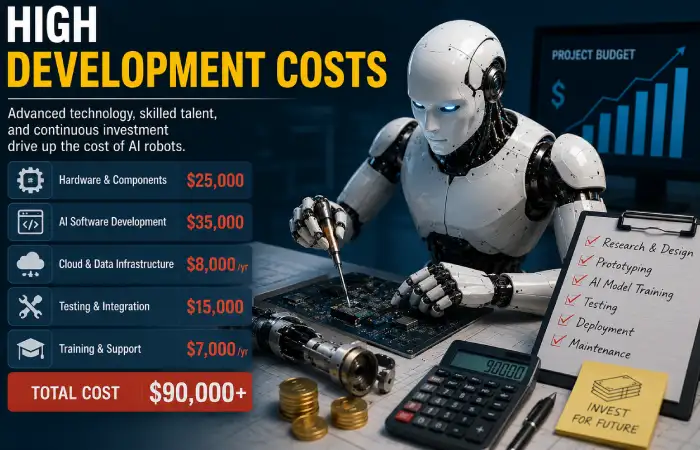
One of the most significant challenges and constraints to the widespread adoption of AI robots is the cost of developing and deploying them. Unlike traditional machines, robots with artificial intelligence need sophisticated hardware, intelligent programs, sensors, cloud infrastructure and maintenance in order to work. Though large companies may manage to pay the high starting cost of robotic automation, startups and small companies may not have such possibilities.
How Much Does An AI Robot Cost?It‘s also important to note that the price of an AI robot is much more than buying the robot. Apart from the mentioned factors, many other factors also need to be taken into account—for example, AI model building, implementation of the model into company system, educate employees to work along with AI, software operational costs etc. Sometimes, customization of the robots also is an important aspect of the project that again increases costs.
Many of today’s technical challenges are especially noticeable in humanoid AI robots, where balancing movement, perception, and human interaction is particularly demanding.
Typical expenses include:
| Cost Category | Estimated Cost (2026 USD) |
| Robot hardware | $15,000–$250,000 |
| AI software | $10,000–$150,000 |
| Cloud infrastructure | $500–$8,000/month |
| Maintenance | 10–20% annually |
| Employee training | $2,000–$20,000 |
Such investment for automation may not be convincing for small companies unless huge savings can be made in labor costs.
Data and Training Requirements
AI robots depend on data of good quality and frequent training in order to achieve accuracy. Traditional robots are programmed with fixed instructions. But AI-robots perform tasks by analyzing data, learning the key features and improving their decisions as they operate. But, gathering of data, pre-preparing data and maintaining the data can be of one of the most difficult and limitations of AI-robots.
AI Robots have to process thousands if not millions labeled images, sensor data, audio clips, and real-world interactions in order to operate efficiently. The accuracy of this data, however, greatly affects the accuracy of the robot. A robot that relies on incomplete, inefficient, or biased data will make mistakes when processing images, identifying objects, navigating, or performing other actions.
Training datasets often include:
- Millions of images
- Video recordings
- Sensor readings
- Human demonstrations
- Environmental mapping
Poor-quality data leads to:
- Incorrect decisions
- Object recognition failures
- Navigation errors
- Reduced productivity
AI Training Comparison
| Factor | Small Dataset | Large Dataset |
| Accuracy | Low | High |
| Adaptability | Poor | Excellent |
| Learning Speed | Slow | Fast |
| Error Rate | High | Low |
Despite these limitations, real-world AI robot applications continue to expand across healthcare, manufacturing, logistics, and education.
Reliability Issues
Reliability is also one of the major factors in assessing the AI robot. Although AI robots are built to learn, adapt and reason independently, it is not always reliable in uncertain and dynamic conditions. Reliability problem in AI robots is one of the major challenges and drawbacks especially in those industry sectors where accuracy and safety are critical.
Unlike the traditional robots, which a limited to operate according to the instruction that it was told, the AI robot operates by machine learning algorithms and real time data to decide. When the data received as input is not perfect (say, one of the sensor receives the wrong information) or outside of the domain that the system was trained in, it can give rise to unexpected results. The robot performance can be affected by minor sensor glitches, software bugs or internet failure.
Prediction errors sometimes result in:
- Wrong object detection
- Unexpected movements
- Inconsistent outputs
- Downtime
- Maintenance interruptions
Reliability Comparison
| Feature | Industrial Robot | AI Robot |
| Predictability | Excellent | Good |
| Adaptability | Low | High |
| Flexibility | Limited | Excellent |
| Unexpected Errors | Rare | Moderate |
Most of the businesses usually utilize the robots together with human operators to lower the risk of the operation.
Understanding how AI robots work makes it easier to see why issues like sensor accuracy, data quality, and computing power create significant challenges.
Security Risks
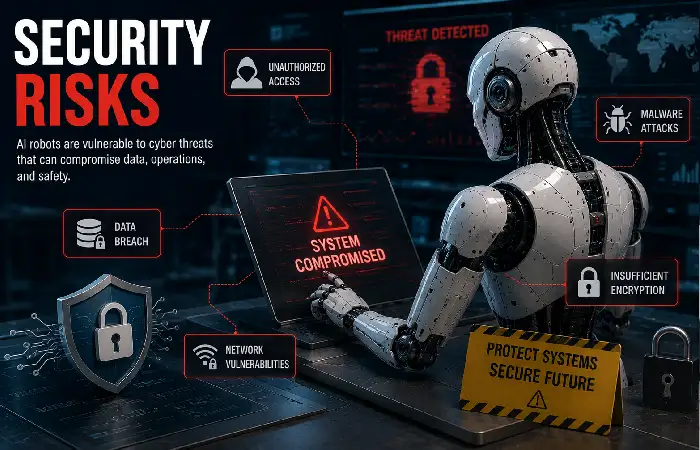
Connected robots are possible targets for cybersecurity
Common risks include:
- Malware attacks
- Unauthorized access
- Cloud breaches
- Data theft
- Remote hijacking
- Network vulnerabilities
Organizations increasingly implement:
- Multi-factor authentication
- Network segmentation
- AI monitoring
- End-to-end encryption
- Zero Trust security
Security Risk Comparison
| Risk | Severity | Prevention |
| Malware | High | Endpoint security |
| Data theft | High | Encryption |
| Unauthorized access | High | MFA |
| Cloud attacks | Medium | Identity management |
| Firmware attacks | Medium | Secure updates |
Regulatory Concerns
Governments across the world are also continuously bringing new regulations about AI.
Organizations deploying AI robots must consider:
- Data privacy laws
- Workplace safety standards
- AI transparency
- Accountability
- Ethical AI practices
Rather than just a statutory obligation, compliance is a competitive advantage.
While it’s important to recognize these drawbacks, the benefits of AI robots continue to drive innovation and widespread adoption across industries.
Comparison of Global AI Regulations (2026)
| Region | Regulation | Focus |
| European Union | EU AI Act | Risk-based AI governance |
| United States | NIST AI RMF | Voluntary AI risk management |
| Japan | AI Governance Guidelines | Responsible AI |
| Singapore | Model AI Governance Framework | Transparency |
| India | Emerging AI governance initiatives | Ethical AI adoption |
Commercial AI Robot Platforms
| Platform | Best For | Advantages | Resource |
| Boston Dynamics | Industrial robots | Advanced mobility | https://bostondynamics.com |
| ABB Robotics | Manufacturing | Reliable automation | https://new.abb.com/products/robotics |
| FANUC | Factory automation | High precision | https://www.fanucamerica.com |
| Universal Robots | SMEs | Easy deployment | https://www.universal-robots.com |
| NVIDIA Isaac | AI development | Powerful simulation | https://developer.nvidia.com/isaac |
Beyond technical limitations, organizations must also address AI robot ethics, including privacy, accountability, bias, and responsible decision-making.
Frequently Asked Questions
What will be the great limitation of AI robots?
The biggest limitation is that they rely on high-quality data, high-powered computers and tight control environments. They perform less when the environment is chaotic.
Why are they so costly?
Cost include hardware, sensors, AI software, cloud infrastructure, system integration, training, maintenance, etc.
Can AI robots supplant human beings?
AI driven robots are important for automating boring and dangerous jobs, but they will never be a substitute for humans’ creative, emotional and moral competencies, and their problem-solving skills.
Is it Safe to ai robots?
May be secure if organizations adopt strong cybersecurity controls such as encryption, multi-factor authentication, secure patches, and active monitoring.
Will costs of AI robots will fall?
Yes. Future developments in AI chips, open source software and mass manufacturing should drive down the costs over the next few years allowing any size business to afford an AI robot.
Conclusion
Despite ongoing innovation and automation, AI robots face Challenges and Limitations of AI Robots that companies should consider before implementation. Technical advances and integration, high cost and consumption of capital, higher reliance on data, “cannibalized” reliability, increased cybersecurity, and compliance/regulatory factors challenge the use of AI powered automation.
Those that develop strong security measures, invest in quality data, utilize skilled engineers, and meet regulatory standards are able to benefit from the efficiency they provide.
Kashifa Jafar is a technology writer and contributor at FutureTechExpert with 4+ years of experience in technology writing and content creation.
Read Full Bio of Author →Sameena reviews selected health, wellness, technology, and digital content for clarity, factual presentation, and reader usefulness.
Read Full Bio of Reviewer →