
 Kashifa Jafar
Technology Writer & Contributor
Kashifa Jafar is a technology writer and contributor at FutureTechExpert with 4+ years of experience in technology writing and content creation.
Read Full Bio of Author →
Kashifa Jafar
Technology Writer & Contributor
Kashifa Jafar is a technology writer and contributor at FutureTechExpert with 4+ years of experience in technology writing and content creation.
Read Full Bio of Author →
 Sameena Begum
Health, Technology & Digital Content Reviewer
Sameena reviews selected health, wellness, technology, and digital content for clarity, factual presentation, and reader usefulness.
Read Full Bio of Reviewer →
Sameena Begum
Health, Technology & Digital Content Reviewer
Sameena reviews selected health, wellness, technology, and digital content for clarity, factual presentation, and reader usefulness.
Read Full Bio of Reviewer →
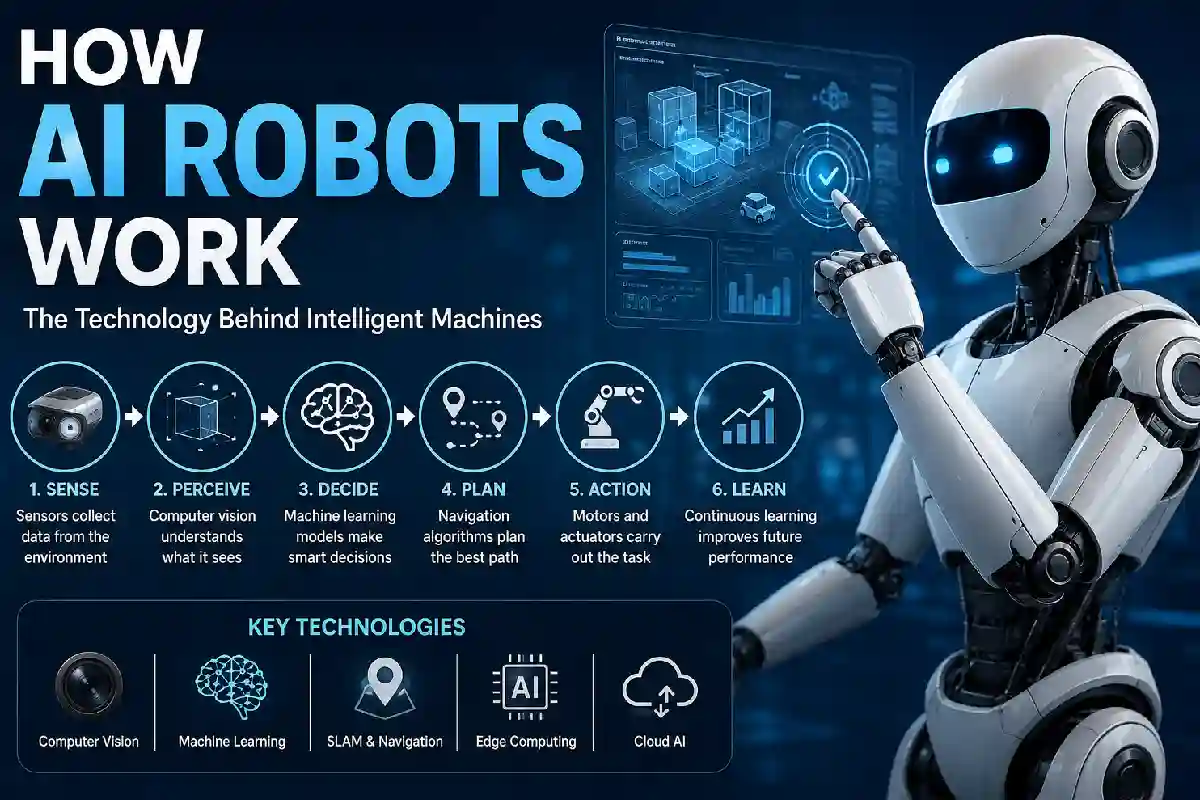
Artificial intelligence has changed robots from basic programmed machine into intelligent systems that can see, learn, decide and communicate with human. How AI robots work has become one of the most common questions for students, experts and businesses in exploring automation in 2026.
Unlike regular robots that strictly follow set instructions, AI robots are equipped with sensors, computer vision, machine learning, automation software etc., and hence are able to perceive the environment and take intelligent actions based on it. All AI robots just like warehouse robots, autonomous delivery robot, robots serving at hospitals, or personal humanoid robots follow a similar process flow.
Before understanding how AI robots work, it’s helpful to explore what AI robot are and how they combine artificial intelligence with robotics to perform intelligent tasks.
This page guides you through each step of this process in accessible, easy to understand language. While also letting you discover more about robotics in our AI robot learning hub.
 This article is part of
Artificial Intelligence Resources
How AI Robots Work (Overview)
| Step | AI Technology Used | Purpose |
| Sense | Cameras, LiDAR, GPS, Sensors | Collect environmental data |
| Perceive | Computer Vision | Understand surroundings |
| Think | Machine Learning Models | Make decisions |
| Plan | Navigation Algorithms | Choose best action |
| Move | Motors & Controllers | Execute movement |
| Learn | Reinforcement Learning | Improve future performance |
Resource
- https://www.nvidia.com/en-us/autonomous-machines/
- https://deepmind.google
Table of Contents
The Robot Perception Process
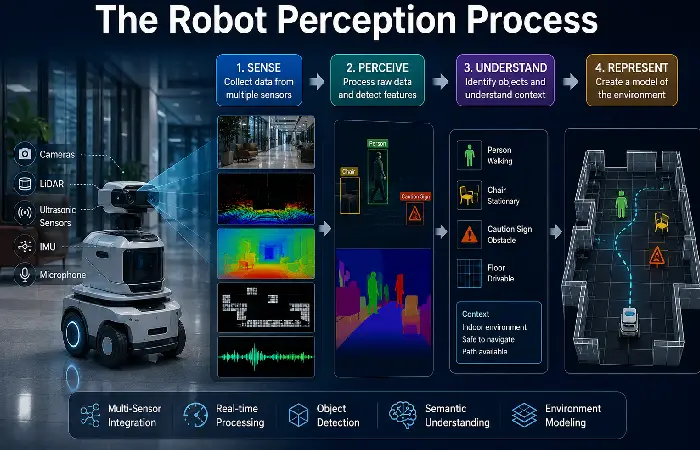
A robot must be aware of its environment before it can carry out any task.
Robot perception relies on various sensors which are continuously gathering information from environment.
Common sensor types include:
| Sensor | Purpose |
| Camera | Detect objects |
| LiDAR | Measure distance |
| Ultrasonic | Detect nearby obstacles |
| Infrared | Night detection |
| GPS | Outdoor navigation |
| IMU | Balance and orientation |
| Force Sensors | Detect touch or pressure |
These sensors are used in conjunction to create a digital map of the environment.
A warehouse robot may detect shelves, people and boxes and then plan a safe route around them.
Many of the technologies discussed here are also used in humanoid AI robots, which are designed to mimic human movement, interaction, and decision-making.
Computer Vision in Robotics
With the use of computer vision, robots are able to see images and videos, like humans.
Instead of simply recording pictures, AI analyzes every frame to identify:
- People
- Animals
- Vehicles
- Products
- Road signs
- Obstacles
- Human gestures
Modern robots utilize deep learning models which are trained on millions of images.
Common Computer Vision Tasks
| Task | Example |
| Object Detection | Find a package |
| Face Recognition | Identify employees |
| Image Classification | Sort products |
| Pose Estimation | Detect human movement |
| Semantic Segmentation | Understand roads or rooms |
Numerous autonomous robots are able to process vision in milliseconds.
The working principles explained above enable the real-world applications of AI robots across industries such as healthcare, manufacturing, logistics, and education.
Machine Learning for Robot Decisions
Machine learning is the fundamental aspect of AI robots. It provides the technology that allows robots to make intelligent decisions, rather than just respond to a set of programmed commands. Through running algorithms on acquired data, recognizing patterns and learning, machine learning is the base that allows the robot to work flawlessly on tasks.
Robots are maybe the most difficult type of AI to use since, unlike other robots that live by repeating the same task, because of the AI they have sensors and cameras to provide them information about the world that they make use of. For instance, a warehouse robot can take the quickest way around items in the way and a health care robot can decide which patient to attend first.
For example:
A cleaning robot pulls up faster in some parts of the house.
Warehouse robot find the shortest routes for hands.
A delivery robot becomes incrementally better at avoiding pedestrians.
Comparison of Robot Intelligence
| Traditional Robot | AI Robot |
| Fixed programming | Learns continuously |
| Same response every time | Adapts to situations |
| Limited flexibility | Dynamic decisions |
| Requires manual updates | Self-improving models |
Resource
- https://pytorch.org
- https://www.tensorflow.org
Understanding how these systems operate also makes it easier to appreciate the key benefits of AI robots, including improved efficiency, precision, and automation.
Motion Planning and Navigation
Once the robot had been mapped and it could recognize the environment, it will try to solve its path in an efficient and secure manner to reach the target. This process is called motion planning and navigation. It is the function used to plan out the desired path from the robot‘s sensors and control its motion.
There is an ex-terrorist robot, a self-steering delivery robot, a robot vacuum, etc, motion planning helps the robot go to the intended position accurately and avoid collision.
Motion planning calculates:
- Destination
- Obstacles
- Battery level
- Speed
- Terrain
- Human movement
Modern robots combine:
- SLAM (Simultaneous Localization and Mapping)
- GPS
- LiDAR
- Computer Vision
Thus allowing movement without human intervention.
Navigation Technologies Comparison (2026)
| Technology | Indoor | Outdoor | Accuracy |
| GPS | Poor | Excellent | Medium |
| LiDAR | Excellent | Excellent | Very High |
| Vision-Based Navigation | Excellent | Good | High |
| Ultrasonic | Good | Limited | Medium |
Despite their advanced capabilities, developers must overcome several challenges facing AI robots, such as technical limitations, safety concerns, and deployment costs.
Human-Robot Interaction Systems
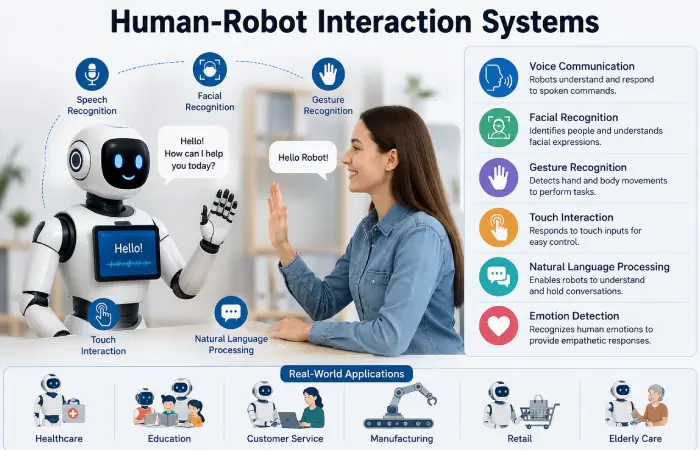
Human-Robot Interaction or HRI is the means by which someone and a robot communicate and work with each other in a safe and effective way. Today‘s AI Robots or artificial intelligence robots, can not only execute specific operations but also understand human instructions, behave naturally, and adjust behavior depending upon the user interaction, and therefore are very useful in hospitals, factories, educational institutions, supermarkets, houses etc.
Examples include:
- Voice assistants
- Touch screens
- Gesture recognition
- Facial recognition
- Emotion detection
- Speech synthesis
Healthcare robots combine these technologies in order to communicate with patients more naturally.
The teaching robots will have the choices of adjusting the pace of delivering the lessons according to students’ responses.
The service robots respond to customer inquiries with conversational artificial intelligence.
Continuous Learning and Adaptation
Another crucial characteristic of current-generation AI robots is that they learn along their lifetime. Conventional robots were not learning, but repetitively executing the same programmed operation.
On the contrary, robots equipped with AI are capable of learning by applying their previous knowledge to new situations. This allows them to perform new tasks with increased precision, efficiency and adaption.
Learning methods include:
- Supervised Learning
- Unsupervised Learning
- Reinforcement Learning
The result is improved accuracy, quicker decision-making and safer operations.
Learning Methods Comparison
| Learning Type | Best For | Example |
| Supervised | Object recognition | Detect products |
| Unsupervised | Pattern discovery | Customer behavior |
| Reinforcement | Autonomous navigation | Delivery robots |
As AI robots become more autonomous, it’s equally important to understand the ethical issues surrounding AI robots, including privacy, bias, accountability, and responsible AI use.
Frequently Asked Questions
What is the process for an AI robot to make decisions?
AI robots interpret sensor readings using a variety of machine learning algorithms, then evaluate potential behaviours and decide on a preferred course of action based on their programming and acquired knowledge.
AI robots not learn autonomously?
A great number of modern AI robots employ continual learning methods, like reinforcement learning or regular model updates, to enhance what they can do.
What sensors do AI robots use?
Some common sensors are: Camera, LiDAR, Ultrasonic, Infrared, GPS, IMU‘s, Force sensors.
Difference between AI and robots?
While most robots operate only according to a set of instructions, AI Robots will be able to interrogate the environment and make their own decisions based on their data and experience, learn, and adapt.
Which industry uses AI robots the most?
From the data available to us, we can distinguish the following applicants: manufacturing, doctors, logistics, farming, multi-trade, education, customer service, defense and unmanned transport.
Conclusion
Ai is easier to analyse how the Ai robots operate if you try to divide them up into six steps: sensing, perception, decision, motion planning, actuation and continuous learning. With high-tech sensors, computer vision, machine learning and automation AI robots can collect data, analyze, and predict, and eventually change their behavior over time.
Kashifa Jafar is a technology writer and contributor at FutureTechExpert with 4+ years of experience in technology writing and content creation.
Read Full Bio of Author →Sameena reviews selected health, wellness, technology, and digital content for clarity, factual presentation, and reader usefulness.
Read Full Bio of Reviewer →