
 Kashifa Jafar
Technology Writer & Contributor
Kashifa Jafar is a technology writer and contributor at FutureTechExpert with 4+ years of experience in technology writing and content creation.
Read Full Bio of Author →
Kashifa Jafar
Technology Writer & Contributor
Kashifa Jafar is a technology writer and contributor at FutureTechExpert with 4+ years of experience in technology writing and content creation.
Read Full Bio of Author →
 Sameena Begum
Health, Technology & Digital Content Reviewer
Sameena reviews selected health, wellness, technology, and digital content for clarity, factual presentation, and reader usefulness.
Read Full Bio of Reviewer →
Sameena Begum
Health, Technology & Digital Content Reviewer
Sameena reviews selected health, wellness, technology, and digital content for clarity, factual presentation, and reader usefulness.
Read Full Bio of Reviewer →
Humanoid AI Robots are some of the most exciting developments in technology in 2026. Combining things such as artificial intelligence, machine learning, computer vision, sensors and advanced machinery, they look and act as real humans do.
With the pressures of a decreasing workforce, and ever higher levels of automation demanded by industry, humanoid robots are naturally making their transition from research laboratories into factories, warehouses, healthcare and customer service settings. Tesla, Figure AI, Agility Robotics and Unitree are some of the forerunners to produce truly functional, mass market human-like robots.
Humanoid robots are one category within the broader field of AI robot, which includes industrial, service, healthcare, and autonomous robotic systems.
 This article is part of
Artificial Intelligence Resources
Table of Contents
What Are Humanoid Robots?
A humanoid robot is a sophisticated machine constructed to resemble the human body and to replicate human behaviors and interactions, including performing activities by using a head, a body, two arms and legs.
It can be used in human-designed world, as doing the human activity by mechanizing the field of robotics and controlling the actions with AI (artificial intelligence). For example walking, fetching, recognizing a face, voice recognition and processing, and communicating with humans naturally.
Unlike industrial robots, which are designed for a single purpose with limits on where they operate, humanoid robots are designed for flexibility and function. They operate in a variety of conditions through the use of sensors and cameras, computer vision, machine learning, and artificial intelligence-based decision-making systems.
From hospitals and warehouses to customer service and education, humanoid machines continue to expand the real-world applications of AI robots across industries.
Core Components of Humanoid AI
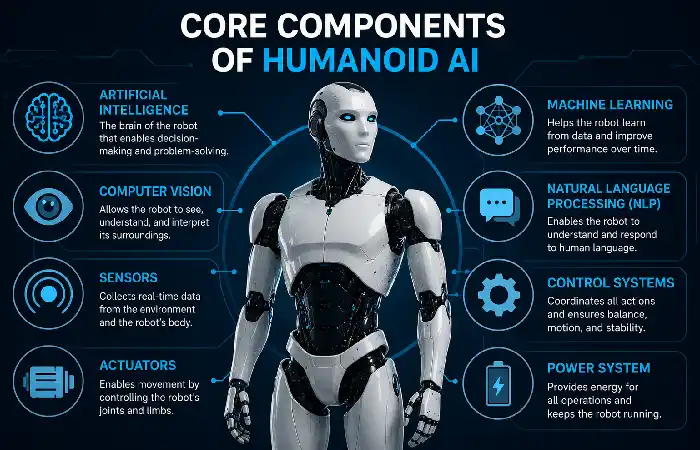
Humanoid AI robots integrate sophisticated hardware and software to think, see, move and act in the world as humans do. This integration of hardware and software allows the robots to react intelligently to the environment, to work autonomously, and to integrate and work with humans safely and efficiently.
Core Components of Humanoid AI
| Component | Function |
| Artificial Intelligence (AI) | Acts as the robot’s brain, enabling decision-making & problem-solving |
| Computer Vision | Allows the robot to see & understand its surroundings |
| Sensors | Collect real-time environmental & physical data |
| Actuators | Create movement in limbs, joints, & hands |
| Machine Learning | Helps the robot improve performance through experience |
| Natural Language Processing (NLP) | Enables speech recognition & human communication |
| Control Systems | Coordinate movement, balance, & task execution |
| Power System | Supplies energy to all robotic functions |
Understanding how AI robots work helps explain how humanoid robots process information, recognize environments, and make intelligent decisions.
Most Advanced Humanoid Robots Today
The race to create advanced humanoid AI robots has become even fiercer over the last decade. The world‘s major technology firms and emerging robotics startups such as Toyota and Boston Dynamics are building machines that can walk, speak, handle many everyday objects and complete various tasks with levels of autonomy.
They bring together machine learning, AI and cutting-edge robotics to integrate into human-designed habitats.
Top Humanoid Robots in 2026
| Robot | Developer | Primary Purpose | Key Strength |
| Optimus Gen 3 | Tesla | Manufacturing & logistics | AI-driven automation |
| Figure 02 | Figure AI | Warehousing & industrial work | Human-like task execution |
| Digit | Agility Robotics | Material handling | Commercial deployment |
| Atlas Electric | Boston Dynamics | Research & industrial applications | Exceptional mobility |
| G1 | Unitree Robotics | Research & education | Affordable humanoid platform |
Humanoid Robot Comparison
| Feature | Tesla Optimus | Figure 02 | Digit | Atlas Electric | Unitree G1 |
| Walking Ability | Excellent | Excellent | Very Good | Outstanding | Good |
| AI Integration | Advanced | Advanced | High | High | Moderate |
| Object Handling | Excellent | Excellent | Good | Very Good | Good |
| Commercial Availability | Limited | Pilot Programs | Available | Testing Phase | Available |
| Industrial Focus | High | High | High | Medium | Low |
| Research Applications | Medium | Medium | Medium | High | High |
Industries Using Humanoid Robots
The humanoid robot is not merely located in research labs and computers exhibitions; it soon becoming emerging with developments in ai, computer vision, motor learning, and robotics engineering.
Because they are adapted to environments designed for humans, robos are particularly well-suited to perform tasks that require mobility, flexibility and human contact.
As productivity advances, work force shortages and task automation, humanoid robots is likely to become a significant part of the future work force.
Major Industries Using Humanoid Robots
| Industry | Primary Applications | Benefits |
| Manufacturing | Assembly, inspection, material handling | Increased efficiency and reduced labor costs |
| Warehousing & Logistics | Picking, sorting, transporting goods | Faster operations and improved accuracy |
| Healthcare | Patient assistance, rehabilitation support | Better patient care and staff support |
| Retail | Customer service and inventory management | Enhanced customer experience |
| Hospitality | Reception, concierge, room service | Improved guest services |
| Education | Research, STEM training, classroom assistance | Interactive learning experiences |
| Construction | Site inspection and material transport | Improved safety and productivity |
| Security | Surveillance and monitoring | Continuous operation and risk reduction |
Businesses increasingly invest in humanoid systems because of the many benefits of AI robots, including improved efficiency, accuracy, and automation.
Current Challenges in Development
Humanoid AI robots have come a long way over the last few years, but there are still many difficulties to overcome before their widespread introduction. Robots today are able to walk, identify objects and comprehend speech and carry out simple tasks, but achieving an artificial construct that is as flexible, intelligent and reliable as a human is a task fraught with engineering difficulty.
Before humanoid robots can become common in our homes and workplaces, developers have to address issues of hardware, AI, safety, cost, and real world usability.
Major Challenges Facing Humanoid Robot Development
| Challenge | Impact on Development |
| High Development Costs | Limits mass production and adoption |
| Battery Life Limitations | Restricts operating time |
| Human-Level Dexterity | Difficult object manipulation |
| AI Decision-Making | Challenges in unpredictable environments |
| Safety Concerns | Risk of accidents and injuries |
| Computing Requirements | Requires significant processing power |
| Regulatory Compliance | Slows commercialization |
| Public Trust and Acceptance | Influences adoption rates |
Despite rapid innovation, manufacturers must still address the challenges of AI robots, such as high costs, technical complexity, and reliability concerns.
Future Possibilities for Human-Like Machines
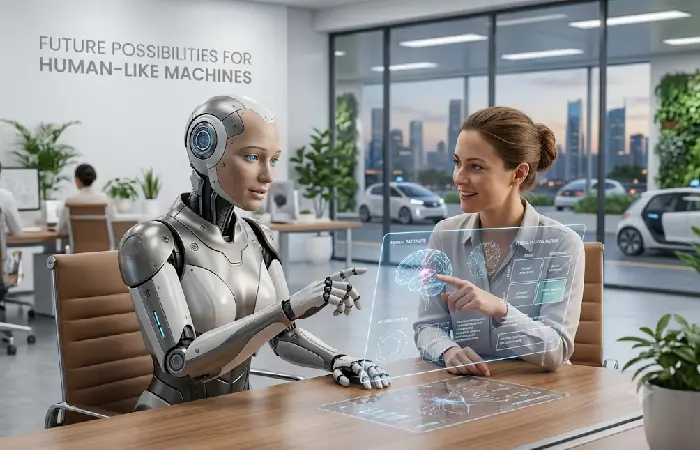
Looking ahead, it’s clear that these types of humanoid AI robots will soon be more capable and widespread than ever, transitioning from simple warehouse specialists to intelligent robotic colleagues capable of more complex tasks. With ongoing development in AI, robotics, machine learning, computer vision, and even batteries, humanoid machines are poised to become ubiquitous in every facet of our lives.
In the view of specialists, in the next ten years humanoids will be the jack of all trades, growing from specialists to collaboration tools to work with humans anywhere.
Why the Future Looks Promising
At least several inventions are facilitating the advancement of human-scale machines, including:
- More powerful AI models
- Improved robotic dexterity
- Better computer vision systems
- Advanced sensors and perception
- Longer-lasting batteries
- Faster onboard computing
- Reduced manufacturing costs
All of these advances are helping humanoid robots become more intelligent, safe and feasible in real life.
As humanoid robots become more human-like, understanding the ethical issues in AI robotics is essential for responsible development and deployment.
FAQ
Can you buy a humanoid robot?
Yes. Certain models, for example Unitree G1, are accessible to developers and other research organizations, other are still in pilot deployment stages.
Will humanoids be able to replace humans in the work force?
B Not quite. Robots today are very good at simple, repetitive and structured tasks, but are not as good with creativity, emotional intelligence or complex decision-making.
What company has the most advanced humanoid robot?
Depending on the application, Tesla, Figure AI, Agility Robotics, and Boston Dynamics are also undeniably the industry leaders.
Price of a humanoid robot?
Prices are found to show a wide range of variation according to capabilities being: from research platforms to full enterprise grade industrial robot.
Which industries are the biggest user of humanoid robots?
The reporting is best right now in manufacturing, logistics, warehousing, health care and customer services.
Conclusion
Humanoid AI Robots are fast transitioning from a handful of research prototypes into practical working tools that can work alongside humans. Driven by recent advances in AI, computer vision, sensors and robotics engineering, they‘ll already be a key part of manufacturing and logistics operations.
Concerns remain regarding their affordability, battery life and safety, however as the industry grows there‘s no reason why a humanoid robot won‘t be commonplace within the next ten years. Those who begin to strategise now will remain well-prepared and equipped for the next wave of intelligent automation.
Kashifa Jafar is a technology writer and contributor at FutureTechExpert with 4+ years of experience in technology writing and content creation.
Read Full Bio of Author →Sameena reviews selected health, wellness, technology, and digital content for clarity, factual presentation, and reader usefulness.
Read Full Bio of Reviewer →