
 Kashifa Jafar
Technology Writer & Contributor
Kashifa Jafar is a technology writer and contributor at FutureTechExpert with 4+ years of experience in technology writing and content creation.
Read Full Bio of Author →
Kashifa Jafar
Technology Writer & Contributor
Kashifa Jafar is a technology writer and contributor at FutureTechExpert with 4+ years of experience in technology writing and content creation.
Read Full Bio of Author →
 Sameena Begum
Health, Technology & Digital Content Reviewer
Sameena reviews selected health, wellness, technology, and digital content for clarity, factual presentation, and reader usefulness.
Read Full Bio of Reviewer →
Sameena Begum
Health, Technology & Digital Content Reviewer
Sameena reviews selected health, wellness, technology, and digital content for clarity, factual presentation, and reader usefulness.
Read Full Bio of Reviewer →
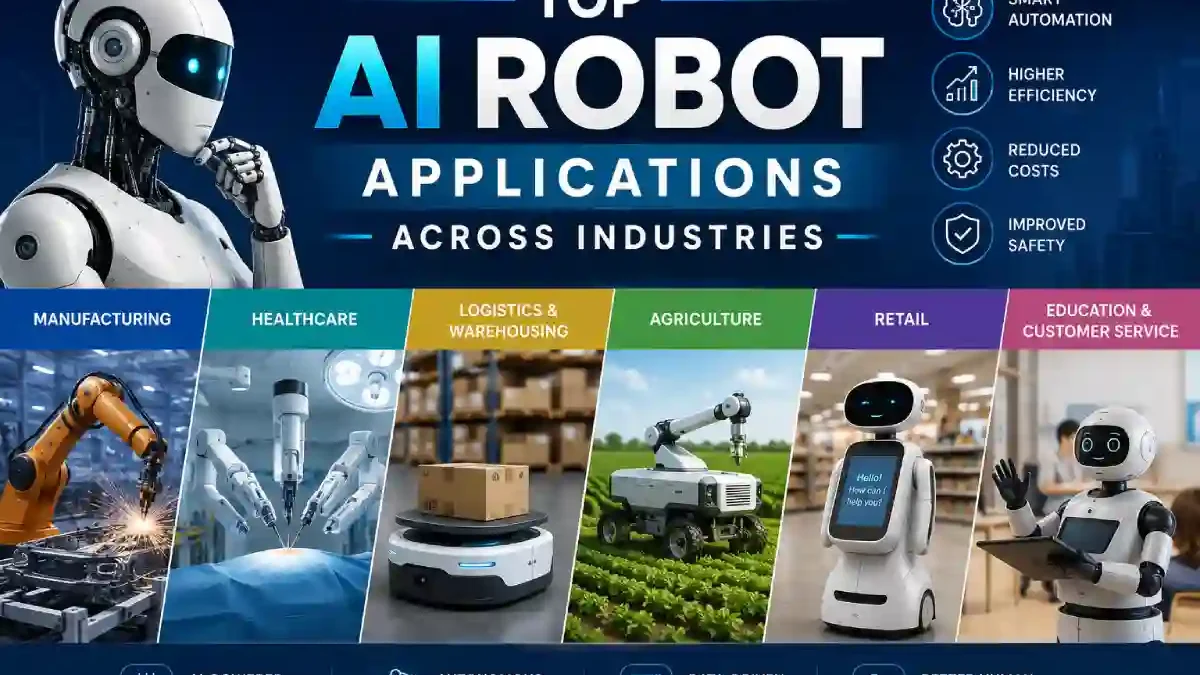
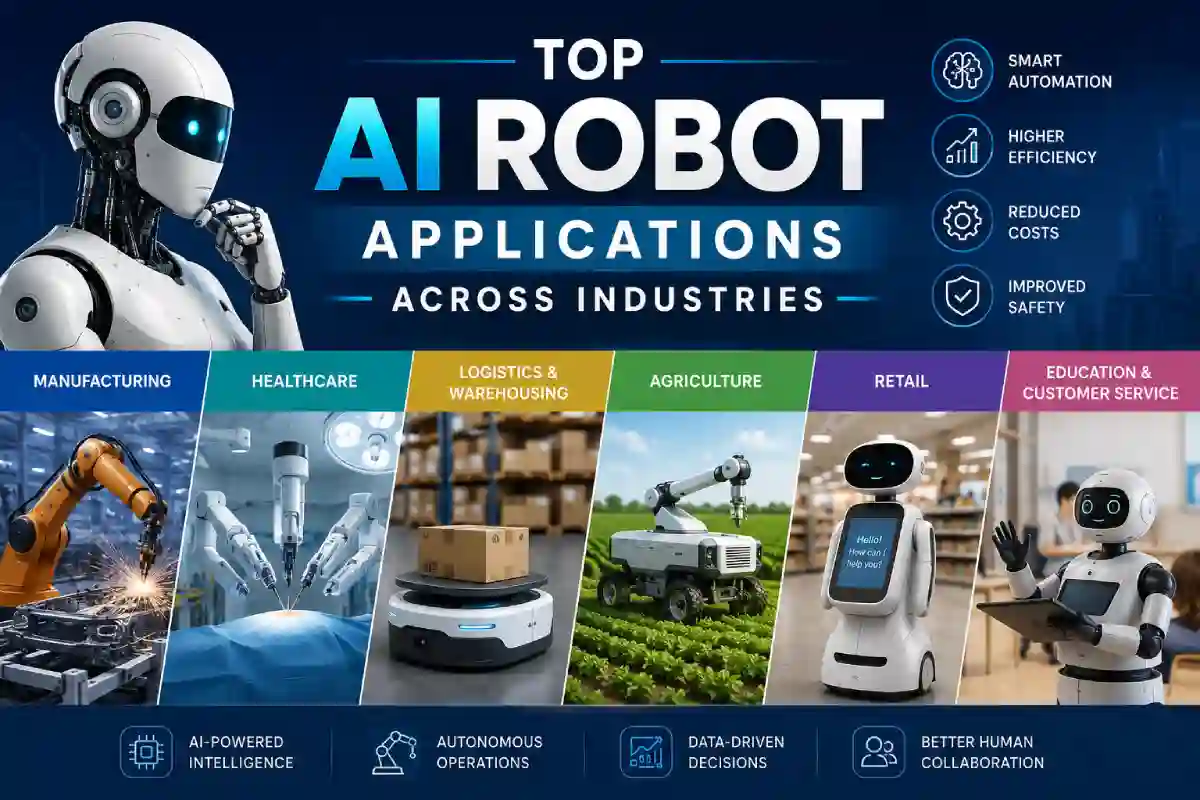
AI robots are making areas as diverse as factories, hospitals and supermarkets more productive, less expensive and more automated, so human involvement is not needed. As the technology continues to evolve, robots will be more intelligent, more secure and independent.
Finding out the Top Ai Robot Applications Across Industries in this manual, that is how the enterprises are currently utilizing intelligent robots, how the popularity is differing in various industries and future tendencies leading to a revolution Automation in 2026.
Before exploring real-world applications, it’s helpful to understand what AI robot are and how they work, including the technologies that power intelligent automation.
 This article is part of
Artificial Intelligence Resources
AI Robot Adoption Across Industries (2026)
| Industry | Main AI Robot Use | Productivity Improvement | Common Robot Types | Resource |
| Manufacturing | Assembly & Quality Inspection | 30–50% | Cobots, Industrial Robots | https://ifr.org |
| Healthcare | Surgery & Patient Assistance | 20–40% | Surgical Robots | https://www.intuitive.com |
| Logistics | Picking & Sorting | 40–70% | AMRs, Warehouse Robots | https://www.amazon.com |
| Agriculture | Harvesting & Monitoring | 25–45% | Field Robots, Drones | https://www.johndeere.com |
| Retail | Inventory Management | 20–35% | Shelf Robots | https://www.simberobotics.com |
| Education | Teaching Assistants | Growing | Social Robots | https://www.softbankrobotics.com |
Table of Contents
AI Robots in Manufacturing
Industry is the one of the earliest and most developed industry to implement AI robots. Traditional industrial robots performs tasks based on fixed programmed instructions. Robots with AI are able to process information coming from environment and time, adapt and improve itself.
In 2026, multiple manufacturers in auto, electronics, food processing, consumer good industries employ AI robots to improve efficiency, quality and job safety.
Common Applications
- Product assembly
- Welding
- Painting
- Packaging
- Quality inspection
- Material handling
Benefits
- Higher production speed
- Lower defect rates
- 24/7 operations
- Improved worker safety
Many industries are adopting humanoid AI robots to improve customer service, healthcare support, education, and interactive workplace assistance.
AI Robots in Healthcare
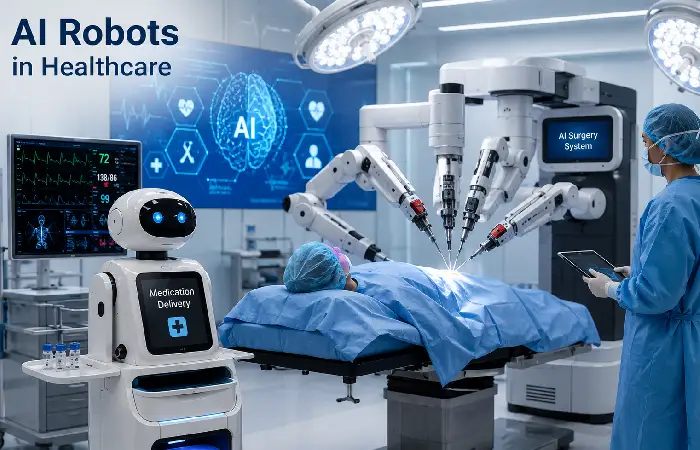
AI robots are revolutionizing the healthcare industry by complementing the work of doctors, nurses and other medical staff by performing jobs with high accuracy, speed and repeatability. Unlike conventional medical devices, AI robots have the capability to process information, detect patterns and produce intelligent decisions by utilizing technologies like machine learning, natural language processing and computer vision.
Hospitals, clinics and research centres in 2026 are more and more adopting the use of AI robots to further enhance patient care, alleviate work load and decrease medical errors.
Popular Applications
- Robot-assisted surgery
- Hospital delivery robots
- Rehabilitation robots
- Elderly care robots
- Pharmacy automation
Benefits
- Reduced human error
- Faster recovery
- Better patient monitoring
- Lower healthcare costs
Some are the da Vinci Surgical System and hospital service robots, which work autonomously.
Understanding how AI robots work provides insight into how sensors, machine learning, and computer vision enable practical applications across industries.
AI Robots in Logistics and Warehousing
Logistics and warehousing is a close second in its rate of adoption of AI-enabled robots, which is surely because of the recent massive growth in online shopping and customer expectations of increasingly smaller delivery times.
Applications
- Inventory management
- Package sorting
- Autonomous mobile robots (AMRs)
- Picking robots
- Pallet transportation
There are now corporations, such as Amazon, for example, that employ hundreds of thousands of staff running warehouse robots.
Benefits
- Faster shipping
- Lower operational costs
- Better inventory accuracy
- Reduced workplace injuries
AI Robots in Agriculture
Human Robotics agricultural sector is also starting to use A.I. robots to combat the lack of agricultural workforce and to increase crop production.
Applications
- Precision spraying
- Autonomous tractors
- Fruit harvesting
- Weed detection
- Crop monitoring using drones
Benefits
- Reduced pesticide use
- Better crop quality
- Lower labor costs
- Increased farming efficiency
AI Robots in Retail
Retail (the usage of AIs in shopping centers). AIs equipped in robots use in shops for protecting the shopping experience of the customers.
Applications
- Shelf scanning
- Inventory tracking
- Smart cleaning robots
- Customer guidance robots
- Automated checkout support
Benefits
- Better stock accuracy
- Reduced operational costs
- Faster restocking
- Improved customer satisfaction
The growing adoption of intelligent automation is driven by the many benefits of AI robots, including higher productivity, improved accuracy, and reduced operational costs.
AI Robots in Education and Customer Service
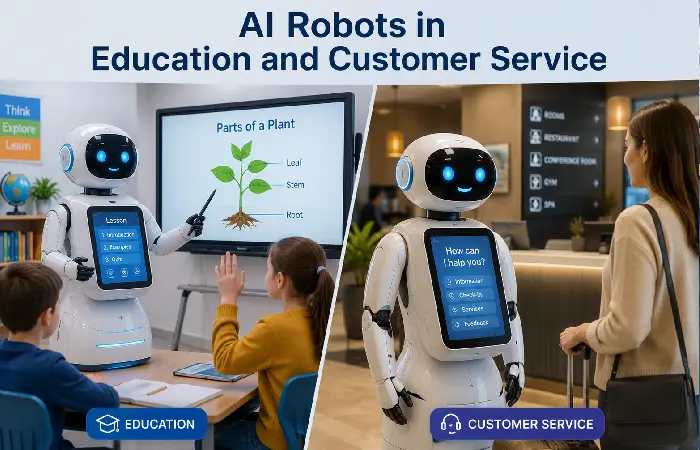
Artificial intelligence (AI) robots are transforming how people learn, communicate and do business. At every level of education from schools and colleges to training providers, AI robots are acting as intelligent teaching assistants that can adapt lessons to the learner and maintain their interest. Customer service robots and AI
AI Robots in Education
Educational institutions use Ai robots to enhance their school environment to be more interesting and inclusive.
Common Applications
Personalised Learning: the robot personalises lessons for each student‘s speed of learning.
Language Learning: Interactive Robots offer an enjoyable avenue for students to develop skills such as pronunciation, vocabulary and dialogue in many languages.
STEM Education: Robots teach coding, robotics and engineering ideas. They help set up fun activities.
Special education: students with learning disorders, or autism for example can benefit from using AI robots, as they can be a patient and consistent friend.
Administrative Support: Robots are helpful in attending to common campus questions and serving as guides to visitors. Robots can also perform routine administrative tasks.
Benefits
| Benefit | Impact |
| Personalized instruction | Improves student understanding and retention |
| Higher classroom engagement | Interactive learning keeps students motivated |
| Teacher support | Reduces repetitive administrative work |
| Accessible education | Supports students with different learning needs |
| Real-time feedback | Helps learners correct mistakes quickly |
While AI robots offer significant advantages, organizations must also address the challenges of AI robots, such as implementation costs, technical limitations, and workforce adaptation.
AI Robots in Customer Service
A variety of businesses in different industries are utilizing AI robots in customer service to improve the quality of customer experience while decreasing costs. The robots can provide useful services including welcoming customers, answering questions and acting on simple requests and providing multiple languages support in retail stores, hotels, airports, hospitals and banks.
Common Applications
- Reception and Front Desk. Greet visiting dignitaries; provide directions.
- Retail Support: Assist customers in finding items and information about stock status.
- Hotel Concierge Services: Help check-in, room queries and provide advice about the local area.
- Airport Information Desks: Assist travelers having information of flight and navigation.
- Banking and Healthcare support: Answer to common questions, point customers to the right department
Benefits
| Benefit | Business Value |
| 24/7 customer support | Improves service availability |
| Faster response times | Reduces customer wait times |
| Multilingual communication | Serves diverse customer bases |
| Lower operational costs | Automates repetitive inquiries |
| Consistent service quality | Delivers accurate and standardized responses |
As AI-powered systems become more common, understanding AI robot ethics is essential for ensuring transparency, fairness, privacy, and responsible decision-making.
Frequently Asked Questions
In which industry are the robots (the AI robots) used most?
The machine is most widely used in widely used industries such as manufacturing, logistics, healthcare, retail, agriculture, education and customer services.
Are AI robots substituted for human workers?
Ai robots tend to take over the more boring, dangerous, and arduous work. In most instances, as opposed to full replacement they work on the same side as the employees.
What actually is the biggest advantages of AI robot?
These primarily lead to improved productivity, reduced operating costs, lowered inaccuracies, safer work environment and better customer services.
Which one? The industry with the fastest AI robot adoption
Manufacturing and logistics seem to be the main areas applying AI robot. These sectors own the most demand on automation and efficiency.
How costly are AI robots?
The price would also be application related. For example, industrial robots are very expensive but as the smaller service robots and collaborative robots have been becoming cheaper they are becoming more cost effective.
Conclusion
Within many industries, AI robots are changing the way things are done, replacing boring processes, boosting efficiencies and adding yet more intelligence to insights. Manufacturing, healthcare, logistics, farming, retail, education and customer service are all top suspects, with new breakthroughs breaking robotics down to the masses each year. Firms maximizing AI automation will save money, increase yield and thrive in the digital age.
Kashifa Jafar is a technology writer and contributor at FutureTechExpert with 4+ years of experience in technology writing and content creation.
Read Full Bio of Author →Sameena reviews selected health, wellness, technology, and digital content for clarity, factual presentation, and reader usefulness.
Read Full Bio of Reviewer →