
 Kashifa Jafar
Technology Writer & Contributor
Kashifa Jafar is a technology writer and contributor at FutureTechExpert with 4+ years of experience in technology writing and content creation.
Read Full Bio of Author →
Kashifa Jafar
Technology Writer & Contributor
Kashifa Jafar is a technology writer and contributor at FutureTechExpert with 4+ years of experience in technology writing and content creation.
Read Full Bio of Author →
 Sameena Begum
Health, Technology & Digital Content Reviewer
Sameena reviews selected health, wellness, technology, and digital content for clarity, factual presentation, and reader usefulness.
Read Full Bio of Reviewer →
Sameena Begum
Health, Technology & Digital Content Reviewer
Sameena reviews selected health, wellness, technology, and digital content for clarity, factual presentation, and reader usefulness.
Read Full Bio of Reviewer →
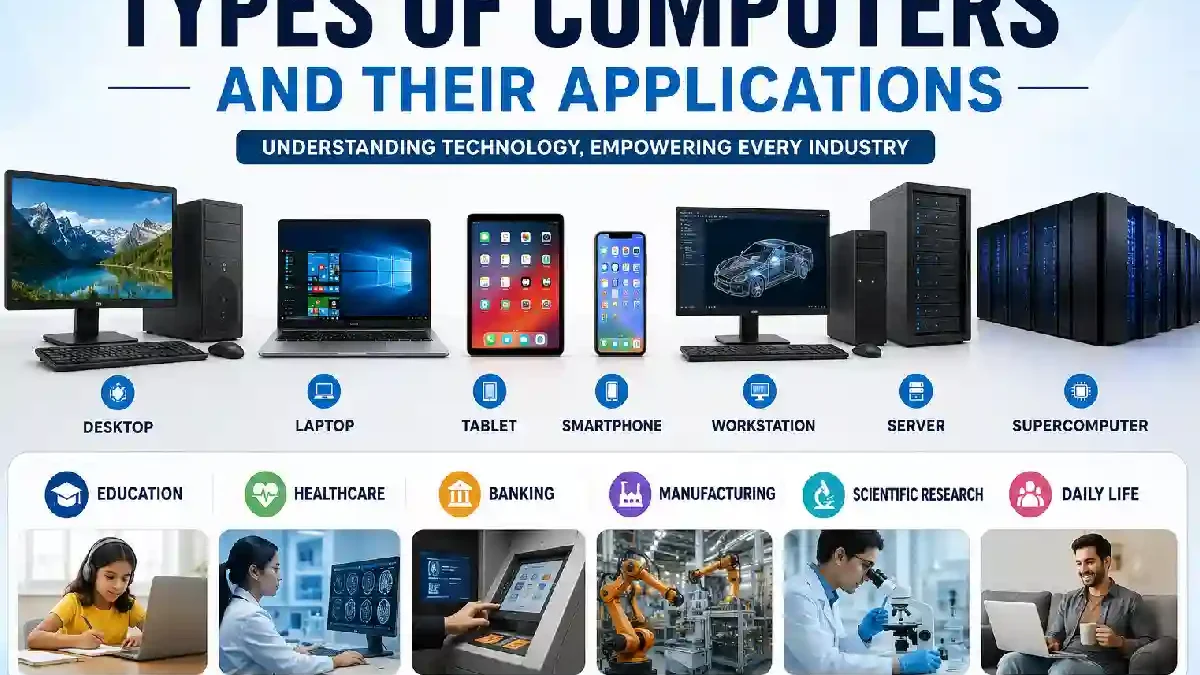
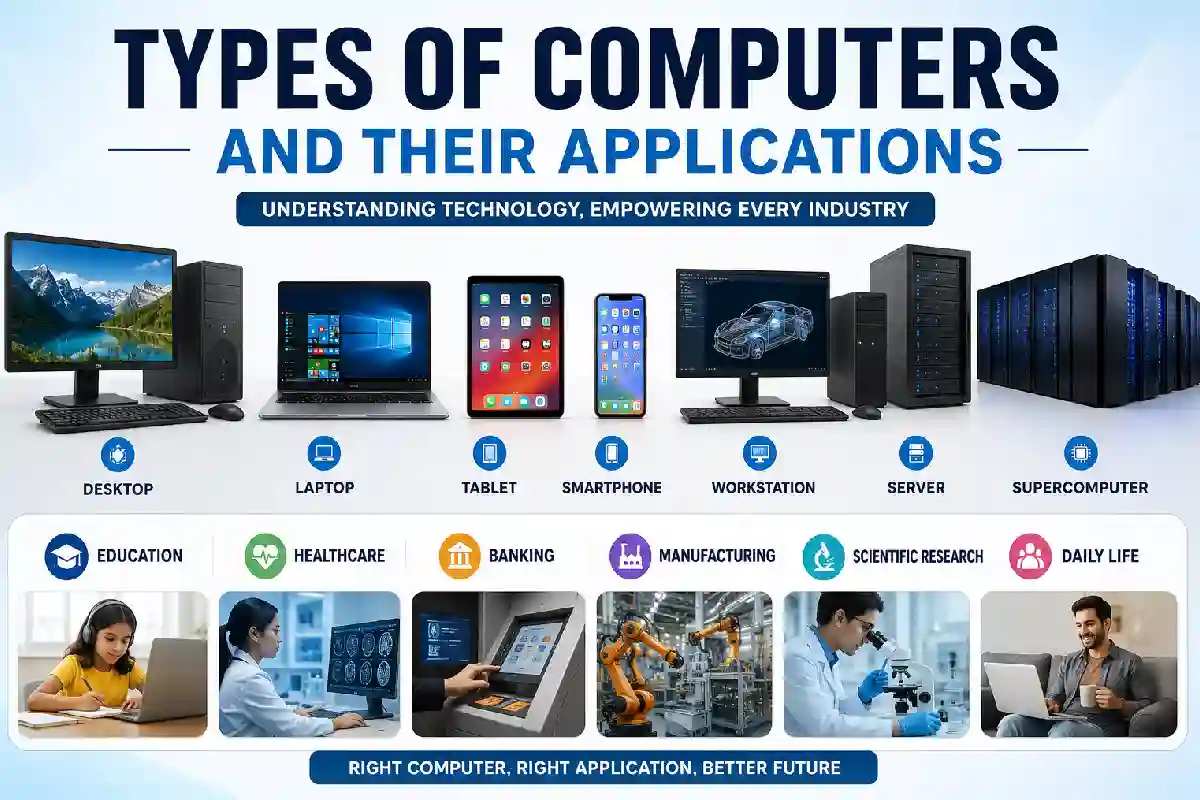
Technology is directly influencing our lives and for a regular user having Knowledge about Types of Computers and their uses makes life much easier. This knowledge enable students, working professionals and business owner to choose an appropriate computing solution like what computers they need to use and require. This article lists down types of computer and their uses in 2026.
 This article is part of
Computers Resources
Types of Computers
Computers are categorized by the following.
| Computer Type | Best For | Typical Users | Resource |
| Desktop Computer | Office & Home | Students, Businesses | https://www.hp.com |
| Laptop | Portable Computing | Professionals | https://www.lenovo.com |
| Tablet | Mobile Learning | Students | https://www.apple.com/ipad |
| Smartphone | Everyday Tasks | Everyone | https://www.samsung.com |
| Workstation | Professional Design | Engineers | https://www.dell.com |
| Server | Hosting Applications | Businesses | https://www.ibm.com |
| Mainframe | Large Organizations | Banks | https://www.ibm.com/ |
| Supercomputer | Scientific Research | Governments | https://www.top500.org |
To understand how each device is used in homes, businesses, and industries, it’s helpful to first explore the different types of computers available today.
Table of Contents
Computers in Education
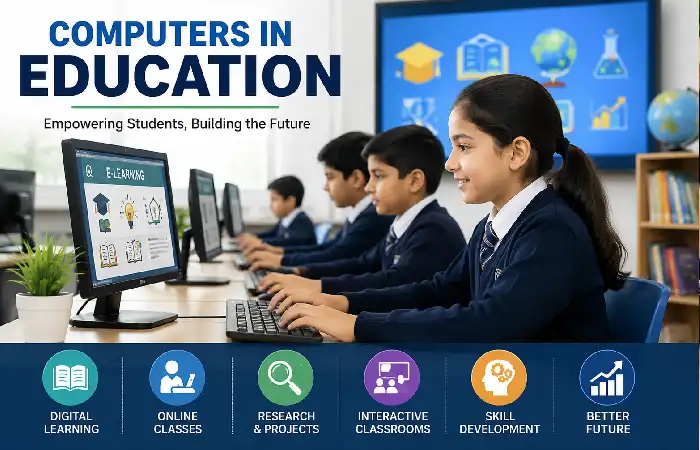
A Computers have changed the way we are learning. They have learning interactive, available and custom. From primary to higher education, they are almost in everything. The students learn computers skills, work with others, get all information they need, at any moment.
In 2026, cloud computing, AI, and virtual learning environments allow schools to Provide quality instruction in the classroom and outside the classroom.
Common applications include:
- Online classes
- Virtual laboratories
- AI tutoring
- Digital examinations
- Research projects
- Coding education
- Interactive whiteboards
The UNESCO and OECD reports state that digital learning, with schools purchasing cloud learning platforms and AI near-learning, is growing world-wide.
Among all computing devices, personal computers (PCs) remain the most common choice for education, office work, gaming, and everyday productivity.
Benefits of Computers in Education
- Better Access to Knowledge: Students can access million of educational resources via internet and digital library.
- Personalized Learning: AI-powered systems adjust sessions according to students’ learning pace and skills.
- Improved Communication: With internet enabled devices, students and teachers can collaborate with each other and work on documents, presentations and assignments.
- Development of Skills: Learners acquire a range of vital digital literacy, programming and problem-solving skills capable of functioning in contemporary workplaces.
- Flexibility: Electronic learning and web-based classrooms provide educational opportunities from anywhere at anytime.
Computers in Healthcare
Hospitals and other health care institutions rely on computers in order to provide quicker diagnosis and better services.
Applications include:
- Electronic Health Records (EHR)
- MRI & CT Scan Processing
- AI Disease Detection
- Robot-assisted Surgery
- Telemedicine
- Medical Imaging
- Drug Research
Use high-performance workstations and cloud computing to analyze medical data.
Large organizations often rely on specialized systems, so understanding the differences between a supercomputer vs mainframe computer can help identify their unique applications.
Benefits of Computers in Healthcare
- Better care: Doctors can view patients’ records quickly and use the information to give better treatment.
- Precisely Diagnose: AI enabled imaging software and tools yield better diagnosis for the diseases.
- Improved Communication: Secure digital networks facilitate uninterrupted information exchange between all practitioners.
- Good Hospital Management: Automating the paper works and workflow reduces errors.
- Further security for the data: Encrypted systems and protected cloud platforms would ensure the patient sensitive data more secure.
Computers in Banking
Enterprise computer systems are used by banks to handle billions of secure transactions daily.
Major applications:
- Online Banking
- ATM Networks
- Fraud Detection
- AI Risk Analysis
- Customer Support
- Loan Processing
- Digital Payments
Mainframes are still managing the considerable volume of financial transactions very reliably.
Choosing between a desktop and portable device depends on your needs, and this desktop vs laptop comparison explains which option is better for different users.
Benefits of Computers in Banking
- Faster Transactions: Millions of monetary transactions are carried out safely in a fraction of a second.
- Enhanced security: By using encryption, multi-factor authentication (MFA), and AI-based fraud detection, one‘s account is enabled to be defended.
- 24/7 Banking Services: Banking services are available around the clock through mobile apps, websites, ATM‘s, etc.
- Increased accuracy- automation minimizes errors that occur during manual handling of transactions and during creation of financial reports.
- Improved customer care: personalized banking facilities and real time notifications enhance customer satisfaction.
Computers in Manufacturing
Computers aid manufacturing companies to make the most of their production efficiency and quality control.
Common uses include:
- CNC Machine Control
- Robotics
- Inventory Management
- Product Design (CAD)
- Supply Chain Management
- Predictive Maintenance
- Factory Automation
Industrial computers and Internet of Things (IoT) devices are allowing smart factories and real-time data monitoring.
Benefits of Computers in Manufacturing
- Higher Productivity: machinery enables factories to manufacture more items compared to working by hand.
- Better Accuracy: The use of computer-controlled equipment reduces human mistakes and ensures product uniformity.
- Lower Production Cost: Proper use of resources reduce labor cost and wastage of materials.
- Improved Product Quality: AI enhanced inspection systems capture defects earlier in the manufacturing process.
- Improved Decision-Making: Access to current production information enables managers to make better decisions about the work flow and processes.
Many modern appliances, medical equipment, and vehicles rely on embedded computers to perform dedicated real-time tasks.
Computers in Scientific Research
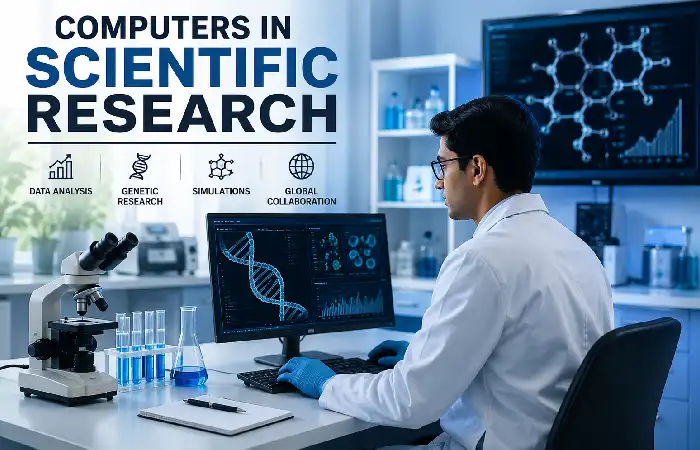
Scientific organizations need large amounts of processing power in order to handle tremendous quantities of data.
Applications include:
- Climate Modeling
- Space Exploration
- DNA Sequencing
- Artificial Intelligence
- Physics Simulations
- Weather Forecasting
- Drug Discovery
A supercomputer is a 1,000,000,000,000 (quadrillion) operations per second computer. Powerful.
Benefits of Computers in Scientific Research
- Fewer Data Processing: The high performance machine can examine volume of several terabytes or even petabytes of data in a matter of hours.
- Enhanced Precision: more sophisticated algorithms diminish mistakes and improve the dependability of the research.
- Complex problem solving: Research can make it possible to model situations that are too complex, costly, or dangerous to explore in the real world.
- International co-operation: Cloud services enable international collaboration among scientists in the sharing of data in real time.
- Faster Innovation: AI and machine learning can discover patterns, generate predictions, and enable groundbreaking discoveries.
Computers in Daily Life
Computers are fully integrated into our lives in every place homes, offices, entertainment sites.
Examples include:
- Online Shopping
- Video Streaming
- Gaming
- Social Media
- Remote Work
- Online Banking
- Navigation
- Smart Home Devices
- Video Calls
Until recently, even the most modest smartphones offered a level of computing power that would be regarded as outdated by personal computer standards.
Benefits of Computers in Daily Life
- Greater Productivity: Computers enable individuals to perform tasks more productively at home, school and work.
- Easy Access to Information: Search engines, digital libraries and other online sources afford us instantaneous access to information.
- Easy and Birect communication: Video conferencing and messaging applications make it easy to communicate with people anytime and anywhere.
- Enhanced financial management: Online banking and budgeting software ease of managing one‘s personal finances.
- Entertainment on Demand: Streaming services and digital media platforms allow instant on-demand streaming of movies, music, and gaming.
- Assistance in Smart Living: IoT enabled devices enable users to program household chores and keep an eye on home security from a distance.
Emerging technologies such as AI, quantum computing, and edge computing are shaping the future of computers across every industry.
Frequently Asked Questions
What are the principal types of computers?
The main types are desktop computers, computers, tablets, cell phones, workstations, servers, computers, supercomputers.
What is the most suitable computer for a student?
For the average student a light, portable computer is the best compromise of battery power and motility.
What is the importance of supercomputers?
Supercomputers address extremely complex scientific and engineering problems like weather forecast, genomic research, training AI models etc.
What sectors use computers the most?
Banking, health care, manufacturing, education, scientific research, retail and government organizations rely heavily upon computer systems.
In what ways do computers make people‘s everyday lives simpler?
They allow us to communicate and access online learning, entertainment, shopping, information, navigation, banking and working from home or away more quickly and easily.
Conclusion
It is also useful to learn about the different kinds of computers and their functionalities as we live in the digital era. The home or office desktop or portable laptop is commonly used in everyday tasks, while data processing-servers, mainframes and huge supercomputers are used in many large organizations as well as for scientific calculations. They all cater to different needs. They have helped improve accuracy, bring convenience and boost productivity in many fields including education, medical, banking, production and scientific venture.
Kashifa Jafar is a technology writer and contributor at FutureTechExpert with 4+ years of experience in technology writing and content creation.
Read Full Bio of Author →Sameena reviews selected health, wellness, technology, and digital content for clarity, factual presentation, and reader usefulness.
Read Full Bio of Reviewer →