
 Kashifa Jafar
Technology Writer & Contributor
Kashifa Jafar is a technology writer and contributor at FutureTechExpert with 4+ years of experience in technology writing and content creation.
Read Full Bio of Author →
Kashifa Jafar
Technology Writer & Contributor
Kashifa Jafar is a technology writer and contributor at FutureTechExpert with 4+ years of experience in technology writing and content creation.
Read Full Bio of Author →
 Sameena Begum
Health, Technology & Digital Content Reviewer
Sameena reviews selected health, wellness, technology, and digital content for clarity, factual presentation, and reader usefulness.
Read Full Bio of Reviewer →
Sameena Begum
Health, Technology & Digital Content Reviewer
Sameena reviews selected health, wellness, technology, and digital content for clarity, factual presentation, and reader usefulness.
Read Full Bio of Reviewer →
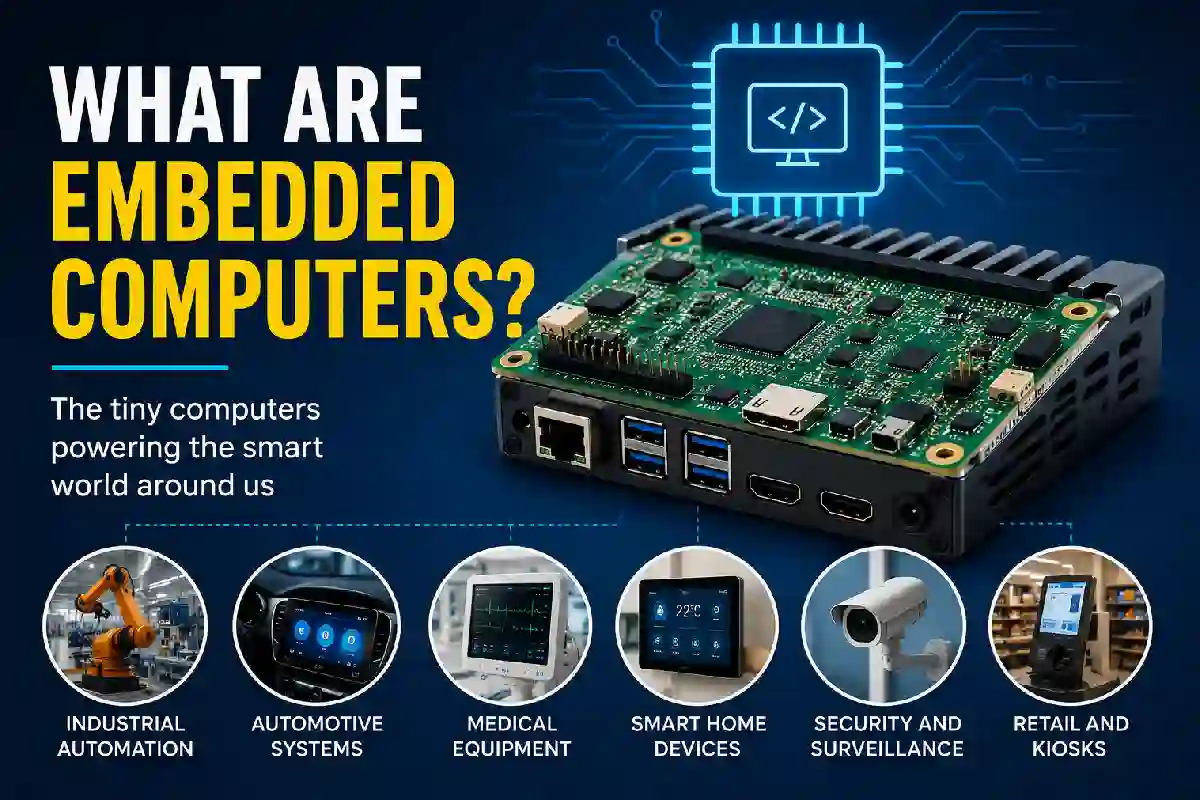
What Is an Embedded Computer? An embedded computer is a computer built for a particular purpose. Traditional desktop and laptop computers remain generally intended for running many different applications, but embedded computers remain intended for very specific functions. For example, they may remain used to control a machine, to process data from sensors, or to automate some industrial equipment.
By 2026 embedded computing will be used in billions of devices all over the world, including smart TVs, smartphones, autonomous vehicles, medical devices, industry robots, smart factories, and many more. With the growth of Artificial Intelligence (AI), Edge Computing and IoT, everything will be embedded into smarter, greener and more connected computers.
Embedded computers are just one category among the many different types of computers, each designed for specific tasks and environments.
This article guides us with all the basics that a novice requires to learn about the technology including features, examples, uses in industry, benefits and future perspectives.
 This article is part of
Computers Resources
Table of Contents
Definition
An embedded computer is a computing device that is used for one or more individual functions, built into and controlled by a larger machine or system. Unlike a general purpose computer (i.e., a desktop or laptop computer), an embedded computer serves a specific purpose. It is designed to handle that purpose efficiently and reliably.
Embedded computers are small computers that integrate CPU, memory, storage, I/O interfaces and software enabling the operation or monitoring of other devices. These computers tend to have their own unique operating system installed such as Linux, Windows IoT, Android or a Real-Time Operating System to provide fast and reliable performance.
Unlike general-purpose PCs, embedded computers are optimized for:
- Reliability
- Low power consumption
- Real-time processing
- Continuous operation
- Small physical size
Most embedded computers include:
- CPU
- RAM
- Storage
- Input/Output interfaces
- Operating system (Linux, Windows IoT, Android, or RTOS)
Rather than being manipulated directly by the user as a desktop computer, embedded computers sit cleanly in the background running a different machine.
Unlike personal computers (PCs), embedded systems are built to perform dedicated functions rather than support general-purpose computing.
Characteristics
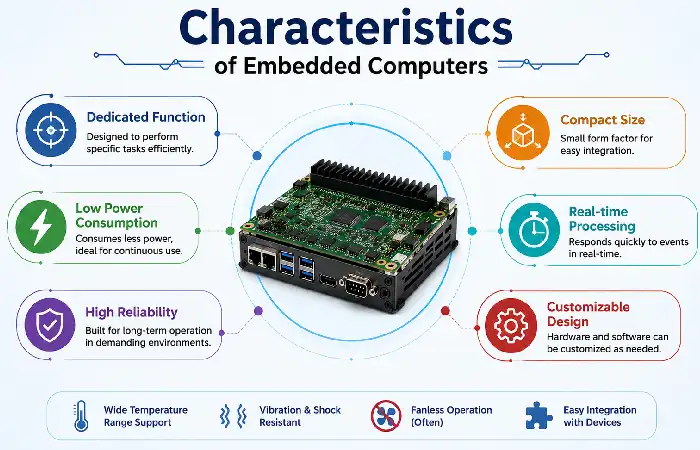
Embedded computers have some characteristics that make them suitable for a dedicated application.
Dedicated Function
Purposely designed to perform one job-same task.
Examples:
- ATM
- Car engine controller
- Medical monitor
Compact Design
Outstanding examples of compact yet efficient computing remain many fanless embedded computers which are often smaller in size than a pocket-sized book.
Benefits include:
- Easy installation
- Reduced maintenance
- Better durability
Low Power Consumption
Most of them are in the 5W–30W range, which fits well into an always-ontype environment.
High Reliability
Running more or less 10 – 15 years without maintenance.
Real-Time Processing
Numerous demands answers in milliseconds.
Examples include:
- Factory robots
- Autonomous vehicles
- Medical devices
While supercomputers and mainframes handle massive computational workloads, embedded computers focus on efficient control of specific devices.
Embedded Computer Features Comparison
| Feature | Consumer Grade | Industrial Grade |
| Temperature Range | 0–40°C | -40°C to 85°C |
| Fanless Design | Sometimes | Usually |
| Dust Resistance | Low | High |
| Shock Resistance | Moderate | Excellent |
| Lifespan | 3–5 Years | 10–15 Years |
Everyday Examples of Embedded Computers
People own and use computers in thousands of their everyday devices. Unlike in general computers, home or office, embedded computers remain integrated into the products to run automatically and effectively.
| Device | How the Embedded Computer Is Used | Typical Processor/Controller | Official Resource |
| Smart TV | Runs the operating system, & display processing | ARM-based SoC | https://www.android.com/tv |
| Washing Machine | Controls wash cycles, & sensors | Microcontroller (MCU) | https://www.lg.com/global |
| Microwave Oven | Manages cooking time, & display | Embedded MCU | https://www.panasonic.com/global |
| Wi-Fi Router | Processes network traffic, & provides wireless connectivity | ARM or MIPS Processor | https://www.tp-link.com |
| Smartwatch | Tracks health data, & fitness activities | ARM Cortex Processor | https://www.apple.com/watch |
If you’re looking for a general-purpose computer instead of an embedded device, our desktop vs laptop comparison can help you choose the right option.
Industrial Applications
Embedded computers are the foundation of any industrial automation project. They remain used to perform processes that happen all the time that require a real-time computing, where the machines or machines work 24 hours a day and need to work constantly. Industrial embedded computers need to work under these conditions where the normal PC cannot.
Manufacturing
Industrial embedded PCs control:
- Robotic arms
- Conveyor belts
- Quality inspection systems
- CNC machines
Healthcare
Examples include:
- MRI scanners
- Ultrasound machines
- Patient monitoring systems
- Laboratory automation
Transportation
Modern vehicles contain dozens of embedded computers controlling:
- Engine management
- ABS braking
- Airbags
- Navigation
- Autonomous driving assistance
Retail
Embedded computers power:
- POS systems
- Self-checkout kiosks
- Digital signage
- Inventory scanners
Smart Cities
Applications include:
- Traffic lights
- Smart parking
- Environmental monitoring
- Surveillance systems
Understanding the applications of different computer types makes it easier to see where embedded systems fit in modern technology.
Advantages
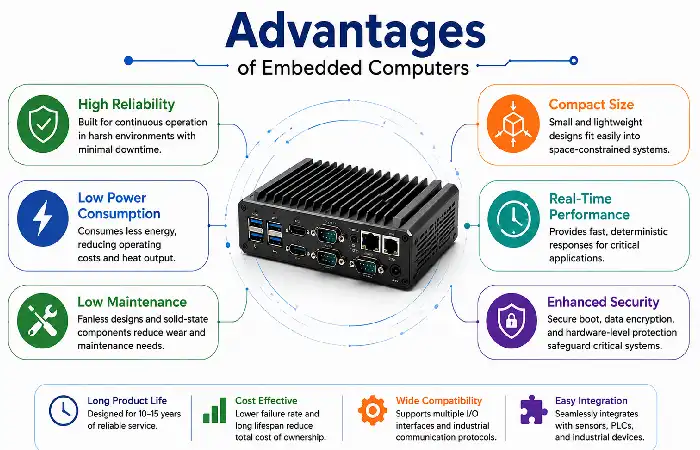
Compared with standard PC computer, built-in computers have the following advantages:
Higher Reliability
Designed to run continuously in a rugged environment.
Better Energy Efficiency
Uses orders of magnitude less electricity.
Compact Installation
Designed for use in tight spaces.
Lower Maintenance
Fanless systems eliminate dust and hardware failure.
Enhanced Security
Limited functionality means less attack surfaces than general-purpose computers.
Long Product Lifecycle
Industrial systems might remain existing for long periods of time and hence, the cost of re-design would remain minimized.
Future Trends
Embedded computing is still advancing quite rapidly.
Artificial Intelligence at the Edge
Further, AI models remain increasingly being directly run on embedded devices in order to reduce latency and reliance on the cloud.
Edge Computing
Increasingly, more processing remain being done near the source of data for the sake of efficiency and privacy.
Industrial IoT Expansion
Factoring are deploying millions of connected embedded devices for predictive maintenance and automation.
5G Integration
More opportunities for wireless communication are opening up for embedded systems in the form of faster and more robust wireless technologies.
As AI, IoT, and edge computing continue to evolve, embedded systems will play an even bigger role in the future of computer technology.
Frequently Asked Questions
What are embedded computers used for?
Embedded computers have dedicated functions built into them. Examples of their use include medical equipment, manufacturing equipment, cars, smart home appliances and the Internet of Things (IoT).
Are embedded computers identical to embedded systems?
No. The hardware and software in an embedded system remain designed to be used for a particular task. The embedded computer remain the computer hardware contained in such an environment.
Is it possible to install Windows on embedded computers?
Yes. Compatible with Windows IoT, Linux, Ubuntu and other more creative, customised real-time operating systems.
How is a microcontroller different from an embedded computer?
A microcontroller is a CPU with memory and i/o facilities on the same chip, suitable for very primitive jobs. An embedded computer is a heavier duty platform, with greater CPU performance, and probably more memory, and perhaps an operating system.
What is the significance of embedded computers?
They deliver safe, dependable, energy-efficient computing to billions of devices allowing automation, connectivity and intelligent control to flourish across every sector.
Conclusion
Embedded computers form the ‘hidden’ technology of today from appliances around the home to complex automation systems used in today‘s industrial facilities. Their small size, low power consumption, & reliability make them invaluable for the IoT, edge computing, healthcare, transportation & manufacturing.
By 2026 as we move further into the era of AI, 5G and Industry 4.0, embedded computers will evolve to be more prevalent and more critical elements of these intelligent systems. For companies, engineers and technology buffs, knowing everything there is to know about embedded computing will be important to mastering the next generation of connected devices.
Kashifa Jafar is a technology writer and contributor at FutureTechExpert with 4+ years of experience in technology writing and content creation.
Read Full Bio of Author →Sameena reviews selected health, wellness, technology, and digital content for clarity, factual presentation, and reader usefulness.
Read Full Bio of Reviewer →