

Last Updated: August 19, 2026
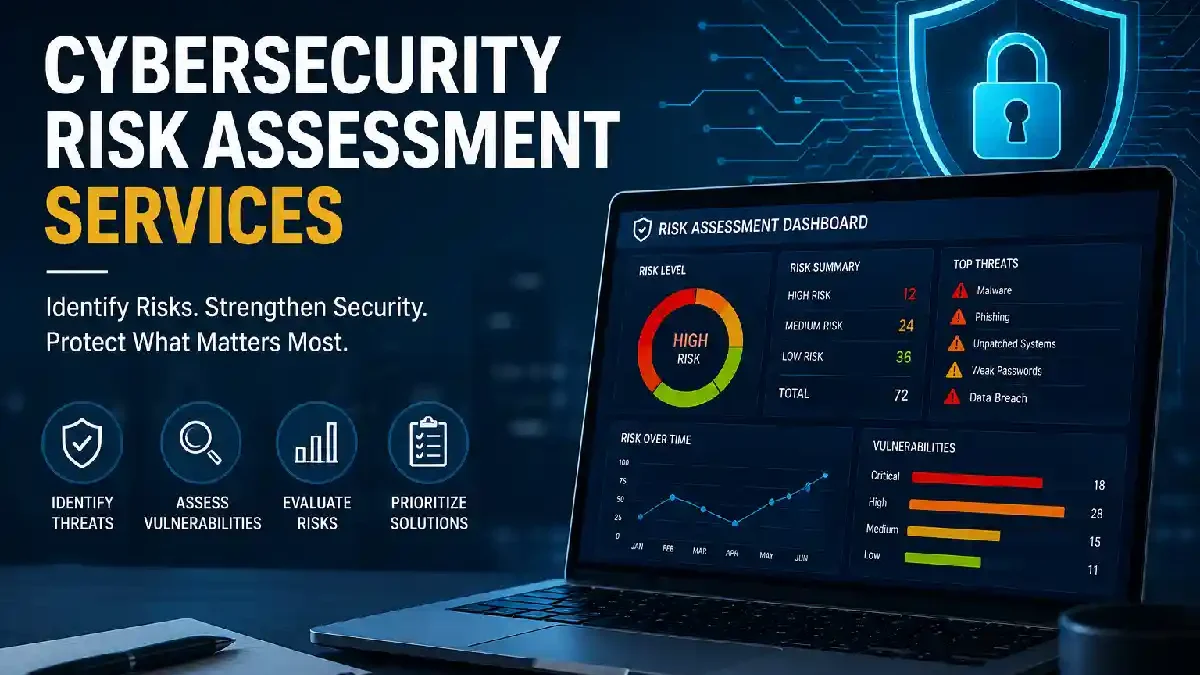
Cyber Security Risk Assessment Services support organizations in identification of security concerns, gaining insight into the potential consequences of cyber risks on essential systems and data and prioritizing controls to diminish the greatest risk. Instead of treating all weaknesses equally, a professional evaluation links technical vulnerabilities with business impact, compliance and the enterprise risk awareness level.
This poses an even greater concern in 2026. Verizon‘s 2026 Data Breach Investigations Report found in 2026, that Verizon analyzed over 31,000 security incidents and confirmed over 22,000 breaches on 145 countries. The report further revealed that 31% of the violations involved the for exploitation software vulnerabilities, and 48% in ransomware.
Table of Contents
What Is a Cybersecurity Risk Assessment?
Cyber risk assessment A structured, systematic process used to evaluate assets, threats, vulnerabilities, security controls and the potential business impact.
A professional assessment typically answers four questions:
- What systems and data are most important?
- What threats could affect them?
- Which vulnerabilities or control gaps increase exposure?
- Which risks should the organization address first?
NIST SP 800-30 defines risk assessment as a component of a comprehensive risk-management process that enables decision-makers to make informed decisions regarding the actions to take in response to risk.
Modern assessment can be used to look at networks, the cloud infrastructure, applications, endpoints, identities, policies, third parties, backup solutions, and risks associated with employees.
Why Cybersecurity Risk Assessments Matter
Cybersecurity teams are frequently faced with an excess of security alerts and vulnerabilities that they need to address right away. Conducting a risk assessment creates a systematic method to identify which issues should be prioritized.
The business benefits include:
- Better visibility into security weaknesses
- More effective cybersecurity spending
- Reduced exposure to data breaches
- Improved compliance readiness
- Stronger cyber-insurance preparation
- Better executive and board-level reporting
- A prioritized remediation roadmap
The NIST Cybersecurity Framework 2.0 aims to enable organizations to effectively manage cybersecurity risk and incorporate cybersecurity into enterprise risk management.
Identifying Cybersecurity Threats
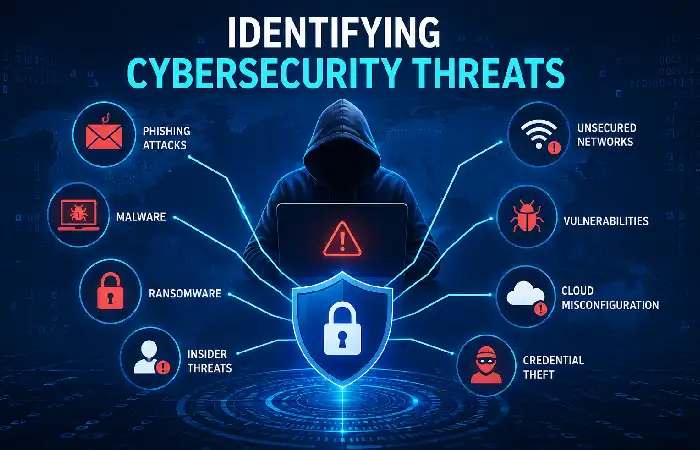
To begin with it is necessary to understand what can actually damage the organization.
Common threats include:
- Ransomware
- Phishing and social engineering
- Credential theft
- Exploitation of unpatched software
- Insider threats
- Cloud misconfiguration
- Supply-chain and third-party attacks
- API and application attacks
- Mobile-device threats
Threats should be identified taking both technical and human considerations into account. For instance, even though the organization has excellent endpoint protection, it can still be vulnerable due to administrator password compromise or exposed cloud account.
Assessing Security Vulnerabilities
Vulnerability assessment looks for vulnerabilities to exploit.
Depending on the engagement, providers may evaluate:
- Network devices and infrastructure
- Servers and endpoints
- Applications and APIs
- Cloud configurations
- Identity and access controls
- Missing patches
- Firewall configurations
- Encryption
- Backup and recovery controls
- Security policies
Of course, a vulnerability scan is not the same as a full risk assessment. When you do a risk assessment, you have more context, such as likelihood of attack, asset value, controls in place, and business impact.
Evaluating Business Cyber Risks
Technical vulnerabilities are only meaningful when they are associated with business impact.
For instance, a medium severity weakness identified on an independent test server may have less impact on the business than a similar security weakness impacting a payment system or customer database.
Assessors may therefore consider:
| Risk factor | Example question | Resource |
| Asset value | What happens if this system becomes unavailable? | NIST SP 800-30 |
| Threat likelihood | How realistic is exploitation? | NIST Risk Assessment Guidance |
| Vulnerability | What weakness could be exploited? | NIST CSF 2.0 |
| Business impact | Could the issue stop operations or expose sensitive data? | NIST Enterprise Risk Management Guide |
| Existing controls | What safeguards already reduce the risk? | NIST CSF 2.0 Resources |
Risk Analysis and Prioritization
Not all cybersecurity problems require an equivalent response.
A simple risk model is:
Risk = Likelihood × Impact
For example:
| Risk | Likelihood | Impact | Priority |
| Exposed administrator account | High | Critical | Critical |
| Unpatched internet-facing application | High | High | Critical |
| Weak internal password policy | Medium | High | High |
| Low-risk workstation configuration issue | Low | Low | Low |
Providers in a professional setting would also be likely to incorporate the following: using quantitative approaches, using risk register, maturity scoring, CVSS information, threat intelligence or framework-based assessment.
The answers are designed to provide management with a “quick response” to the question of where to begin.
Compliance and Security Risk
They can be used to verify compliance and prepare for audits too.
Depending on the organization, assessments may map security controls against frameworks or requirements such as:
- NIST Cybersecurity Framework
- NIST SP 800-30
- ISO 27001/27005
- CIS Controls
- HIPAA
- PCI DSS
- SOC 2
- CMMC
- GDPR
The current CSF 2.0 resources from NIST highlight the enterprise-wide and organizational risk-management endeavors to contain the cybersecurity threat.
However compliance should not be the sole goal. It is theoretically possible for a business to meet a checklist and yet be heavily exposed to operational issues.
Creating a Cybersecurity Risk Management Plan
A good assessment would not conclude with a list of all the weaknesses found but instead would conclude with a proposed action plan.
A practical remediation roadmap can categorize findings into:
Zero hour: Critical security flaws, compromised passwords, presence of active attack vectors, or significant areas of non-compliance.
Short term: Configuration issues that are high-risk, poor access controls, the absence of security controls and significant patch work.
Medium term: Policy enhancements, security consciousness activities, architecture adjustments, maturity initiatives.
Ongoing: Continuous vulnerability management, monitoring, testing, re-assessment, and employee training.
Benefits of Cybersecurity Risk Assessment Services
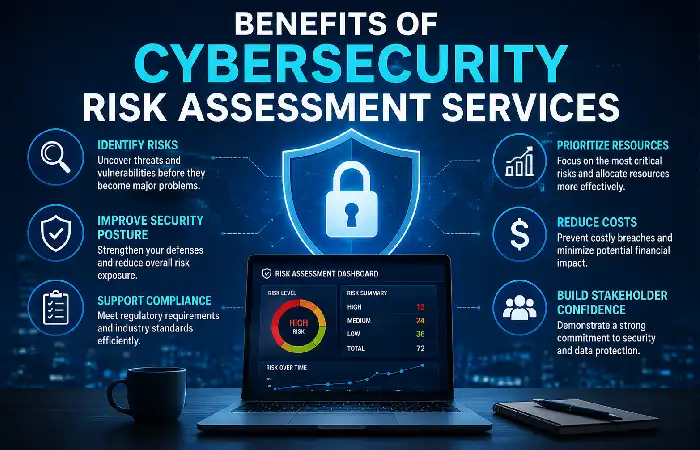
When an organization does not have the expertise in security-risk risk management, then sourcing experienced providers can be useful for assistance.
Key benefits include:
- Independent assessment of security posture
- Access to specialized cybersecurity expertise
- Objective risk prioritization
- Framework and compliance mapping
- Executive-level reporting
- Actionable remediation recommendations
- Identification of previously unknown exposures
- Better allocation of security budgets
In 2026 regular reassessment remains essential as the threat techniques are evolving rapidly. ‘Verizon‘s latest DBIR, identifies exploitation of vulnerabilities, ransomware, AI aided operations and social engineering as some of the important component of the present threat landscape.
How to Choose a Cybersecurity Risk Assessment Provider
Never purchase a vendor based solely on the cheapest price or most security tools listed.
Look for these characteristics:
| Selection factor | What to look for |
| Methodology | NIST, ISO, CIS or another clearly documented methodology |
| Scope | Network, cloud, endpoints, applications, identity, people and third parties where relevant |
| Expertise | Relevant industry and technical experience |
| Deliverables | Executive summary, detailed findings, risk register and remediation roadmap |
| Prioritization | Clear explanation of likelihood, impact and business risk |
| Compliance | Experience with your required regulatory frameworks |
| Validation | Retesting or remediation validation after fixes |
| Reporting | Reports understandable to both technical teams and executives |
The best providers communicate the technical analysis to the business leaders, not just the output from the scanner.
FAQs
How often should a cybersecurity risk assessment be performed?
The usual baseline is at least annually; however, organizations should recheck following significant technology changes, acquisitions, a significant incident, or and major change of threats environment.
Is a risk evaluation the same as conducting a penetration test?
No. Penetration testing tests to show how holes can be exploited. Risk assessment takes a wider perspective and looks at threats, vulnerabilities, controls, assets, probability, and business impact.
How long is a cybersecurity risk assessment?
The time frame is down to size of the organization, the scope, the number of systems, the regulatory environment, and the level of detail of the assessment. A specific assessment could take significantly less time than an enterprise-wide assessment.
What information should a security risk assessment report include?
An effective report should have the following: risks identified, asset affected, severity or risk score, impact to business, evidence, controls recommended, remediation priorities, and executive summary.
Are small business services for cybersecurity risk assessment really worth it?
Yes. For small organizations the security budget will often be limited, and therefore a third-party assessment which finds the greatest risk impacts early on will be most cost-effective.
Final Takeaway
Cybersecurity Risk Assessment Services give an organization a reference point of where remain we exposed to what threats most, and what are we first to remediate. The most successful assessment is not a list of vulnerabilities but what take the issues back to business risk and what deliver a prioritized plan.
For organizations constructing their 2026 cybersecurity program, utilizing a familiar framework such as NIST CSF 2.0, up-to-date threat intelligence, vulnerability analysis, business impact assessment, and ongoing analysis, creates a far more stable foundation for cybersecurity risk management.