
 Kashifa Jafar
Technology Writer & Contributor
Kashifa Jafar is a technology writer and contributor at FutureTechExpert with 4+ years of experience in technology writing and content creation.
Read Full Bio of Author →
Kashifa Jafar
Technology Writer & Contributor
Kashifa Jafar is a technology writer and contributor at FutureTechExpert with 4+ years of experience in technology writing and content creation.
Read Full Bio of Author →
 Sameena Begum
Health, Technology & Digital Content Reviewer
Sameena reviews selected health, wellness, technology, and digital content for clarity, factual presentation, and reader usefulness.
Read Full Bio of Reviewer →
Sameena Begum
Health, Technology & Digital Content Reviewer
Sameena reviews selected health, wellness, technology, and digital content for clarity, factual presentation, and reader usefulness.
Read Full Bio of Reviewer →
Managed Cybersecurity Services provide organizations with an externalized security management team, ongoing monitoring, threat detection, incident response and security management, without the need to establish a complete cybersecurity function internally. For organizations with cloud workloads, remote workers, Internet of Things devices and more complex threats, managed security may reduce the granularity of coverage and speed of response.
In 2026, the business case will be too compelling to overlook. According to the most recent IBM research, the average cost of a data breach in India was said to be to ₹25.5 crore representing a 15.9% increase over 2025. IBM also pointed out that 26% of all malicious breaches in India were AI-generated.
 This article is part of
Cybersecurity Resources
Table of Contents
What Are Managed Cybersecurity Services?
Managed cybersecurity services are security capabilities operationalized by an external cybersecurity provider on an ongoing basis.
Business doesn‘t have to transmit: where the internal IT team would normally be overwhelmed by alerts, firewalls, “I‘m seeing strange activity here”, keeping endpoints safe, dealing with incidents, a business can instead turn over part or all of the workload to a Managed Security Service Provider (MSSP).
Typical services include:
- 24/7 security monitoring
- Managed detection and response
- SIEM monitoring
- Endpoint detection and response
- Firewall management
- Vulnerability management
- Threat intelligence
- Incident response
- Identity and access security
- Cloud security
- Compliance reporting
The precise extent is determined by the provider and service offering.
Businesses can strengthen their overall security posture by combining managed protection with specialized cybersecurity services designed to address different types of digital threats.
How Managed Security Services Work
A managed cybersecurity engagement normally follows a continuous security lifecycle:
Assess → Deploy → Monitor → Detect → Investigate → Respond → Report → Improve
Initially, the provider examines the security environment, the risks, the assets and security controls of the organization. Subsequently, security tools are being incorporated into network, cloud, endpoint, identity and other sources.
The providers SOC receives security telemetry and alerts. Analysts and automated systems examine suspicious activity, prioritize false positive threats and escalate incidents as agreed.
For example, a questionable login could lead to an identity analysis, endpoint investigation and correlation with network activity. If proven to be malicious, the provider could then, subject to the SLA, isolate an endpoint, block an address, or respond to an incident.
IBM defines(MSSP business): As monitoring and management services provided on an outsource basis by high-availability security operation centers( SOCs) to ensure coverage20.
Managed cybersecurity can include continuous monitoring and protection through network security services that help detect unauthorized access, suspicious traffic, and other network-based threats.
Managed Security Service Providers
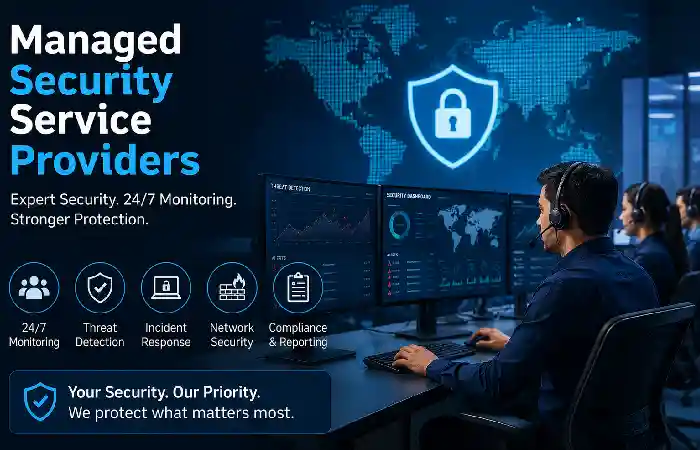
An MSSP is a managed security service provider that manages security functions for customers.
MSSPs can be a worldwide security provider, or a regional security service catering to specific markets, products, sectors and/or size of business.
When evaluating an MSSP, look beyond the phrase “24/7 security.” Ask:
| Evaluation factor | What to check | Why it matters |
| SOC coverage | 24/7/365 availability | Determines whether alerts are handled outside business hours |
| Response | Defined escalation and response SLAs | Monitoring without response has limited value |
| Technology | SIEM, EDR/XDR, MDR, SOAR and threat intelligence | Determines visibility and detection capability |
| Human analysts | SOC staffing and expertise | Helps reduce dependence on automated alerts |
| Compliance | Relevant regulatory experience | Important for regulated industries |
| Reporting | Monthly/quarterly reports and dashboards | Makes security performance measurable |
| Integration | Existing cloud, endpoint and network tools | Reduces deployment friction |
| Contract | Service scope, exclusions and responsibilities | Prevents misunderstandings during incidents |
IBM Managed Security Services provides an example of a large-scale MSS offering, while AWS’s MSSP program illustrates how cloud-focused MSSPs can provide 24/7 monitoring across AWS and multicloud environments.
24/7 Security Monitoring
Cyberattacks are 24 hour a day.
24/7 security monitoring forces security systems and alerts to be continuously overlooked rather than simply during the business‘s normal work hours.
Monitoring may cover:
- Network traffic
- User identities
- Cloud workloads
- Endpoints
- Servers
- Applications
- Security logs
- Firewall events
- Authentication activity
Collecting alerts isn‘t the primary purpose. A mature security operation will take the originating alerts, correlate on them, follow up on suspicious activity and escalate confirmed incidents based on defined procedures.
As organizations move more workloads to the cloud, cloud security services can help protect cloud infrastructure, applications, identities, and sensitive business data.
Threat Detection and Response
Threat detection identifies suspicious activity; response determines what happens next.
In general, today‘s managed security services to integrate SIEM, EDR/XDR, threat intelligence, automation, and human investigation.
According to IBM‘s 2026 X-Force research: 44% growth in exploitation of public facing applications from one year to the next and, 49% growth in the number of active ransomware gangs.
This is why quick detection is so very important.
A typical response process is:
- Alert generated.
- Security platform correlates the event.
- Analyst investigates.
- Threat severity is assigned.
- Customer is notified according to the SLA.
- Containment begins.
- Evidence is collected.
- Recovery and remediation are performed.
- A post-incident report is produced.
Organizations can identify vulnerabilities more effectively by using cybersecurity risk assessment services to evaluate threats, weaknesses, and potential business impact.
Managed Firewall and Network Security
Managed firewall services A provider of security makes use of a firewall infrastructure to remain administered and monitored in behalf of the customer.
Depending on the environment, this can include:
- Firewall policy management
- IDS/IPS monitoring
- VPN management
- Network segmentation
- Traffic analysis
- Rule optimization
- Security updates
- Suspicious traffic investigation
This can be especially handy for companies with large infrastructures but without the time or skilled security experts to effectively manage them.
Protecting sensitive information is another important part of managed security, with data security services helping organizations secure critical business and customer data.
Managed Endpoint Protection
Endpoint devices remain often targeted as attackers can use connected devices such as laptop and PC, printing, server and other hardware to attack an institution.
Managed endpoint protection can combine:
- Antivirus
- EDR/XDR
- Malware detection
- Behavioral analysis
- Patch coordination
- Device isolation
- Threat hunting
- Endpoint investigation
The benefit of a managed approach is that the organization does not just install security software and walk away. There is a security team in place to continually analyze the telemetry produced by those tools.
Managed security programs can also incorporate endpoint security services to protect laptops, desktops, mobile devices, and other endpoints from malware and unauthorized activity.
Benefits of Managed Cybersecurity Services
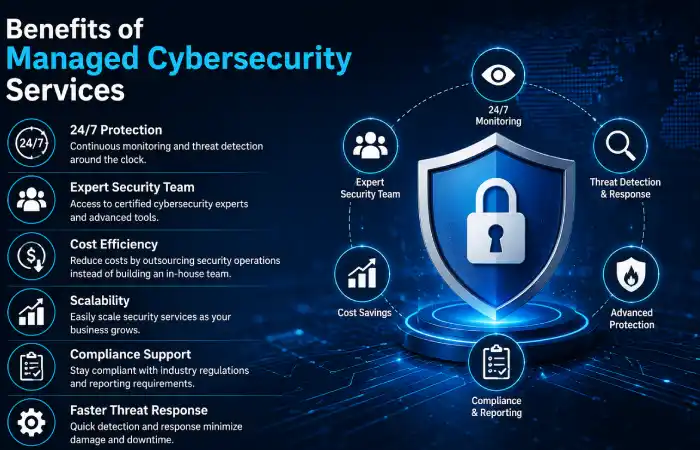
- 24/7 Protection
Organizations can also make security applicable out of usual working hours.
- Access to Security Expertise
They can have access to security analysts and specialized skills without having to adopt their own internal SOC.
- Faster Threat Detection
Instant detection and automated correlation could shorten the time of suspicious activity and investigation.
- Lower Operational Complexity
The provider takes control of elements of the security technology stack lessening the effort required for internal IT teams.
- Scalability
Managed services can grow with the growing requirements of a business including new employees, more endpoints, new applications and increased resources in the cloud.
- Better Security Visibility
Centralized monitoring provides organizations with a more comprehensive view of activity across endpoints, networks, identities and cloud environments.
- Support for Compliance
Providers may be able to assist with monitoring, documentation and reporting requirements, but the business remains accountable for compliance with the regulation.
- Predictable Security Operations
This alternative to inducting and training dedicated security personnel is to buy security functionality on an ongoing basis, rather than doing so in-house.
According to 2015 ISC2 workforce study 95% felt they had at least one cybersecurity skills gap, and 59% reported critical or significant skills gaps.
Managed Security Services for Small Businesses
Small businesses may not be able to justify a complete internal SOC.
This, however, does not mean they can turn a blind eye to the matter of cybersecurity.
A practical SMB managed-security package may include:
| Security need | Recommended managed capability |
| Employee laptops | Managed EDR/endpoint protection |
| Suspicious logins | Identity monitoring |
| Network attacks | Managed firewall/IDS |
| Phishing and malware | Email and endpoint security |
| Security alerts | 24/7 monitoring |
| Vulnerabilities | Vulnerability scanning |
| Cyber incidents | Incident response |
| Compliance | Security reporting |
| Cloud applications | Cloud security monitoring |
There is no perfect package for everyone. It all depends on the size of business, security of information, legal framework, profiles of working from home and the security tools in place.
FAQs About Managed Cybersecurity Services
What are managed cybersecurity services?
They are an external service which provides dedicated security capabilities on an ongoing basis through a dedicated provider. Service options may include monitoring, intrusion detection, incident management, endpoint security, firewall administration, vulnerability management and assurance compliance.
What is an MSSP? How is it different from an MDR provider?
Not quite. MSSPs be responsible for large array of security operations tasks, but MDR concentrates on managed threat detection and response. IBM defines that MDR emphasizes on continuous monitoring, investigations and remediation, unlike traditional MSSPs where more focuses on monitoring and security management activities.
Remain managed security services right for your small business?
They can be, especially if a business doesn‟t have enough staff or skill to monitor the security constantly itself. The best option is to select a service that works on the highest risk systems for the company, instead of buying all possible security options.
Remain the Managed security services meant to supplant the internal IT personnel?
Most of the time no. Managed security providers can work alongside internal IT to handle specific security processes while experts keep hold of the business and IT infrastructure expertise.
What is the pricing range for the managed cybersecurity services?
Cost – can vary significantly by endpoint, user, cloud infrastructure involved, security tools used, monitoring requirement, coverage for incident response, compliance need and service-level agreement.
Final Takeaway
Equipped with the right managed cybersecurity services organizations are able to observe security without gaps, take advantage of specialist knowledge, and be able to respond to threats in a systematic way. All this is without the need of hosting a security operation center.
For 2026 the most powerful approach is not a provider promising “around the clock” protection in the sky. Organizations should measure the technology stack, human analysts, incident response, detection capabilities, authority, SLAs, reporting, compliance understanding and integration.
As attacks become more automated and security teams continue to face skills shortages, an effectively designed managed security service can become an important component of an overall security strategy not a replacement for one.
Kashifa Jafar is a technology writer and contributor at FutureTechExpert with 4+ years of experience in technology writing and content creation.
Read Full Bio of Author →Sameena reviews selected health, wellness, technology, and digital content for clarity, factual presentation, and reader usefulness.
Read Full Bio of Reviewer →