
 Kashifa Jafar
Technology Writer & Contributor
Kashifa Jafar is a technology writer and contributor at FutureTechExpert with 4+ years of experience in technology writing and content creation.
Read Full Bio of Author →
Kashifa Jafar
Technology Writer & Contributor
Kashifa Jafar is a technology writer and contributor at FutureTechExpert with 4+ years of experience in technology writing and content creation.
Read Full Bio of Author →
 Sameena Begum
Health, Technology & Digital Content Reviewer
Sameena reviews selected health, wellness, technology, and digital content for clarity, factual presentation, and reader usefulness.
Read Full Bio of Reviewer →
Sameena Begum
Health, Technology & Digital Content Reviewer
Sameena reviews selected health, wellness, technology, and digital content for clarity, factual presentation, and reader usefulness.
Read Full Bio of Reviewer →
Cloud Security Services allow organizations to protect applications, data, identities, workloads, networks and infrastructure that resides in the cloud environment from cyber security attacks. With the proliferation of business workloads hosted in public, private, hybrid and multi-cloud environments, the traditional notion of security being centered around a network perimeter can no longer be adhered to.
Today, cloud security is a combination of technologies, policy, monitoring, identity management, data security, threat detection, compliance, and automatic remediation. Companies like IBM, Accenture, Deloitte, Rackspace Technology, and Wipro have all begun to provide cloud security as a continuous service rather than a once-off configuration.
 This article is part of
Cybersecurity Resources
Table of Contents
What Are Cloud Security Services?
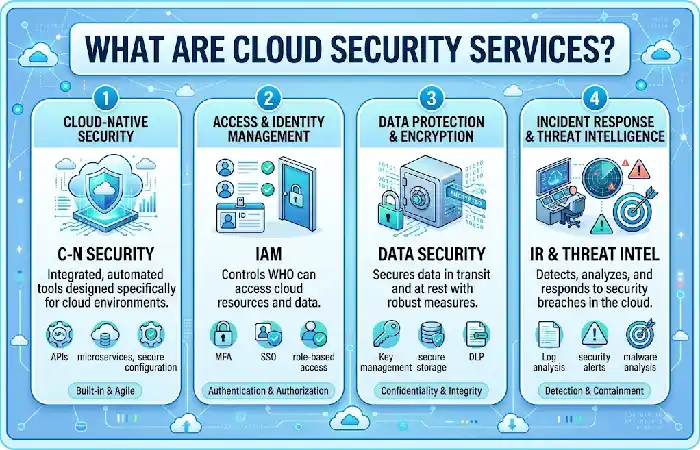
Cloud security services: Technologies and managed security services that are designed to secure the cloud environment from intrusion, data breach, malware injection, misconfiguration, vulnerabilities, and other security threats.
Depending on the organization, services may include:
- Identity and access management (IAM)
- Cloud security posture management (CSPM)
- Cloud access security broker (CASB)
- Data encryption and data loss prevention
- Cloud workload protection
- Threat detection and response
- Security information and event management
- Vulnerability management
- Compliance monitoring
- Zero Trust security
- Security assessments and penetration testing
- Managed security operations
The specific responsibility division relies on the cloud provider and deployment model. With the shared responsibility model, the cloud provider securing some underlying infrastructure and the customer has to handle the identities, configuration, data and workloads in a proper way.
Businesses can strengthen their overall security posture by combining cloud protection with comprehensive cybersecurity services.
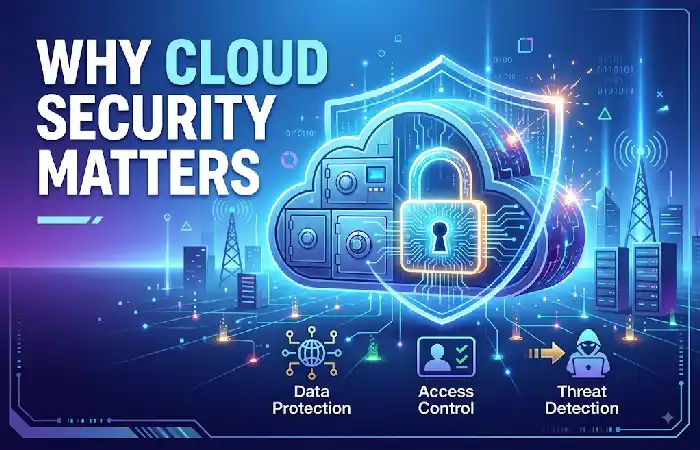
Why Cloud Security Matters
The use of cloud computing enables applications to be scaled with a lot more convenience and at much faster speeds and information can be gained from anywhere in the world. This level of flexibility however, leads to greater identities, devices and applications, APIs and workloads and configurations that need to be secured.
Common risks include:
- Misconfigured cloud storage
- Excessive user permissions
- Stolen credentials
- Unpatched workloads
- Insecure APIs
- Malware and ransomware
- Insider threats
- Compliance failures
- Poor visibility across multiple cloud accounts
IBM notes the importance of ongoing visibility, control, mitigation, risk and compliance.
A cloud security strategy that is effective thus cannot solely be a network security strategy. The strategy needs to be a comprehensive security approach that protects identities, applications, data, workloads and configurations.
Types of Cloud Security Solutions
Cloud security is not a one product. Most organizations combine multiple controls.
| Solution | Primary purpose | Best suited for |
| IAM | Controls identities and permissions | All cloud environments |
| CASB | Secures cloud application access and data | SaaS-heavy organizations |
| CSPM | Finds cloud configuration and compliance issues | Public and multi-cloud |
| CWPP | Protects cloud workloads | VMs, containers and workloads |
| CIEM | Manages cloud entitlements and least privilege | Complex multi-cloud environments |
| SIEM | Collects and analyzes security events | Security operations teams |
| CNAPP | Combines several cloud-native security capabilities | Cloud-native development |
| Zero Trust | Verifies every access request | Distributed organizations |
Resource: NIST Cybersecurity Framework
Cloud Access Security
Cloud access security is the focus of managing the way people and devices connect to cloud applications and services.
A further device of interest is the Cloud Access Security Broker (CASB). CASB implementations can offer insight into cloud activity, file protection, threat protection, and policy enforcement. HPE and Trend Micro have defined CASB as a security checkpoint between users and clouds that presents the enforcement of policies and the protection of sensitive data.
Effective cloud access security commonly includes:
- Multi-factor authentication
- Single sign-on
- Conditional access
- Device security checks
- Role-based access control
- Least-privilege permissions
- Data loss prevention
Data Protection in the Cloud
Cloud data protection is targeted at maintaining the confidentiality, accuracy and availability of the data.
Protection of data at rest, in transmission, and during processing as appropriate, is another key area.
Common controls include:
- Encryption
- Key management
- Data classification
- Backup and recovery
- Data loss prevention
- Access controls
- Retention policies
- Security monitoring
Encryption is important as cloud environments may have customer data, financial data, intellectual property and mission critical applications.
Cloud environments still depend on secure network connections, making network security services essential for protecting traffic, systems, and connected resources.
Cloud Identity and Access Management
One of the most critical aspect in cloud security today is identification.
Organizations should adhere to the least-privilege policy. Rather than providing users with generalized control, each employee, application, and service need only be assigned the necessary privileges which will enable it to complete that task.
IAM programs commonly use:
- Role-based access control
- Multi-factor authentication
- Privileged access management
- Single sign-on
- Automated user provisioning
- Access reviews
- Service-account controls
In bigger multi-cloud environment, Cloud Infrastructure Entitlement Management (CIEM) assists organizations to discover and manage too many permissions across multiple clouds.
Organizations should also protect laptops, desktops, mobile devices, and other access points with reliable endpoint security services.
Cloud Threat Detection and Monitoring
Prevention is not the whole story. Companies require ongoing visibility into rogue activity.
Cloud threat detection can monitor:
- Authentication events
- API activity
- Network traffic
- Configuration changes
- Application behavior
- Endpoint activity
- Unusual user behavior
- Security alerts
Managed security providers are more and more providing constant monitoring and response. Rackspace for one, enables ‘Threat Detection and Response 24/7 for Multicloud Environments’ and Deloitte provides ‘Cloud Monitoring & Managed Security’.
An established program should grow beyond tracking alerts. Security teams require processes to investigate, prioritize, respond, and remediate.
Companies without dedicated security teams can use managed cybersecurity services to continuously monitor and protect their cloud infrastructure.
Multi-Cloud Security Challenges
Employing AWS, Microsoft Azure, Google Cloud, or other platforms in combination may introduce more security complications.
The most common challenges include:
- Different security controls between providers.
- Inconsistent IAM policies.
- Limited centralized visibility.
- Configuration drift.
- Duplicate security tools.
- Different compliance requirements.
- Difficulty monitoring APIs and workloads.
- Skills gaps within security teams.
IBM, for its part, features the requirement to have visibility and control over hybrid and multicloud and the cloud security platform offered by Deloitte provides constant multi-cloud posture scanning and policy enforcement.
A unified governance policy allows to organizations enforce uniform policies without dictating all clouds will have identical technical architecture.
Since cloud platforms store large volumes of sensitive information, data security services can help protect business data from unauthorized access and breaches.
Benefits of Cloud Security Services
A sound cloud security service can bring much business value.
Better visibility
Security teams can find assets, users, configurations and threats within cloud environments.
Reduced security risk
Early detection Continuous monitoring and automated controls can help to pinpoint vulnerabilities before intruders do.
Stronger compliance
Security policies, logging, access controls and reporting can ease the burden of compliance requirements.
Faster threat response
Managed detection and response services can assist companies in speeding up the investigation of suspicious activity.
Lower operational burden
The more sophisticated external security experts.
Safer cloud growth
Security controls could also be built into the cloud migration, development and deployment; rather than relying on just implementing them after the fact.
The 2026 cloud-security work by Accenture also focuses in a proactive approach to security such as defense, automated response and fighting security blind spots in dispersed multi-cloud environments.
Best Practices for Cloud Security
Organizations can strengthen their cloud security posture by following these practices:
- Use strong identity controls.
Enable MFA and apply least-privilege permissions. - Continuously monitor configurations.
Regularly check cloud resources for exposed services, excessive permissions and insecure settings. - Encrypt sensitive information.
Protect important data both during transmission and while stored. - Centralize security visibility.
Use appropriate logging, SIEM and security monitoring tools to correlate activity. - Secure APIs and workloads.
Review application interfaces, containers, virtual machines and serverless workloads. - Automate where practical.
Automated policy checks and remediation can reduce repetitive manual work. - Test incident-response plans.
Teams should know what happens when an account is compromised or sensitive data is exposed. - Review third-party access.
Regularly evaluate vendors, integrations and external identities. - Build security into DevOps.
Security testing should happen throughout the software development lifecycle. - Review the shared responsibility model.
Know exactly which security responsibilities belong to the cloud provider and which belong to your organization.
Before deploying critical workloads to the cloud, organizations can use cybersecurity risk assessment services to identify vulnerabilities and prioritize security controls.
Frequently Asked Questions
What are these cloud security services?
Cloud security services are technical and professional services that are utilized to secure cloud infrastructure, applications, data, identities, and workloads against security threats.
What is Cloud security‘s keypoint?
No single control will safeguard each and every cloud environment. A combination of robust identity management, secure configurations, data protection, continuous monitoring and incident response should be employed.
Should I even consider using cloud security for my small business?
Can be useful for small organizations that use cloud applications but do not have cybersecurity experts. Their managed services can be used to support internal IT expertise.
What are the distinctions here between cloud security and cybersecurity?
Cybersecurity is a more broad term and includes all of digital systems and information security. Cloud security is a subcategory related to cloud infra, applications, workload, identity and data security.
What benefits do cloud security services bring to multi-cloud environments?
Can offer centralized visibility, security policies, monitoring, compliance controls, and threat detection across multiple clouds.
Conclusion
The explosion of Cloud Security Services in IT Security has been brought to a new level already. With the proliferation of SaaS applications, expansion onto the public clouds, coupling containers and APIs, the emergence of hybrid infrastructure and the proliferation of Multi-Cloud architectures you can no longer rely solely on securing the network perimeter.
The most effective method for most organizations is a hybrid of the technology categories that incorporates the following software components: IAM, cloud access security, data security, threat detection, posture management, workload security, monitoring and governance. In addition, organizations should consider the vendor‘s cloud presence, integrations, experience, response capabilities, compliance support and growth potential.
Kashifa Jafar is a technology writer and contributor at FutureTechExpert with 4+ years of experience in technology writing and content creation.
Read Full Bio of Author →Sameena reviews selected health, wellness, technology, and digital content for clarity, factual presentation, and reader usefulness.
Read Full Bio of Reviewer →