
 Kashifa Jafar
Technology Writer & Contributor
Kashifa Jafar is a technology writer and contributor at FutureTechExpert with 4+ years of experience in technology writing and content creation.
Read Full Bio of Author →
Kashifa Jafar
Technology Writer & Contributor
Kashifa Jafar is a technology writer and contributor at FutureTechExpert with 4+ years of experience in technology writing and content creation.
Read Full Bio of Author →
 Sameena Begum
Health, Technology & Digital Content Reviewer
Sameena reviews selected health, wellness, technology, and digital content for clarity, factual presentation, and reader usefulness.
Read Full Bio of Reviewer →
Sameena Begum
Health, Technology & Digital Content Reviewer
Sameena reviews selected health, wellness, technology, and digital content for clarity, factual presentation, and reader usefulness.
Read Full Bio of Reviewer →
Network Security Services provide businesses with comprehensive protection from cyber threats such as intrusions, rogue access and malware, ransomware and data theft, by safeguarding networks, users, devices and applications. In 2026, network security services see the integration of multiple layers including firewalls, intrusion prevention, secure remote access, continuous monitoring, Zero Trust, threat intelligence and automated response.
Networks today no longer consist solely of office based computers. Instead, employees work from home, applications are remotely hosted in the cloud, and a business‘s networks are supported by the Internet of Things (IoT) devices, mobile endpoints, SaaS applications and third party services. In such an environment, layered network security is paramount.
By analyzing the Verizon‘s 2026 data breach investigations report, a software vulnerability wasused in 31% of the breaches which it was the number one initial access vector in the report. The same report also shows that in 48% of the breaches were found ransomware.1, which indicates why organizations need a security control that can prevent, detect and respond as a multi-layered approach.
 This article is part of
Cybersecurity Resources
Table of Contents
What Are Network Security Services?
Network security services are technologies and professional services that secure an organization‘s network infrastructure and the traffic flow through the infrastructure.
They can include:
- Firewall management
- Intrusion detection and prevention
- Network access control
- VPN and secure remote access
- Zero Trust Network Access (ZTNA)
- Network monitoring
- Threat detection
- DDoS protection
- Network segmentation
- Security assessments
- Managed security operations
A network security service can be implemented in the following ways.
For instance, the service provider of a managed service could keep an eye on the logs from a customer‘s firewall, research anomalous traffic, update security policies and inform the customer IT department if a serious threat were to appear.
Strong network security starts with a broader security strategy. Businesses can combine network protection with comprehensive cybersecurity services to address threats across their entire IT environment.
Why Network Security Is Important
A breached network can reveal sensitive information, cause operational delays, lose customer confidence and result in costly recovery efforts.
Network security is especially critical as there are a rising number of attack focused on exploiting weaknesses in internet-facing systems and network infrastructure.
2026 Network Security Threat Snapshot
| Security concern | 2026 data / observation | Why it matters |
| Vulnerability exploitation | 31% of breaches | Patch and vulnerability management are critical |
| Ransomware | 48% of breaches | Organizations need prevention and recovery controls |
| Generative AI | 15% of attack techniques augmented by GenAI | Threat detection must adapt faster |
| Mobile social engineering | 40% higher click rates | Secure access must include mobile users |
| Third-party involvement | 48% of breaches | Vendor and supply-chain security matter |
The figures are not probability of a specific company getting attacked they are reported proportions from the breach dataset of Verizon.
As organizations move applications and data to the cloud, network protection should extend beyond traditional infrastructure. Cloud cybersecurity services can help secure cloud environments, workloads, and sensitive resources.
Types of Network Security Solutions
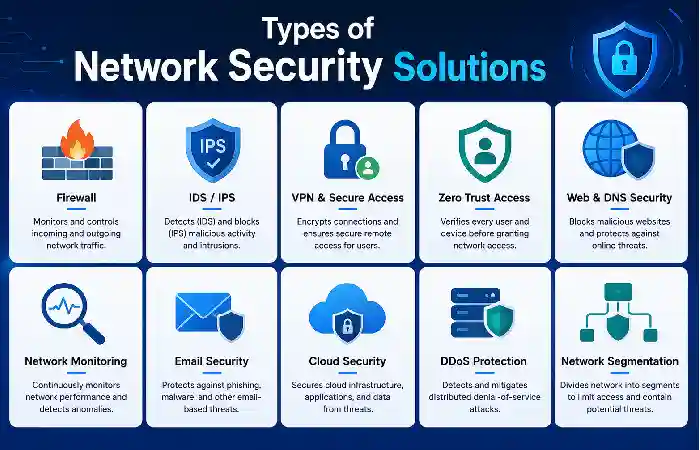
No single product is sufficient, and an organization will generally deploy a range of security technologies.
| Solution | Primary purpose | Best suited for |
| Firewall | Controls network traffic | All business networks |
| NGFW | Advanced traffic and application inspection | Medium and large businesses |
| IDS | Detects suspicious activity | Monitoring and investigation |
| IPS | Detects and blocks threats | Active network protection |
| VPN | Encrypts remote connections | Remote workers |
| ZTNA | Provides identity-based application access | Hybrid/remote organizations |
| Network monitoring | Identifies unusual activity | IT/security teams |
| DDoS protection | Mitigates traffic floods | Public-facing services |
| Network segmentation | Limits lateral movement | Enterprise/complex networks |
| Managed security | Outsources monitoring and response | Organizations with limited security staff |
More and more vendors today are bundling some of these capabilities into integrated platforms. With Fortinet, for instance, secure networking is blended with firewalls, switching, wireless access, 5G gateways and intelligent security services.
Network defenses are stronger when connected devices are protected as well. Endpoint security services help secure laptops, desktops, servers, and other devices that connect to the business network.
Firewall and Network Protection
Firewalls are the primary building blocks for network security.
It inspects every packet entering and leaving the network and enforces the security rules to decide whether to permit or deny packet transmission.
Traditional firewalls have become NGFWs (Next-Generation Firewalls) that provide more comprehensive traffic inspection, application knowledge, intrusion prevention, URL filtering, malware protection, and much more.
Firewall comparison
| Feature | Traditional Firewall | NGFW |
| IP/port filtering | Yes | Yes |
| Stateful inspection | Yes | Yes |
| Application awareness | Limited | Yes |
| Deep packet inspection | Limited | Yes |
| Integrated IPS | Usually separate | Common |
| Threat intelligence | Limited | Common |
| Advanced malware controls | Limited | Available |
A business firewall well configured and used can be enough for a small business. Larger companies will require policy management at a central point, advanced inspection, segmentation, cloud connect and integrated threat prevention.
Organizations without a dedicated security team can strengthen their network defenses through managed cybersecurity services, providing ongoing monitoring and security support.
Intrusion Detection and Prevention
Intrusion Detection System (IDS) monitors network activity and act against any unacceptable activity.
A IPS not only detects intrusion, it also stops or prevents malicious activity when it occurs.
For instance, if an attacker tried to use a previously documented vulnerability, the IPS can recognize the nature of the traffic and terminate the connection before it even hits the victim.
Today, many network security platforms are blending intrusion prevention systems (lPS) with threat intelligence, malware detection and behavioral analysis capabilities. Fortinet states that intrusion prevention system is “a component that can identify and prevent targeted attacks,” and the Palo Alto Networks offers “integrated intrusion prevention with its cloud-delivered security platform”.
Protecting the network is only one part of a complete security strategy. Data security services help organizations safeguard sensitive information from unauthorized access, loss, and cyber threats.
Secure Network Access
Control over network access. Both remote working and cloud applications have impact on the control over network access for the organizations.
Traditional Virtual Private Networks are still employed, however many businesses are also applying Zero Turn Trust Network Access( ZTNA).
Instead of automatically trusting a device because it is connected to the corporate network, Zero Trust evaluates factors such as:
- User identity
- Device security
- Application
- Location
- Authentication status
- Security policy
- Context of the request
The basic concept is straightforward: -A it will authenticate, not trust.
This makes it extremely useful for a business that has remote employees, contractors, multiple locations, clouds applications.
Before implementing security controls, businesses should understand where their infrastructure is most vulnerable. Cybersecurity risk assessment services can identify vulnerabilities and prioritize security improvements.
Network Monitoring and Threat Detection
Monitoring your network provides visibility into your entire infrastructure for your IT and security teams.
Monitoring can identify:
- Unusual traffic spikes
- Unauthorized devices
- Repeated login failures
- Suspicious DNS activity
- Malware communication
- Unexpected data transfers
- Port scanning
- Lateral movement
Provides ongoing monitoring of managed network security services in case a company lacks adequate staff.
Services offered by IBM‘s Managed Network Security Services, for instance, comprise of monitoring, managing and analyzing security-device alerts and logs reporting and also providing threat intelligence.
For those businesses that are open 24/7, this may be very good for them as the attackers are no longer just doing their dirty work between 9 and 5.
Benefits of Network Security Services
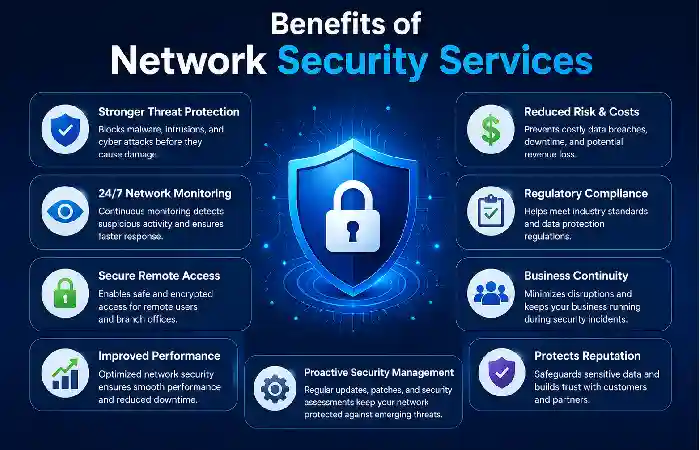
A properly designed network security program can provide several benefits:
- Reduced Cybersecurity Risk
The existence of Firewalls, IPS, access controls and monitoring there are several barriers.
- Better Visibility
Monitoring tools provide security teams with an understanding of devices, users, applications and traffic moving through the network.
- Faster Threat Detection
Automated alerts will detect unusual activity at an earlier stage than looking through logs.
- Secure Remote Work
VPN, ZTNA and identity-based controls can keep remote workers safe when accessing company resources.
- Reduced Security Workload
Managed security services enable organizations to contract out monitoring and specialized security operations.
- Better Business Continuity
The operational impact of an attack can be mitigated through the use of DDoS protection, segmentation, threat prevention and incident-response planning.
How to Choose Network Security Services
The best network security service varies depending on the size of you organization, its network, its risks and the budget.
Before selecting a provider, evaluate these factors:
| Evaluation factor | Questions to ask |
| Network size | How many users, locations and devices need protection? |
| Cloud usage | Does the service protect AWS, Azure, SaaS and hybrid environments? |
| Monitoring | Is 24/7 monitoring available? |
| Response | Who investigates serious alerts? |
| Firewall | Does it support NGFW capabilities? |
| Remote access | Does it support VPN and/or ZTNA? |
| Scalability | Can the service grow with the organization? |
| Reporting | Are security reports and dashboards provided? |
| Integration | Can it integrate with existing security tools? |
| Support | Is expert support available when incidents occur? |
| Compliance | Does it support relevant regulatory requirements? |
Never use a provider just because it has the most features. It is much better to identify your highest risk assets and then acquire services that can help you cover those high risk areas.
Likewise Tech-Target, who also says providing a managed security service should not be seen as a commodity that you can swap out by simply shopping around. You need to ensure the service provider has the skills and knowledge to meet your security needs.
Network Security Best Practices
A comprehensive approach to network security will rely upon technology, policies and people.
Keep Systems Updated
Procedures to update patch operating systems, firewalls, routers, VPN appliances, applications and any other system connected to the network as soon as available.
In 2026 alone this could become an even more relevant contribution due to the fact that, on the Verizon breach report 11’, advantage exploitation is the primary initial access vector.
Use Multi-Factor Authentication
Use of MFA provides an additional layer of authentication on top of a password and, where feasible, should be configured for administrative accounts and when accessing remotely.
Segment the Network
Isolate critical systems from regular user devices. Consider whether payment systems, servers, staff computers, guest Wi-Fi, IoT devices should necessarily be on an unfiltered network.
Monitor Security Logs
Centralized log management enables easier detection and investigation of potential malicious activity.
Apply Least Privilege
Access should be granted to users and machines only according to their every need.
Back Up Critical Data
Security controls cannot eliminate all risk and protect against every attack. Implement tested backups and an incident-response plan.
Review Security Policies Regularly
Configurations, permissions and other policies will change over time. Regular reviews avoid leaving obsolete policies behind creating further exposures.
FAQs About Network Security Services
So what exactly we mean by network security services?
Network security services are a combination of technology and professional services used to safeguard network infrastructure, users, devices, applications and traffic from theft or damage.
What are the main network security services?
Some of the common services are firewall, NGFW, IDS/IPS, VPN, ZTNA, network monitor, DDoS protection, segmentation, vulnerability management and managed security operations.
Do small companies require a security services of network?
Yup. Small businesses for the most part will not have the necessary security as they can be desirable targets. An appropriately configured, hardened firewall, MFA, remote access security, endpoint protection, backups and monitoring will lay a good foundation.
How does an IDS differentiate itself from an IPS?
IDS mainly monitors and alert on abnormal activities. On the other hand, IPS is capable of blocking unwanted attacks.
Network Security: can VPN do it?
No. A VPN can secure a connection, but the VPN itself is only one layer of the security stack. It does not supplant firewall, access control, endpoint security, monitoring, patch management or other security layers.
Final Thoughts
Much more than just installing a firewall, in 2026 effective Network Security Services are multi-layered, incorporating targeted network security, intrusion 708prevention, secure access, basic security monitoring, vulnerability management and security policies.
Kashifa Jafar is a technology writer and contributor at FutureTechExpert with 4+ years of experience in technology writing and content creation.
Read Full Bio of Author →Sameena reviews selected health, wellness, technology, and digital content for clarity, factual presentation, and reader usefulness.
Read Full Bio of Reviewer →