
 Kashifa Jafar
Technology Writer & Contributor
Kashifa Jafar is a technology writer and contributor at FutureTechExpert with 4+ years of experience in technology writing and content creation.
Read Full Bio of Author →
Kashifa Jafar
Technology Writer & Contributor
Kashifa Jafar is a technology writer and contributor at FutureTechExpert with 4+ years of experience in technology writing and content creation.
Read Full Bio of Author →
 Sameena Begum
Health, Technology & Digital Content Reviewer
Sameena reviews selected health, wellness, technology, and digital content for clarity, factual presentation, and reader usefulness.
Read Full Bio of Reviewer →
Sameena Begum
Health, Technology & Digital Content Reviewer
Sameena reviews selected health, wellness, technology, and digital content for clarity, factual presentation, and reader usefulness.
Read Full Bio of Reviewer →
Endpoint security services is enable organizations to secure laptops, desktops, mobile devices, servers and other connected devices against malware, ransomware, unauthorized access and other cyber threats. Today‘s modern services put in place the concept of a comprehensive security coverage rather than simply traditional antivirus combining prevention, EDR, endpoint management, monitoring, and security know-how.
With the shift to cloud-based applications, traditional boundaries have expanded with the rise of remote work and bring your own device (BYOD). If an organization has managed endpoints that span BYOD, cloud and traditional user devices.
 This article is part of
Cybersecurity Resources
Table of Contents
What Are Endpoint Security Services?
An endpoint security service is a technology or profession directed toward protecting endpoints any device that establishes a connection to an enterprise network and access to its resources and data.
Depending on the provider, services can include:
- Antivirus and malware protection
- Endpoint Detection and Response (EDR)
- Managed Detection and Response (MDR)
- Mobile Device Management (MDM)
- Endpoint monitoring
- Vulnerability and patch management
- Device control
- Ransomware protection
- Incident investigation and response
- Security policy configuration
Dell again breaks its endpoint security services into planning, implementation, sustain and custom services and GuidePoint offers selecting a product, implementation, integration and optimization.
It‘s not just about deploying security solutions.1 With effective endpoint security, the organization can continuously recognize the high risk devices, detect anomalous behavior and enable security teams to respond before an attack propagates.
Businesses can strengthen their overall security posture by combining endpoint protection with comprehensive cybersecurity services designed to address multiple layers of digital risk.
Why Endpoint Security Is Important
Endpoints are also an appealing target because they are used directly by the employees and access business applications and data often.
The 2016 Verizon Data Breach Investigations Report determined that vulnerability exploitation was responsible for 31% of breaches, making it the most common initial breach-entry in the 2016 report. Also according to Verizon, attackers are using AI to speed up exploitation, lowering the reaction time of the defender.
Another serious concern is ransomware. During the first quarter of 2026, 2,122 ransomware victims appeared on data-leak sites, according to Check Point Research–approximately 707 victims each month.
2026 Cybersecurity Risk Snapshot
| 2026 indicator | Finding | Why it matters for endpoints | Resource |
| Breaches involving vulnerability exploitation | 31% | Unpatched endpoint software can create an entry point | Verizon 2026 DBIR |
| Ransomware victims listed in Q1 2026 | 2,122 | Endpoint compromise can enable ransomware deployment | Check Point Research Q1 2026 |
| Average ransomware victims/month in Q1 2026 | ~707 | Continuous detection and response remain important | Check Point Research |
Endpoint protection works best alongside network security services that monitor and protect the connections between users, devices, applications, and business systems.
Types of Endpoint Security Solutions
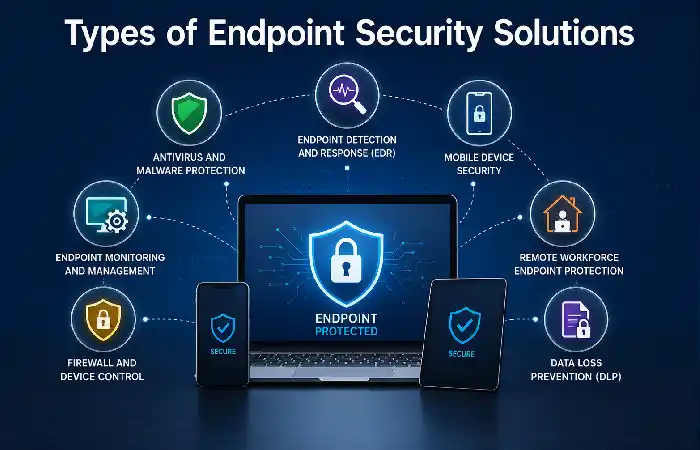
A full endpoint security approach is most often made up of a number of different technologies.
| Solution | Primary purpose | Best suited for |
| Antivirus/anti-malware | Blocks known malicious software | Every organization |
| EDR | Detects and investigates suspicious endpoint behavior | Medium and large organizations |
| MDR | Adds security experts and continuous monitoring | Businesses without large SOC teams |
| MDM/UEM | Controls and secures mobile and endpoint devices | Mobile/remote workforces |
| Endpoint DLP | Helps prevent sensitive data leakage | Regulated businesses |
| Patch management | Keeps operating systems and applications updated | All environments |
| Device control | Controls USB and peripheral access | High-security environments |
According to NIST, device-management capabilities should be used to enforce support for different operating systems, archive or maintain certificates, deploy patches and monitor or audit endpoints.
As organizations move more workloads to the cloud, endpoint protection should be complemented by cloud security services that help secure cloud applications, infrastructure, and data.
Antivirus and Malware Protection
Antivirus is still an important initial layer for endpoint security. Newer endpoint platforms are capable of detecting malicious files and operation through signatures, behavioral techniques and cloud data.
However, Antivirus is not a sufficient option for lot of business environments.
Contemporary attacks can include compromised accounts, existing administrative or management tools, malicious scripts, or devices or techniques unknown to date. Endpoint platforms thus more and more combine prevention with behavioral detection and automatic response.
A practical security stack can look like:
Antivirus → EDR → centralized monitoring → investigation → response
This methodology prevents a single missed detection from becoming a security event.
Companies without a dedicated security team can use managed cybersecurity services to continuously monitor threats, manage security controls, and respond to suspicious activity.
Endpoint Detection and Response
End Point Detection and Response, (EDR), gathers end point activity and checks it for malicious activity.
Instead of asking only, “Is this file malware?”, EDR can help security teams investigate questions such as:
- Which device generated the alert?
- What process started the activity?
- Which user was logged in?
- What files or applications were affected?
- Did the activity spread to other systems?
- What actions should be taken?
Motorola Solutions defines endpoint services as “the ability to monitor ongoing endpoint activity, analyze endpoint events as they happen, and correlates endpoint data with network and cloud alert”.
EDR doesn‘t sound like a replacement for standard AV in my view but it is far more than this, if a key benefit is it provides greater visibility into your environment.
Protecting endpoints is only one part of cybersecurity; data security services help safeguard sensitive business information from unauthorized access, loss, and breaches.
Mobile Device Security
More and more users are now establishing access to business applications, email, cloud and other sensitive information through the use of mobile devices such as smart phones and tablets.
NIST‘s mobile-device recommendations address both enterprise-owned and personally owned devices and include guidelines for managing security through the mobile device lifecycle.
Mobile endpoint security can include:
- Mobile Device Management (MDM)
- Application controls
- Encryption
- Screen-lock policies
- Remote wipe
- Security updates
- Device compliance checks
- Conditional access
As this is primarily aimed at companies with BYOD policies.
Organizations can identify vulnerabilities before attackers exploit them by using cybersecurity risk assessment services to evaluate security gaps and prioritize remediation.
Remote Workforce Endpoint Protection
Remote employees have the flexibility to work from their homes, from hotels, co working spaces , and networks outside of the usual corporate vicinity.
As such, it has to work no matter where the device is.
Key controls include:
- Enforce strong authentication.
- Keep operating systems and applications patched.
- Require endpoint security software.
- Monitor device health.
- Encrypt sensitive data.
- Restrict unnecessary administrative privileges.
- Separate personal and business data where appropriate.
- Use centralized endpoint management.
The guidance on zero-trust by NIST calls for device posture and unified endpoint management to secure access for modern enterprise environments.
Endpoint Monitoring and Management
Monitoring at the endpoint provides security teams with insight into what devices are being used, and their activity.
A good monitoring program should track:
- Device inventory
- Operating-system versions
- Patch status
- Security-agent health
- Suspicious processes
- Malware detections
- Login activity
- Policy violations
- Endpoint compliance
Centralized management makes sense when the organization contains hundreds or thousands of devices.
For example, the Microsoft 365 enterprise plans include endpoint security, endpoint policy management, device compliance and endpoint analytics features, with additional EDR and ransomware-protection capabilities available at higher levels.
Benefits of Endpoint Security Services
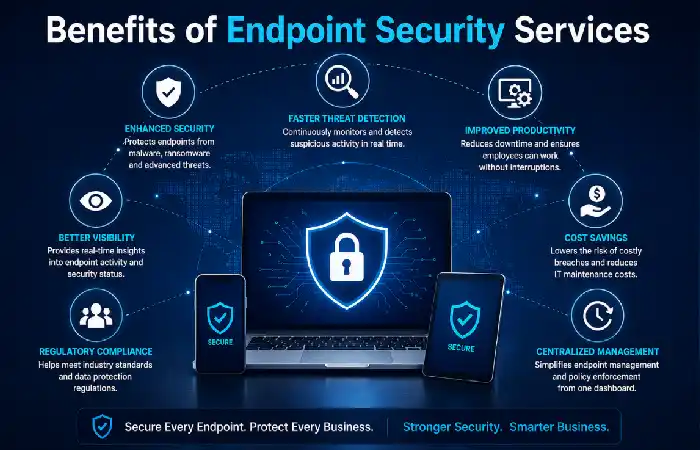
There are numerous advantages to an effective endpoint security program for an enterprise.
- Faster threat detection
By monitoring continuously the illegal activities can be detected at the earliest possible stage than in the case of periodical security checks.
- Reduced ransomware risk
The tip, at the endpoint level, is to show prevention of the attack and behavioral detection to spot the ransomware.
- Better visibility
Security teams will be able to know what devices should be secure, insecure and out of compliance.
- Support for remote work
Security controls may also be applied to employees and their devices even when they are away from the office.
- Reduced IT workload
Managed services can also provide monitoring, troubleshooting, and security experience for organizations without a large internal Security Operation Center (SOC).
- Improved incident response
EDR and MDR capabilities can also inform security teams to investigate and contain incidents.
Endpoint Security Best Practices
Organizations should approach the duration of 2026 as a life cycle of endpoint protection instead of merely a software installation.
Follow these best practices:
- Maintain an accurate endpoint inventory.
- Patch operating systems and applications quickly.
- Deploy modern endpoint protection.
- Use EDR where deeper detection is required.
- Monitor endpoints continuously.
- Apply least-privilege access.
- Enforce strong authentication.
- Encrypt business data.
- Secure mobile and BYOD devices.
- Disable unnecessary services and applications.
- Restrict removable media where appropriate.
- Test incident-response procedures.
- Review endpoint policies regularly.
- Train employees to recognize phishing and social engineering.
The same guidance by CISA emphasizes how critical it is to monitor endpoint-management systems as they often have greater access to multiple hosts.
FAQs About Endpoint Security Services
What are end point security services?
The security services point equipment safeguards laptops, desktops, mobile phones, servers and any other connected equipment using technologies such as antivirus, EDR, device management, monitoring and incident response.
So are endpoint security services the same as antivirus?
No. Antivirus is only 1 layer of endpoint security. Today‘s endpoint services may also encompass EDR, MDR, mobile security, patch management, monitoring and response.
Is endpoint security necessary for small businesses?
Yes. Smaller organizations could be an easier target as they might not have a dedicated security team. Managed endpoint services can offer professional monitoring service, of course on a limited security team.
What EDR and MDR is?
EDR is an endpoiint technology that detects and investigates suspicious activity, whereas an MDR is a managed services where security experts will monitor and respond to security threats using technologies such as EDR.
Remote workers, does endpoint security matter?
Definitely. Remote endpoints are able to connect to a company‘s business applications and data on networks located outside of the traditional boundaries of the organization, which makes management and protection of these endpoints even more essential.
Final Takeaway
Endpoint Security Services have moved well beyond AV in 2026 organizations require combination of prevention, EDR, device management, continuous monitoring and rapid response.
It all boils down to the number of devices the company has, the company‘s working model, the regulatory environment, IT team and risk management capability. Companies should look at more than just the security solution itself; they also need to assess the level of monitoring, response, management and support the solution provider offers..
Kashifa Jafar is a technology writer and contributor at FutureTechExpert with 4+ years of experience in technology writing and content creation.
Read Full Bio of Author →Sameena reviews selected health, wellness, technology, and digital content for clarity, factual presentation, and reader usefulness.
Read Full Bio of Reviewer →