
 Kashifa Jafar
Technology Writer & Contributor
Kashifa Jafar is a technology writer and contributor at FutureTechExpert with 4+ years of experience in technology writing and content creation.
Read Full Bio of Author →
Kashifa Jafar
Technology Writer & Contributor
Kashifa Jafar is a technology writer and contributor at FutureTechExpert with 4+ years of experience in technology writing and content creation.
Read Full Bio of Author →
 Sameena Begum
Health, Technology & Digital Content Reviewer
Sameena reviews selected health, wellness, technology, and digital content for clarity, factual presentation, and reader usefulness.
Read Full Bio of Reviewer →
Sameena Begum
Health, Technology & Digital Content Reviewer
Sameena reviews selected health, wellness, technology, and digital content for clarity, factual presentation, and reader usefulness.
Read Full Bio of Reviewer →
Telecommunication technology serves as the foundation of the modern digital world. Whether making phone calls, accessing the internet, or supporting the cloud and smart devices, telecommunication technology serves to link everyone globally – individuals, businesses, and governments. With 5G, fiber optics, cloud communications, and satellite internet rapidly maturing by 2026, telecommunication technology continues to be integral in the digital transformation.
Whether you are a business, IT expert, student or just an ordinary user interested in the field of communication networks; learning about the telecommunications technology will provide you with the basic knowledge in the ever-growing communication network environment.
 This article is part of
Telecommunications Services Resources
Table of Contents
What Is Telecommunications Technology?
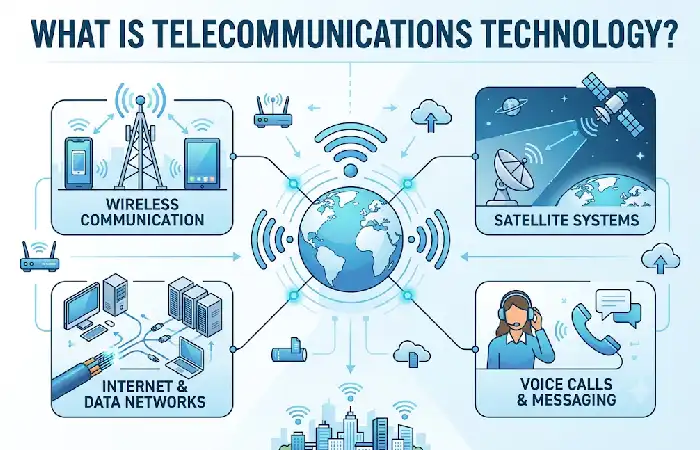
Telecommunications technology encompasses the hardware, software, networks, and infrastructure that enables the transmission of information over long distances by electronic means.
These technologies enable:
- Voice communication
- Video conferencing
- Internet access
- Data transmission
- Mobile communications
- Cloud connectivity
- IoT device communication
Core Functions of Telecommunications
| Function | Purpose | Examples |
| Voice Communication | Real-time conversations | Phone calls, VoIP |
| Data Transmission | Digital information exchange | Internet traffic |
| Video Communication | Visual interactions | Zoom, Teams |
| Wireless Connectivity | Mobile access | 4G, 5G, Wi-Fi |
| Network Infrastructure | Data transport | Fiber optics |
Telecommunications technology forms the backbone of the modern telecommunications industry, enabling seamless voice, data, and video communication across global networks.
Evolution of Telecommunications Technology
It is clear, therefore, that telecommunications has undergone significant development during the last century.
| Era | Major Innovation | Impact |
| 1870s | Telephone | Voice communication |
| 1920s | Radio Broadcasting | Mass communication |
| 1960s | Satellite Communications | Global connectivity |
| 1980s | Digital Switching | Faster networks |
| 2000s | Broadband Internet | High-speed connectivity |
| 2010s | 4G LTE | Mobile internet revolution |
| 2020s | 5G Networks | Ultra-low latency |
| 2026+ | AI-Powered Networks | Intelligent automation |
Telecommunications Evolution Timeline
Telephone
↓
Radio
↓
Satellite
↓
Digital Networks
↓
Broadband
↓
4G LTE
↓
5G
↓
AI Networks
Current telecommunications technology is capable of supporting billions of devices on a global network.
Advanced communication technologies rely on robust telecommunications infrastructure, including fiber-optic networks, cell towers, data centers, and transmission equipment.
Fiber Optic Technology
A thin strand of glass or plastic fiberoptic uses light to transmit data.
Benefits of Fiber Optics
- Extremely high bandwidth
- Faster speeds
- Low latency
- Long-distance transmission
- Reduced signal interference
Fiber vs Traditional Copper Networks
| Feature | Fiber Optic | Copper Cable |
| Speed | Up to 100+ Gbps | Typically below 1 Gbps |
| Distance | Longer reach | Shorter reach |
| Reliability | Very high | Moderate |
| Latency | Low | Higher |
| Future Scalability | Excellent | Limited |
Resource Links
| Resource | Purpose |
| Fiber Broadband Association | Fiber deployment standards |
| ITU Fiber Networks | Global telecommunications standards |
| IEEE Communications Society | Research and networking standards |
Wireless Communication Technology
Wireless communication is used to transfer data through radio waves instead of wires.
Common wireless technologies include:
- Cellular networks
- Wi-Fi
- Bluetooth
- Microwave communications
- Fixed wireless access
Wireless Communication Applications
| Application | Technology |
| Smartphones | Cellular Networks |
| Smart Homes | Wi-Fi |
| Wearables | Bluetooth |
| IoT Devices | LPWAN |
| Enterprise Connectivity | Private Wireless Networks |
The wireless industry has been rapidly expanding as mobile devices use and the number of IoT devices continue to increase.
4G and 5G Technology
The development of the mobile communication technology has been greatly advanced by 4G and 5G networks.
4G vs 5G Comparison
| Feature | 4G LTE | 5G |
| Peak Speed | 1 Gbps | 10-20 Gbps |
| Latency | 30-50 ms | 1-10 ms |
| Device Density | Moderate | Massive IoT Support |
| Reliability | High | Very High |
| Network Efficiency | Good | Excellent |
Key 5G Benefits
- Faster downloads
- Better video streaming
- Improved gaming performance
- Smart city applications
- Autonomous vehicle support
- Industrial automation
Modern telecommunications systems integrate hardware, software, and network protocols to deliver reliable communication services across multiple platforms.
Satellite Communication Technology
With satellite communications, you can connect anywhere that terrestrial communications aren‘t available.
Common Uses
- Remote internet access
- Maritime communications
- Aviation connectivity
- Disaster recovery
- Military communications
- Global broadcasting
Satellite Types
| Type | Altitude | Use Case |
| GEO | 35,786 km | Broadcasting |
| MEO | Medium Orbit | Navigation |
| LEO | Low Orbit | High-speed Internet |
LEO satellite networks are altering world connectivity, offering lower latency and wider coverage.
Voice over IP Technology
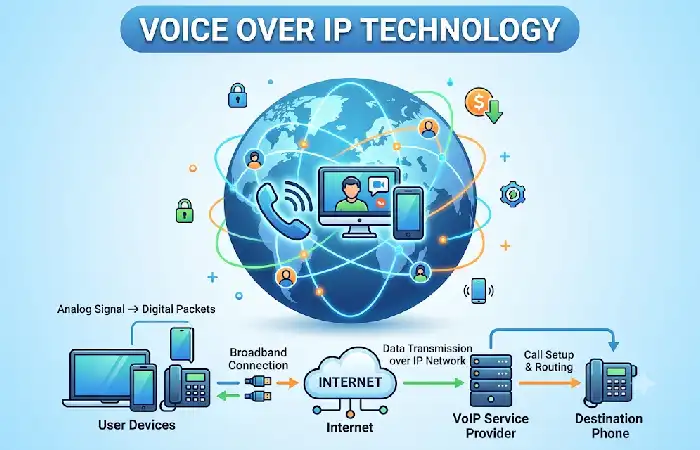
VoIP(Voice over IP) which translates voice communications into a packet-based transmission across a network using the internet protocol.
VoIP Advantages
- Lower communication costs
- Remote workforce support
- Unified communications
- Video conferencing integration
- Scalability
Traditional Phone vs VoIP
| Feature | Traditional Phone | VoIP |
| Infrastructure | Physical lines | Internet |
| Cost | Higher | Lower |
| Scalability | Limited | High |
| Mobility | Low | Excellent |
| Features | Basic | Advanced |
VoIP technology is widely being implemented by businesses for its flexibility and cost savings.
As cyber threats continue to evolve, organizations must implement strong telecommunications security solutions to protect sensitive data and network
Cloud Communication Technology
It involves telecommunications services provisioned via cloud infrastructure as opposed to a dedicated on-premise solution.
Cloud Communication Services
- UCaaS (Unified Communications as a Service)
- CPaaS (Communications Platform as a Service)
- Contact Center Solutions
- Cloud PBX
- Video Collaboration Platforms
Benefits
| Benefit | Business Impact |
| Reduced Costs | Lower hardware investment |
| Scalability | Easy growth |
| Flexibility | Remote access |
| Reliability | High uptime |
| Integration | Better workflows |
Digital transformation in the workplace continues with communications over cloud-based platforms.
Innovations such as 5G, cloud communications, and IoT have significantly expanded the range of telecommunications services available to businesses and consumers.
Emerging Telecommunications Technologies
There are several innovative technologies transforming telecommunications as of 2026.
Emerging Trends
Artificial Intelligence
AI-powered networks improve:
- Traffic management
- Predictive maintenance
- Security monitoring
- Customer support
Open RAN
Increased flexibility and vendor interoperability are achieved in Open Radio Access Networks.
Edge Computing
Reduced latency, by processing data closer to the user, leading to greater performance.
Internet of Things (IoT)
The modern telecommunications networks are used by billions of connected devices.
Emerging Technology Comparison
| Technology | Primary Benefit |
| AI Networks | Automation |
| Open RAN | Flexibility |
| Edge Computing | Lower Latency |
| IoT | Connectivity |
| Network Slicing | Custom Performance |
Future of Telecommunications Technology
The direction in telecommunications will likely be intelligent, autonomous and worldwide.
Expected developments include:
- 6G research and deployment
- AI-native networks
- Quantum communication security
- Advanced satellite constellations
- Autonomous network management
- Digital twin networking
Over the next ten years, the experts predict the telecom networks will evolve into being driven by software, automated, and responsive.
Emerging technologies like AI-driven optimization and network virtualization are transforming telecommunications networks, improving performance, scalability, and reliability.
FAQ
Could you please define telecommunications technology?
The phrase Telecommunication technology is the systems and networks designed to send voice, video and data from a location to another through wires or wirelessly.
What is the relevance of telecommunications technology?
It is the platform that supports the internet, wireless and business communication, cloud services and international connectivity.
How does telecommunications differ from networking?
Telecommunications, information transfer over distance, and networking, linking devices and systems.
What is fiber optic technology?
Transmits data using a light beam over a thin strand of glass, allowing for speeds and bandwidth greater than a copper cable.
The future of telecommunications is being shaped by what technology?
In the future the focus is anticipated to be on 5G, AI enabled networks, edge computing, Open RAN, IoT, Satellite internet and also upcoming 6G.
Conclusion
Telecommunications technology supports the digital economy via fiber optic, wireless, 5G, cloud communications, satellites and the use of the latest technology driven by artificial intelligence. Business and consumer‘s need for higher speed, higher reliability and greater security of communications will drive further reliance on advanced telecommunications technology. It will also enable organizations to better serve customers during digital transformation, increase efficiency of operations, and prepare for the next generation communications network.
Kashifa Jafar is a technology writer and contributor at FutureTechExpert with 4+ years of experience in technology writing and content creation.
Read Full Bio of Author →Sameena reviews selected health, wellness, technology, and digital content for clarity, factual presentation, and reader usefulness.
Read Full Bio of Reviewer →