
 Kashifa Jafar
Technology Writer & Contributor
Kashifa Jafar is a technology writer and contributor at FutureTechExpert with 4+ years of experience in technology writing and content creation.
Read Full Bio of Author →
Kashifa Jafar
Technology Writer & Contributor
Kashifa Jafar is a technology writer and contributor at FutureTechExpert with 4+ years of experience in technology writing and content creation.
Read Full Bio of Author →
 Sameena Begum
Health, Technology & Digital Content Reviewer
Sameena reviews selected health, wellness, technology, and digital content for clarity, factual presentation, and reader usefulness.
Read Full Bio of Reviewer →
Sameena Begum
Health, Technology & Digital Content Reviewer
Sameena reviews selected health, wellness, technology, and digital content for clarity, factual presentation, and reader usefulness.
Read Full Bio of Reviewer →
Telecommunications is the backbone of today‘s digital system, connecting our world and allowing people and companies to communicate information across towns, countries and boundaries. Today telecommunications supports all our life, from mobile phone calls and broadband internet access to cloud communications and satellite networks.
By 2026, telecommunications is no longer just a calling service, but rather a complex transmission system that will accommodate fast 5G mobile, fiber-optic broadband connections, resources for the Internet of Things (IOT), cloud applications, artifi cial intelligence, and worldwide enterprises. To enable consumers to select and use better services, and businesses to construct more effi cient communication systems, is the focus of telecommunications knowledge today.
 This article is part of
Telecommunications Services Resources
Table of Contents
What Is Telecommunications?
Telecommunication is the transmission of information over significant distances by electronic means and various communication networks. Through telecommunications, individuals, organizations, and devices can communicate and interact without regard to their respective locations.
The word telecommunications comes from two terms:
- Tele = “at a distance”
- Communication = “sharing information”
A telecommunications is defined as any system that provides communication between two or more locations, separated by a distance.
Today, telecommunications powers many of the technologies we use every day, including:
- Mobile phone calls
- Text messaging (SMS)
- Broadband internet
- Video conferencing
- Email communication
- Television broadcasting
- Satellite communications
- Cloud-based communication services
The possibilities for digital services like online banking, social media, remote working, online shopping and even streaming services rely on the existence of telecommunications networks.
A reliable telecommunications environment begins with robust telecommunications infrastructure, including fiber-optic networks, communication towers, data centers, and transmission equipment that support modern connectivity.
Examples of Telecommunications
| Service | Example |
| Mobile Calls | Smartphone voice communication |
| Broadband Internet | Fiber internet service |
| Video Calls | Zoom, Teams, Google Meet |
| Television | IPTV and cable TV |
| Messaging | SMS and instant messaging |
| Satellite Communication | Starlink internet |
How Does Telecommunications Work?
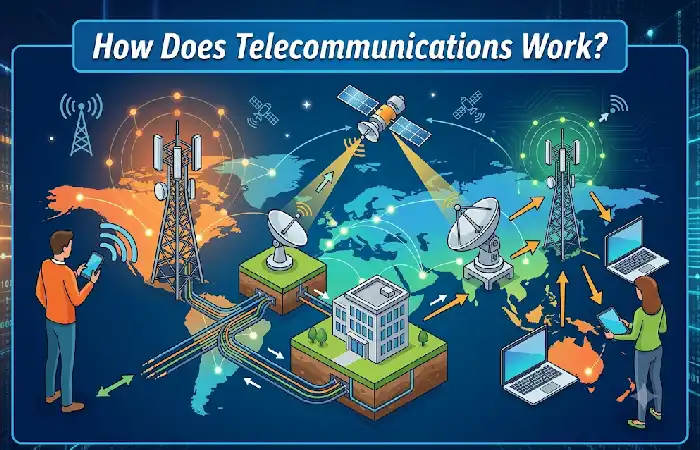
Telecommunications involves sending information between people from one place to another via wire or wireless transmission systems. Wherever you are sending a message by phone, internet, video, or any other communication, telecommunications systems convert information into electronic signals, carry those signals through a network, and then re-create your information at the end point.
At its core, telecommunications involves four essential components:
- Sender – The person, device, or system generating information.
- Transmission Medium – The path used to carry signals, such as fiber-optic cables, wireless radio waves, or satellites.
- Network Equipment – Routers, switches, cell towers, and data centers that direct traffic.
- Receiver – The device or person receiving the information.
The Telecommunications Process Step-by-Step
The process follows a series of stages:
| Step | Description |
| Information Creation | A user creates a voice call, text, video, or data request. |
| Signal Conversion | The device converts information into digital or analog signals. |
| Signal Transmission | Signals travel through wired or wireless networks. |
| Routing and Switching | Network equipment directs traffic to the correct destination. |
| Signal Reception | The receiving device captures the transmitted signal. |
| Decoding | The signal is converted back into usable information. |
Basic Process
- Information is created.
- Information is converted into electronic signals.
- Signals travel through a transmission medium.
- Network equipment routes the signals.
- Receiving devices decode the information.
The rapid evolution of telecommunications technology has introduced innovations such as 5G, cloud communications, IoT devices, and AI-powered network optimization.
Telecommunications Communication Flow
| Stage | Function |
| Sender | Generates information |
| Encoder | Converts data into signals |
| Network | Transfers signals |
| Receiver | Decodes signals |
| Destination | Delivers information |
Types of Telecommunications
The term telecommunications refers to various modes of communications. With the advancement in communication techniques, the telecommunications industry has devised various ways to transmit voice, data, video and internet traffic. Knowing the different forms of telecommunications helps consumers and businesses select the appropriate communication technology.
- Wired Telecommunications
Uses physically separate cable.
Examples:
- Fiber-optic networks
- Copper telephone lines
- Ethernet networks
Advantages
- High reliability
- Faster speeds
- Lower latency
- Wireless Telecommunications
Utilizes radio waves, electromagnetic and other waves.
Examples:
- Mobile networks
- Wi-Fi
- Satellite communications
Advantages
- Mobility
- Easy deployment
- Broad coverage
- Satellite Telecommunications
Providing communication via the communication satellites which are in orbit around the world.
Common Uses:
- Remote internet access
- Maritime communications
- Aviation connectivity
- Emergency services
- Cloud Telecommunications
They are using the latest communication services, and running from a variety of cloud locations.
Examples:
- VoIP systems
- UCaaS platforms
- Contact center solutions
Telecommunication is not just about phones or internet, there are many types of Telecommunication like cable, wireless, mobile, broadband internet, satellite communications, cloud communications, Internet of Things communications. All the Telecommunication types is the global communication technology infrastructure to provide modern day business, government service and our digital life.
Modern communication depends on advanced telecommunications systems that manage voice, data, and multimedia transmissions across local and global networks.
Telecommunications Networks
A telecommunications network is a network of communicating devices, transmission media and infrastructure that carry, transmit, and transmit voice, data, video, and other communications between other communication devices and user devices. Networks are the backbone of communications today, conveying information from one to another across city, country and continent in a matter of seconds.
If you pick up the phone, click on a website, watch a streaming video or have a video conference, telecommunications networks are working to route the data to where it’s got to go as fast and secure as possible.
Core Components
| Component | Purpose |
| Routers | Direct data traffic |
| Switches | Connect devices |
| Cell Towers | Wireless coverage |
| Fiber Networks | High-speed transmission |
| Data Centers | Data processing |
| Satellites | Global connectivity |
Major Network Types
| Network Type | Coverage |
| LAN | Local Area |
| MAN | Metropolitan |
| WAN | Wide Area |
| PAN | Personal |
| Cellular | Regional/National |
| Satellite | Global |
Telecommunications networks underlie all digital communication today. They link every ‘thing’ people, machines, companies, public and private services using an integrated web of wired, wireless, fiber, cellular, and satellite networks. In an era where high speed capability is continually required, the importance of telecommunications networks cannot be underestimated into 2026.
Protecting sensitive data and communication channels requires strong telecommunications security measures to defend against cyber threats, unauthorized access, and network vulnerabilities.
Mobile Telecommunications
Mobile telecommunications involves the wireless transmission of voice, data, video and message services through cellular networks enabling users to communicate and access the information on the move. It is among the most significant parts of the telecommunications market as they interconnect billions of people globally through the provision of smarphones, tablet, wearable devices and IoT technologies.
Mobile telecommunications have changed dramatically from traditional voice calls. In addition to calls today, mobile networks provide internet connections, streaming videos, cloud services, online games, m-banking, flexible computer work, and all smart devices connection.
Evolution of Mobile Networks
| Generation | Technology | Key Features |
| 1G | Analog | Voice Only |
| 2G | GSM | Digital Voice |
| 3G | UMTS | Mobile Data |
| 4G LTE | Broadband Mobile Internet | Streaming |
| 5G | Ultra-Fast Connectivity | IoT, AI, Edge Computing |
2026 Mobile Network Comparison
| Technology | Typical Speed | Latency |
| 4G LTE | 20–100 Mbps | 30–50 ms |
| 5G Mid-Band | 100–1000 Mbps | 10–20 ms |
| 5G mmWave | 1–10 Gbps | Under 10 ms |
Mobile telecommunications has changed the way humans communications, works and gain knowledge. This evolution from voice function to 5G speed telecommunications has become an indispensable component of daily life as well as industries. In the future, using of AI, IoT, satellite communication and 6 G, mobile telecommunications will be more influential to support the connected world.
Businesses and consumers rely on a variety of telecommunications services, including mobile communication, broadband internet, VoIP, satellite connectivity, and cloud-based solutions.
Internet and Broadband Telecommunications
Internet and broadband telecommunications encompasses the technologies, networks and services that deliver fast internet access and transfer of digital data to homes, businesses, and mobile terminals. Transmission of digital data via telecommunications services has grown to be fundamental to all communication in the home, at the workplace, for learning, forms of entertainment (film, games), and digital trade.
With the worldwide thirst for higher speeds and more dependable communications, broadband telecommunications has advanced from slow dial-up to fiber, cable, fixed wireless, 5G, and satellite providers of gigabit broadband.
Broadband Technologies
| Technology | Speed Range | Reliability |
| DSL | Up to 100 Mbps | Moderate |
| Cable | 100 Mbps–2 Gbps | High |
| Fiber | 300 Mbps–10 Gbps+ | Very High |
| Fixed Wireless | 50 Mbps–1 Gbps | Moderate |
| Satellite | 50–300 Mbps | Improving |
Broadband Technology Comparison (2026)
| Technology | Download Speed | Upload Speed | Latency |
| DSL | Low | Low | Medium |
| Cable | High | Moderate | Low |
| Fiber | Very High | Very High | Very Low |
| Satellite | Moderate | Moderate | High |
| Fixed Wireless | High | Moderate | Low |
Official Resources
| Resource | Link |
| GSMA | GSMA |
| ITU | International Telecommunication Union (ITU) |
| Ericsson Mobility Report | Ericsson Mobility Report |
| Cisco Networking | Cisco |
The internet and broadband telecommunications form the core component of the digital economy in 2026. Broadband communications networks, via fiber, cable, fixed wireless, 5G and satellite access, provide basic access to information, communication, entertainment and cloud applications. As digital network infrastructure continues to evolve, broadband telecommunications will be an essential support to continued innovation, economic growth and the interconnected world of 2026.
The foundation of global communication is built on interconnected telecommunications networks that enable the seamless transmission of voice, video, and data across different regions.
Telecommunications Services
Telecommunication services are the services of telecom operators, ISPs (Internet Service Providers) and technologies companies that offer for transmission of voice, data, pictures, video and digital content. They are designed to keep connected everyone, every business and every government through phone network, broadband internet, cellular communication, cloud platforms and new digital technologies.
In 2026, telecom services have a much wider scope than just landlines. Telecom companies of today are shouldering integrated solutions that provide support to remote working, cloud computing, video conferencing, a wide range of connected devices like IoT, cybersecurity, and other digital transformation programs.
Consumer Services
- Mobile voice plans
- Mobile data
- Broadband internet
- Television services
- Home phone services
Business Services
- Dedicated internet
- VoIP systems
- Unified communications
- SD-WAN
- Managed security
Telecommunications services are the backbone for communication today, connecting people and business all over the world with voice, data, internet, video, cloud and IoT services. They are vital for residential users, mobile consumers, business enterprises and public institutions, delivering everything from broadband and mobile plans to complex cloud based communications solutions and managed services. With the rise of 5G, AI, cloud computing and IoT, the future of telecommunications will see it further entrenched into all aspects of our lives and digital business.
Telecommunications Infrastructure
Telecommunications infrastructure comprises the hardware and software that facilitate the transmission of voice, video, internet, and data across local, national and international networks. It is the foundation of today‘s telecommunications industry the foundation that, among many other things, supports your mobile calls, broadband internet, cloud computing, video streaming services and broadband gaming, 5G, Internet of Things and other new and developing services.
Without a solid telecommunications infrastructure there would be no digital services to support business and consumer activity. To facilitate the ever increasing need of higher bandwidth and faster connectivity telecom service providers keep on investing in upgrading and building new telecom infrastructure:
Essential Infrastructure
Fiber-Optic Cables
Carry data using light signals.
Benefits:
- High capacity
- Long-distance transmission
- Low latency
Cell Towers
Provide wireless coverage for mobile devices.
Data Centers
Store and process network traffic.
Submarine Cables
Enable international connectivity.
Global Telecommunications Infrastructure Comparison
| Infrastructure Type | Capacity | Coverage |
| Fiber | Highest | Regional/Global |
| Cellular Towers | High | National |
| Satellites | Moderate | Global |
| Microwave Links | Moderate | Regional |
The network infrastructure that enables our highly connected world. The network infrastructure consists of fiber networks, cell sites, data centers, switching facilities, satellites, undersea cables and internet exchange facilities that support the voice, data, internet and clouds movement. As the telco networks and technologies progress in 5G, artificial intelligence, edge computing, internet of things and further to 6G, the network infrastructure will continue to enable better, faster, secure and reliable global connectivity.
Telecommunications Technologies
Telecommunication Technologies are the devices (hardware and software), the methods of transmitting and the network innovations that allow you to transmit voice, data, video and digital information over communication networks.
The last decade has seen the very fabric of the telecom world change with the convergence of time, space, and technology. New technologies are steadily emerging that leverage the rapid growth of bandwidth, longer reach, higher efficiency, and now, being able to connect billions of devices. The change in the telecommunication networks with new technologies by 2026 include; 5 G, AI, Edge computing, and satellite broadband.
5G
Supports:
- Smart cities
- Autonomous vehicles
- Industrial IoT
- Augmented reality
Fiber Optics
Provides ultra-high-speed internet connectivity.
Edge Computing
Processes data closer to users.
Benefits:
- Lower latency
- Faster applications
- Better user experiences
Artificial Intelligence
AI improves:
- Network optimization
- Predictive maintenance
- Fraud detection
- Customer support
Telecommunications Security
Telecommunications security (or ‘telecom security’) involve the technologies, policies, processes and measures used to ensure the integrity of telecommunication networks, systems, and the data that traverse them, against destruction, disruption, intrusion and theft. With huge amounts of voice, video, messaging and internet traffic flowing across telecommunications networks, security is a high priority for carriers, enterprises, governments and end-users.
By 2026, the security requirements of telecommunication will go well beyond securing the network. Telecom landscapes will be securing; networks and cloud communications 5G, IoT devices, mobile apps, data center installations and more complex digital ecosystems.
Common Security Threats
| Threat | Impact |
| DDoS Attacks | Service disruptions |
| Phishing | Credential theft |
| SIM Swapping | Account compromise |
| Malware | Data theft |
| Ransomware | Business interruption |
Security Best Practices
For Consumers
- Enable MFA
- Use strong passwords
- Update devices regularly
For Businesses
- Zero-trust security
- Network segmentation
- Security monitoring
- Employee training
Telecommunications for Businesses
The term business telecommunications refers to the information systems, communication technologies and infrastructure that are in use by organizations for interactions between employees, clients, partners and organization itself. Currently, the term business telecommunications is not just office desk phones but broadband internet connectivity, cloud –based communications, video conferencing applications, unified communications, tablet or smartphone connectivity, network security and internet-of-things (IoT) facilities.
In a now digitally dominant economy, businesses must depend on telecommunications infrastructure to be productive, collaborate, provide good customer service and grow. From one local branch to the entire globe, telecommunications infrastructure keeps companies talking and exchanging data.
Why Telecommunications Is Important for Businesses
The uses of telecommunications in businesses include.
Key benefits include:
- Faster communication
- Improved collaboration
- Enhanced customer service
- Remote and hybrid work support
- Increased productivity
- Better operational efficiency
- Global business connectivity
Companies dedicating resources to advanced telecommunications systems tend to have an advantage in terms of responsiveness, skalability, and the customer experience.
Business Benefits
Improved Collaboration
The teams are able to communicate directly between locations.
Remote Work Enablement
Cloud communications enable hybrid way of working.
Enhanced Customer Service
The contact centers facilitate better interaction with customers.
Operational Efficiency
Automated communication work flows.
Business Telecommunications Solution Comparison
| Solution | Best For |
| VoIP | Cost-effective calling |
| UCaaS | Unified communications |
| SD-WAN | Multi-location networking |
| Dedicated Fiber | High-performance connectivity |
Arguably one of the most critical business enablers, communications technology enables communication, provides the foundation of collaboration, allows for customer interaction and supports the digital revolution. Whether it is broadband access over fibre, cloud unified communications and collaboration services, dedicated 5G networks, or AI-enabled automation tools, organizations are leveraging telecom in order to succeed. Organizations need to maintain access to the right technologies.
Future of Telecommunications
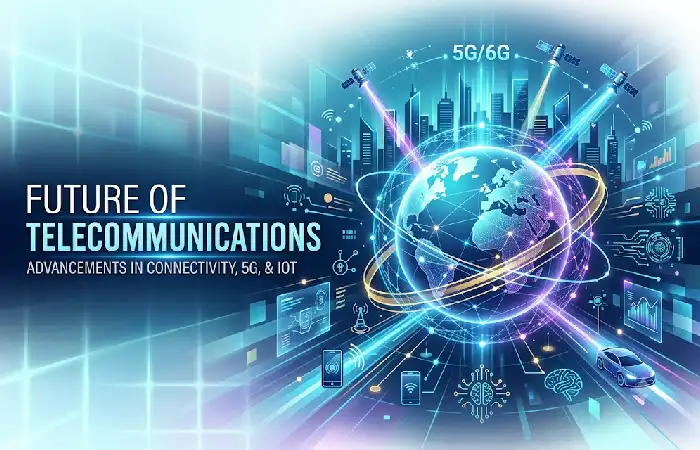
The telecoms of tomorrow are already being designed with the booming development of artificial intelligence, 5G-Advanced, Satellite links, cloud native infrastructure, Edge Computing and new 6G development. Telecom is becoming an intelligent digital infrastructure where people, data, machines and devices will move towards.
With ademand from businesses, governments and consumers alike for faster speeds, lower latency, more security and to be connected anytime, anywhere, telecom providers are pouring billions of dollars into next generation technologies that will transform communication networks over the next ten years.
Key Trends for 2026 and Beyond
5G Advanced and Beyond
As 5G keeps rolling out worldwide, the telco industry is fast approaching 5G Advanced (5G-A), the successor to 5 G that will bring improvements in network quality, reliability, automation, and facilitation of AI-powered applications. According to industry experts, 5 G-A is considered a stepping stone toward 6G:
Expected Benefits of 5G Advanced
- Higher network efficiency
- Better support for AI applications
- Improved uplink performance
- Enhanced industrial automation
- Greater reliability for mission-critical services
Artificial Intelligence-Powered Networks
Artificial intelligence (AI) is increasingly becoming a fundamental part of telecommunications networks as opposed to merely being a part of supporting infrastructure. As in other industries, operators are deploying AI for a number of network-related functions such as automating network management and monitoring, increasing traffic efficiency and predicting outages.
AI Applications in Telecom
- Predictive maintenance
- Automated fault detection
- Network optimization
- Customer service automation
- Fraud detection
- Resource allocation
Telecom industry surveys indicate that adoption of AI is still accelerating due to the operators searching for cost reductions and enhanced network quality and uptime.
The Rise of AI-Native Networks
The future generation of telecommunications networks will be AI-native. That is, the whole network shall embed an AI mechanism in the network architecture itself and have AI capabilities instantly available.
These networks will be capable of:
- Self-monitoring
- Self-optimizing
- Self-healing
- Autonomous decision-making
This could effectively lead to a simplified operation with quality service and more efficient system.
Expansion of Satellite Connectivity
The satellite telecommunication is getting very fast developments with use of some LEO satellite constellations.
Modern satellite systems provide:
- Global internet coverage
- Rural broadband access
- Emergency communications
- Maritime connectivity
- Aviation services
According to industry professionals, upcoming telecommunication networks will be a combination or hybrid of ground based and space borne networks.
Edge Computing Growth
Edge computing rather than stream information through a central cloud data center, there is processing at the edge of the network near the end user.
Benefits
- Reduced latency
- Faster application performance
- Improved reliability
- Better support for real-time applications
Edge infrastructure will play a critical role in enabling:
- Autonomous vehicles
- Industrial IoT
- Smart cities
- Augmented reality
- Remote healthcare
Telecommunications Technology Outlook
| Technology | Adoption Outlook |
| Fiber Broadband | Very Strong |
| 5G Advanced | Rapid Growth |
| AI Networks | Rapid Growth |
| Private 5G | Growing |
| Satellite Broadband | Expanding |
| 6G | Research Stage |
The evolution of telecommunications has moved well beyond the promise of a better internet, higher speeds, and expanded mobile coverage. Today, artificial intelligence native networks, 5G Advanced, satellite to terrestrial interconnection, cloud native infrastructure, edge computing, and 6G research, are all making telecommunications a very intelligent digital ecosystem.
Gradually, these breakthroughs will develop into the infrastructure that will support the world of smart cities, autonomous vehicles and systems, healthcare, augmented reality, and the next wave of worldwide connectivity.
Frequently Asked Questions About Telecommunications
What is telecommunications?
The transmission of data across distance by electronic systems like telephones, internet networks, satellites, and wireless services.
What is driving telecommunications?
It makes possible international communications; internet services; run businesses; cloud computing; and use electronic services.
What are the types of telecommunications?
The main types include wired, wireless, satellite, and cloud telecommunications.
What is the difference between networking and telecommunications?
Telecommunication is concerned with the transfer of information over a distance. Networking is concerned with the logical linking of systems and devices.
Is fiber actually any better?
FC is usually faster, more symmetrical (higher uplink bandwidth) latency and more scalable over the long run.
Conclusion
Telecommunications are a critical part of the digital era we live in. This industry brings people, businesses, machines and services together around the world, making communications more accessible than ever before. Despite the prevalence of digital communications, telecommunications is still a dynamic industry driven by innovative networks such as fiber broadband, cloud communication and satellite connectivity and systems like traditional phone lines, virtual managed services, fronthaul links, 5G and satellite communications. Telecom industry looks set to transform as intelligent solutions like AI, edge computing, IoT and private 5G networks, become more available.
Telecom services that are reliable provide better connectivity, faster connectivity and enable faster communication for consumers. Flexible telecommunication services can help organizations achieve digital transformation, improve customer service, enable remote working and increase efficiency. Understanding the various types of telecommunication networks, telecom infrastructure, technologies and security practices can help individuals and organizations make the right decision.
Kashifa Jafar is a technology writer and contributor at FutureTechExpert with 4+ years of experience in technology writing and content creation.
Read Full Bio of Author →Sameena reviews selected health, wellness, technology, and digital content for clarity, factual presentation, and reader usefulness.
Read Full Bio of Reviewer →