



Last Updated: September 19, 2026
Web Application security involves the use of software, hardware, and related technologies to prevent any attacks, security breaches, or damage to those applications in order to prevent any unauthorized attack or threat. It is important to understand that the primary goal of this application is to provide total security for the application.
More than 50 percent of organizations had a web application or API security incident within the last 12 months, according to application security research.
Table of Contents
What Is Web Application Security?
Web Application Security is the general term covering security measures to protect web applications, websites and APIs against threats of web security like cyber-attacks, unauthorised access and data loss. It is concerned at least with the security through whole web app life-cycle, including development, deployment, maintenance and monitoring of web applications.
Today, web applications manage sensitive data. For example, they store information about users, security, monetary transactions and businesses. Due to the fact that they are available over the internet, modern web applications tend to be the focus of attack and most hackers will attempt to exploit their vulnerability by using methods such as SQL injection, cross-site scripting, unfair authentication, and unauthorised access.
Securing web applications can protect against these attacks by employing various methods, policies, and techniques that detect and prevent these risks prior to utilization. A secure web application protects:
- User accounts
- Personal information
- Payment details
- Business data
- APIs and backend services
- Authentication systems
Contemporary web applications are vulnerable to attack from hackers, automated attack tools, and malicious software or (bots). Security controls prevent attack from corrupting application integrity and data security for the user.
Common Components of Web Application Security
| Security Component | Purpose |
| Authentication | Verifies user identity |
| Authorization | Controls access permissions |
| Encryption | Protects sensitive data |
| Firewalls | Filters malicious traffic |
| Security Testing | Identifies vulnerabilities |
| Monitoring | Detects suspicious activity |
Why Is Web Application Security Important?
Web applications are attractive to cybercriminals as they contain sensitive data related to the customer as well as the business.
Strong security helps organizations:
- Prevent data breaches
- Protect customer information
- Maintain regulatory compliance
- Avoid financial losses
- Reduce downtime
- Preserve brand reputation
2026 Application Security Statistics
| Security Finding | 2026 Data | Resource |
| Organizations experiencing web app/API breaches | More than 50% | Fortinet Report |
| Confidence in application security posture | 29% | Fortinet Report |
| Organizations using AI in security | 76% | Fortinet Report |
| Average vulnerabilities per web application | 20 vulnerabilities | Barracuda Research |
Common Web Application Security Risks

The OWASP Top 10 is still the de-facto standard for web application vulnerabilities.
Top Risks in 2025–2026
| OWASP Risk | Description |
| Broken Access Control | Unauthorized access to resources |
| Security Misconfiguration | Incorrect server or application settings |
| Software Supply Chain Failures | Vulnerable dependencies and libraries |
| Cryptographic Failures | Weak encryption practices |
| Injection Attacks | SQL Injection and command injection |
| Authentication Failures | Weak login security |
| Data Integrity Failures | Compromised software updates |
Broken Access Control which is still the most significant risk as of OWASP 2025.
User Authentication
It ensures users remain who they claim to be before accessing application resources.
Authentication Best Practices
- Use Multi-Factor Authentication (MFA)
- Enforce strong passwords
- Implement password hashing
- Use Single Sign-On (SSO)
- Apply account lockout policies
- Monitor login attempts
Authentication Comparison
| Method | Security Level |
| Password Only | Low |
| Password + SMS | Medium |
| Password + Authenticator App | High |
| Biometric Authentication | Very High |
Access Control
An authentication is used to verify that the user is indeed who he/she claims to be prior to accessing the application resources.
Common Access Control Models
| Model | Description |
| Role-Based Access Control (RBAC) | Access based on user roles |
| Attribute-Based Access Control (ABAC) | Access based on attributes |
| Least Privilege | Minimum required permissions |
| Zero Trust | Verify every request |
It is called access control how the user who has been authenticated can access in the application.
Protecting User Data
It is also desirable for organizations to periodically audit the user permissions.
Sensitive Data Types
- Personal information
- Login credentials
- Financial records
- Healthcare data
- Business documents
Data Protection Strategies
- Encrypt stored data
- Mask sensitive information
- Implement secure backups
- Apply data retention policies
- Monitor data access logs
Secure Data Transmission
Maintaining the privacy of users’ information is one of the primary goals of securing web applications.
Recommended Security Protocols
| Protocol | Purpose |
| HTTPS | Secure web communication |
| TLS 1.3 | Encryption in transit |
| HSTS | Prevents protocol downgrade attacks |
| Secure Cookies | Protect session information |
A vital need that one must fulfill is the encryption of information leaving the user to the server and vice versa should be kept secure.
Secure Coding Practices
Application/ Program Security Coding reduces program/application vulnerabilities.
Developer Security Checklist
- Validate all user input
- Use parameterized database queries
- Sanitize output data
- Avoid hardcoded credentials
- Update third-party libraries
- Follow secure development frameworks
Example Security Controls
| Practice | Security Benefit |
| Input Validation | Prevents injection attacks |
| Output Encoding | Mitigates XSS attacks |
| Dependency Management | Reduces supply chain risks |
| Error Handling | Prevents information leakage |
Security Testing
Security testing assessments can discover vulnerabilities for exploitation by others.
Types of Security Testing
| Testing Type | Purpose |
| Vulnerability Scanning | Detect known weaknesses |
| Penetration Testing | Simulate real attacks |
| Static Application Security Testing (SAST) | Analyze source code |
| Dynamic Application Security Testing (DAST) | Test running applications |
| API Security Testing | Evaluate API vulnerabilities |
Security testing should be part of the CI/CD pipeline for security in motion.
Web Application Security Best Practices
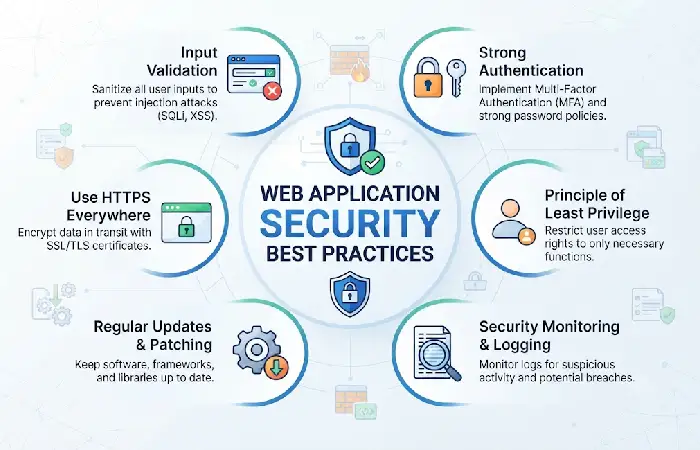
Security perimeter should be seen as a layered architecture.
Security Best Practices Checklist
| Best Practice | Priority |
| Implement MFA | High |
| Use HTTPS Everywhere | High |
| Conduct Regular Security Testing | High |
| Patch Vulnerabilities Quickly | High |
| Monitor Security Logs | High |
| Secure APIs | High |
| Train Developers | Medium |
| Maintain Backups | Medium |
A study showed the most majority of vulnerabilities originates from common security misconfigurations, which indicated the need for regular security hygiene monitoring.
Frequently Asked Questions
What is web application security?
Web application security: It is the measure of defending web applications, API and websites against cyber attacks, vulnerabilities and unauthorized access.
Why is web application security important?
It ensures that sensitive data is protected, breaches are prevented, all rules and regulations are adhered to and trust between the customer and company is maintained.
What are the biggest web application security risks?
Typical examples are broken access control, security misconfiguration, injection, authentication and supply chain, software.
What tools are used for web application security?
For example, common security controls are web application firewall (WAF), vulnerability scanners, SIEM platforms, penetration testers, and APIs security solutions are used by organizations.
How often should security testing be performed?
Security testing should be ongoing, with automated scans being performed every cycle possible, and penetration tests taken at least once annually.
Conclusion
Considering the current environment of security threat, Web Application Security does not remain left out or considered just an afterthought. As the number of Web applications increase and threats intensify, Organizations should take a proactive security approach, adopt secure coding practices, implement strong authentication and encryption, provide the constant vigilance and perform comprehensive and up-to-date security testing.
By following the OWASP guidance and modern web application security topics of the day, an enterprise would considerably mitigate the risk of a security breach or compromise, protecting its user database and its internet position.