
 Kashifa Jafar
Technology Writer & Contributor
Kashifa Jafar is a technology writer and contributor at FutureTechExpert with 4+ years of experience in technology writing and content creation.
Read Full Bio of Author →
Kashifa Jafar
Technology Writer & Contributor
Kashifa Jafar is a technology writer and contributor at FutureTechExpert with 4+ years of experience in technology writing and content creation.
Read Full Bio of Author →
 Sameena Begum
Health, Technology & Digital Content Reviewer
Sameena reviews selected health, wellness, technology, and digital content for clarity, factual presentation, and reader usefulness.
Read Full Bio of Reviewer →
Sameena Begum
Health, Technology & Digital Content Reviewer
Sameena reviews selected health, wellness, technology, and digital content for clarity, factual presentation, and reader usefulness.
Read Full Bio of Reviewer →
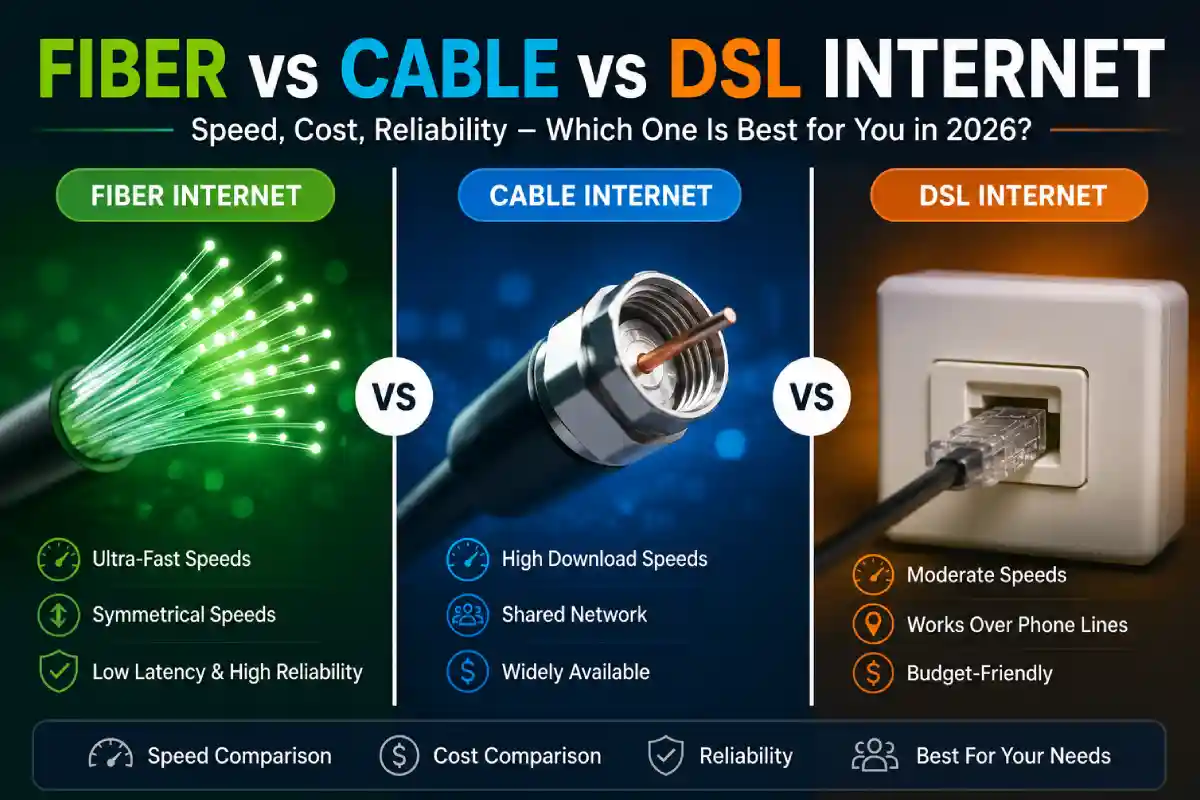
Finding the best internet connection for your needs is an important decision that can affect your entire online life. Fiber vs Cable vs DSL Internet comparisons are some of the most prevalent in the web world today because they show you the variety of options of speed, price, reliability, and accessibility each technology provides. From on-line videos to on-line gaming, be sure that you know what factor is most important to you.
The internet technology in 2026 has grown significantly. Fiber is spreading throughout various places, although cable is still the most prevalent high speed internet access in the country. DSL is still retained to an extent for rural or lower income homes that do not have newer wires.
When comparing fiber, cable, and DSL internet connections, it helps to understand how each fits into a modern home internet setup, including speed requirements, connected devices, and long-term reliability.
 This article is part of
Internet Resources
Table of Contents
What Is Fiber Internet?
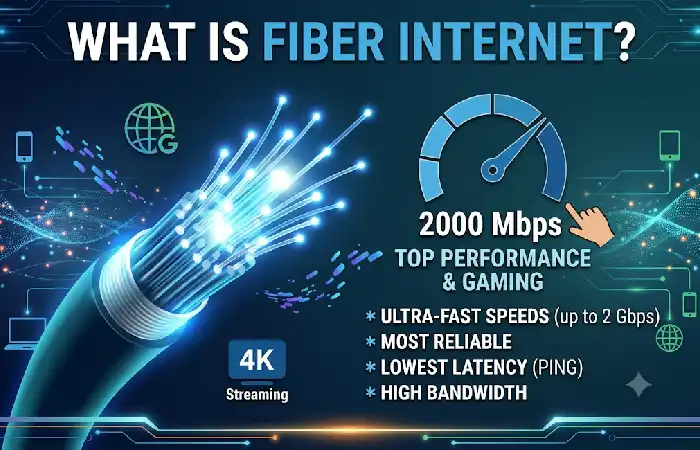
Fiber internet is a form of broadband a high-speed internet access that employs fiber-optic lines to carry information in the form of pulses of lights, rather than electrical signals. Since lights travel very quickly through these lines made out of either glass or plastic, fiber internet provides by 2026 the most speedy, dependable, and lowest delay internet connections for homes and businesses.
As opposed to cable or DSL where upload and download speeds aren‘t equal, with fiber you get symmetrical speeds so you often get the same upload as download speed. This makes it the best option for video conference, cloud backups, online gaming and 4K/8K streaming.
Advantages
- Extremely fast download speeds
- Symmetrical upload speeds
- Very low latency
- Excellent for gaming
- Ideal for video conferencing
- Supports dozens of connected devices
Typical Fiber Speeds (2026)
| Plan | Download | Upload | Best For | Resource |
| Entry | 300 Mbps | 300 Mbps | Small households | https://www.fcc.gov/broadband |
| Standard | 500 Mbps | 500 Mbps | Families | https://www.fcc.gov/broadband |
| Gigabit | 1 Gbps | 1 Gbps | Gamers & creators | https://www.fcc.gov/broadband |
| Premium | 2–10 Gbps | 2–10 Gbps | Businesses & power users | https://www.fcc.gov/broadband |
For online gaming, fiber is usually the strongest option because of its low latency and consistent upload speeds, but our home internet gaming performance guide explains which connection type works best for competitive and casual gamers.
What Is Cable Internet?
This type of broadband internet service is delivered through the coaxial cable that is used for cable TV. This is one of the most common internet technologies and provides fast download speeds for streaming, online gaming and working from home, as well as day to day use.
This delivers data using electrical signals over coaxial cables, not light of the type used in fiber Internet. Download speeds are often fast and speeds are usually comparable or faster than other broadband options, but upload rates are generally slower. Also, during busy times bandwidth is shared with adjacent homes.
Advantages
- Widely available
- Fast downloads
- Affordable plans
- Easy installation
Disadvantages
- Slower uploads
- Network congestion
- Variable performance
What Is DSL Internet?
This old broadband technology is still in use. Its conventional location is in rural and suburban regions where cable or even fibre is not an attainable option. It can be slower than cable and fibre but remain an affordable and dependable solution for light internet use.
Advantages
- Low monthly cost
- Wide availability
- Stable for basic browsing
- Doesn’t require cable infrastructure
Disadvantages
- Much slower than fiber
- Distance affects speed
- Limited upload bandwidth
Large homes often struggle with dead zones regardless of whether they use fiber, cable, or DSL, which is why understanding mesh WiFi systems vs. range extenders can help improve whole-home coverage.
Speed Comparison
The speed of the Internet is the rate at which your device connects to and decelerates from the internet.
2026 Performance Comparison
| Technology | Download Speed | Upload Speed | Latency | Best Use | Resource |
| Fiber | 300 Mbps–10 Gbps | 300 Mbps–10 Gbps | 2–10 ms | Everything | https://www.fcc.gov/broadband |
| Cable | 100 Mbps–2 Gbps | 10–100 Mbps | 15–35 ms | Streaming & gaming | https://www.fcc.gov/broadband |
| DSL | 10–100 Mbps | 1–20 Mbps | 20–60 ms | Browsing & email | https://www.fcc.gov/broadband |
Speed Growth (2021–2026)
| Year | Average Fiber Speed | Average Cable Speed | Average DSL Speed |
| 2021 | 500 Mbps | 250 Mbps | 35 Mbps |
| 2022 | 700 Mbps | 350 Mbps | 40 Mbps |
| 2023 | 900 Mbps | 500 Mbps | 45 Mbps |
| 2024 | 1.2 Gbps | 700 Mbps | 55 Mbps |
| 2025 | 1.5 Gbps | 900 Mbps | 65 Mbps |
| 2026 | 2 Gbps | 1.2 Gbps | 75 Mbps |
Even if fiber delivers gigabit speeds to your home, poor wireless coverage can create bottlenecks, so optimizing your WiFi signal strength and coverage is just as important as choosing the right internet connection.
Cost Comparison
Your monthly price will vary depending on the country you‘re in, your cell phone provider, and any specials available.
| Technology | Average Monthly Cost | Installation | Equipment Fees | Resource |
| Fiber | $50–$120 | Often Free | Optional | https://www.fcc.gov |
| Cable | $40–$100 | Sometimes Free | Usually Required | https://www.fcc.gov |
| DSL | $25–$70 | Low | Minimal | https://www.fcc.gov |
Although DSL is usually the cheapest, fiber tends to be the most cost-effective because of the drastic increase in rate and dependability.
To get the full benefit of a high-speed fiber plan, you may also need one of the best WiFi routers for fast and stable home internet, especially if multiple users stream, work, and game at the same time.
Which One Should You Choose?
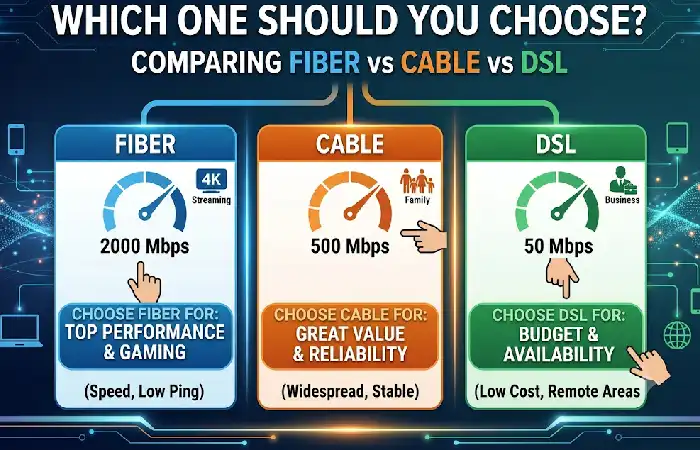
The type of internet connection depends on your mode of internet usage.
| User Type | Recommended Connection |
| Remote Workers | Fiber |
| Gamers | Fiber |
| 4K Streaming | Fiber or Cable |
| Large Families | Fiber |
| Small Apartments | Cable |
| Rural Areas | DSL (if fiber/cable unavailable) |
| Budget Users | DSL |
| Content Creators | Fiber |
Choose Fiber if:
- You need maximum speed
- You upload large files
- You stream in 4K or 8K
- You work from home
- You play competitive online games
Select Cable if:
- Fiber isn’t available
- You want fast downloads at a lower cost
- Your household has moderate internet usage
Choose DSL if:
- You have basic internet needs
- You’re in a rural area
- You want the lowest monthly bill
No matter which internet technology you choose, protecting your network is essential, so follow this home internet security guide to secure your router, connected devices, and personal data from common online threats.
Frequently Asked Questions
Is fiber internet necessarily faster than cable?
Yes. Fiber usually has the fastest download and upload speeds with the lowest latency; therefore it is the fastest residential internet technology.
Is the prospect that I am still using my DSL in 2026 worth doing it?
While not very practical is still an acceptable option for basic browsing, email use, and slightly intensive streaming, which will come in handy in regions where the options of fiber or cable are limited.
Now a common question arises; which is the best type of internet to game over?
Fiber is normally the most suitable choice as it has lower delays, symmetrical rate and most predictable performance.
Is cable internet suitable for streaming?
Yes. Most cable plans today will allow HD and 4K streaming of unlimited devices at the same time, but speeds will drop during prime time because of the shared bandwidth.
is the fiber more expensive?
Due to the newer infrastructure the performance, reliability and upload speed of these networks is substantially better.42 Thus they tend to be more expensive.
Key Takeaways
Fiber, cable, and DSL all serve different purposes. Using the criteria of maximum speed, maximum ping latency, and overall performance fiber is by far the best for remote work, gaming, and content creation. Using those same criteria cable is better for most households that need a balance of speed, cost, and availability. DSL is still a good budget choice and has more availability than newer broadband products.
The type of connection you select will depend on your wallet, your location and your internet usage. Where fiber is an option it is, by and large, the best future-proof purchase. Cable is still a good all-round choice for many users and DSL still a solid option for light users and isolated communities.
Kashifa Jafar is a technology writer and contributor at FutureTechExpert with 4+ years of experience in technology writing and content creation.
Read Full Bio of Author →Sameena reviews selected health, wellness, technology, and digital content for clarity, factual presentation, and reader usefulness.
Read Full Bio of Reviewer →