

Last Updated: August 5, 2026
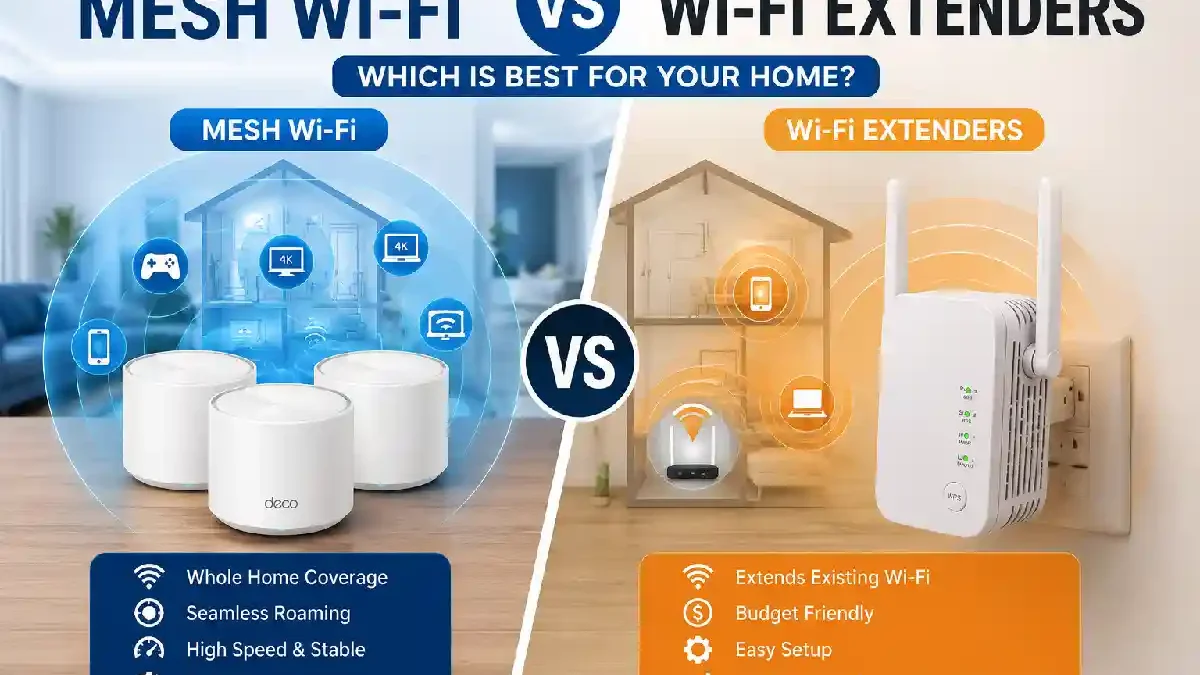
Slow internet in some of the rooms is also one of the most common home networking issues. If the global search term that got you to this page was Mesh Wi-Fi vs Wi-Fi Extenders, you may be trying to decide which option to go for in terms of coverage, speed and value for money.
While they both increase the coverage of a wireless system, they are very different. You will learn in this guide the operation of the systems, the pros and cons, cost comparisons and which is the best suited for various home sizes in 2026.
If you’re trying to improve coverage across multiple rooms, understanding the basics of home internet setup and optimization can help you decide whether a mesh system or a Wi-Fi extender is the better investment.
 This article is part of
Internet Resources
Table of Contents
How Mesh Networks Work
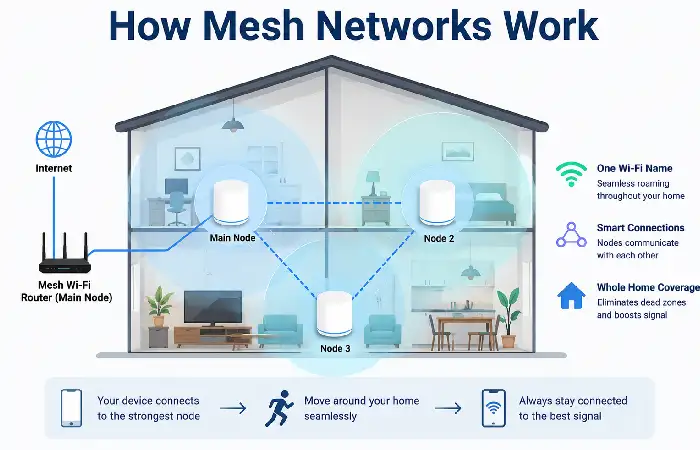
A mesh Wi-Fi system essentially does away with your normal router and replaces it with multiple smart nodes talking to each other.
Wi-Fi is not broadcasted from one central place, but rather each node is a single unified network for your entire home.
How it works
Internet
│
Main Router
/ \
Node A Node B
│ │
Node C Node D
When you walk through around your house your phone or laptop switches from one node to another without disconnecting.
Benefits
- Single Wi-Fi network
- Seamless roaming
- Better speeds throughout the house
- Easy expansion
- Smart traffic management
Popular Mesh Systems in 2026 include:
- Google Nest WiFi Pro
- TP-Link Deco BE Series
- ASUS ZenWiFi
- Amazon eero Max
- Netgear Orbi WiFi 7
A mesh network performs best when paired with a reliable broadband connection, so it’s worth comparing fiber, cable, and DSL internet connections before upgrading your networking hardware.
Wi-Fi Range Extenders Explained
A Wi-Fi Range Extender (also called Wi-Fi Repeater or Wi-Fi Booster) is a device that extends and boosts the range of a wireless network. It works by capturing the existing signal from a wireless router or access point, boosting it and then transmitting the improved signal.
One of the cheapest solutions to remove dead zones in an apartment or a small house or an office is to use a Wi-Fi extender.
How Does a Wi-Fi Extender Work?
A Wi-Fi extender is an intermediary that builds a bridge between your router and your more distant devices. The signal should be strong enough to be strong enough when it reaches the extender before rebroadcasting to other rooms.
Basic Network Layout
Internet
│
Wi-Fi Router
│
Strong Signal
│
Wi-Fi Extender
│
Extended Wi-Fi Coverage
│
Bedroom • Garage • Home Office
When properly connected, the extender will re-broadcast the wireless signal providing increased coverage to areas that have poor wireless reception.
Before buying additional hardware, check whether the issue is caused by interference, poor placement, or other common Wi-Fi signal problems and fixes that can often be resolved without replacing your existing network.
Pros and Cons
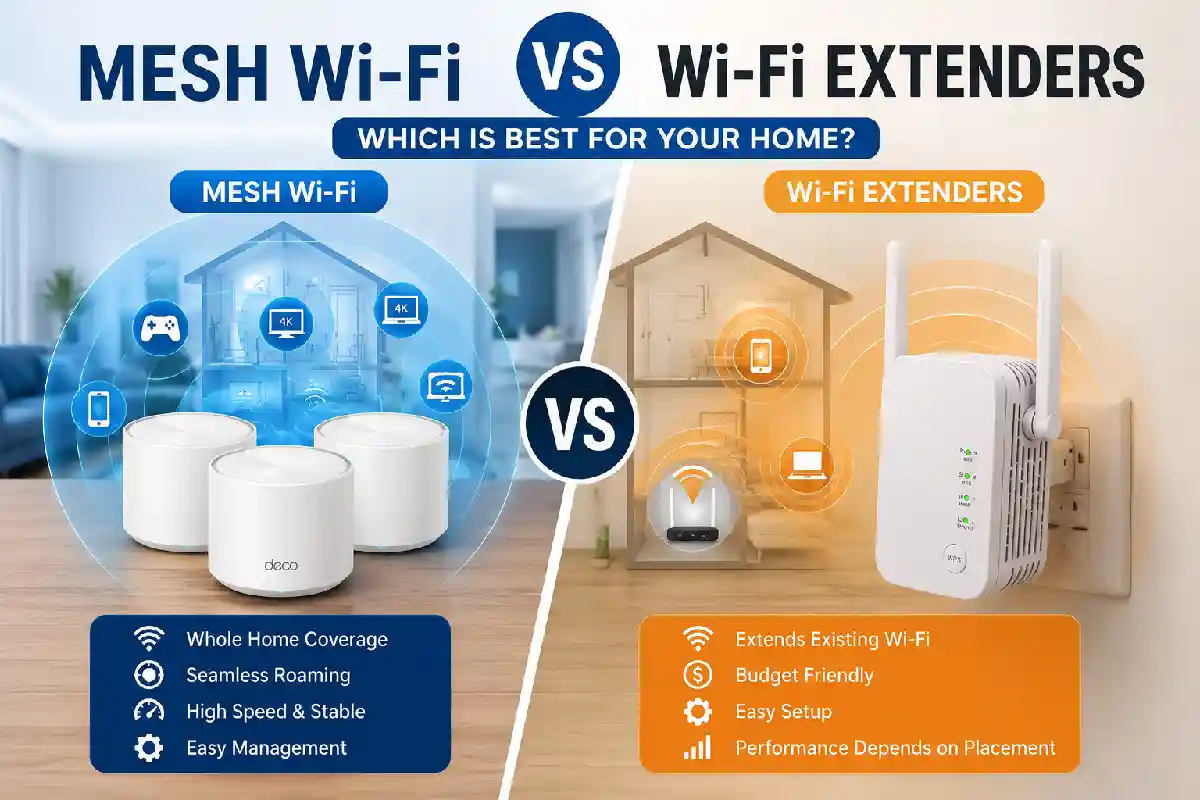
Whether you should choose a Mesh Wi-Fi solution or a Wi-Fi extender is determined by the size of your house, your budget and your needs. Both the Mesh Wi-Fi and Wi-Fi extender are good options for improving the wireless coverage in your house; but they also offer different features, price, scalability and ease of use. Continue reading to learn the details.
Mesh Wi-Fi: Pros and Cons
A mesh is a series of interconnected nodes, working together to form a one large wireless network in your house. Mesh Wi-Fi provide your home with a seamless wireless experience, without break-ups or missing coverage.
Pros of Mesh Wi-Fi
- Seamless Roaming: Devices join the closest node without dropping the signal or handover to another network.
- Moons Network extensive coverage(Wi-Fi): Several nodes deliver Wi-Fi all through a large single-family home, a multi-story building, or outdoors.
- Minimal Speed Downtime: Backhaul that is more advanced than extenders can keep up achieve higher speeds.
- Supports Numerous Devices: Works well in a smart home with dozens of devices, such as IP and security cameras, smart TVs and other IoT gear.
- Easy management: least manage via their mobile apps, set up, parental controls, guest networks, firmware updates.
- Future-Proof -a lot of current Mesh systems include Wi-Fi 6E support and the upcoming Wi-Fi 7, which makes it future-proof.
Cons of Mesh Wi-Fi
- Higher initial purchase cost.
- May require replacing your existing router.
- Additional nodes increase the overall investment.
- Some advanced features require subscription services on certain brands.
Wi-Fi Extenders: Pros and Cons
Wi-Fi extendersenhance existing coverage by capturing your wireless router‘s signal and then broadcasting it again. Cheap way to eliminate dead spots in small areas.
Pros of Wi-Fi Extenders
- Budget-friendly Much cheaper than a mesh Wi-fi system.
- Simple to install: Nearly all models can be installed in minutes with either WPS or an app.
- Compatible with Your Current Routers: Allows you to use your existing network hardware.
- Small Home Friendly: Best suited for covering an entire house or apartment, whether .
- Compact Build- Plug-in builds are space-efficient and move easily from site to site.
Cons of Wi-Fi Extenders
- Wireless speeds may decrease because the extender retransmits data.
- Performance depends heavily on proper placement.
- Older models often create a separate Wi-Fi network (SSID), requiring manual switching.
- Less effective in large or multi-story homes.
- Cannot match the seamless roaming and performance of a mesh Wi-Fi system.
If your current router is several years old, upgrading to one of the best Wi-Fi routers for modern home networks may provide a bigger performance boost than adding an extender.
Cost Comparison
There different factors will affect how much upgrading your home Wi-Fi will cost. The factors include the area of your coverage, your current type of internet speed and your the upgrades that are required to be done in the future.
Although, Wi-Fi extenders is a cost-effective solution for clearing smaller dead zones, Wi-Fi mesh systems are vastly better than extending Wi-Fi coverage for larger homes in regards to coverage, signal quality and ability to maintain performance levels with an increasing number of devices. Below is a cost comparison based on average prices observed in 2026 and, as a reference, taken from official product and network information.
Average Price Comparison (2026)
| Product Category | Typical Price (USD) | Typical Price (INR)* | Best For | Official Resource |
| Basic Wi-Fi Extender | $25–$50 | ₹2,000–₹4,500 | Apartments & small homes | https://www.tp-link.com/home-networking/range-extender/ |
| Mid-Range Wi-Fi Extender | $50–$100 | ₹4,500–₹8,500 | HD streaming & remote work | https://www.netgear.com/home/wifi/range-extenders/ |
| Premium Wi-Fi Extender | $100–$180 | ₹8,500–₹15,000 | High-speed broadband | https://www.linksys.com/wifi-range-extenders/ |
| Entry-Level Mesh Wi-Fi (2-Pack) | $120–$200 | ₹10,000–₹18,000 | Small–medium homes | https://eero.com/ |
| Mid-Range Mesh Wi-Fi (3-Pack) | $200–$400 | ₹18,000–₹35,000 | Large homes | https://www.asus.com/networking-iot-servers/whole-home-mesh-wifi-system/ |
| Premium Wi-Fi 7 Mesh System | $450–$900+ | ₹40,000–₹80,000+ | Smart homes & multi-gig internet | https://www.netgear.com/home/wifi/mesh/ |
Whichever option you choose, don’t forget to secure your network with strong passwords, updated firmware, and other home Wi-Fi security best practices to protect every device connected to your network.
Which Is Best for Large Homes?
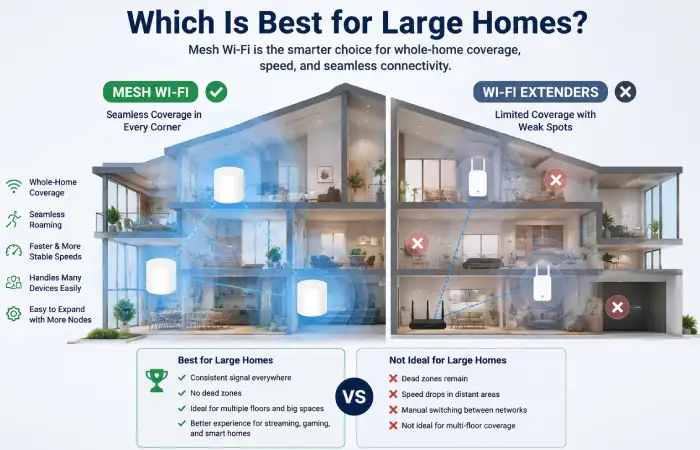
Given the above, what we would expect is that modern mesh Wi-Fi is hard to beat for larger than 2,000 sq.ft. (185 m 2) home by an access point.
Why Mesh Wins
- Eliminates dead zones
- Supports dozens of connected devices
- Better roaming
- Stable 4K and 8K streaming
- Lower latency for gaming
- Easier expansion
Large Home Recommendation
| Home Size | Recommendation |
| Apartment | Wi-Fi Extender |
| Under 1,500 sq ft | Either Option |
| 2,000–3,500 sq ft | Mesh Wi-Fi |
| 3,500+ sq ft | Mesh Wi-Fi (3–5 Nodes) |
For online gaming, a mesh system usually provides more stable roaming and lower latency than a basic extender, especially when following these home internet gaming optimization tips.
Frequently Asked Questions
Which gives you faster Wi-Fi mesh or Wi-Fi extender?
Yes. Mesh systems tend to be faster as they intelligently route traffic between nodes and allow seamless roaming.
I use a Wi-Fi repeater with a mesh network?
Generally this shouldn‘t be done. Combining the two will often decrease performance and introduce unwanted complexity.
Should I get mesh Wi-Fi? Is mesh Wi-Fi worth the premium?
If you have a house with multiple levels, a ton of devices, or patchy dead spots that keep reappearing it‘s probably worth the investment.
Do Wi-Fi extenders slow down the connection?
Yes. Most conventional extenders can cause bandwidth loss as they receive and rebroadcast data over the same wireless channel. This is addressed with dual-band and tri-band variants.
Which would be better for gaming?
In general, mesh Wi-Fi has less latency, more stable connection and better roaming and they are good for online games.
Conclusion
In general, Wi-Fi extenders are the best fix for small home coverage problems with dead spots while mesh Wi-Fi provide a more reliable, high performance Wi-Fi experience with strong wireless coverage over larger areas with roaming Wi-Fi on all mesh nodes. It is exactly behind the trend of Wi-Fi 6E and 7 today, more and more homes in 2026 are getting best mesh Wi-Fi system to stream high-bandwidth contents, enjoy fast online games, video conference, and run smart home appliances.