

Last Updated: September 18, 2026
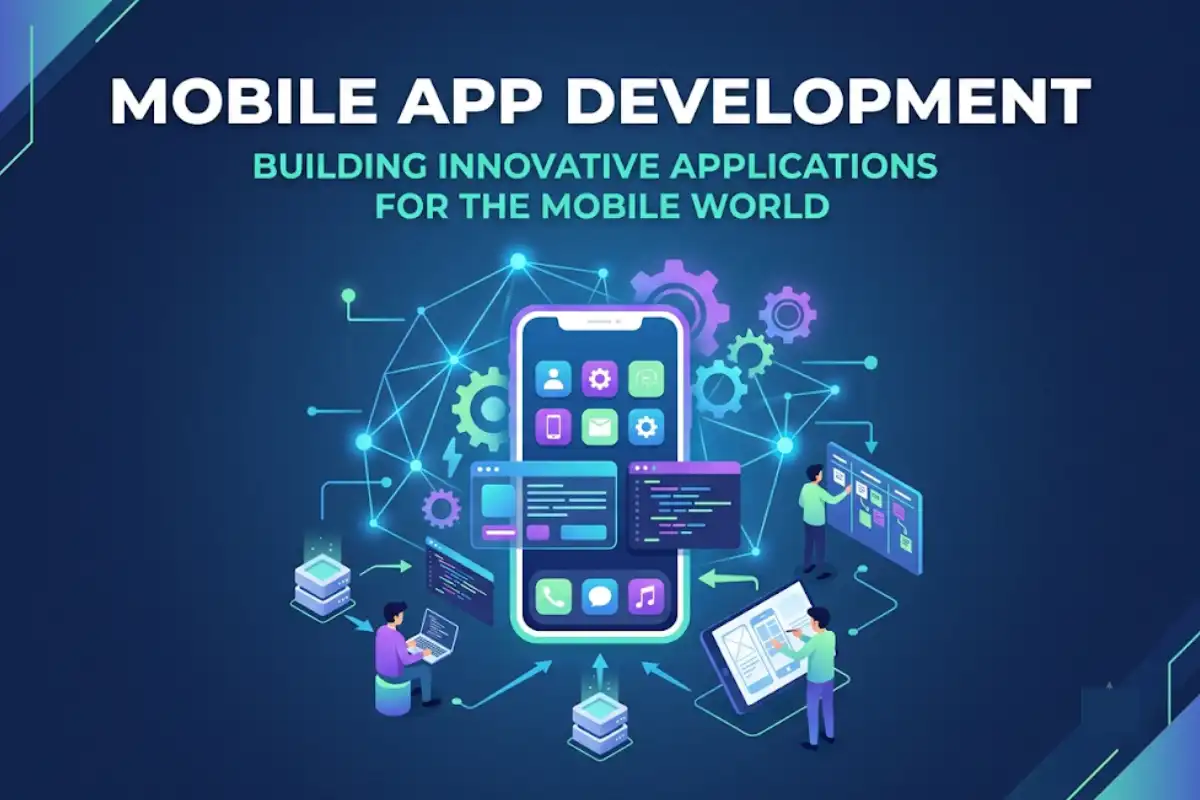
Mobile App Development is the act or process by which mobile applications are developed for mobile devices such as tablets, smart phones, or any other hardware device. With the increase in mobile usage in 2026, mobile apps are becoming a necessity for businesses, startups, and entrepreneurs to acquire customers, reach audiences, generate sales and run their day to day operations.
Today‘s mobile apps impact our lives in multiple ways, from handling our banking and healthcare needs to spicing up our social media and online shopping experiences. Read on to discover what mobile app development entails and how to develop a successful app.
Table of Contents
What Is Mobile App Development?
Mobile App Development is the creation of mobile applications that involves various stage of development inclusive of designing, developing, testing, commissioning and supporting the applications.
Mobile applications remain intended to perform a variety of functions, services and experiences to users of mobile devices, for instance smart phones and tablets, including social networking and shopping on-line, banking, healthcare, gaming and productivity.
In this ever changing mobile industry mobile applications remain now widely used. They are becoming an integral part of the business world in modern days, to interact with customers, to become more efficient in the day to day running of a business and to also generate revenue.
Mobile App development is composition of various fields of knowledge such as the design of the software architecture, the design of the experience, the design of the visual element, management of the database, safety.
Mobile apps generally fall into three categories:
| App Type | Description | Best For |
| Native Apps | Built specifically for Android or iOS | Maximum performance |
| Cross-Platform Apps | One codebase for multiple platforms | Faster development |
| Progressive Web Apps (PWAs) | Web-based apps with app-like features | Cost-effective deployment |
Useful Resources
| Resource | Purpose |
| Android Developer | Android app development documentation |
| Apple Developer | iOS development resources |
| Flutter | Cross-platform framework |
| React Native | Cross-platform mobile development |
How Mobile Applications Are Developed
Developing a mobile application include several steps that tailored an idea into a working end process.
The process typically includes:
- Research and planning
- UI/UX design
- Development
- Testing
- Deployment
- Ongoing maintenance
The more out of the system, the higher the work involved, but the aims is still the same. Every phase adds quality to the application, the usability and its sustainability.
Mobile App Development Process
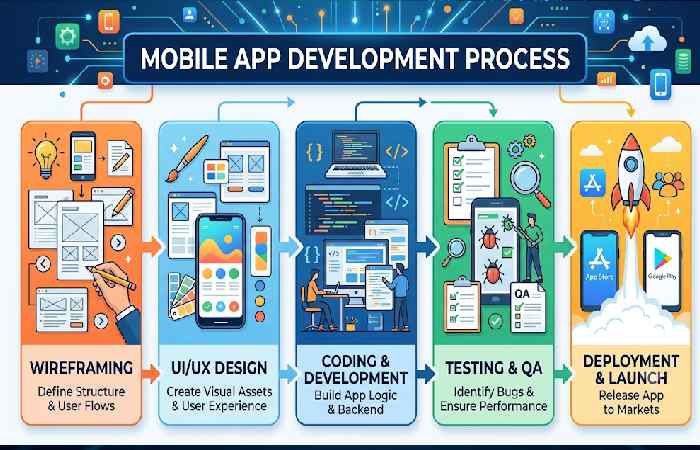
Lifecycle of mobile application development Process: It is designed in such a way to reduce the risk factors and enhance the efficiency.
2026 Mobile Development Lifecycle
| Phase | Objective | Deliverables |
| Planning | Define goals and requirements | Project roadmap |
| Design | Create user experience | Wireframes and prototypes |
| Development | Build application features | Working app |
| Testing | Identify issues | Quality assurance reports |
| Deployment | Launch app stores | Published app |
| Maintenance | Improve and update | New releases |
By establishing this workflow, teams are able to keep quality while reducing the cost of development.
Planning a Mobile Application
Planning is the foundation of successful app development. Before writing code, businesses should define:
- Target audience
- Business goals
- Core features
- Platform requirements
- Budget
- Monetization strategy
Key Questions to Answer
| Question | Why It Matters |
| Who will use the app? | Defines user requirements |
| What problem does it solve? | Establishes value proposition |
| Which platform is needed? | Impacts development strategy |
| How will revenue be generated? | Supports business objectives |
A well-defined strategy reduces costly changes later in development.
Designing the User Interface
Interface (UI) and User Experience (UX) design create the experience for the user to use an application.
Designers create:
- Wireframes
- User flows
- Interactive prototypes
- Visual layouts
Essential UI Design Principles
| Principle | Benefit |
| Simplicity | Easier navigation |
| Consistency | Improved usability |
| Accessibility | Inclusive experience |
| Fast Navigation | Better engagement |
Nowadays apps provide user-friendly experiences that enable users to get things done very quickly.
Developing the Application
Development brings design ideas to life in the form of working computer programs.
Developers create:
- Front-end interfaces
- Backend systems
- APIs
- Databases
- Authentication systems
Popular Mobile Development Technologies (2026)
| Technology | Type | Use Case |
| Kotlin | Android Native | Android applications |
| Swift | iOS Native | iPhone and iPad apps |
| Flutter | Cross-platform | Android + iOS |
| React Native | Cross-platform | Multi-platform development |
| .NET MAUI | Cross-platform | Enterprise applications |
Development Approach Comparison
| Factor | Native | Cross-Platform |
| Performance | Excellent | Very Good |
| Development Speed | Moderate | Fast |
| Cost | Higher | Lower |
| Maintenance | Separate codebases | Single codebase |
Testing a Mobile Application
Testing validates the application. It confirms that it is working as expected and providing the end-user with a satisfying experience.
Common testing methods include:
- Functional testing
- Performance testing
- Security testing
- Compatibility testing
- Usability testing
Testing Checklist
| Area | What to Verify |
| Performance | Speed and responsiveness |
| Security | Data protection |
| Compatibility | Device support |
| Functionality | Feature accuracy |
| UI/UX | User experience quality |
The requirements for over testing should be addressed by conducting tests all along the development and not only before launching.
Publishing a Mobile App
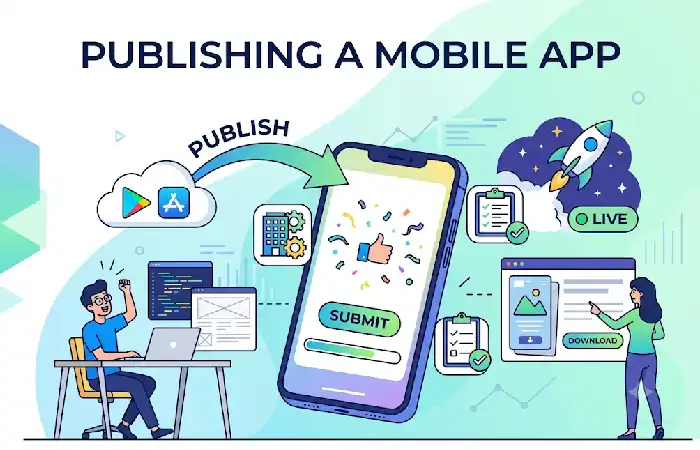
Additional to the testing aspect, the app could be uploaded to app stores.
Major App Distribution Platforms
| Platform | Review Process | Audience |
| Google Play Store | Automated + Manual | Android users |
| Apple App Store | Manual Review | iOS users |
Publishing Requirements
- App icons
- Screenshots
- Privacy policy
- Store description
- App metadata
- Security compliance
Correct optimization helps the app remain noticed in searches.
Maintaining and Updating Mobile Applications
Launching a mobile app is just the starting point of mobile app development. Once an app remain launched it requires constant upgrades, updates, security patches and enhancements to stay competitive and relevant. Mobile apps are constantly changing because of devices, hardware, technology advances and market demands.
Mobile app maintenance is useful to improve performance, rectify bugs, improves security and add new features which helps to stay competitive in market.
Ongoing Maintenance Tasks
| Activity | Purpose |
| Bug Fixes | Improve reliability |
| Security Updates | Protect users |
| Feature Enhancements | Increase engagement |
| OS Compatibility Updates | Support new devices |
| Performance Optimization | Improve user experience |
Regular updates help retain users and improve app store rankings.
FAQ
What is development of a mobile app?
Mobile application development refers to the act or process by which one makes a mobile application.
Which is better, Native or cross platform development?
Platform performance is best with native development, whereas platform can remain developed faster and cheaper with cross-platform development.
How much time is needed to create a mobile app?
All in all, it can take a couple of months for a simple app to be built, but six months or more for a sophisticated one.
Which mobile apps are implemented in which programming language?
Languages are usually (but not exclusively) common ones like Kotlin, Swift, JavaScript, Dart.
Why test? Is mobile app testing necessary?
Testing results in performance, security, compatibility, and a good experience.
Conclusion
Mobile App Development is still the top software innovation area in 2026. Throughout all stages of mobile app life cycle- from planning, designing, developing, testing, deploying and maintaining, the importance of each contributes remarkably to the overall result. Companies should focus on user-centered approach, top security, extensive testing, and avoid complacency to succeed in mobile apps.
By being developed following a well-defined process and using contemporary set of technologies like Flutter, React Native, Kotlin and Swift, it can be built the most performing applications in the market.