
 Kashifa Jafar
Technology Writer & Contributor
Kashifa Jafar is a technology writer and contributor at FutureTechExpert with 4+ years of experience in technology writing and content creation.
Read Full Bio of Author →
Kashifa Jafar
Technology Writer & Contributor
Kashifa Jafar is a technology writer and contributor at FutureTechExpert with 4+ years of experience in technology writing and content creation.
Read Full Bio of Author →
 Sameena Begum
Health, Technology & Digital Content Reviewer
Sameena reviews selected health, wellness, technology, and digital content for clarity, factual presentation, and reader usefulness.
Read Full Bio of Reviewer →
Sameena Begum
Health, Technology & Digital Content Reviewer
Sameena reviews selected health, wellness, technology, and digital content for clarity, factual presentation, and reader usefulness.
Read Full Bio of Reviewer →
4G Mobile Network is still one of the top technologies that drive the mobile internet around the world. Even with 5G still growing, billions of people still need 4G to browse websites fast, stream HD movies, play online games, make Skype video calls, and stay connected through 4G network wherever they are. Currently, 4G service is available to around 93% of the world, making it the most widely deployed mobile broadband.
It doesn‘t matter if you‘re selecting a mobile operator, purchasing a new mobile phone or simply comparing 4G and 5G networks, knowing what 4G is all about will definitely help you to better choose your means of connection.
 This article is part of
Mobile Networks Resources
Table of Contents
What Is a 4G Mobile Network?
4G Mobile Network – Fourth Generation Mobile Communications 4G was the fourth generation of mobile network technology to succeed 3G networks. The objective was to enable wireless broadband access with much higher speed as well as lower latency with higher quality of voice. and better mobile internet access.
When hearing “4G” most people think of LTE, LTE Advanced, which are both Wireless Broadband technologies.
Key Features of 4G
| Feature | 4G Mobile Network |
| Technology | LTE / LTE Advanced |
| Typical Download Speed | 10–100 Mbps |
| Peak Speed | Up to 1 Gbps |
| Latency | 20–50 ms |
| Voice Service | VoLTE |
| Coverage | Extensive Global Availability |
The majority of users find that 4G is fast enough and reliable enough to run streaming, working remotely, social media and cloud based applications.
How Does 4G Work?
4G is based on an all-IP (Internet Protocol) architecture. Older generations of cellular networks established their connection based on circuit-switched technology, while 4G delivers the voice, video and data via packet-switched technology.
Basic 4G Network Process
- Your smartphone sends a request.
- The nearest LTE tower receives the signal.
- The LTE core network processes the data.
- Information is delivered through the internet.
- The response is sent back to your device.
This simplified structure minimizes delays and improves network efficiency, leading to quicker speeds when browsing.
A mobile network enables wireless communication by connecting smartphones, tablets, and other devices through cellular infrastructure. 4G technology significantly improved data transmission speeds compared to earlier generations.
4G Network Speed
The greatest benefit of 4G is however the speed of access.
Average 4G Speed Requirements by Activity
| Activity | Recommended Speed |
| Email & Messaging | 1 Mbps |
| Web Browsing | 1–3 Mbps |
| Social Media | 2–5 Mbps |
| HD Video Streaming | 5–8 Mbps |
| Video Conferencing | 5–10 Mbps |
| Mobile Gaming | 10+ Mbps |
| 4K Streaming | 25 Mbps+ |
Real-World Speed Comparison
| Network Generation | Average Speed |
| 3G | 1–8 Mbps |
| 4G LTE | 10–100 Mbps |
| LTE Advanced | 100–300 Mbps |
| 5G | 100 Mbps–1 Gbps+ |
LTE networks nowadays should in theory achieve speeds of 100Mbit/s or more depending on the spectrum available and how many carriers been combined.
Several factors influence mobile network speed, including network congestion, signal strength, device capabilities, and the distance from the nearest cell tower.
4G LTE Technology
LTE (Long-Term Evolution) is the current standard used by most 4G networks.
While most people use “4G” and “LTE” synonymously, LTE is simply the radio interface technology that provides ultra-high-speed wireless broadband.
LTE Technology Benefits
| LTE Feature | User Benefit |
| OFDMA Technology | Higher efficiency |
| MIMO Antennas | Improved signal quality |
| Low Latency | Better gaming experience |
| Carrier Aggregation | Faster speeds |
| VoLTE Support | HD Voice Calling |
In order to increase capacity, lower congestion and to support emerging broadband services, LTE employs new advanced antenna systems (NDAS) which include techniques like MIMO and OFDMA.
LTE vs LTE Advanced
| Feature | LTE | LTE Advanced |
| Download Speed | Up to 150 Mbps | Up to 1 Gbps |
| Carrier Aggregation | Basic | Advanced |
| Network Efficiency | High | Very High |
| Device Support | Broad | Newer Devices |
4G Coverage
Coverage is still by far the biggest advantage of 4G.
According to GSMA connectivity figures, 4G networks currently reach about 93% of the world‘s population and are the most widely available mobile broadband standard.
Global Coverage Comparison
| Technology | Global Population Coverage |
| 3G | ~75% |
| 4G | ~93% |
| 5G | More than 50% |
Why 4G Coverage Matters
- Better rural connectivity
- More stable mobile internet
- Wider device compatibility
- Reliable backup for 5G networks
And additional low-band spectrum also contributes to the development of the coverage and connectivity performance in rural area.
The quality of a 4G connection depends heavily on mobile network coverage. Areas with strong signal availability generally deliver more stable performance and fewer connection issues.
4G vs 3G
Majority of the countries such as shutting down legacy 3G networks where more and more mobile users are switching to 4G and 5G mobile devices are.
Comparison Table
| Feature | 3G | 4G |
| Download Speed | 1–8 Mbps | 10–100 Mbps |
| Latency | 100+ ms | 20–50 ms |
| HD Streaming | Limited | Excellent |
| Gaming | Basic | Smooth |
| VoLTE Support | No | Yes |
Why Users Upgraded to 4G
- Faster internet access
- Better video streaming
- Improved mobile gaming
- Higher-quality voice calls
- More reliable connectivity
4G vs 5G
Although 5G is the current technology of wireless in the world, we‘ll look at 4G as well.
Feature Comparison
| Feature | 4G | 5G |
| Typical Speed | 10–100 Mbps | 100 Mbps–1 Gbps+ |
| Latency | 20–50 ms | Under 10 ms |
| Coverage | Extensive | Expanding |
| Device Cost | Lower | Higher |
| Availability | Nearly Universal | Region Dependent |
Which Network Should You Choose?
Choose 4G if:
- You prioritize coverage.
- You want lower-cost mobile plans.
- Your device doesn’t support 5G.
Choose 5G if:
- You need ultra-fast speeds.
- You frequently stream 4K content.
- You use cloud gaming or advanced business applications.
When comparing modern wireless technologies, many users consider the differences between 4G and the 5G mobile network. While 5G offers higher speeds and lower latency, 4G continues to provide reliable connectivity for everyday use.
Benefits of 4G
- Faster Mobile Internet
Browsing, streaming, downloading, and cloud applications perform dramatically better on 4G.
- Better Voice Calls
VoLTE: Utilizing VoLTE, HD quality voice calls with faster call setup can be achieved.
- Reliable Coverage
Compared to today, 4G networks have a much greater coverage, covering a lot more places than most current 5 G deployments.
- Enhanced Mobile Gaming
Lower latency enables the multiplayer games to run much more smoothly
- Better Battery Efficiency
According to current LTE chipsets, battery consumption is reduced compared to other older cellular standards.
- Support for Modern Applications
Video calls, navigating with GPS, saving documents on a cloud and connecting with friends on Facebook these are all possible thanks to 4G.
4G Network Compatibility
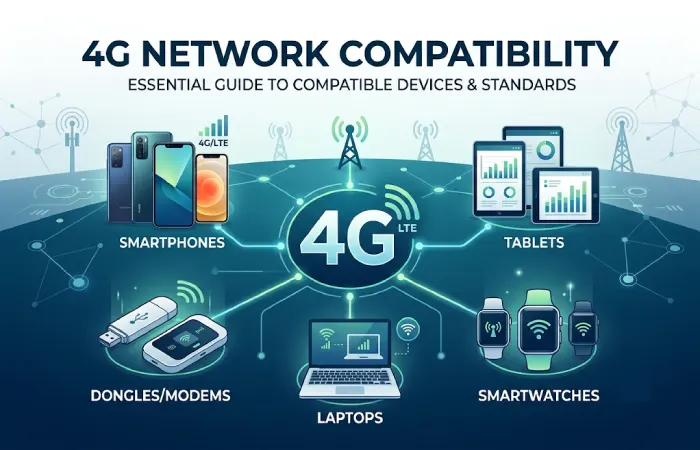
Before using 4G network, make sure your device is LTE enabled.
Compatibility Checklist
| Requirement | Why It Matters |
| 4G Smartphone | Required for LTE access |
| LTE SIM Card | Enables network registration |
| Active Data Plan | Provides internet access |
| Compatible Frequency Bands | Ensures connectivity |
How to Check Compatibility
- Open phone settings.
- Navigate to Mobile Networks.
- Check preferred network type.
- Confirm LTE or 4G is enabled.
- Verify carrier support.
Different mobile network operators provide varying levels of 4G service quality, coverage, and data plans. Choosing the right provider can have a significant impact on your mobile experience.
Future of 4G Networks
While 5G rollouts are in progress around the world, 4G will stay relevant during the decade,
Industry data indicates that hundreds of operators worldwide are still providing LTE services and LTE remains a key point for mobile broadband access into the future.
Future Trends
| Trend | Impact |
| LTE Advanced Expansion | Higher Speeds |
| Rural Network Growth | Better Coverage |
| IoT Connectivity | More Smart Devices |
| VoLTE Adoption | Improved Voice Quality |
| 4G and 5G Coexistence | Seamless Connectivity |
A number of operators still optimize LTE infrastructure also as a backup layer for 5G.
4G is part of the broader evolution of mobile network generations, representing the fourth generation of cellular technology between 3G and 5G networks.
Frequently Asked Questions
Does 4G still exist in 2026?
Yes. 4G is currently the most prevalent mobile broadband technology and it has coverage of about 93% of the population.
What throughput should I get from 4G?
Most users will be getting anywhere between 10 Mbps up to around 100 Mbps depending on the device and network conditions.
Is LTE just another term for 4G?
4G- LTE remain the most common technology used for providing 4G services. The 4G technology is said to be the most advanced when it is at LTE Advanced stage.
Is online game playing accessible with 4G?
Yes, 4G. The latency rate of 4G is low enough to remain used for the majority of multiplayer mobile games and cloud gamings.
Does 4G become obsolete once 5 G is prevalent?
No. Industry analysts believe 4G and 5G will co-exist for many years because of the vast LTE coverage and device ecosystem.
Conclusion
The 4G Mobile Network remain still being utilized on a universal scale to this current date 2026, as it still provides geographically diverse coverage, greater bandwidth and remain more reliable for billions of subscribers worldwide. Fully adopted 5G network; still 4G is the most popular choice of consumers and businesses due to its spread and grace of entertainment over wide range of devices.
Kashifa Jafar is a technology writer and contributor at FutureTechExpert with 4+ years of experience in technology writing and content creation.
Read Full Bio of Author →Sameena reviews selected health, wellness, technology, and digital content for clarity, factual presentation, and reader usefulness.
Read Full Bio of Reviewer →