

 Kashifa Jafar
Technology Writer & Contributor
Kashifa Jafar is a technology writer and contributor at FutureTechExpert with 4+ years of experience in technology writing and content creation.
Read Full Bio of Author →
Kashifa Jafar
Technology Writer & Contributor
Kashifa Jafar is a technology writer and contributor at FutureTechExpert with 4+ years of experience in technology writing and content creation.
Read Full Bio of Author →
 Sameena Begum
Health, Technology & Digital Content Reviewer
Sameena reviews selected health, wellness, technology, and digital content for clarity, factual presentation, and reader usefulness.
Read Full Bio of Reviewer →
Sameena Begum
Health, Technology & Digital Content Reviewer
Sameena reviews selected health, wellness, technology, and digital content for clarity, factual presentation, and reader usefulness.
Read Full Bio of Reviewer →
Mobile network coverage means your phone has a reliable connection to your network provider. Good coverage ensures good reception while talking on the phone, sending and receiving texts or using the internet. Good coverage also provides fast download and upload speeds.
So as Mobile Operators deploy more and more 4G LTE and 5G networks during 2026, the knowledge of coverage maps, signal strength and network performance has never been more relevant.
A simple guide to everything a beginner needs to understand about mobile network coverage and selecting a network provider that can provide the best signals where you want them.
 This article is part of
Mobile Networks Resources
Table of Contents
What Is Mobile Network Coverage?
Mobile Network Coverage describes the coverage area where a mobile carrier has a network of cells and base stations to enable wireless communication.
Coverage determines whether your device can:
- Make voice calls
- Send text messages
- Access mobile internet
- Use 4G LTE services
- Connect to 5G networks
You can tell how robust the coverage is when the connection is more stable. The stronger the coverage is, the more reliable connection you can get.
Types of Coverage
| Coverage Type | Purpose |
| Voice Coverage | Calling and SMS |
| 4G LTE Coverage | Mobile broadband |
| 5G Coverage | High-speed data |
| Indoor Coverage | Service inside buildings |
| Outdoor Coverage | Open-area connectivity |
Mobile coverage refers to the geographic area where users can access cellular voice and data services. Understanding mobile network technology helps explain why coverage quality can vary between locations and devices.
How Mobile Network Coverage Works
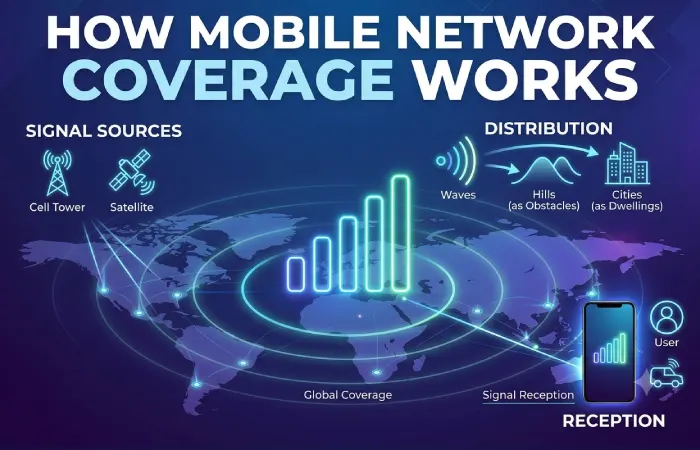
The cellular networks (also called mobile networks) are based on kilometers- and mile-wide systems of thousands of interconnected base stations (cell towers).
Basic Process
- Smartphone sends a signal.
- Signal reaches nearest cell tower.
- Tower routes data through carrier network.
- Information reaches destination.
- Response returns to your device.
Generally what counts is how close you are to a tower (closer is better) and how much is in between you and the tower (less is better).
The reach and performance of cellular signals often depend on different mobile network generations, each offering unique capabilities and coverage characteristics.
Factors That Affect Network Coverage
Multiple factors affect the quality of mobile signals:
Coverage Impact Factors
| Factor | Effect on Signal |
| Distance from Tower | Signal weakens over distance |
| Buildings | Block radio waves |
| Mountains & Terrain | Create dead zones |
| Weather Conditions | Can affect high-frequency signals |
| Network Congestion | Slower speeds during peak usage |
| Device Quality | Better antennas improve reception |
| Frequency Band | Lower frequencies travel farther |
Coverage Ranking by Frequency
| Band Type | Range | Building Penetration |
| Low Band | Excellent | Excellent |
| Mid Band | Good | Good |
| High Band (mmWave) | Limited | Poor |
How to Check Mobile Network Coverage
Check your coverage in your area before selecting a carrier.
Recommended Coverage Resources
| Tool | Purpose | Resource |
| OpenSignal | Real-world coverage data | https://www.opensignal.com |
| Ookla Speedtest Maps | Network performance | https://www.speedtest.net |
| nPerf Coverage Maps | Coverage visualization | https://www.nperf.com |
| FCC Broadband Maps | US coverage data | https://broadbandmap.fcc.gov |
| Carrier Coverage Maps | Official coverage | Carrier websites |
What to Check
- Home coverage
- Workplace coverage
- Travel routes
- Indoor signal availability
- 5G availability
Comparing different mobile network operators can help users find the best balance of coverage, reliability, and performance in their area.
Indoor vs Outdoor Coverage
The quality of coverage is often vastly different indoors and outdoors.
Indoor Coverage
Challenges include:
- Concrete walls
- Metal structures
- Energy-efficient windows
- Underground locations
Outdoor Coverage
Benefits include:
- Fewer signal obstructions
- Better tower visibility
- Stronger reception
- Faster data speeds
Comparison
| Feature | Indoor | Outdoor |
| Signal Strength | Moderate | Strong |
| Data Speeds | Variable | Faster |
| Reliability | Lower | Higher |
| Interference | More | Less |
A strong signal does not always guarantee the best user experience. Factors such as congestion and infrastructure quality can significantly affect mobile network speed.
Rural and Urban Network Coverage
The coverage will be different throughout the country. The coverage on top of the building.
Urban Areas
Advantages:
- Dense tower deployment
- Extensive 5G rollout
- Faster average speeds
- Better network redundancy
Rural Areas
Challenges:
- Fewer towers
- Larger coverage gaps
- Slower expansion of advanced technologies
- Greater dependence on low-band frequencies
Coverage Comparison
| Metric | Urban | Rural |
| Tower Density | High | Low |
| 5G Availability | Excellent | Growing |
| Average Speeds | Faster | Moderate |
| Signal Reliability | Strong | Variable |
4G Network Coverage
Despite the popular focus on 5G, 4G LTE continues to be the solid base of mobile connectivity.
Benefits of 4G Coverage
- Wide availability
- Strong reliability
- Better battery efficiency
- Consistent performance
- Extensive rural reach
Typical 4G Performance
| Metric | Average |
| Download Speed | 20–100 Mbps |
| Upload Speed | 5–30 Mbps |
| Coverage Availability | Very High |
| Device Compatibility | Universal |
Even as newer technologies expand, 4G mobile networks continue to provide reliable coverage for millions of users and remain the foundation of mobile connectivity in many regions.
5G Network Coverage
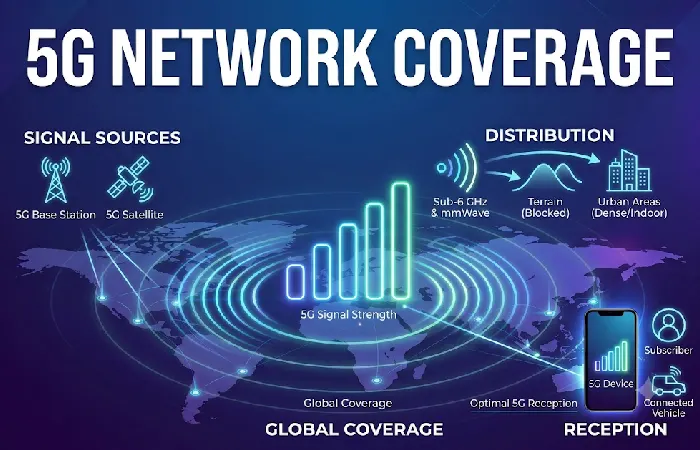
The 5G coverage is gaining ground globally in the year 2026.
Advantages of 5G
- Faster downloads
- Lower latency
- Better streaming quality
- Improved gaming performance
- Support for more connected devices
4G vs 5G Coverage
| Feature | 4G LTE | 5G |
| Coverage Reach | Extensive | Expanding |
| Speed | Good | Excellent |
| Latency | Moderate | Low |
| Availability | Nearly Universal | Growing |
| Future Readiness | Moderate | High |
The ongoing rollout of 5G network coverage is improving connectivity, enabling faster downloads, lower latency, and support for advanced mobile applications.
How to Improve Network Reception
A weak signal does not necessarily imply bad coverage.
Quick Fixes
- Move near a window.
- Restart your device.
- Toggle Airplane Mode.
- Update carrier settings.
- Enable Wi-Fi Calling.
- Remove thick phone cases.
- Switch network modes.
Advanced Solutions
| Solution | Benefit |
| Signal Booster | Strengthens weak signals |
| Wi-Fi Calling | Improves indoor calling |
| Carrier Update | Fixes connectivity issues |
| New SIM/eSIM | Resolves provisioning problems |
Choosing a Network With Better Coverage
Choosing the right carrier is a matter of knowing where you are most of the time.
Evaluation Checklist
Coverage at home
Coverage at work
Rural travel performance
Indoor signal strength
4G availability
5G availability
Network reliability
Customer reviews
Carrier Comparison Factors
| Factor | Importance |
| Coverage Area | High |
| Signal Reliability | High |
| Speed | High |
| 5G Expansion | Medium |
| Price | Medium |
| Customer Support | Medium |
Future of Mobile Network Coverage
By 2030, mobile coverage is expected to improve through:
- Expanded standalone 5G deployment
- Open RAN infrastructure
- Satellite-to-phone connectivity
- AI-powered network optimization
- Increased rural broadband investment
These improvements will minimize coverage gaps and enhance reliability globally.
Frequently Asked Questions
What does coverage mean in a mobile network?
This is a defined area of the country in which a carrier provides wireless service for phone calls, text messages and mobile internet.
Can I find out if a mortgage product is available in my location?
Check signal on the coverage maps from the cellcarriers or use OpenSignal, Ookla, or nPerf coverage tools.
What causes my signal to be so strong outside and very weak inside?
However, the materials used in the construction of buildings can also block cellular signals. Materials such as concrete, metal and insulated glass do prevent signals from penetrating.
Is 5G coverage better compared to the coverage 4G offers?
Not at this point, but 4G will be covering in more detail while 5G has higher regularity.
What is the key factor that influences the strength of the signals from mobiles?
The most significant factors are the distance from cell towers, the environment, the materials being transmitted, the band frequency, and the level of congestion.
Conclusion
Mobile network coverage is the backbone of a solid mobile experience, playing a role in calls, texts, browsing, gaming, streaming, working remote, and more. With 4G rolling out to most of the population and 5G expanding in cities and towns, coverage could be confusing here‘s a quick overview so you can shop for a carrier and solve problems confidently.
Kashifa Jafar is a technology writer and contributor at FutureTechExpert with 4+ years of experience in technology writing and content creation.
Read Full Bio of Author →Sameena reviews selected health, wellness, technology, and digital content for clarity, factual presentation, and reader usefulness.
Read Full Bio of Reviewer →