
 Kashifa Jafar
Technology Writer & Contributor
Kashifa Jafar is a technology writer and contributor at FutureTechExpert with 4+ years of experience in technology writing and content creation.
Read Full Bio of Author →
Kashifa Jafar
Technology Writer & Contributor
Kashifa Jafar is a technology writer and contributor at FutureTechExpert with 4+ years of experience in technology writing and content creation.
Read Full Bio of Author →
 Sameena Begum
Health, Technology & Digital Content Reviewer
Sameena reviews selected health, wellness, technology, and digital content for clarity, factual presentation, and reader usefulness.
Read Full Bio of Reviewer →
Sameena Begum
Health, Technology & Digital Content Reviewer
Sameena reviews selected health, wellness, technology, and digital content for clarity, factual presentation, and reader usefulness.
Read Full Bio of Reviewer →
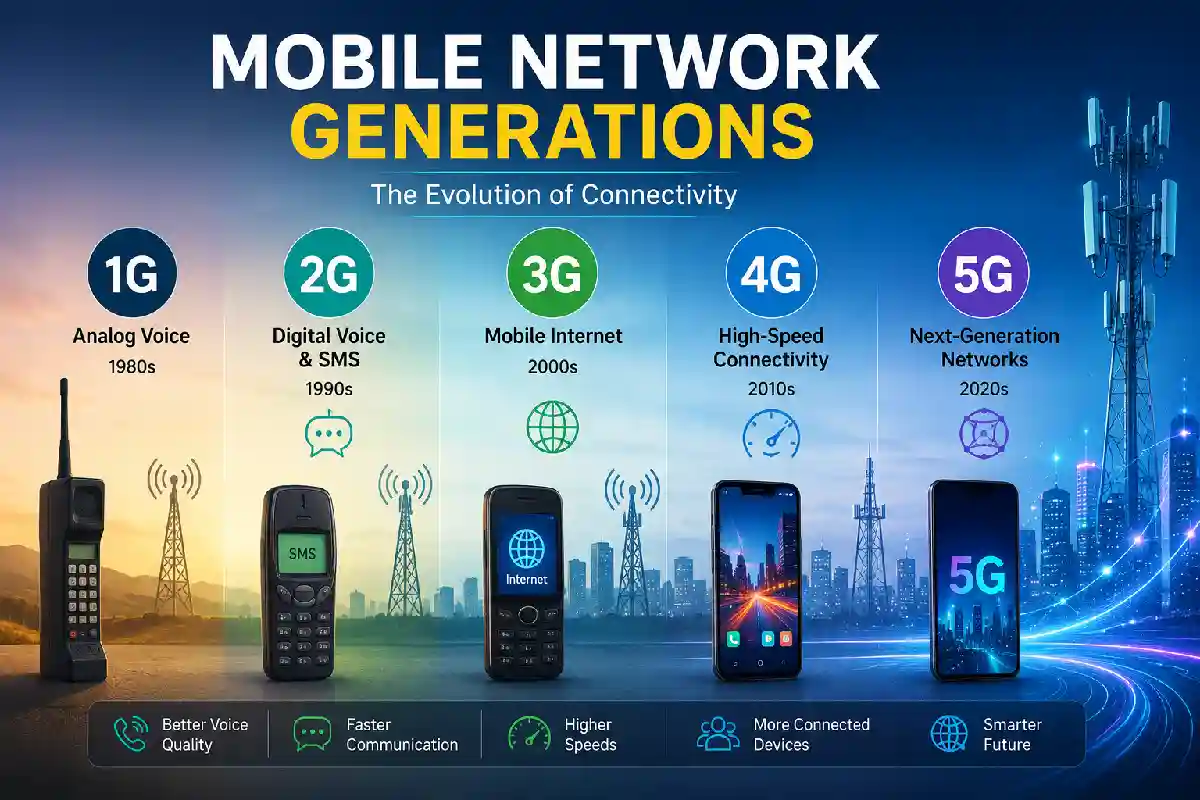
The evolution of mobile network generations has revolutionized the way individuals communicate, gather information, and interact within the digital realm. Starting from the analog voice services provided by 1G to the remarkably high data rates, minimal latency, and enhanced services delivered by 5G, each generation has brought a leap in terms of performance.
Today we have mobile networks connected to everything from mobile devices, entertainment and Smart Cities to Industry 4.0. Learning about the progression of mobile network technology can support consumers and business in making informed purchasing and investment decisions.
 This article is part of
Mobile Networks Resources
Table of Contents
What Are Mobile Network Generations?
These are the different stages of evolution of wireless communication technology. The different versions of wireless networks are defined based on the rate of speed, security, coverage and the services can be provided through the mobile network.
Mobile networks have changed the art of communication from just a voice call to internet on the high-speed, video, streaming of video, cloud computing, AI applications and IoT. Each generation has brought unprecedented capability over the previous one by delivering data transfer at tremendous speed and making new possibilities feasible.
Each generation introduces:
- Faster data transmission
- Better network capacity
- Improved voice quality
- Enhanced security
- New communication capabilities
The term “G” stands for “Generation.”
Examples include:
- 1G (First Generation)
- 2G (Second Generation)
- 3G (Third Generation)
- 4G (Fourth Generation)
- 5G (Fifth Generation)
Mobile network generations have evolved significantly from early voice-only systems to today’s high-speed data networks. Understanding the foundations of mobile network technology helps explain how each generation introduced new capabilities and improved performance.
Evolution Timeline of Mobile Networks
| Generation | Launch Period | Main Capability | Typical Speed |
| 1G | 1980s | Analog Voice Calls | Up to 2.4 Kbps |
| 2G | 1990s | Digital Voice & SMS | Up to 64 Kbps |
| 3G | 2000s | Mobile Internet | Up to 2 Mbps |
| 4G | 2010s | HD Streaming & Apps | Up to 100 Mbps |
| 5G | 2020s | IoT, AI, Smart Cities | Up to 10 Gbps |
Industry Resources
| Resource | Purpose |
| https://www.gsma.com | Global mobile industry standards |
| https://www.ericsson.com | Mobile network research and reports |
| https://www.qualcomm.com | Wireless technology innovations |
| https://www.3gpp.org | Cellular technology standards |
1G: The Beginning of Mobile Networks
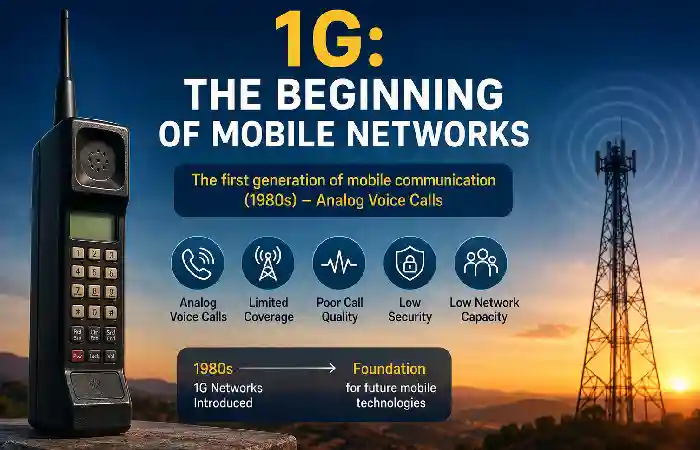
1G was the first mobile communication technology in the world, which was launched in late 1970s and early 1980s. Mobile phones could be used without being wired to a fixed landline.
Unlike the current day mobile networks 1G used analog signals to carry the voice calls. This was an innovative advancement back when it was built, however it had its loopholes that led to the era of the next network generations.
Key Characteristics
- Analog technology
- Voice-only communication
- Limited coverage
- Poor call quality
- Minimal security
Advantages
Introduced mobile communication
Limitations
No data support
Susceptible to interference
Weak security mechanisms
Although it could be considered revolutionary in the 1980s, 1G was soon rendered redundant as digital technology became available.
2G and Digital Mobile Communication
2G (Second Generation) was a remarkable leap forward for the generations of mobile networks. Partly emerging in the early 1990s, 2G was the successor to analog systems. It quickly replaced the analog system with digital communications, boosting the quality and security of calls, and the efficiency of the networks. It also introduced and facilitated a number of new services, including SMS (Short Message Service).
By 1990, with the transition from analog to digital signals, mobile networks had enough capacity to serve more customers, while providing clearer voice communication and more secure data transmission.
Major Innovations
- Digital voice calls
- SMS messaging
- Better security
- Improved call quality
- Lower power consumption
Technologies Used
- GSM
- CDMA
2G introduced text messaging, which is by far, one of the most common ways of communication in the world.
Typical Use Cases
- Voice calls
- SMS
- Basic internet access
3G and Mobile Internet
3G brought mobile internet and altered the interaction of users with their phones.
Key Features
- Mobile web browsing
- Video calling
- Multimedia messaging
- Mobile applications
Benefits
- Faster internet speeds
- Better network reliability
- Enhanced user experiences
Typical Speeds
| Technology | Speed |
| UMTS | 384 Kbps |
| HSPA | Up to 14 Mbps |
| HSPA+ | Up to 42 Mbps |
3G was the seminal forerunner on which today‘s growth of the smartphone ecosystem has been built.
4G and High-Speed Connectivity
4G opened up access to the internet using broadband like speeds.
Key Benefits
- HD video streaming
- Online gaming
- Cloud computing
- Faster downloads
- Video conferencing
Common Technologies
- LTE
- LTE Advanced
4G Performance Comparison
| Activity | 3G | 4G |
| Web Browsing | Moderate | Fast |
| Video Streaming | Limited | HD & 4K |
| Gaming | Lag Issues | Smooth |
| Downloads | Slow | Rapid |
4G established itself as the center of modern mobile apps and digital services.
5G and Next-Generation Networks
5G is the most sophisticated of the cellular network generations which are used around the world today.
Key Capabilities
- Multi-gigabit speeds
- Ultra-low latency
- Massive device connectivity
- Enhanced network reliability
- Edge computing support
5G Performance Metrics (2026)
| Feature | 4G | 5G |
| Peak Speed | 100 Mbps | 10 Gbps |
| Latency | 30–50 ms | 1–10 ms |
| Device Density | 100,000/km² | 1 Million/km² |
| Reliability | High | Ultra High |
Common Applications
- Autonomous vehicles
- Smart factories
- Remote healthcare
- Augmented reality
- Virtual reality
- Smart cities
4G vs 5G
Many people ask themselves is it really worth to make the jump to 5G
Comparison Table
| Feature | 4G LTE | 5G |
| Download Speed | Up to 100 Mbps | Up to 10 Gbps |
| Upload Speed | Moderate | Extremely Fast |
| Latency | Higher | Ultra-Low |
| IoT Support | Limited | Massive Scale |
| Energy Efficiency | Good | Better |
| Network Capacity | High | Extremely High |
When 4G Is Enough
- Social media
- Standard streaming
- Casual browsing
When 5G Makes Sense
- Competitive gaming
- AR/VR applications
- Enterprise solutions
- Smart devices
- High-bandwidth workloads
While 4G LTE networks enabled widespread mobile broadband, HD streaming, and improved app experiences, modern 5G mobile networks provide even faster connections, lower latency, and support for emerging technologies such as IoT, autonomous systems, and smart cities.
Evolution of Mobile Network Technology
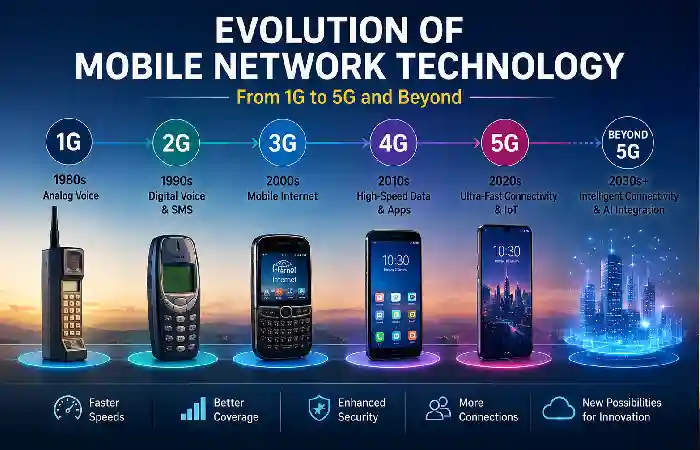
From 1G to 5G that is, from basic voice calls to smart digital environment.
Major Trends
- Increasing network speeds
- Lower latency
- Better security
- Cloud integration
- Artificial Intelligence optimization
- Edge computing deployment
Today networks are more automated and software-centric than they have ever been.
What Comes After 5G?
6G technologies are being emerged and developed today by researchers and telecomm companies.
Expected 6G Features
- Terabit-level speeds
- AI-native networks
- Holographic communication
- Advanced digital twins
- Extended reality experiences
- Space-air-ground integrated networks
Industry experts expect commercial 6G deployment around 2030.
The overall user experience also depends on mobile network coverage, which determines signal availability and reliability across different regions. In addition, improvements in mobile network speed have made activities such as video streaming, cloud gaming, and remote work more efficient than ever before.
The Future of Mobile Networks
The next generation of mobile networks will connect billions of things, including devices, cars, sensors and intelligent systems.
Key Innovations Expected
- AI-powered network management
- Sustainable telecom infrastructure
- Quantum communication research
- Smart city integration
- Industrial automation
- Enhanced cybersecurity
Companies that work on next-generation connectivity now will enjoy major competitive advantages in the years to come.
These advancements are driven by mobile network operators, which invest heavily in spectrum, infrastructure, and next-generation technologies to expand connectivity and improve service quality worldwide.
FAQ
What definition of the generations of mobile networks?
The mobile network generations Mobile network generations refer to the successive types of wireless communication technologies: 1G, 2G, 3G, 4G, and 5G.
Which mobile generation is the fastest today?
5G is the fastest technologically available mobile network today.
Is 4G still a valid option in 2026?
Yes. 4G is still being used today and is adequate for most mobile activities.
What 4G is and 5 G?
5G also provides much higher speeds, lower latency and much higher capacity and better support for IoT devices.
When will 6G arrive?
Industry forecasts are mostly implying commercial 6 G networks could start showing up by 2030.
Conclusion
Mobile Network Generations are what modern day wireless communication is built upon, with each generation bringing a new threshold to what the capabilities of mobile technology can provide, whether it be the analog voice networks of 1G, or the knowledge driven intelligent broadband networks of 5G.
With the evolution of 6G and AI enabled connectivity within the network, it is vital for the customers, companies and technologists to understand these generations of the network. Keeping track of current mobile technologies can help organizations and individuals to cater to future innovations.
Kashifa Jafar is a technology writer and contributor at FutureTechExpert with 4+ years of experience in technology writing and content creation.
Read Full Bio of Author →Sameena reviews selected health, wellness, technology, and digital content for clarity, factual presentation, and reader usefulness.
Read Full Bio of Reviewer →