



Last Updated: September 16, 2026
Satellite Internet Coverageis among the most important aspect for individuals residing in rural, remote and underserved areas. Differing from traditional broadband services that relies upon terrestrial infrastructure and cable systems, satellite internet provides access to users from space where fiber, DSL or cable networks are not available.
As Low Earth Orbit (LEO) satellite constellations continue their brisk proliferation with large giants like Starlink, and newer entrants like Project Kuiper, satellite coverage has now extended from land mass to water bodies. Currently millions of users are dependent on satellite internet for remote working, education, telemedicine, agriculture, maritime activities, as well as in times of distress.
Table of Contents
What Is Satellite Internet Coverage?
Satellite internet coverage is a term used to describe the geographical coverage that a satellite internet provider is able to offer. There are many considerations for satellite internet coverage including:
- Satellite orbit type
- Number of satellites in operation
- Ground station availability
- Regulatory approvals
- Terrain and environmental conditions
It is important to note that satellite connection is available over a larger area in comparison to a fixed broadband network. Satellite coverage can provide coverage over a large geographical area and as a result is more suitable to specific areas.
Coverage Types
| Coverage Type | Description |
| Local Coverage | Limited regional service areas |
| National Coverage | Service available throughout a country |
| Continental Coverage | Coverage across multiple countries |
| Global Coverage | Worldwide internet access |
Resource Links
- Starlink Coverage Map
- OneWeb Coverage Information
- Project Kuiper Updates
- ITU Satellite Communications
How Satellite Coverage Works
The internet is carried to and from ground stations and user terminals by a network of satellites orbiting the planet.
Coverage Process
- User terminal sends data request.
- Signal travels to a satellite.
- Satellite communicates with a ground gateway.
- Data reaches the internet backbone.
- Information returns through the same path.
Factors Affecting Coverage
| Factor | Impact |
| Orbit Type | Determines coverage size and latency |
| Satellite Density | Affects reliability |
| Ground Stations | Improve network performance |
| Weather | May affect signal quality |
| Obstructions | Trees and buildings can block signals |
Global Satellite Internet Coverage
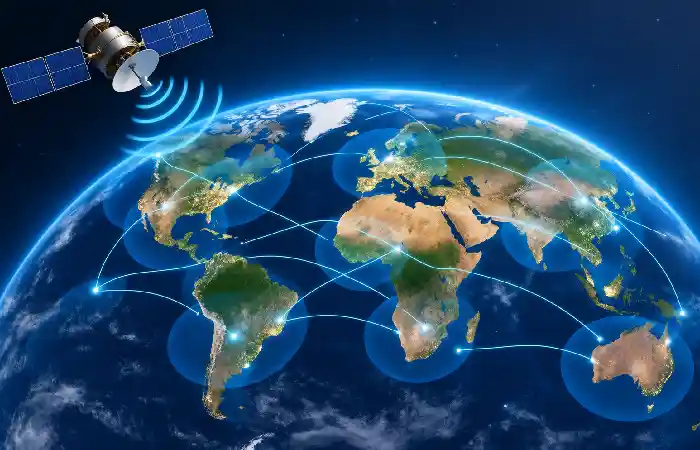
Today, most satellite providers are extending their global coverage even more quickly.
Global Coverage Comparison (2026)
| Provider | Coverage Region | Orbit Type |
| Starlink | 125+ Countries | LEO |
| OneWeb | Global Enterprise Coverage | LEO |
| Viasat | North America, Europe, Asia-Pacific | GEO |
| HughesNet | Americas and Selected Regions | GEO |
| Project Kuiper | Expanding Deployment | LEO |
Starlink presently provides services to over 125 countries, and maintains a LEO satellite constellation, which at the time, was the world‘s largest, close to reaching global coverage.
Rural and Remote Coverage
One of the greatest benefits of satellite internet is that it can be used anywhere there is no broadband access available.
Common Rural Applications
- Remote homes
- Farms and agricultural facilities
- Mining operations
- Oil and gas sites
- National parks
- Mountain communities
- Islands
Benefits for Rural Areas
| Benefit | Description |
| Wide Availability | Covers difficult terrain |
| Fast Deployment | No cable installation |
| Mobility | Portable service options |
| Business Connectivity | Supports remote operations |
For some of the rural users, satellite internet is the only viable solution for high speed internet.
LEO Satellite Coverage
Satellites in low earth orbit (LEO) are in the around 500–2000km height.
Advantages
- Lower latency
- Faster speeds
- Better video conferencing
- Improved gaming performance
- Continuous network expansion
LEO Coverage Characteristics
| Feature | LEO Networks |
| Altitude | 500–2,000 km |
| Latency | 20–60 ms |
| Speed | Up to 400 Mbps+ |
| Coverage Method | Thousands of satellites |
Today, LEO systems have made satellite internet comparable to fiber in many areas.
GEO Satellite Coverage
GoS is about 35286 km above surface.
Advantages
- Large coverage area
- Fewer satellites required
- Established infrastructure
- Reliable broadcast services
GEO Coverage Characteristics
| Feature | GEO Networks |
| Altitude | 35,786 km |
| Latency | 600+ ms |
| Coverage Area | Extremely Large |
| Number of Satellites | Limited |
There are still hundreds of thousands of customers who are being provided service by companies like HughesNet and Viasat, which use GEO technology.
Coverage Limitations
While satellite internet services are broad, there are some disadvantages.
Common Challenges
- Regulatory restrictions
- Capacity constraints
- Network congestion
- Terrain obstructions
- Satellite handoffs
- Equipment positioning issues
Coverage Gaps
| Limitation | Impact |
| Dense Forests | Signal blockage |
| Tall Buildings | Reduced visibility |
| Extreme Polar Regions | Limited availability |
| Congested Cells | Speed reduction |
Weather and Satellite Connectivity

It can influence satellite internet performance.
Weather Conditions Affecting Coverage
- Heavy rain
- Snowstorms
- Thunderstorms
- Dense cloud cover
- Ice accumulation
Weather Impact Comparison
| Condition | Potential Impact |
| Light Rain | Minimal |
| Heavy Rain | Moderate |
| Snow | Moderate |
| Severe Storms | Temporary degradation |
Troubleshooting Weather Issues
- Ensure dish alignment
- Remove snow accumulation
- Check cable connections
- Reboot equipment
- Monitor provider outage alerts
How to Check Coverage
Before passing to buy satellite internet, check whether it is available.
Steps to Check Coverage
- Visit provider coverage maps.
- Enter service address.
- Confirm equipment requirements.
- Review plan options.
- Check local regulations.
Coverage Verification Checklist
| Check | Importance |
| Address Availability | High |
| Clear Sky View | High |
| Installation Space | Medium |
| Service Plans | High |
| Data Limits | Medium |
Future of Satellite Internet Coverage
The future of satellite internet coverage is motivated by huge financial investments in next-generation constellations.
Emerging Trends
- Direct-to-device connectivity
- AI-powered network optimization
- Expanded rural broadband initiatives
- Hybrid satellite-terrestrial networks
- Global maritime and aviation coverage
Coverage Outlook for 2030
| Trend | Expected Impact |
| More LEO Satellites | Better global coverage |
| Lower Costs | Increased adoption |
| Faster Speeds | Improved user experience |
| Reduced Latency | Enhanced applications |
Amazon‘s Project Kuiper and the continued growth of Starlink is projected to increase worldwide coverage even more in the coming years.
Frequently Asked Questions
Does satellite internet work anywhere?
Satellite internet is available in most areas of the world where a provider is present and there is a clear view of the sky.
Which satellite technology offers the best coverage?
GEO satellites serve larger areas for individual satellite, LEO constellations can generate extensive global networks using thousands of satellites.
Is it possible that the weather can impact the satellite internet availability?
Yes. Heavy rain snow and an occasional great storm can temporarily affect the signal.
Does satellite internet is good for the remote place?
Yes. It is one of the best Connectivity providers in rural and remote regions.
What can I do to find out if satellite internet is accessible from my property?
Consult the provider‘s official coverage map or availability checker.
Conclusion
Satellite Internet Coverage is growing at an incredible pace, with new constellations being launched in different parts of the world. Whether you are in a rural area, a remote work site, or simply on the move, satellite internet can provide you with a viable alternative to traditional broadband services. As the Low Earth Orbit satellite networks evolve and new facilities get put into place around the globe, internet coverage, speed, and reliability should receive many upgrades, greatly increasing the global coverage for satellite based internet.