



Last Updated: September 16, 2026
Delivered by Satellite Internet Plans from 1 of 3 satellites flying above the globe is the perfect for remote, rural and hard-to-reach locations where cable, DSL and fiber have yet to reach. As technical advances continue to come in 2026, satellite internet services by firms such as Starlink, HughesNet and Viasat now offer higher rates, improved stability as well as an options of plans for residences and enterprises.
No matter if you‘re a telecommuter, binge-watcher, farm owner, or a remote business owner, satellite internet plans can lead you to the right choice according to your requirements and budget.
Table of Contents
What Are Satellite Internet Plans?
The satellite internet plans are subscription plans that access internet via communication satellites, in place of using cable connections or cell-site towers.
A typical satellite internet setup includes:
- Satellite dish
- Modem/router
- Mounting equipment
- Service subscription
The dish is talking with satellites orbiting around the space station, which is then passing information to ground stations and the web.
Supporting Resource
If a more detailed explanation of the technology is required, follow the link to our guide on How Satellite Internet Works and Communication Satellites.
Types of Satellite Internet Plans
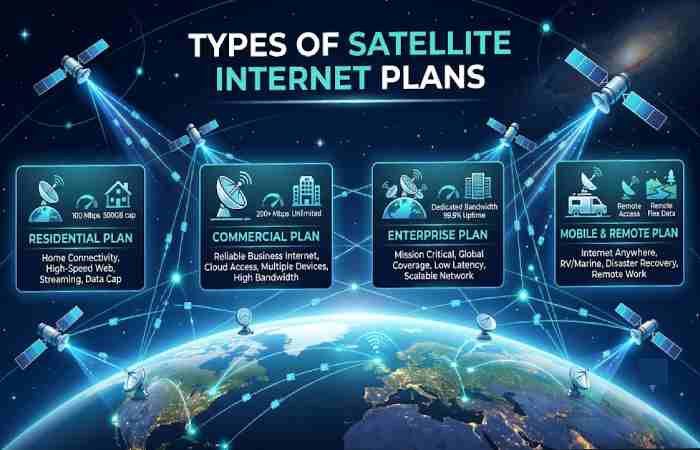
Modern providers offer several plan categories.
| Plan Type | Best For | Typical Speed |
| Residential Plans | Homes and families | 25–400 Mbps |
| Business Plans | Companies and enterprises | 50–400 Mbps |
| Mobile/RV Plans | Travelers and RV owners | 50–200 Mbps |
| Priority Plans | Heavy users and professionals | 100–1000 Mbps |
| Backup Connectivity Plans | Emergency internet access | 25–150 Mbps |
‘Most providers offer unlimited data plans now although there is fairuse policies that apply.’
Data Limits and Usage Policies
Data limits is currently one of the most significant factors in the selection process for satellite internet plans.
Common Data Policies
| Policy Type | Description |
| Unlimited Data | No hard cap but possible deprioritization |
| Priority Data | Full speed until threshold reached |
| Soft Data Cap | Speeds may slow during congestion |
| Hard Data Cap | Reduced speeds after allowance is exhausted |
2026 Industry Trend
While many providers promote unlimited data, speed may be throttled once consumers hit their priority data. All three providers use different fair-use policies: Starlink, Viasat, HughesNet.
Download and Upload Speeds
Speed is the number one factor that determines how fast you can stream, surf the web, download files, and join videoconferences.
Satellite Internet Speed Comparison (2026)
| Provider | Download Speed | Upload Speed |
| Starlink | 100–400 Mbps | 10–40 Mbps |
| Viasat | 25–150 Mbps | 3–10 Mbps |
| HughesNet | 25–100 Mbps | 3–5 Mbps |
Source data collected through comparisons of industry providers, market review.
Recommended Speeds
| Activity | Recommended Speed |
| Web Browsing | 5 Mbps |
| HD Streaming | 25 Mbps |
| Remote Work | 50 Mbps |
| Video Conferencing | 50–100 Mbps |
| 4K Streaming | 100 Mbps+ |
| Business Operations | 100 Mbps+ |
Monthly Costs
Prices are different for each provider and user depending on the speed, the data amount and the provider.
Average Monthly Costs (2026)
| Provider | Starting Price | Maximum Price |
| HughesNet | $39.99 | $94.99 |
| Viasat | $39.99 | $119.99+ |
| Starlink | $55 | $130+ |
Data was obtained from publicly available provider pricing and comparison services.
Cost Considerations
Factors affecting pricing include:
- Speed tier
- Priority data allocation
- Equipment fees
- Installation costs
- Business-grade service features
Equipment Fees
All the equipment needed to access satellite internet.
Typical Equipment Costs
| Provider | Equipment Model |
| Starlink | One-time purchase |
| HughesNet | Lease or purchase |
| Viasat | Monthly equipment lease |
Average Equipment Pricing
| Equipment | Cost Range |
| Satellite Dish | $150–$600 |
| Modem/Router | Included or leased |
| Mounting Hardware | $50–$200 |
Most Starlink installations tend to have a higher initial cost, whereas leasing options are regularly available for HughesNet and Viasat.
Installation Costs
The initial installation costs can also have a great influence on the costs incurred in the first year.
| Installation Type | Cost Range |
| Self Installation | Free–$50 |
| Professional Installation | $99–$300 |
| Complex Roof Installation | $300+ |
Most customers of the service install it by themselves, while conventional providers usually insist on clients to have it installed by specialists.
Residential vs Business Plans
Specifically, the decision between residential and business plans will be driven by your internet requirements.
| Feature | Residential | Business |
| Price | Lower | Higher |
| Speeds | Moderate to High | High |
| Priority Support | Limited | Enhanced |
| SLA Guarantees | Rare | Common |
| Network Priority | Standard | Priority Access |
Business plans are ideal for:
- Remote offices
- Retail locations
- Agricultural operations
- Construction sites
- Emergency response teams
Business oriented packaging generally offers higher priority into Data pipelines and better service guarantees.
How to Compare Plans

Before selecting a provider, evaluate these factors:
- Speed Requirements
The obvious factor to consider in knowing these is to determine how many users and devices will be connected at the same time.
- Data Allowances
Check the thresholds for Priority Data and see if there is a fair-use policy.
- Total Cost of Ownership
Include:
- Monthly fees
- Equipment costs
- Installation fees
- Contract commitments
- Latency Performance
Most LEO services such as Starlink typically provide less latency to the customer than other typical geostationary satellite services.
- Coverage Availability
Actually, not all providers are available at each location.
Choosing the Right Satellite Internet Plan
The best plan depends on your usage habits.
Best for Basic Users
- Browsing
- Social media
Recommended: HughesNet entry-level plans.
Best for Families
- Streaming
- Remote work
- Multiple devices
Recommended: Viasat mid-tier plans.
Best for Power Users
- Gaming
- 4K streaming
- Video conferencing
Recommended: Starlink Residential or Priority plans.
Best for Businesses
- Mission-critical operations
- Multiple employees
- Cloud applications
Recommended: Business-grade satellite internet plans with priority service.
Frequently Asked Questions
What is the average cost of a satellite internet plan?
Most plans fall within the 40-130 a month span (varies by speed and provider). Though many plans offer unlimited data, there still may be fair-use policies and priority data limits.
Compared to each provider, who is the fastest satellite internet?
Starlink now provides some of the fastest commercially available satellite internet speeds, clocking in as high as 400 Mbps in many areas.
Is satellite internet suitable for remote work?
They can use today’s LEO satellite networks for video conferencing, cloud office applications, and remote work.
Is it possible for that business to rely solely on a satellite internet connection?
Absolutely. Several businesses depend on satellite internet for their main connection or for a backup connection.
Conclusion
Satellite Internet Packages have come a long way in the last few years. Now there are more choices in speed, coverage and pricing, making satellite internet a more viable option than ever before, for both residential and corporate applications (such as rural home. To better understand existing choices, it is always advisable to compare the speed, data policies, equipment costs and set-ups charges involved.
With satellite networks still growing in 2026, customers should see such growing competition, higher speeds and lower prices on satellite internet plans. Take the time to explore your options to find the right plan that provides a solid working connection wherever you need it.